

How to Build a Clinic with Great Doctors and Excellent Service? Insights from Entrepreneurs and Investors
“Consultation,” “examination,” and “prescribing” constitute the stereotypical service workflow that comes to mind when we think of clinics. As a practitioner in the new wave of clinic models, Li Tiantian, founder and chairman of DXY, stated at the Second Clinic Development Conference, “Future clinics must not only do more, but also do better; they should serve not only patients, but also healthy individuals.”

Li Tiantian, Founder and Chairman of DXY
Overcrowding at the top tier and underutilization at the grassroots level have led to an “inverted triangle” demand structure. Rising consumer demands are driving industrial development, while the evolving definition of health has shifted human expectations beyond merely seeking medical consultation and treatment, placing higher requirements on community healthcare services.
Policy, capital, public opinion, and doctors’ entrepreneurial drive are propelling practitioners to join the clinic-startup wave in droves. Yet once the idea of opening a clinic is put into practice, challenges inevitably arise: How should internal operations and management be handled? How can competitive pressures be withstood externally? And how can patient acquisition and traffic generation be achieved to realize commercial monetization?
On May 11–12, DXY held the Second China Clinic Development Conference in Hangzhou, themed “Embracing the Next Development Opportunities for Clinics,” to jointly discuss a series of key issues concerning new-model clinics.
In May 2017, the State Council issued the "Opinions on Supporting Social Forces to Provide Multi-level and Diversified Medical Services," which provided specific guidelines for opening up medical service institutions to social capital in areas such as market access, approval services, investment cooperation, and opening to the outside world. It supports social-run medical institutions in introducing strategic investors and partners, and attracts overseas investors to establish high-level medical institutions in China through joint ventures and cooperation.
What Kind of New Clinics Do Investors Seek as Social Capital Enters the Healthcare Services Sector? At the Second China Clinic Development Conference, Yen Hung-shun, Chief Executive Officer of Taiwan’s Lian An Medical Group, shared potential investment opportunities for new types of clinics, drawing on the model and development of primary care in Taiwan. He stated that establishing specialized clinics with differentiated features can coordinate with and complement public hospitals, transforming patients’ visits to clinics from merely “seeking medical treatment” to pursuing in-depth specialized “services.” “This sector boasts substantial market demand; however, uneven resource distribution currently leads to unmet needs,” Yen noted. He added that mainland China’s public hospitals possess abundant high-quality talent resources, representing the greatest potential advantage for the further development of primary care.
According to public data released by the National Health Commission, since the launch of the new healthcare reform in 2009, the number of clinics has been growing rapidly at an annual rate of 6,000–7,000. According to the Statistical Bulletin on National Economic and Social Development in 2018 issued by the National Bureau of Statistics, by the end of 2018, there were a total of 248,000 clinics (including outpatient departments) nationwide, representing an increase of 18,000 compared with 2017.
With 18,000 new clinics opening annually, averaging 49 per day, there are heightened demands for clinic differentiation. Wu Lili from Star Future Capital believes that the rising middle class’s strong willingness to pay for mid-to-high-end medical services has created substantial market opportunities for private institutions to provide differentiated healthcare and fill gaps in public system supply.
Li Jiacong, Executive Director of United Medical China Limited, shared his experience with Hong Kong-style family doctor services. He stated that having primary care physicians diagnose patients can help resolve the majority of common illnesses, while referring those with complex or severe conditions to specialists or hospitals ensures accurate and timely medical care. This approach has been proven viable through practice in the development of new-type clinics.
On September 11, 2015, the General Office of the State Council issued the “Guiding Opinions on Advancing the Construction of a Tiered Diagnosis and Treatment System,” explicitly encouraging qualified physicians to establish private clinics. As the new healthcare reforms continue to advance, restrictions on physicians founding private practices, engaging in multi-site practice, and practicing freely are being gradually relaxed. Physicians are leaving the public system to become “independent practitioners,” with more highly skilled doctors beginning to serve in community settings.
A physician from Shandong established a private clinic specializing in pediatrics and traditional Chinese medicine (TCM) healthcare services, handling 100–200 patient consultations daily. She raised a question that was of greatest concern to the attendees present and is also an issue that standalone clinics must address once they reach a certain stage of development: How to recruit full-time physicians who are both highly professional and competent.
Data shows that China faces a scarcity of general practitioners. By the end of 2018, the number of general practitioners was nearly 300,000, leaving a gap of approximately 400,000 to be filled in order to achieve the target of having five qualified general practitioners per 10,000 residents in both urban and rural areas by 2030.

Addressing the talent acquisition concerns that are top of mind for every entrepreneur, He Yuanqiang, CEO of Tian’ai Pediatrics, stated that to encourage physicians to transition from the public healthcare system to private clinics, several key factors must be considered. First, it is essential to evaluate working conditions and determine whether physicians can derive a sense of professional fulfillment within a manageable patient volume. Second, regional policy differences must be taken into account; for instance, in cities like Guangzhou, policies favor title advancement for physicians in primary care institutions, offering clear career progression opportunities that serve as a significant attraction. Furthermore, many physicians do not prefer underutilized roles with insufficient clinical activity. Therefore, ensuring an adequate outpatient volume while fostering strong patient-physician interaction, engagement, and trust is also a critical factor.
Zhao Qiang, CEO of Zhibei Pediatrics, believes that there are always more solutions than problems, and for Zhibei Pediatrics, the key lies primarily in its own talent development system. The company has established its own criteria for recruiting talent: first, physicians must align with the medical institution’s philosophy; second, individuals should be assigned to roles that match their expertise, with physicians focusing on clinical care and managers overseeing administrative operations. Meanwhile, through internal training mechanisms, the company cultivates professionals who possess both medical and managerial competencies.
Having operated in Taiwan for 25 years, Lian An Medical Group adheres to the business philosophy of “Kindness, Professionalism, and Service.” Yan Hongshun stated that providing medical services to the public requires professional physicians and nursing staff, making a comprehensive education and training system critically important.
Therefore, within Lian'an Medical's system, education and training encompass both onboarding and in-service programs. These programs cover physicians, pharmacists, nursing staff, physical therapists, and customer service personnel. The curriculum includes general education courses and specialized professional courses, while the training methods comprise on-site instruction, physician case conferences, and other modalities.
When physicians enter the market to launch their own ventures, clinics represent an excellent option, characterized by low capital requirements and self-assumed risks. Compared with hospitals, clinics require significantly lower investment and offer substantial market capacity. Indeed, establishing clinics has become a primary strategy for many internet healthcare companies expanding into offline medical services. Furthermore, in the past two years, influential key opinion leader (KOL) physicians, foreign-funded medical institutions, and publicly listed companies have all actively invested in and established clinic networks.
The diversification of clinic investors has also driven the upgrading of clinic forms and types. Citing the definition of “new-type clinics” within the clinic industry: “A new-type clinic is a clinic that centers on a new medical model, better reflects physicians’ service value and humanistic care in medicine, adopts a dual-centered approach focusing on both patients and physicians, fully integrates with emerging elements associated with healthcare services, and provides high-quality, convenient, and effective healthcare services.”
From this, we can extract several key phrases: “patient- and physician-centered,” “high-quality,” “convenient,” and “effective.” Ultimately, the focus of new-type clinics rests on physicians, patients, and service quality.
In her presentation on the commercial value of physicians, Dr. Yu Ying, Chief Medical Operations Officer at Penguin Almond, emphasized that individual commercial value is manifested through both clinical expertise and service capabilities, which are complementary and indispensable. With the rapid development of the clinic industry, prioritizing patient experience while establishing a solid foundation and building a distinct brand image are critical factors in realizing one’s professional value.
Yang Zefang, head of Dingxiang Clinic, stated that new-type clinics represent a novel care delivery model oriented toward medical services. Their value should not be reflected merely by attractive décor and relatively high fees, but rather by the provision of professional medical services.
Whether patients are treated with respect during their consultations, whether they are involved in medical decision-making, and whether physicians possess advanced concepts and modern medical knowledge. If a facility merely boasts attractive decor and short wait times, while physicians’ service awareness and delivery methods differ little from those of large public hospitals, patients will not perceive the value of consultation fees amounting to several hundred yuan.
Daring physicians are leaving the public healthcare system in droves, creating what appears to be a booming wave of clinic startups. However, Yu Ying has pointed out a critical issue: “Investment interest is not particularly strong at present.” “Without brand endorsement, even a physician with exceptional clinical skills cannot generate double the profits or deliver high returns on investment.” Yu Ying believes that when opening a clinic, physicians must carefully consider “how much capital they have on hand” and even “who is backing them.”
Clinics typically exhibit relatively low profit margins and extended payback periods, with a high likelihood of initial losses. To achieve profitability, private clinics often resort to operating in a fragmented, scattered, unregulated, and substandard manner. Furthermore, the strong regional nature of healthcare services implies that rapid chain expansion will encounter substantial challenges.
Rapid chain expansion carries significant risks, while the high costs associated with single-store clinics make industry alliances a potentially suitable development model. In May 2018, DXY launched the Clinic Development Alliance at the First China Clinic Development Conference, connecting alliance members through a standardized system.
Li Tiantian stated, “The establishment of the clinic alliance is driven by two considerations: First, to build a platform for communication, sharing, and learning, enabling more clinics to learn from each other and achieve mutual progress; second, to openly export the standardized protocols, best practices, and advanced concepts explored by DXY Clinic through the alliance, thereby empowering third-party clinics and jointly enhancing the quality of diagnosis and treatment services in primary healthcare.”
At the inception of the alliance, Xu Kenan, head of the DXY Clinic Development Alliance, introduced that all clinics joining the alliance would be entitled to five key benefits: information technology services (SaaS system), online and offline training courses, talent recruitment services, brand building, and third-party resource matchmaking. These services will be continuously updated and iterated based on DXY’s own big data platform.
After a year of development, DXY has established DXY Clinic as its offline physical foundation. Addressing the three major pain points in the clinic industry—customer acquisition, operations, and management—DXY has integrated its advantageous resources, including Medication Assistant, Clinical Pathways for Clinics, and DXY Talent, into the DXY Cloud Manager SaaS information management system. This integration enables the provision of DXY Talent services for recruitment, “DXY Open Courses” for clinic operational training, and “DXY Doctor” growth and development assessment services tailored for children. By combining DXY’s rich online resources with DXY Clinic, the company has developed standardized supporting service products for clinics.
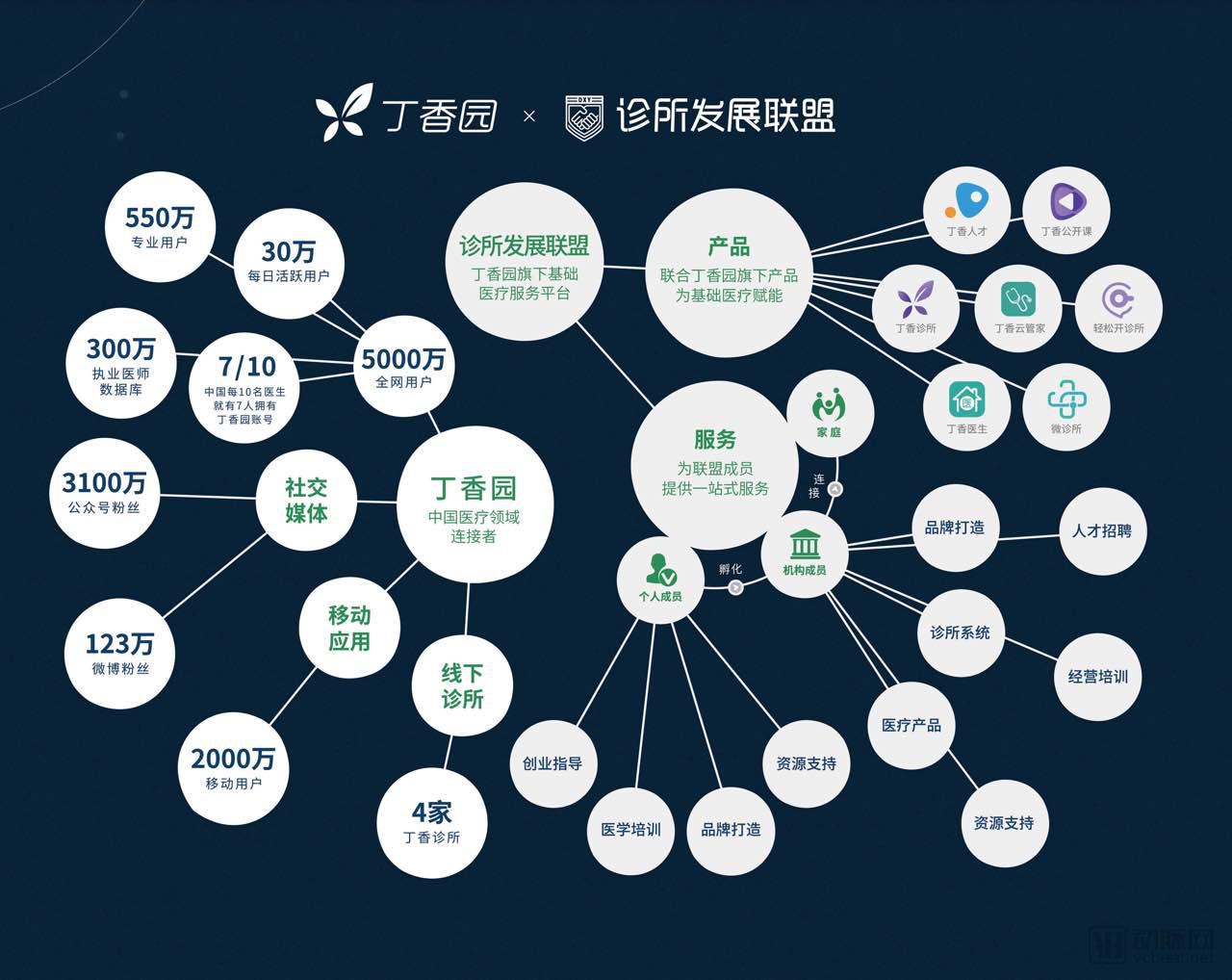
Li Tiantian stated that during the exploration process, DXY Clinic itself has neared profitability. Meanwhile, a series of products derived from using DXY Clinic as a “testing ground” have gradually yielded results. Since the establishment of the Clinic Development Alliance, it has aggregated over 60,000 users in the primary care sector.
“By operating as an alliance, we can influence more clinics and demonstrate that it is possible to generate revenue without relying on drug sales or IV infusions. In fact, such clinics can even be included in the national medical insurance scheme, thereby earning the trust of local residents,” said Li Tiantian. He noted that the Clinic Development Alliance is currently deepening its collaboration with new-type clinics, empowering them while ensuring quality standards. Addressing the many physicians present who are solo clinic entrepreneurs, Li Tiantian further emphasized, “In addition to supporting new-type clinics, the Clinic Development Alliance is also helping numerous traditional clinics transition into new-type clinics.”