

Real-World Evidence Breaks New Ground: FDA’s First Drug Approval Based on Real-World Data Marks a Turning Point for Pharma Informatics
On April 4, 2019, the FDA approved a new indication for Pfizer’s Ibrance (palbociclib) based on real-world data (RWD): in combination with an aromatase inhibitor or fulvestrant, it is indicated for the treatment of male patients with HR-positive, HER2-negative metastatic breast cancer.
The FDA’s current approval is primarily based on U.S. electronic health record data, as well as real-world medication data for male patients using Ibrance post-marketing, sourced from the IQVIA insurance database, Flatiron Health’s breast cancer database, and Pfizer’s global safety database, rather than on clinical trials or assessments of clinical performance. Typically, FDA drug approvals are grounded in open-label Phase III clinical trials; however, for drugs targeting very rare conditions with notably significant efficacy, single-arm trials may serve as the basis for review. Even for biosimilar approvals, rigorous evaluation of equivalent clinical performance is required. This marks the first time the FDA has approved a drug indication based solely on real-world data, challenging our traditional understanding of drug regulatory review.
However, this approval was not entirely unexpected. In 2016, the U.S. Congress passed the 21st Century Cures Act, which explicitly authorized the FDA to use real-world data as evidence for approving post-market studies of medical devices and drugs, as well as for the development of new indications. Overnight, real-world studies (RWS) became a hot topic and emerged as a key strategic direction for pharmaceutical giants in expanding their portfolios.
Notably, in December 2018, the FDA appointed Amy Abernethy, Chief Medical Officer of Flatiron Health, a clinical data integration company, as Principal Deputy Commissioner. Scott Gottlieb, then-FDA Commissioner, stated, “Abernethy brings extensive experience in the application of real-world evidence and in conducting efficient, innovative clinical trials, which will help the FDA improve its review policies for clinical drugs and accelerate the review process.” Three years later, real-world data has been successfully applied to FDA drug reviews, marking a milestone for real-world research in the field of drug approval.
So, what is real-world data? Beyond the regulatory review of new indications for drugs, what are its other application prospects? How large is the market space, and how can pharmaceutical companies position themselves in this sector? In this article, VBInsight (WeChat ID: biobeat1) will provide a comprehensive overview of the real-world study (RWS) landscape. The main contents include:
1. RWS is a new trend in pharmaceutical informatization, with promising application prospects
2. RWE Industry Players Approaching from Different Angles, Each with Unique Business Models
3. The nascent domestic RWS industry holds immense potential for development
When discussing real-world studies, it is essential to first distinguish among the common concepts of RWS, RWE, and RWD. Real-world data (RWD) refers not to data collected in experimental settings, including those from randomized controlled trials (RCTs), but rather to observational data obtained through various channels. Such data are related to patients’ health status and healthcare behaviors, derived from sources such as patient surveys, clinical trials, and observational cohort studies. Data sources include electronic health records, medical claims data, registries for medical products or diseases, and patient information collected via home-based and mobile devices. The goal of RWD is to generate real-world evidence (RWE).
Another common term in the RWS industry is Real-World Evidence (RWE). Real-world data are not equivalent to real-world evidence. The FDA defines real-world evidence as clinical evidence regarding the usage, potential benefits, or risks of a medical product derived from the analysis of real-world data. Strictly speaking, only real-world evidence can serve as evidence for clinical regulatory review.
Real-world studies (RWS) involve the systematic collection and analysis of real-world data (RWD) generated in routine clinical practice. Randomized controlled trials (RCTs) represent the highest level of evidence-based medicine and are frequently used as evidence for drug approval and market authorization, as well as for updating clinical practice guidelines and consensus statements. RWS and RCTs are not mutually exclusive but rather complementary.
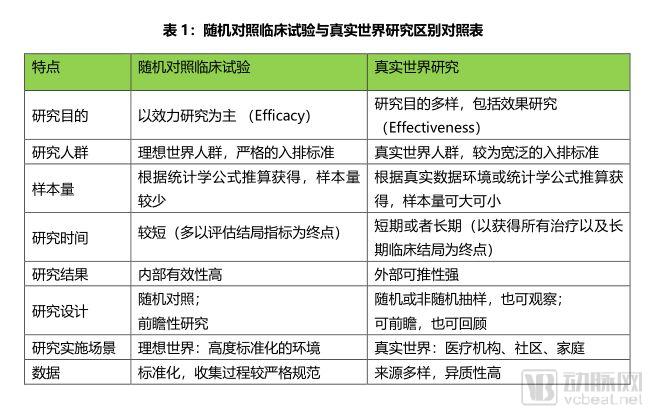
Image from Guidelines for Real-World Studies
In fact, since 2015, international guidelines related to the Real-World Study (RWS) industry have been successively issued, including the Good Pharmacoepidemiology Practices (GPP), the ISPOR Real-World Data (RWD) Guidelines, and the US FDA’s Use of Real-World Data to Support Regulatory Decision-Making for Medical Devices. These guidelines have gradually defined key concepts in the RWS field and outlined data requirements for Real-World Evidence (RWE) as well as its application scenarios.
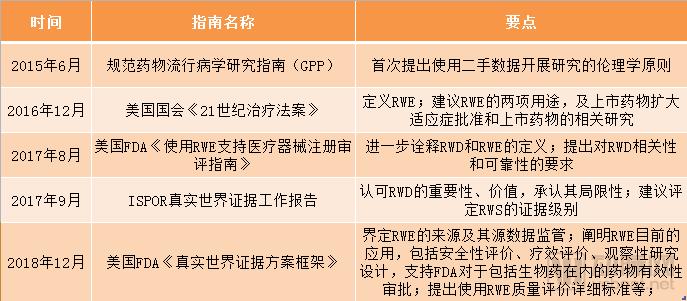
Data Source: “Real-World Study Guidelines,” compiled by VCBeat
On the basis of clarifying the application directions of RWS, the applications of RWS have gradually become clearer. In the commercial field, there are mainly three types of RWS applications:
1. Exploring new patient populations; the recent FDA approval of Ibrance for the treatment of male breast cancer is a concrete example of such applications in real-world studies (RWS);
2. Explore new applicable dosages. The fixed dosage of a drug is usually based on dose-escalation studies in Phase I clinical trials, which identify the dose-limiting toxicity (DLT) at a preset frequency. However, the sample size in Phase I studies is often too small, and drug dosage can vary significantly due to factors such as ethnicity, age, and gender. Real-world studies (RWS) can leverage massive amounts of clinical data to determine the optimal dosage range that maximizes therapeutic benefit.
3. Explore drug usage cycles and supplement clinical data. For immunotherapy, randomized controlled trials (RCTs) can only confirm efficacy but struggle to determine the timing of immune memory formation. In contrast, real-world studies (RWS) can identify optimal treatment durations by analyzing therapeutic outcomes across varying treatment periods. Furthermore, RWS can be used to accumulate long-term survival data for cancer patients, exploring 5-year and 10-year survival rates associated with oncology therapies.
In the field of clinical research, real-world studies (RWS) can also generate scientifically and clinically meaningful insights. Recently, in a latest study published in the Journal of the American Medical Association (JAMA), researchers from Flatiron Health, a U.S.-based clinical big data company, and Foundation Medicine, a genomic big data company, utilized large-scale clinical genomics databases to confirm previously known associations between genomic characteristics and clinical outcomes in patients with non-small cell lung cancer (NSCLC). Furthermore, they demonstrated that real-world clinical genomic data obtained during routine patient care can enhance the understanding of novel disease-related biomarkers.
Since the enactment of the 21st Century Cures Act, pharmaceutical giants have rushed to capitalize on the trend of real-world studies (RWS). In February 2018, Roche acquired Flatiron Health for $1.9 billion; in June, Roche made another major acquisition, purchasing Foundation Medicine for $2.4 billion.
Flatiron Health focuses on developing a clinical data platform that connects and shares patient data from community oncologists, academics, hospitals, life science researchers, and regulatory agencies, leveraging this real-world data to design clinical trials and prospective studies.
Foundation Medicine is dedicated to building a genomic database for cancer patients, matching this data with known targeted therapies, immunotherapies, and clinical trials. This information is leveraged to help design clinical trials, develop new drugs, and formulate personalized treatment plans. Its FoundationCore™ is one of the world’s largest cancer genomic databases, containing genomic data from more than 200,000 anonymized cancer patients.
In 2018 alone, Roche invested heavily in acquiring two oncology big data companies. The integration of clinical data with genomic data has also provided Roche with a solid foundation for entering the field of real-world studies (RWS). In addition to Roche, pharmaceutical giants such as Bristol-Myers Squibb and Sanofi have also incorporated RWS into their strategic planning.
In February 2019, Sanofi participated in the Series B financing of Aetion, a company dedicated to developing real-world evidence (RWE) platforms and analyzing their outcomes. Previously, Sanofi had incorporated RWE into its strategic planning and established the RWE & CO initiative. Sanofi’s real-world data (RWD) platform encompasses data from 300 million patients globally, covers 318 disease areas, and has completed more than 40 RWE projects. In 2018, the company planned to add 209 projects across more than 11 therapeutic areas. Juhaeri Juhaeri, Vice President at Sanofi, stated, “RWE will significantly drive Sanofi’s efforts to maximize the value of patient clinical data, holding substantial potential to bridge the gap between clinical development and patient care.”
In March 2019, Bristol-Myers Squibb (BMS) and Concerto HealthAI announced a partnership to incorporate real-world data (RWD) and artificial intelligence (AI) technologies into clinical trial design. BMS also collaborated with Flatiron Health, a Roche company, to establish real-world data standards for its drug approvals and regulatory submissions.
Certainly, pharmaceutical giants are actively entering the RWS arena. On one hand, this is to inform the clinical trial design of drugs under development; on the other, it aims to address cost concerns from health insurance payers and PBMs after drug launch. For instance, diabetes drug manufacturers such as Sanofi and Novo Nordisk have long faced pressure from PBM pricing and negotiations, prompting them to leverage RWE to highlight the future potential of their products.
Although the RWS industry started relatively late, many overseas companies have recognized its future potential. Overall, companies in the RWS sector fall into two categories: those that build their own clinical and genomic databases to provide real-world evidence (RWE) services, and those focused on data analytics and delivering healthcare solutions.
List of Overseas RWS Companies
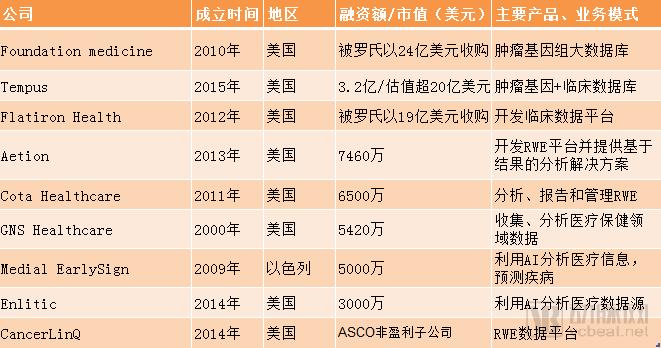
Taking Tempus and Cota Healthcare as examples, we examine the business models and development trajectories of real-world evidence (RWE) companies.
Tempus
Founded in 2015, Tempus has built its own oncology genomics and clinical database by providing affordable genomic sequencing, data structuring, pathological image analysis, and biological modeling services to hospitals, oncologists, and cancer centers. By 2019, Tempus had assembled one of the world’s largest cancer databases, accounting for nearly one-third of all cancer data in the United States.
Tempus’s business model has also gained recognition from investors and partners. In just three years, Tempus secured RMB 320 million in financing, achieving a valuation exceeding USD 2 billion and joining the ranks of unicorns. Furthermore, after prevailing in competition with Flatiron and IQVIA, Tempus entered into a collaboration with CancerLinQ (a subsidiary of the American Society of Clinical Oncology and an FDA partner for oncology clinical databases) to provide real-world data (RWD) on cancer to the FDA.
Cota healthcare
Cota Healthcare, founded in 2011, is dedicated to providing data and technology solutions to healthcare providers, life sciences companies, and insurance payers. Cota primarily offers two types of services: 1) Real-World Data (RWD) analysis and solution provision, where its CNS system employs concise digital codes to precisely classify patient and disease information based on genomic analysis, tumor type, and other factors, thereby enabling the analysis and visualization of RWD; 2) Structured clinical data services, where Cota works directly with clients to transform inaccurate and incomplete unstructured data into precise, structured data.
Summary
It is not difficult to observe that Tempus and Cota Healthcare share a strikingly similar entrepreneurial philosophy, both predicated on the premise that cancer treatment plans lack reasonable and accurate data support, particularly failing to fully leverage real-world data (RWD) from similar patients. However, there are significant differences in their business models. For instance, Cota posits that healthcare providers and payers (primarily insurance companies) are motivated to improve patient outcomes and are therefore willing to pay for such solutions. In contrast, Tempus’s model is more akin to Google’s approach: offering low-cost services to accumulate a massive database, which is then leveraged for commercial value realization. Whether by providing RWD analysis services directly to hospitals, pharmaceutical companies, and insurers, or through data commercialization, these represent promising future directions for real-world studies (RWS).
In contrast, the real-world study (RWS) industry in China is still in its infancy. In August 2018, at the 8th China Oncology Clinical Trial Development Forum, the Wu Jieping Medical Foundation and the Chinese Thoracic Oncology Group (CTONG) jointly released the “2018 Chinese Guidelines for Real-World Studies,” the first RWS guideline in China.
Recently, Nature published a real-world study (RWS) report from Peking Union Medical College Hospital. The report provides a detailed description of data on patients with advanced lung cancer who received PD-1 immunotherapy at Peking Union Medical College Hospital between August 1, 2015, and January 1, 2018. This is the first RWS report on immunotherapy in China. These two significant events also mark China’s entry into the new field of real-world studies.
In China’s RWS landscape, companies have also begun to make strategic moves. Gennlife (Beijing) Technology Co., Ltd. partnered with the Tianjin Medical University Cancer Institute and Hospital, a national-level clinical research center for oncology, to jointly establish China’s first “Big Data Center for Precision Oncology.” In late 2016, it launched VitArk, the country’s first commercialized big data platform for precision medicine. VitArk leverages a mature high-throughput NGS sequencing system, combined with its proprietary gene panels and interpretation databases, to measure patients’ genomic variations and transcriptome expression levels, and to interpret their clinical significance for physicians.
As a leading domestic team specializing in medical text NLP technology, Gennlife accurately and efficiently performs semantic understanding and post-structured information extraction, transforming large volumes of text into variables ready for direct statistical analysis. It supports the processing of massive datasets, encompassing billions of clinical records and hundreds of billions of data items. By integrating structured clinical data with rich molecular data, Gennlife provides high-quality real-world evidence (RWE) for clinical research, facilitating data-driven generation of evidence-based medicine, evaluation of therapies and efficacy, analysis of adverse reactions, queries of clinical guidelines and literature databases, and clinical decision support. Furthermore, through powerful and user-friendly data visualization and exploratory analysis tools, Gennlife builds an AI-powered learning healthcare system, delivering valuable RWE to medical institutions across various domains, including clinical research, clinical decision support, and operational management.
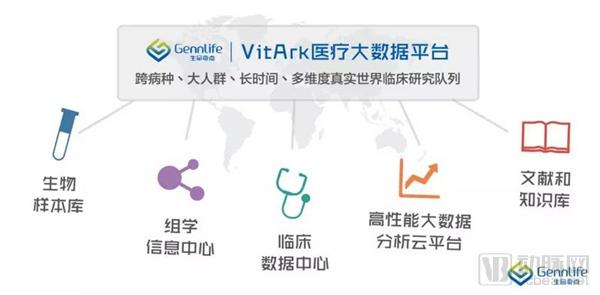
VitArk Medical Big Data Platform by Gennlife
Leveraging real-world data research, Gennlife has collaborated with hospitals to conduct dozens of investigator-initiated trials (IITs), resulting in multiple publications in high-impact-factor journals. These studies span a wide range of fields, including cardiovascular disease, chronic kidney disease, respiratory diseases, solid tumors, lymphoma, emergency medicine, critical care, pharmacy, and nursing.
For example, in a multicenter, long-term retrospective cohort study, the research teams from Gennlife and the hospital found that for patients with early-stage renal cell carcinoma undergoing surgical resection, detecting specific gene mutations using pathological paraffin blocks, combined with laboratory test results, could accurately identify patients who would experience recurrence or metastasis within one year post-surgery. If these patients undergo close monitoring and receive timely intervention upon recurrence or metastasis, their 5-year survival rate can reach 93%. In contrast, the 5-year survival rate for patients who do not receive timely intervention is only 52%. Additionally, by leveraging recurrent neural networks to analyze waveform data from intensive care units (ICUs), the research teams from Gennlife and the hospital developed a model to accurately predict whether patients are suitable for transfer out of the ICU. This model can increase ICU utilization by more than 20%, while reducing mortality by 5% and the 48-hour readmission rate.
Cancer is one of the major diseases affecting national health and remains a persistent global challenge. The development of the Gennlife Precision Medicine Big Data Platform is poised to better support cancer-related research, clinical translation, and clinical decision-making. By strengthening the integration of clinical information with multidisciplinary fields such as molecular biology and genomics, the platform assists clinical professionals in uncovering the underlying mechanisms of disease, exploring real-world evidence (RWE), enhancing the efficiency of clinical medical research, and advancing the realization of personalized precision medicine.
Liu Liyu, founder of Gennlife, stated, “We will continue to explore and accumulate experience and lessons in data governance, paving the way for medical big data governance in China and contributing our insights to the industry. Only with solid and in-depth data governance can the applications of medical big data and AI be truly implemented.”
The domestic real-world study (RWS) industry is still in an exploratory phase, yet its prospects are vast. On one hand, clinical data collection in China is relatively easier compared to abroad, and numerous genomics and healthcare big data enterprises have emerged. These companies are gradually exploring the integration of clinical data with genomic data to generate real-world evidence (RWE), which is then applied to clinical trial design, the formulation of personalized medical plans, and other areas. On the other hand, RWS abroad has achieved milestone results, setting a benchmark for drug approval and clinical trial research in China. We look forward to healthcare big data enterprises in this domestic sector seizing development opportunities and maintaining strategic direction, continuing to exert effort and achieve greater successes.