

China's First Internet Hospital Public Welfare Fund Launched at Chengdu High-Tech Zone's Inaugural Health New Economy Conference
On May 11, the 2019 International Forum on Leadership in Medical Science and Technology Innovation was held in Chengdu High-Tech Industrial Development Zone. The forum was hosted by the Chinese Academy of Medical Sciences & Peking Union Medical College, the Journal of the American Medical Association (JAMA), the Sichuan Medical Association, West China Hospital of Sichuan University, and the Sichuan Academy of Medical Sciences & Sichuan Provincial People’s Hospital; co-organized by the Training Center of Peking Union Medical College and Medlinker; and supported by the Chengdu High-Tech Industrial Development Zone. As a key component of the forum, the Healthcare Industry Sub-forum—also serving as the First Chengdu High-Tech Zone Health New Economy Conference (hereinafter referred to as the “Conference”)—was convened on the afternoon of the same day. The Conference featured in-depth discussions on topics such as how innovative healthcare policies can bolster the development of the new health economy, how internet technologies can support medical public welfare initiatives, and the exploration of innovative models within the broader health industry.
Zheng Chaoying, Director of the Industry Development Office at the Capacity Building and Continuing Education Center of the National Health Commission; Hu Ningning, Vice Chairman of the China Primary Health Care Foundation; Wang Xiaoning, Director of the Achievement Transformation Division of the Biological Industry Development Bureau of Chengdu High-Tech Zone; Yu Yuan, Vice President of the Chengdu High-Tech Zone Biological Industry Experts Association; Wang Haitao, Dean of the School of Continuing Education at Peking Union Medical College; Luo Yongqing, Global Vice President and General Manager of Greater China at Gilead Sciences; Zhang Cheng, Managing Director and Head of Commercial Operations at MSD (China) Investment Co., Ltd.; and Wang Shirui, Founder and CEO of Medlinker, were among the distinguished guests attending the conference.
The conference released the Guidelines for the Development of Chengdu High-Tech Zone’s New Health Economy. The Guidelines propose that Chengdu High-Tech Zone will leverage two major industrial platforms—the Frontier Medical Center and the Tianfu International Medical Center—to establish itself as a source of original innovation and a hub for translational application in the new health economy. By pursuing integrated development, the zone will strategically lay out three key industrial directions—precision medicine, smart healthcare, and novel health medical services—to construct a comprehensive industrial system for the new health economy. Building on the rapid growth of its new economy and biopharmaceutical sectors, how should Chengdu High-Tech Zone advance its new health economy? The Guidelines for the Development of Chengdu High-Tech Zone’s New Health Economy provides the answer: the convergence of BT (Biotechnology) and IT is the trend, and leveraging this momentum is the key.
“We pioneered the concept of the ‘New Health Economy’ in 2018,” introduced a relevant official from the Biological Industry Bureau of Chengdu High-Tech Zone. The New Health Economy is dedicated to meeting the people’s growing new health needs, driven by new technologies such as information technology and biotechnology, pursuing new application scenarios in the health sector, supported by new factors of production including data, knowledge, technology, and information, and centered on new business formats and models to form a new industrial morphology. It primarily covers key areas such as precision medicine, smart healthcare, and novel health medical services.
A relevant official from the Chengdu High-Tech Zone stated that the zone will leverage the dual drivers of new technologies and emerging demands to promote the upgrading and innovation of the traditional health industry. By targeting fields such as precision medicine and smart health, the zone will vigorously foster the development of the new health economy and accelerate the construction of an innovative ecosystem for the new health economy industry.
At the conference, China’s first public welfare fund for internet hospitals was announced. Initiated by Medlinker and hosted by the China Primary Health Care Foundation, the fund’s establishment was officially unveiled by Hu Ningning, Vice Chairman of the China Primary Health Care Foundation, and Wang Shirui, Founder and CEO of Medlinker. Liu Xin, Director of the Program Department at the China Primary Health Care Foundation, presented appointment certificates to members of the Management Committee. Wang Shirui was appointed as Chairman of the Management Committee, Li Yue, Vice President of Medlinker, as Secretary-General, Liu Chunmei, Vice President of Medlinker, as Deputy Secretary-General, and Cheng Jin, Vice President of Medlinker, as Director of the Management Committee Office.
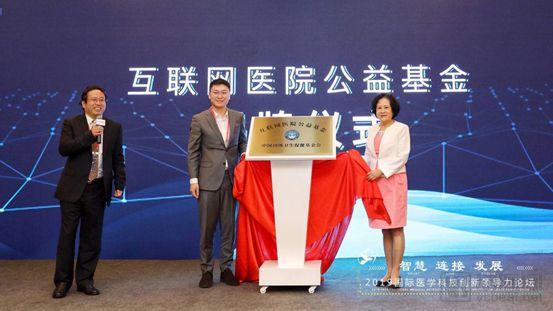 Wang Shirui (center), Founder and CEO of Medlinker, and Hu Ningning (right), Vice Chairman of the China Primary Health Care Foundation
Vice Chairman Hu Ningning delivered an address, stating that the fund will be dedicated to supporting development in four key areas: exploring and establishing operational norms and standards for the internet hospital industry, setting industry benchmarks, and promoting the sector’s growth; exploring and facilitating public welfare initiatives that align with national policies; supporting multidisciplinary academic discussions and clinical medical projects to provide real-time academic backing for the implementation of standardized medical diagnosis and treatment protocols, while also fostering talent development in internet hospitals; and advancing online diagnosis and treatment, education and training, medical science popularization, patient care, and medical humanities, thereby promoting the standardized development of multi-site practice for physicians in internet hospitals.
At the conference, Li Yue, Vice President of YiLian; Zhang Cheng, Managing Director and Head of Commercial Operations at Merck Sharp & Dohme (China) Investment Co., Ltd.; and Huang Qinqin, Medical Management Director of Taikang Pension Health Insurance Development Center, delivered thematic presentations on exploring innovative models for internet hospitals, enhancing drug accessibility through “Internet + Pharmaceuticals,” and innovations in internet healthcare integrated with health insurance.
Li Yue, Vice President of Medlinker, believes that the emergence of internet hospitals aims to alleviate the strain on offline medical resources, extend the scope of medical service capabilities, transfer the trust-based relationship between doctors and patients to online platforms, and improve diagnostic and treatment efficiency. Meanwhile, Li Yue holds that integrating internet healthcare with public welfare initiatives and exploring collaborations with insurance sectors also enhance the operational efficacy of internet hospitals. For instance, establishing a public welfare fund for internet hospitals can not only provide academic support to physicians—facilitating professional learning among grassroots doctors and promoting standardized treatments—but also leverage the advantages of the internet to launch charitable programs such as patient aid and mutual assistance. These efforts help substantially reduce the financial burden on patients, thereby delivering more valuable services to society.
Policies often determine the direction of the healthcare industry. At the end of 2018, the Chinese government introduced the “4+7” volume-based pharmaceutical procurement policy, which significantly impacted the distribution channels of pharmaceutical companies. Zhang Cheng believes that drug accessibility is a highly complex issue, with its meaning varying across different countries and stages of industrial development. Undoubtedly, the internet has opened up more possibilities and solutions for improving drug accessibility; however, it requires concerted efforts from all stakeholders to ultimately ensure that patients in China have access to medications that are safe, convenient, efficient, and affordable.
4+7, Critical Illness Medical Insurance, and other related industry policies are driving the upgrade of commercial health insurance from providing post-onset financial compensation to users’ health management and disease progression delay (i.e., “health protection”). As the economic burden of disease on the public decreases, health protection has become a shared interest of both the public and the government’s medical insurance system.
Huang Qinqin, Director of Medical Management at the Health Insurance Development Center of Taikang Pension, stated that commercial entities engaged in health and disease management must be grounded in comprehensive whole-course data and a robust medical service system. To excel further, they require commercial incentives—specifically, a profit model derived from maintaining customer health rather than from customer illness. For long-term sustainability, financial instruments are also needed to distribute the high costs of health and disease management across every healthy individual, thereby ensuring affordability. Only commercial health insurance can establish long-term payment and data relationships with customers while generating profits through health maintenance. Under the new market policy environment, commercial health insurance must achieve deep integration with the healthcare industry to enable a self-sustaining cycle within its medical financing and payment system.
Finally, moderated by Bi Yuanfeng, Co-founder and COO of VCBeat, a lively discussion on how to build a new ecosystem for smart city healthcare was held among Hu Ningning, Vice Chairman of the China Primary Health Care Foundation; Wang Haitao, Dean of the School of Continuing Education at Peking Union Medical College; Li Yue, Vice President of Medlinker; Huang Qinqin, Director of Medical Management at Taikang Pension Health Insurance Development Center; and Zhong Jing, Chief Technology Officer of China Mobile (Chengdu) Industrial Research Institute.
In particular, the application of 5G technology in the medical field, as mentioned by Zhong Jing, sparked strong interest among the attendees. He noted that the 5G era will usher in an Internet of Everything model. As part of smart cities, smart healthcare will interconnect all data from the moment a patient enters the hospital, synthesizing big data to generate patient profiles and facilitate efficient management of medical practices and services. In the future, doctors, nurses, and technical professionals alike will be both beneficiaries and contributors to smart healthcare.