Dazhou Biopharma Files IPO Prospectus for Ketamine Transdermal Patch Targeting Major Depressive Disorder, Set to Challenge Johnson & Johnson's Spravato
Depression has now become a focal point of international attention. Prior to this year, no new drugs with novel mechanisms of action had been approved for major depressive disorder (MDD) in three decades. Yet, within just the first five months of this year, significant breakthroughs have emerged in the MDD field. On March 5, the U.S. Food and Drug Administration (FDA) approved Spravato (esketamine) nasal spray, developed by Janssen Pharmaceuticals, a subsidiary of Johnson & Johnson. Subsequently, on March 19, the FDA approved Sage Therapeutics’ Zulresso for the treatment of postpartum depression. However, FDA approval does not equate to a resolution of the challenges associated with MDD. Spravato demonstrated numerous adverse reactions in clinical trials, which can significantly impact patients’ daily lives during treatment. Furthermore, its cost is prohibitively high.
Guangzhou Continent Biomedical Technology Co., Ltd. has strategically targeted major depressive disorder (MDD) as its entry point, addressing the various challenges associated with ketamine therapy through innovative drug formulation and groundbreaking pharmacological modifications. The company has integrated ketamine into a transdermal patch system. By leveraging the sustained-release properties and controllability of the transdermal delivery method, it mitigates the adverse effects of ketamine—often regarded as a double-edged sword—enabling patients with MDD to maintain a normal quality of life during treatment.
Guangzhou Continent Biomedical Technology Co., Ltd. was established in April 2017 and secured Pre-A round investment from Guangzhou Yuexiu Industrial Fund in August 2017. The company’s founder, Dr. Tang Huadong, earned his bachelor’s degree from Fudan University in China before pursuing further studies in the United States, where he obtained a Master’s degree in Biochemistry from Iowa State University and a Ph.D. in Pharmacy from the University of Arizona. After graduation, Dr. Tang held senior positions such as Senior Researcher and Chief Scientist at major international pharmaceutical companies including Bristol-Myers Squibb, Merck & Co., and Wyeth Pharmaceuticals (later acquired by Pfizer). He led the research and development of novel therapeutics for various refractory diseases, including Parkinson’s disease, Alzheimer’s disease, and hepatitis C. During his tenure at Merck & Co., Dr. Tang served as a lead scientist responsible for human pharmacokinetic/pharmacodynamic/dose predictions for nearly all projects at Merck’s largest R&D site in New Jersey, playing a pivotal role in key decisions regarding the advancement of projects into clinical stages.

Dr. Tang Huadong, Founder of Continent Biomedical
Huadong Tang has established profound expertise and prominence in the field of human pharmacokinetic prediction. The methods and models he developed for predicting human pharmacokinetics are widely applied in both industry and academia, with some companies even referring to his approach as “Tang’s coefficient.” In academia, the FCIM model constructed by Huadong Tang attracted significant attention from the Pharmaceutical Research and Manufacturers of America (PhRMA) in 2006, prompting the Clinical Pharmacology Committee for Drug Development (CPCDC) to establish a dedicated project to independently compare various methods for predicting human pharmacokinetics. Huadong Tang’s model for predicting human clearance—the most critical parameter in pharmacokinetics—is recognized as the current best-in-class method.
During his tenure at a pharmaceutical company, Tang Huadong identified unmet needs in the field of depression and recognized its future growth potential. The suicide of a key life mentor from his post-graduation working years, who suffered from depression, deeply impacted him. Driven by his industry insights and this personal tragedy, Tang Huadong entered the field of depression treatment. After defining his strategic direction, he swiftly established Shenox Pharmaceuticals in the United States to initiate research on ketamine transdermal patches. With the support of Yuexiu Financial Holdings, the project was ultimately implemented in Guangzhou, evolving into what is now Guangzhou Continent Biomedical Technology Co., Ltd.
Tang Huadong’s founding team also includes his doctoral advisor, close friend, and retired professor from the Department of Pharmacy at the University of Arizona, Dr. Michael Mayersohn, a renowned authority in pharmacokinetics. Dr. Mayersohn brings robust academic and regulatory resources to the company, enhancing its reputation and strategic positioning in related fields. His expertise and resources in formulation, pharmacokinetics, and patents constitute a significant value component for the company’s 505(b)(2) submission projects. Another founding team member, Dr. Hock Tan, is an expert in transdermal and transmucosal delivery systems, as well as a distinguished expert witness in formulation and patent matters. Dr. Tan previously held positions at major multinational pharmaceutical companies such as Abbott and Johnson & Johnson, where he successfully developed the first skin penetration-enhancing adhesive. He founded Bionex, which specializes in transdermal patches and operates GMP-compliant facilities capable of directly producing clinical trial samples for Phase I and Phase IIa studies. As a senior consultant on formulation for Guangzhou Continent Biomedical Technology Co., Ltd. (Continent Biomedical), Dr. Tan fulfills the company’s needs in transdermal dosage forms, while Bionex’s GMP manufacturing qualifications enable Continent Biomedical’s products to enter clinical trials efficiently and rapidly.
Guangzhou Continent Biomedical Technology Co., Ltd. has established a laboratory of approximately 300 square meters in Guangzhou, equipped with GMP-compliant production facilities. The company has completed the strategic layout of its patent chain covering formulations, pharmacokinetics, and pharmacodynamics. Although the core team consists of only around ten members, quality prevails over quantity; this lean structure is entirely sufficient for the R&D of core products. Early-stage formulation manufacturing and subsequent clinical trials can be outsourced to appropriate CMO/CDMO/CRO partners. Furthermore, tailored advisory teams comprising active frontline experts are established in relevant fields based on the specific needs of each project. The company’s current Scientific Advisory Board includes: Dr. Maurizio Fava, Chief of Psychiatry at Massachusetts General Hospital/Harvard Medical School and a leading authority in depression; Dr. Thomas Laughren, former Director of the FDA’s Division of Psychiatry Products and a regulatory authority in psychiatry; and Dr. Carl Peck, an expert in clinical pharmacology and former Director of the FDA’s Center for Drug Evaluation and Research.
Continent Biomedical’s product pipeline is focused on psychiatric and neurological indications, with its primary formulation platforms being transdermal patches and film formulations. The company has more than a dozen drug candidates in development, targeting conditions such as depression, chronic pain, Parkinson’s disease, and acute systemic allergic reactions. The lead clinical candidate currently under advancement is SHX-001, a transdermal patch for the treatment of major depressive disorder (MDD), which is positioned to compete with Spravato, Janssen Pharmaceuticals’ newly FDA-approved novel therapy for MDD.
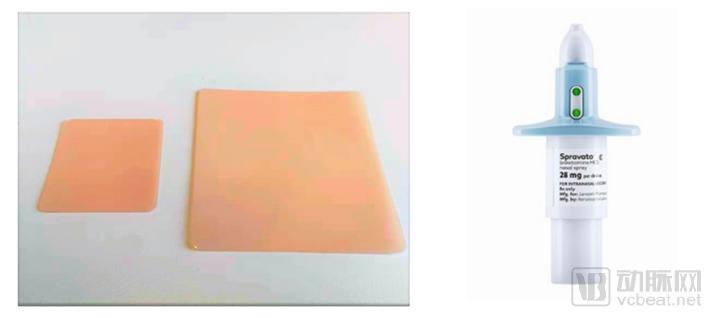
Left: Continent Biomedical's SHX-001 transdermal patch; Right: Johnson & Johnson Medical's Spravato
The primary active ingredient in Spravato is S-ketamine. Similarly, the primary active ingredient in Continent Biomedical’s SHX-001 is racemic ketamine. Currently, these are the only two ketamine-based products that have entered clinical trials for the treatment of major depressive disorder (MDD). Ketamine is the main component of “K-powder,” a commonly known illicit drug. Originally synthesized as a surgical anesthetic, ketamine was later subjected to abuse and regulatory bans before ultimately returning to medical use, albeit with a significantly shifted therapeutic focus. Ketamine has achieved two breakthroughs in the treatment of depression. First, it has a rapid onset of action. While traditional antidepressants (such as the most commonly used SSRIs) take nearly a month to become effective, ketamine can produce rapid effects within hours to 1–2 days. Second, ketamine demonstrates groundbreaking efficacy in treating treatment-resistant major depressive disorder. One-third to one-half of patients with MDD do not respond to traditional antidepressants or develop drug resistance after a period of use. For these patients, ketamine offers significantly better therapeutic outcomes than conventional treatment regimens.
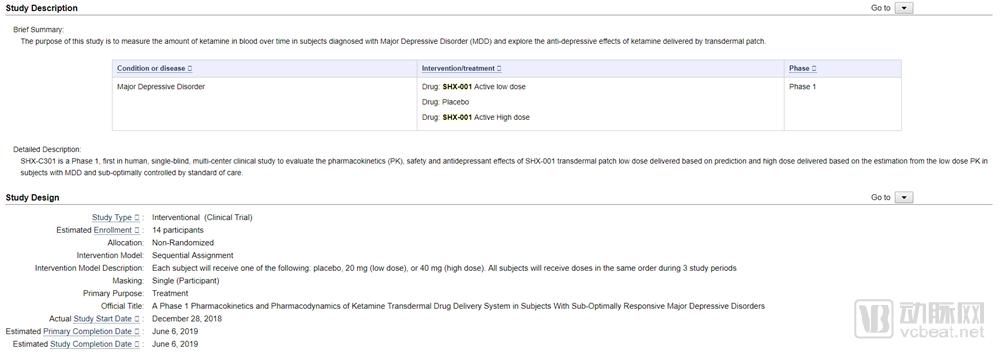
Figure: ClinicalTrials.gov shows that the Phase I (effectively Phase IIa) clinical study of SHX-001 in the United States, SHX-C301, will conclude shortly.
SHX-001 initiated its Phase I (effectively Phase IIa) clinical trial in the United States in December 2018, with completion expected by June 2019. The trial was designed to enroll 14 patients; recruitment has now been closed, and the specific results are scheduled to be presented at the annual meeting of the American Psychiatric Association by the end of this year. Arrangements for the Phase IIb clinical trial of SHX-001 are also being actively advanced. In addition to SHX-001 (a transdermal patch for the treatment of depression), Continent Biomedical has established a robust portfolio of projects centered around ketamine, including orally disintegrating films, combination therapies, and indication expansions (such as pain management and PTSD). By leveraging synergies across its formulation platforms, facilitating data sharing and complementarity across different indications, and securing multi-dimensional and in-depth patent protection, Guangzhou Continent Biomedical Technology Co., Ltd. has efficiently enhanced the value of its project pipeline.
The most significant issue with Spravato use is the high incidence (70–80%) of severe adverse effects. The FDA-approved labeling for Spravato includes a boxed warning explicitly stating that, due to the abuse potential of esketamine and the risk of adverse reactions such as sedation, dissociation, dizziness, nausea, vertigo, hypoesthesia, and elevated blood pressure following administration, Spravato must be administered only in certified healthcare settings. Patients require continuous monitoring by healthcare professionals until the adverse effects have resolved before they can be discharged. Furthermore, patients are prohibited from driving or operating heavy machinery on the day of treatment and the following day. These requirements inevitably disrupt patients’ daily lives, and currently, there are no adequate strategies to mitigate the adverse effects associated with Spravato.
Effectively controlling side effects, or minimizing them to the greatest extent possible, is precisely the core rationale and competitive advantage of SHX-001. This project embodies bold hypothesis, rigorous validation, and efficient execution. Within the industry, there is no consensus on the mechanism of ketamine’s antidepressant effects, and significant controversy remains. Which specific target(s) does ketamine act upon? What is the complete pathway of its action? Is it ketamine itself or its metabolites that exert the therapeutic effect? Do the rapid-onset and delayed therapeutic effects operate through different mechanisms? How should these be defined in terms of quantitative pharmacology (dose-response and time-response relationships)? These are critical questions closely monitored in the field of depression treatment.
In 2000, Berman and a team of clinical scientists conducted the first randomized controlled trial (RCT) involving a 40-minute intravenous infusion at a dose of 0.5 mg/kg. After discovering ketamine’s rapid onset and high response rate in producing antidepressant effects, nearly all subsequent clinical studies adopted administration methods based on the same pharmacological principle—namely, rapid absorption kinetics. The nasal spray formulation of Spravato also adheres to this pharmacological mechanism. However, these rapid-absorption pharmacokinetics are the primary cause of various adverse effects. Building on these insights and after conducting a series of validations, SHX-001 boldly opted for a unique transdermal delivery route, significantly altering its pharmacological profile to reduce multiple side effects, including abuse potential. The ultimate product goal for SHX-001 is outpatient prescription use, meaning that side effects are lowered sufficiently to allow patients to safely obtain and self-administer the medication from pharmacies based on their prescriptions. With characteristics such as rapid onset, low side effects, ease of use, and low abuse potential, SHX-001 is poised to become a disruptive therapeutic approach in the field of depression treatment.
Currently, the primary activities for SHX-001 are conducted within the United States, a decision influenced by China’s regulatory controls on ketamine. The U.S. classification of controlled substances aligns closely with international standards, categorizing ketamine as a Schedule III controlled substance. In contrast, ketamine is classified as a Category I psychotropic substance in China, representing the highest level of control. Considering the social environment and the scientific and medical understanding of ketamine among regulatory authorities, conducting clinical research and realizing the drug’s value in the United States is evidently more practical and effective. However, the domestic environment in China has shown significant improvement. Spravato’s clinical trials in China have advanced to Phase III. On the evening of May 13, 2019, Jiangsu Hengrui Medicine Co., Ltd. announced that it had received clinical trial approval from relevant authorities for its independently developed (R)-ketamine hydrochloride nasal spray, intended for the treatment of treatment-resistant depression. Guangzhou Continent Biomedical Technology Co., Ltd. believes that with growing awareness of depression, increasing medical demand, and scientific and medical advancements in this field in China, the country will likely embrace and accelerate the research and development of more ketamine-based therapies in the near future.
To this end, Guangzhou Continent Biomedical Technology Co., Ltd. (hereinafter referred to as "Continent") has submitted a project initiation application for ketamine SHX-001 to China’s National Medical Products Administration (NMPA). Continent plans to establish clinical trial centers in China during the later stages of clinical development (Phase 2b, or at the latest, Phase III) and integrate them into its international clinical trials, making them an integral component thereof. This approach will also facilitate future regulatory submissions for market approval in China. The Investigational New Drug (IND) approval and clinical outcomes of SHX-001 in the United States will significantly support its regulatory review process with the Chinese NMPA.
Although SHX-001 competes with Spravato, it actually benefits more from Spravato’s approval. First, the FDA’s approval of Spravato signifies regulatory recognition of the efficacy of ketamine and its analogs in treating major depressive disorder (MDD). This will facilitate the review and conduct of subsequent clinical trials for SHX-001 in the United States. Additionally, Spravato helps educate the market, making it easier for SHX-001 to gain market acceptance upon its future launch. Furthermore, Spravato’s efforts in developing the Chinese market have paved the way for SHX-001’s eventual reintroduction into China.
Over the past few decades, the incidence of depression has increased exponentially. The Baidu Tieba (forum) dedicated to depression has become the second-largest health and wellness community on the platform, surpassed only by the HIV-phobia forum. As public understanding of depression becomes increasingly clear, the perception that it is incurable has emerged as the most significant challenge in the field today. Guangzhou Continent Biomedical Technology Co., Ltd. has applied transdermal patch technology to the treatment of depression, offering the potential to fundamentally transform the current predicament in depression care within a few years. Yet, addressing depression is merely the beginning.