Camrelizumab Launches in China, Marking Phase Two of Domestic PD-1 Market Competition

Hengrui Pharma
Innovative and High-Quality Pharmaceutical Developer
By Hao Han, Cao Xian
Camrelizumab is a PD-1 antibody drug independently developed by Hengrui Pharma, which was accepted for review by the CDE in April 2018. On the afternoon of May 5, 2019, media reports indicated thatHengrui Pharma’s PD-1 monoclonal antibody (camrelizumab, brand name: Airuituo) was approved for market launch on the same day.The newly approved indication is for the treatment of patients with relapsed/refractory classical Hodgkin lymphoma who have received at least two prior lines of systemic therapy. This indication is fully consistent with that previously approved for sintilimab. With the approval of camrelizumab, BeiGene remains the only company with a PD-1 monoclonal antibody under regulatory review in China. This signifies that competition in the domestic PD-1 monoclonal antibody market is poised to enter its second phase, characterized by competition across indications.
The approval of camrelizumab for the indication of Hodgkin lymphoma was primarily based on a relevant clinical trial initiated in June 2017 (Registration No. CTR20170500). The trial planned to enroll 60 patients but actually enrolled 75. According to the clinical results presented at the CSCO Academic Annual Conference in September 2018, as of March 18, 2018, there were 66 evaluable cases, including 20 complete responses and 36 partial responses. The complete response rate (CR) was 30.3%, and the overall response rate (ORR) was 84.8%.
Currently, the most concerning issue regarding camrelizumab is its adverse reactions. According to previous disclosures, 60–70% of patients treated with camrelizumab developed cutaneous capillary endothelial proliferation (CCEP). A 2017 article published in the Journal of Clinical Oncology conducted a statistical analysis of patients receiving camrelizumab therapy. The results showed that among 45 patients evaluable for efficacy, 35 developed CCEP, and the incidence of CCEP was significantly higher in these patients compared to those who did not develop it.
An article published in *mAbs* in January 2019 elaborated on the potential mechanisms underlying this adverse reaction. Researchers screened the human receptor proteome for low-affinity binding partners of camrelizumab and identified vascular endothelial growth factor receptor 2 (VEGFR2). This finding suggests that camrelizumab acts as a potent agonist of VEGFR2, which may activate vascular endothelial cells and promote hemangioma development, thereby leading to capillary hemangiomatosis.
Although the use of camrelizumab induces cutaneous capillary endothelial proliferation (CCEP) in most patients, it has minimal impact on their quality of life. Furthermore, CCEP primarily occurs on the body surface skin, with no reported cases involving visceral mucosa. In patients who develop CCEP, the proliferative lesions are expected to gradually decrease in size and fade over a period of 3 to 6 months, ultimately resolving completely.
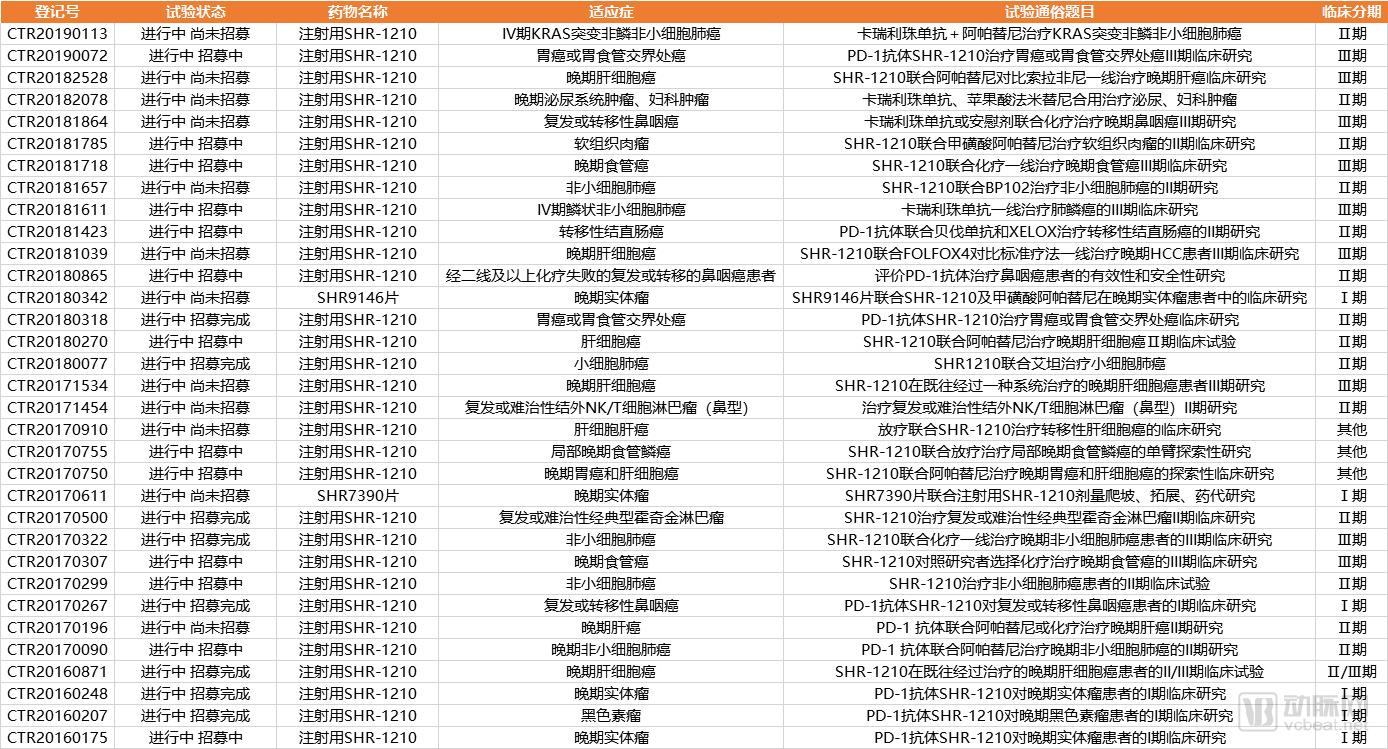
Ongoing Clinical Trials of Camrelizumab
Currently, the primary clinical research on camrelizumab focuses on combination therapy with chemotherapy or other agents. A total of 33 clinical trials involving camrelizumab are registered on the Clinical Trial Registration Platform, including 20 trials of combination therapy and 13 trials of monotherapy. Among these, 10 trials have advanced to Phase III, covering indications for various high-incidence malignancies such as non-small cell lung cancer, hepatocellular carcinoma, and esophageal cancer.
In combination therapy, eight clinical trials involving apatinib combinations are currently underway. Apatinib is a small-molecule anti-angiogenic agent characterized by its highly selective binding to VEGFR2. Hengrui Pharma likely aims to use apatinib to block the binding of camrelizumab to VEGFR2, thereby preventing the occurrence of CCEP. This approach may also become a key future development direction for camrelizumab.

Five Approved PD-1 Monoclonal Antibody Drugs
Currently, the five approved PD-1 monoclonal antibodies cover only three indications. The indication approved for Hengrui Pharma’s camrelizumab is Hodgkin lymphoma, which is the same as that for Innovent Biologics’ sintilimab (Tyvyt). Competition within the same drug class for the same indication is inevitable. Nivolumab (Opdivo), currently the only agent approved for non-small cell lung cancer (NSCLC), holds a competitive advantage in China’s PD-1 market. Camrelizumab, having just entered the fray, may temporarily lag behind due to its side-effect profile and overlapping indications. However, the ultimate direction of the PD-1 monoclonal antibody landscape following Hengrui Pharma’s entry remains to be determined by the market.
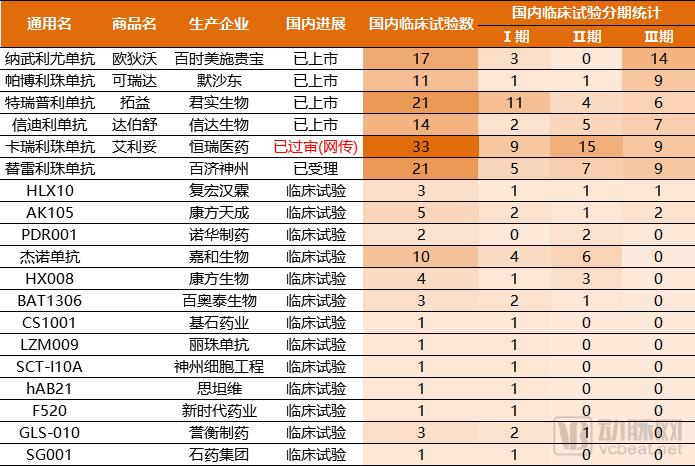
Clinical Trial Status of PD-1 Monoclonal Antibodies Displayed on the Drug Clinical Trial Registration and Information Disclosure Platform
Following the approval of camrelizumab, the only PD-1 monoclonal antibody currently under regulatory review but not yet approved is tislelizumab from BeiGene. Other PD-1 monoclonal antibodies that have not yet been submitted for approval lag significantly behind the first batch of six drugs in terms of development progress; the most advanced candidates, from Henlius and Akeso, have only just initiated Phase III clinical trials. Therefore, with camrelizumab’s approval, there is likely only one more PD-1 monoclonal antibody that may gain approval in the short term. This indicates that the initial round of competition in the PD-1 monoclonal antibody market is drawing to a close. For PD-1 monoclonal antibodies still in clinical development, the remaining market share is limited. The domestic market has largely been carved up by already-approved drugs. If other PD-1 inhibitors wish to continue entering the market, they will have to rely on differentiated indications and pricing strategies to compete indirectly with existing products.
Following the initial round of competition, approved PD-1 monoclonal antibodies will continue to pursue further indication expansions, which will become the core focus of market competition in the next phase. Although camrelizumab has lost its first-mover advantage, Hengrui Pharma has prepared 33 subsequent clinical trials for camrelizumab, far exceeding the number of clinical trials for other PD-1 monoclonal antibodies. The other five drugs from the first batch are currently conducting between 11 and 21 clinical trials each. Among them, Opdivo has the highest number of Phase III clinical trials, totaling 14. Although Keytruda has the fewest ongoing clinical trials, public information from the Center for Drug Evaluation reveals that there are currently 20 items related to Keytruda under review, which are estimated to be applications for indications already approved abroad. Therefore, it appears that all PD-1 monoclonal antibodies launched in the first batch have made preparations for the second stage of competition, and this bloodless war may have already begun.