

Business Model Innovation for Survival: How Genomic Testing Companies Navigate a Crowded Tumor Targeted Therapy Market
Reflections on the post-boom genetic testing market continue, and we have received another submitted article from our contributor, Shishangliu. This time, they offer insights into innovative models for tumor targeted therapy testing. The article explores how to integrate genetic testing into pharmaceutical companies’ patient assistance programs (PAPs), enabling testing companies to become an indispensable link in the ecosystem while achieving a multi-party win-win situation for patients, hospitals, pharmaceutical manufacturers, and the testing companies themselves.
How is this remarkable ecosystem structured? Read Shishangliu’s analysis. Meanwhile, if you are a professional in the biopharmaceutical industry and wish to document your insights and engage in discussion with peers, you are welcome to submit your articles to tg@vcbeat.top.
Author:Shi Shangliu
Recently, I conducted a preliminary review of the various business models and challenges faced by domestic genetic testing startups (Reflections After the Frenzy: Gene Testing Startups, Are You Ready for the Future?), which has sparked considerable discussion in the industry. During this period, based on my own observations and analysis, I offer here a brief reflection on the business model of genetic testing for tumor-targeted therapies.
Since the publication of my previous article, I have observed a growing number of startups entering the field of tumor targeted therapy testing. A prime example is that several industry leaders on my WeChat Moments, who previously rarely shared content related to tumor targeted therapy testing, have not only started reposting articles but also begun announcing that their companies now offer this service.
Let’s start with the premise: the pathogenic mechanisms of most tumors remain unclear. A considerable number of physicians are pessimistic about humanity’s ability to cure cancer, believing that tumors will not be conquered within at least the next 100 years. They cite the example of AIDS: although it has been many years since HIV/AIDS was first identified, and while effective medical care can achieve relatively good disease control, a radical cure remains elusive.
Given the unclear underlying mechanisms, regardless of the tests and medications provided, they may only offer symptomatic relief. In fact, there are numerous clinical cases where genetic testing indicated that a specific targeted therapy would be effective, yet the patient experienced no benefit after taking the drug. Conversely, there are also patients whose test results suggested they would not benefit from targeted therapy, but who, out of sheer hope or luck, took the medication anyway and unexpectedly responded well. These fortunate patients themselves do not understand why their cancer cells disappeared, and doctors remain equally perplexed, offering a wide array of speculative explanations.
Currently, if a new drug can extend progression-free survival by more than three months, it is considered a significant achievement. For cancer patients, life is measured in days.
Furthermore, the technical approaches currently employed by various testing companies are largely identical; no single company holds an absolute technological advantage. Essentially, any test that Company A can perform, Company B can also perform. Competition therefore hinges on channel capabilities and the willingness to offer greater profit concessions.
After all this preamble, it is time to turn to the main topic. Some pharmaceutical companies are currently promoting a model whereby patients who respond positively to targeted therapy may receive complimentary medication after completing a specified treatment duration (e.g., three or six months). However, the complimentary drugs are dispensed at regular intervals, typically on a monthly basis, and require in-person pickup by the patient. Furthermore, patients must undergo periodic examinations at designated hospitals, obtain signatures from specified physicians, complete required forms, and submit these documents back to the pharmaceutical company.
This involves certain details; for instance, if a patient is out of town and occasionally cannot pick up their medication at the scheduled time due to unforeseen circumstances, they may need to purchase a one-month supply out-of-pocket. I personally believe this model is quite effective. Beyond the fact that these patients continue to generate intermittent purchasing activity, the pharmaceutical manufacturer, while securing exclusive patient engagement, can also foster word-of-mouth promotion within patient support groups. These patient-side effects, in turn, influence physicians’ prescribing decisions, further reinforcing this ecosystem dependency. Additionally, the clinical treatment processes at hospitals can provide data to pharmaceutical companies, guiding their drug research and development efforts.
So, what is the relationship between this pharmaceutical company model and genetic testing companies? Through my follow-up observations of certain cancer patients, I have found that the model provided by pharmaceutical companies is insufficient, indicating that there are unmet needs. Fortunately, this gap is precisely an area that genetic testing companies can attempt to fill.
To receive free medication, patients must undergo regular medical examinations; however, there is currently no systematic framework or standardized protocol for the required tests, and existing practices remain rudimentary. Taking lung cancer as an example, patients typically undergo a chest CT scan every three months to assess whether lesions have recurred or progressed. If no progression is observed, the treatment is deemed effective and continued. However, this approach carries hidden risks: lung cancer has a high propensity for brain metastasis, making chest CT scans alone insufficient. Regular contrast-enhanced brain MRI is also necessary. Additionally, patients may consider circulating cell-free DNA (cfDNA) testing in blood during this process.
Thus, a potential business model is emerging:Testing companies can consider offering an initial bundled package to patients. If a patient purchases the company’s testing services and a suitable targeted therapy is identified, the patient will be required to undergo periodic MRI scans (benefiting hospitals) and cfDNA tests (benefiting the testing company). The cost of these examinations, when purchased as part of a bundled package (with installment payment options), is lower than that of individual purchases. Furthermore, testing companies can collaborate with pharmaceutical manufacturers to offer discounts on medication prices to patients who enter into long-term agreements (providing long-term benefits to pharmaceutical companies). Through more comprehensive follow-up monitoring, hospitals can promptly detect any abnormalities in patients and adjust treatment plans accordingly (benefiting patients).
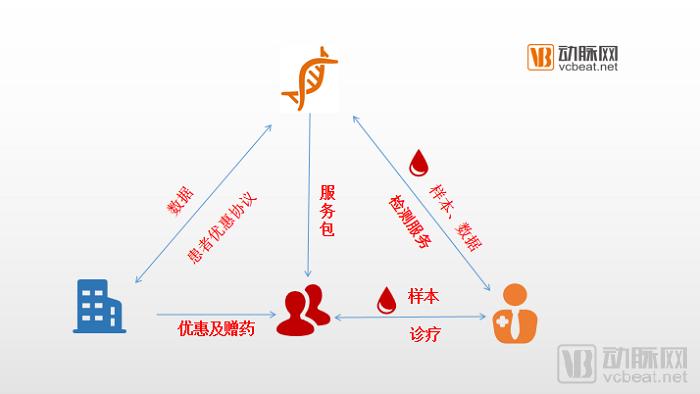
Therefore, companies providing testing services should systematically review all cancer types and offer long-term bundled service packages tailored to each specific cancer. This model is not only suitable for companies that provide free medication samples but also applicable to pharmaceutical manufacturers whose patients must pay out-of-pocket (or receive partial reimbursement) for their medications.
Furthermore, the ecosystem can consider offering value-added services for bundled packages, such as expedited medical access channels (with a corresponding increase in the price of the bundled package), and even collaborate with insurance companies to develop tailored insurance products designed specifically for these bundled solutions. Under such arrangements, if a patient passes away before completing a minimum duration of medication, the insurance company provides a specified compensation. After the initial testing, neither the patient, their family, nor the physician can determine with certainty whether the medication will be effective; therefore, this is essentially an act of risk selection. Any choice involving inherent risk naturally possesses insurable attributes. This, in turn, can incentivize companies to improve product quality and accelerate market consolidation, as a company lacking confidence in its own products would hardly dare to underwrite them with insurance.
This offers several benefits:
1. Long-term patient retention, creating a deeper moat.By offering services in the form of service packages, the likelihood of users switching to other testing companies mid-process is reduced, allowing genetic testing to return to its core nature as a service. If you view testing merely as a fast-moving consumer good (FMCG)—where delivering a report marks the end of the transaction—how can you differentiate yourself in a market saturated with such commodities? Currently, most testing services are essentially one-off transactions. Testing companies remain completely unaware of patients’ subsequent conditions: whether the medication was effective, whether the patient’s progression-free survival (PFS) exceeded the median, or what the first step should be if the patient experiences a recurrence. Some argue that genetic testing is a one-time consumption activity; however, I believe there is a potential market for secondary testing. The primary reason is that current treatment modalities cannot cure cancer, and no physician can guarantee definitive efficacy. Evidence also shows that a significant number of patients experience tumor recurrence. Therefore, converting patients into repeat customers represents a long-tail market worth capturing.
2. Effectively aligned the interests of hospitals, pharmaceutical manufacturers, testing companies, and patients.This is a win-win situation; if a business partnership is built on the premise that one party loses while the other gains, it is inevitably unsustainable.
3. Enhance ecological stability.If a testing company merely provides testing services, it exists only as an isolated node under current technological conditions, and the cost of replacing it is actually very low—a point that needs little elaboration. However, if it builds this type of ecosystem-dependent structure, the cost for others to replace it becomes significantly higher.
4. By leveraging collaborations with pharmaceutical companies and hospitals, testing companies can collect more long-term patient dynamic information.We all know that the value of a single data point is limited, but the long-term accumulation of tracked data can create economies of scale, turning into a significant asset. Readers are free to let their imaginations run wild; just thinking about it is exhilarating.
5. Grant testing companies greater initiative.Frankly speaking, patients currently have little say in choosing which company’s testing products to use; in most cases (though not all), the decision rests entirely with physicians. This approach is essentially passive, as the testing companies’ business volume is wholly dependent on third-party referrals from doctors. If long-term agreements are established, the cost for physicians to switch to other testing providers mid-term will increase: first, due to contractual restrictions; and second, because the testing kits include differentiated pre- and post-test analytical services. If patients can understand the value of these services through education, the likelihood of physicians arbitrarily switching testing providers will be further reduced.
You might question whether patients would be willing to purchase such a long-term bundled service. However, healthcare entrepreneurship is about developing products that meet the needs of patients and clinical practice. This model can genuinely create value for patients, and if executed with care, it will certainly gain acceptance among a segment of the patient population. I have encountered cases where patients had been taking targeted therapy for three years, believing the medication was effective, only to discover brain metastases that had grown to the size of an egg. Had they undergone regular MRI scans, I believe the outcome would have been different.
You could also say that I am considering a path of technological innovation. Not to mention how much resources a startup can actually devote to technological innovation, even if you have the resources to invest, it does not conflict with business model innovation.
In short, genetic testing for tumor-targeted drugs does generate some cash flow for certain companies, making it a viable business. However, given the current lack of clarity regarding the underlying mechanisms of cancer and the homogenization of technological approaches among testing companies, I believe that innovation in business models is essential to address the challenges of corporate growth and expansion. Mere imitation makes it difficult to achieve sustainable growth; even if there is some business activity in the short term, it is destined to be unsustainable.
The above content represents personal views only; any similarities are purely coincidental.