

JoyHealth Expands Clinic Reach with 'Micro-Clinic' as a Community Healthcare Traffic Gateway
Within the radius of a community’s living circle, there is invariably a clinic frequently visited by residents, serving the population within a three-kilometer radius and providing basic medical services.
In 2017, the number of outpatient visits in the urban primary healthcare market reached 1.516 billion. According to data from the National Bureau of Statistics, by the end of 2018, there were 248,000 clinics in cities of all sizes across China, representing a net increase of 18,000 compared with 2017—a significant acceleration from the previous annual average of 6,000–7,000 new clinics.
On May 13, the National Health Commission, the National Development and Reform Commission, the Ministry of Finance, the Ministry of Human Resources and Social Security, and the National Healthcare Security Administration jointly issued the “Opinions on Launching Pilot Programs to Promote the Development of Clinics.” The pilot programs will be implemented in ten cities, including Beijing, Shanghai, and Shenyang. Key measures include replacing the approval-based system for clinic establishment with a record-filing system, and encouraging qualified physicians to open clinics on either a part-time or full-time basis. These reforms will lower the barriers to establishing clinics.
Following the introduction of regulations allowing physicians who have practiced in medical institutions for at least five years and hold intermediate or senior professional titles to establish specialized clinics on a full-time or part-time basis, competition has intensified. Discussions on operations, branding, and personnel management have become commonplace.
In 2017, a surge of new-type clinics emerged. When we speak of these new-type clinics, we are referring to convenient and efficient services, as well as an operational system centered on both physicians and patients.
As the fundamental form of primary healthcare delivery, clinics are typically located in communities of varying sizes or in high-traffic areas with convenient transportation. Amidst ongoing consumption upgrades, patients are increasingly willing to pay for higher-quality medical services. However, traditional clinics clearly fail to meet the demands for enhanced medical care and improved patient environments. To effectively acquire patients within a three-kilometer radius and maximize the efficiency of diagnosing and treating common diseases, Jia You Jian Kang has introduced the concept of the “New Clinic.”
A representative from Jiayou Health stated that, unlike traditional chain clinics as commonly understood, the new type of clinic refers to “a new model that leverages the internet and advanced technologies such as big data and artificial intelligence to reimagine service experiences and operational processes, thereby reshaping business structures and ecosystems, and achieving deep integration of online and offline services.”
In basic community medical services, by introducing technological enhancements and refining the concept over a year, Jiayou Health has developed the Unmanned Micro-Clinic project.
Due to its close integration with real estate, Jia You Jian Kang’s clinics lack autonomy in site selection during construction. Their service scope is limited to residents within or surrounding the residential communities, typically covering a few thousand households. In addition to exploring an annual package model for contracted family doctor health management services, Jia You Jian Kang has begun to consider how to provide real estate developers with a standardized set of medical support solutions and enhance the clinics’ customer acquisition capabilities.
In the "impossible trinity" of healthcare, there is an inherent logical inconsistency among accessibility, affordability, and quality. The only way to resolve this impossible trinity is by introducing new technological and model-based increments.
Clinics seeking to expand their service offerings and business scope typically adopt a chain model, which aligns with the current trend toward chain-based and group-oriented development in the clinic sector. However, relying on continuous expansion by opening clinics in every corner of various localities incurs substantial investment and operational costs.
The aforementioned representative stated, “From the perspective of intelligentization, we explored whether a miniaturized version of a clinic could be developed—an intelligent product that distills the core functions of a physical clinic—to improve the convenience for community residents in seeking treatment for common diseases.” Thus, in 2018, Jiayou Health developed a micro-clinic integrating remote consultation, online medication purchase, and online testing, while also introducing incremental business models.
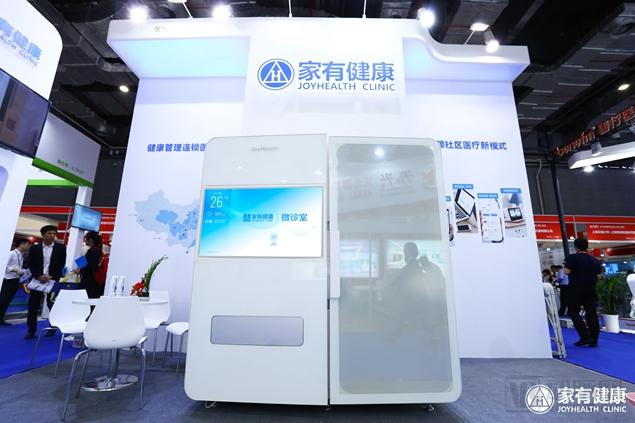
Home Health Micro-Clinic (Source: Provided by the company)
The micro-clinic consists of two parts: one side features a smart medicine cabinet stocked with over 100 types of medications for common diseases, while the other side is an unmanned consultation room. Patients can scan a QR code to enter, undergo tests based on their own needs or as recommended by physicians, and consult with online doctors.
"Treating minor illnesses within the community is one of the fundamental requirements of the tiered diagnosis and treatment system. In addition to basic consultations and prescription services, community clinics must offer a range of essential diagnostic tests. For common conditions such as chronic diseases, colds, and fever, basic indicator testing is indispensable."
The Home Health Micro-Clinic offers a comprehensive suite of services, including height and weight measurement, body fat analysis, temperature monitoring, blood pressure measurement, blood oxygen saturation testing, electrocardiogram (ECG) recording, skin assessment, and oral examination. Innovatively equipped with a remote auscultation module, the micro-clinic connects patients to more than ten physicians at Home Health’s physical clinics. Through online auscultation, doctors can assess conditions and issue prescriptions. Patients can then pay for their medications via mobile devices and collect them from the medication cabinet located on the left side of the micro-clinic.
In addition to services such as medication purchase, medical consultations, and skin analysis, basic health indicator measurements—including blood pressure, heart rate, and body fat—are provided free of charge. With the exception of electrocardiogram (ECG) and skin analysis, which must be conducted under the guidance of a physician, all other measurements can be performed independently by users. Furthermore, to attract traffic, skin analysis is offered at a nominal fee of just one yuan.
In December 2018, the first-generation Jia You Health Micro-Clinic was officially launched, with pilot deployments within a 3–5 kilometer radius of clinics across various settings, including enterprises, residential communities, business districts, and commercial streets. Following the collaborative development and pilot deployment of the first generation, the second-generation Micro-Clinic was independently developed to deliver a more refined user experience.
A relevant executive from Jiayou Health shared several details with us. For instance, in version 1.0 of the Micro-Consultation Room, the medication jamming rate was approximately 15%, resulting in a very poor user experience. In response to customer feedback, the company’s self-developed second-generation product adopted a more efficient and rational track-based medication delivery system, which effectively reduced the medication jamming rate.
Furthermore, the exterior design incorporates advanced smart materials capable of chromatic adaptation based on specific conditions. The consultation room environment and ventilation systems are configured to align with the behavioral habits of modern populations.
He emphasized, “It is the gradual integration of these details that creates the unique experiential effect of the Micro-Clinic.”
Initially, the goal was simply to provide community residents with more convenient health management and medical consultation options. The original concept behind “Jiayou Health” was to transform micro-clinics into “unmanned health kiosks,” thereby expanding the service radius of the clinics and directing patients to these facilities, thus creating a “traffic gateway” for community-based medical services.
This model has long been established abroad, where free or low-cost services are used to convert foot traffic into a customer base. VCBeat once reported on a health management company named higi, which is headquartered in Chicago and was founded in 2012. Its core business involves deploying kiosk-like health terminals in retail pharmacies and train stations, with retail pharmacies being the preferred locations. These terminals provide the public with free screenings for blood pressure, weight, pulse, and Body Mass Index (BMI).
This new model is akin to the concept of shared medical services, deploying testing devices in high-traffic areas—particularly retail pharmacies with a concentrated base of target users—to enable self-testing for health assessment, while partnering with local healthcare providers to deliver follow-up health services.
Notably, smart products such as unmanned consultation rooms and automated medication dispensers have also emerged in China’s healthcare market, addressing accessibility issues in medical services.
Relevant executives believe that the advantage of Jia You Jian Kang lies in its integrated resources. This integration goes beyond merely combining multiple testing modules into a single physical product. In terms of post-test medical services, patients can engage in remote consultations by directly communicating with on-duty physicians at Jia You Jian Kang clinics through micro-clinics. At the brick-and-mortar level, Jia You Jian Kang operates four clinics, all of which can directly accommodate patients who have booked appointments via the micro-clinics.
In the health tech sector, Jia You Jian Kang’s smart product matrix includes patient-facing devices such as WeChat mini-programs, wearable devices, home health robots, and unmanned micro-clinics, as well as standardized IT products—namely, the HIS system independently developed by Jia You Jian Kang. This matrix supports Jia You Jian Kang’s concept of the “New Clinic.”
In fact, for real estate developers, amid increasingly fierce competition in the housing market, intelligent service amenities have become a key factor enabling many residential projects to evolve into high-quality living communities. Healthcare and education are essential needs within living environments. Relevant executives emphasized that by leveraging Home Health’s standardized services and its distinctive focus on preventive medicine, complemented by a comprehensive portfolio of technology-enabled medical products, Home Health will ultimately transition from providing real estate healthcare support solutions to building smart communities.