

Alibaba Health's 2019 Financial Report: E-commerce Dominates Revenue, Consumer Healthcare Expands Rapidly

AliHealth
Medical and Health Services Network Service Provider
On May 16, AliHealth, which integrates pharmaceutical e-commerce, consumer healthcare, internet healthcare, and smart healthcare services, released its fiscal year 2019 financial report. The company reported annual revenue of RMB 5.096 billion, a year-on-year increase of 108.6%; gross profit reached RMB 1.331 billion, up 103.9% year on year. After deducting share-based compensation expenses, the net profit amounted to RMB 122 million.
VCBeat (WeChat ID: vcbeat) analyzed AliHealth’s annual report, examining the company’s development trajectory through the performance of its various business segments.
As is well known, AliHealth has always been the implementation and practice platform for Alibaba Group’s “Double H Strategy” (Happiness & Health) in the broader healthcare sector, attracting significant attention since its establishment. Within the large commercial ecosystem built by Alibaba, AliHealth plays the role of providing “Internet + Healthcare” service solutions to 1.4 billion Chinese people.
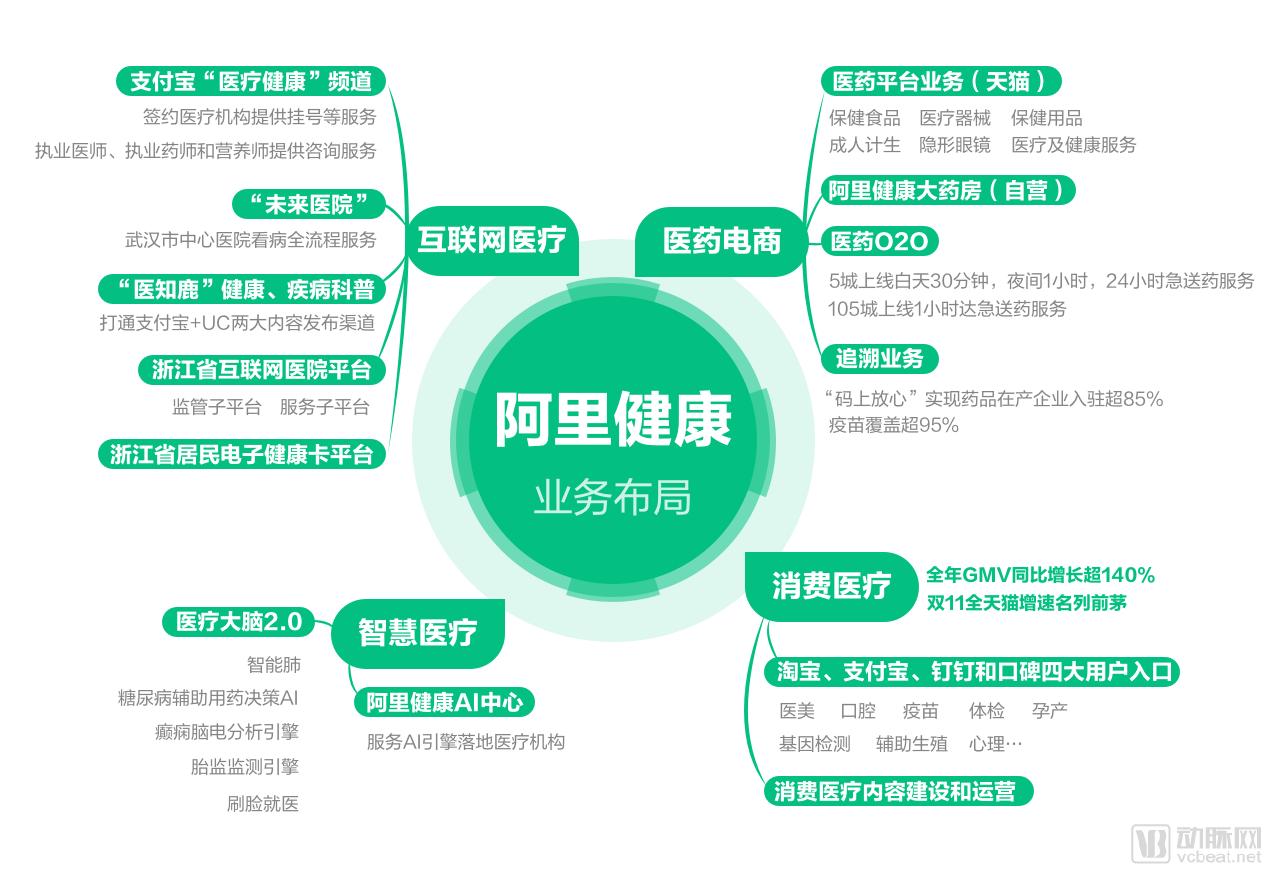
Since its establishment, AliHealth has entered its fifth year of deep cultivation in the internet healthcare sector. Evolving from solely operating China’s electronic drug supervision code system to building a comprehensive internet health platform, AliHealth has formed four core business lines—pharmaceutical e-commerce, smart healthcare, internet-based medical services, and consumer healthcare—fostering its own ecosystem.
According to industry insiders, Alibaba’s current initiatives in the vertical healthcare and pharmaceutical sector are all led and driven by AliHealth, which collaborates with Taobao Mobile, Alibaba Cloud, DingTalk, and Ant Financial to leverage their respective strengths. For instance, Alipay utilizes its advantages in the payment sector to handle patients’ needs for in-hospital medical insurance payments and facial recognition payments; Alibaba Cloud is responsible for building the underlying platforms and infrastructure for the healthcare industry; DingTalk provides smart hospital management tools and serves as the enterprise user entry point; while AliHealth builds the platform and extends application scenarios, facilitating organic integration among all parties.
Overview of Medical Services on Alibaba-affiliated Platforms
Financial report data reveals the revenue breakdown of AliHealth’s various business segments. In fiscal year 2019, with total revenue reaching RMB 5.096 billion, the self-operated pharmaceutical business accounted for 82.9% of revenue, while the pharmaceutical e-commerce platform business contributed 13.5%, together comprising 96.4%. This indicates that the pharmaceutical e-commerce business serves as the primary pillar of AliHealth’s revenue.
In addition, we noted that AliHealth’s consumer healthcare business experienced rapid growth, with a growth rate of 275.5%, reaching RMB 128 million in revenue for fiscal year 2019.
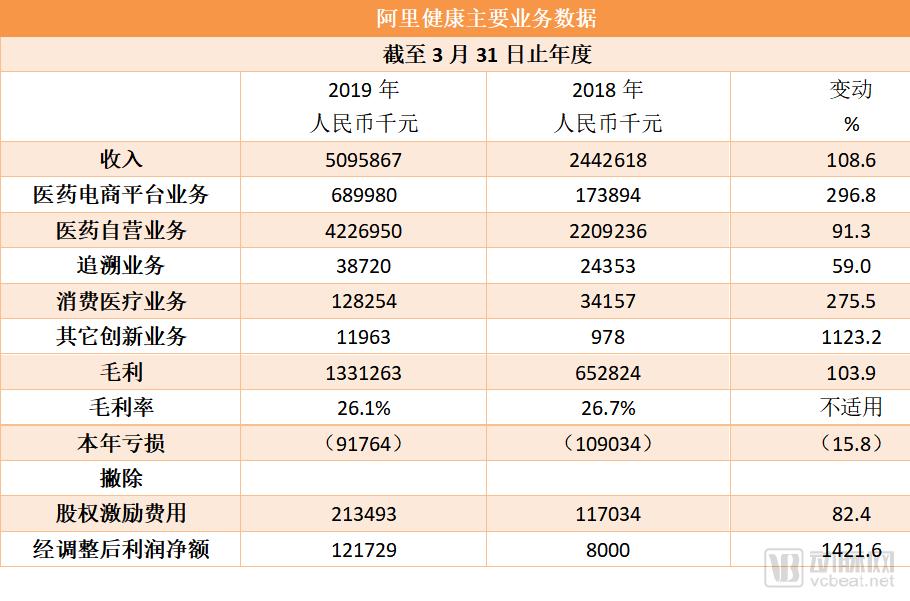
Data Source: AliHealth Financial Report
Next, we will analyze the development of AliHealth's various business segments one by one.
Pharmaceutical E-commerce
According to AliHealth’s latest performance announcement, the Gross Merchandise Volume (GMV) of Tmall Pharmacy reached approximately RMB 59.5 billion, with over 130 million annual active consumers, meaning that one in every ten people in China has used Tmall Pharmacy’s services. During the same period, the number of annual active consumers for AliHealth’s self-operated pharmacy, which has been in operation for less than three years since its launch, exceeded 27 million.
Whether evaluated by platform GMV, user scale, or activity levels, the pharmaceutical e-commerce platform operated by AliHealth has become the largest in China. While this achievement benefits from the traffic advantages of Taobao, Tmall, and Alipay, it also indirectly demonstrates AliHealth’s strong capabilities in supply chain management and membership management within its e-commerce business.
Directly linked to its e-commerce operations is the drug traceability business. Leveraging a decade of accumulated expertise in drug traceability, AliHealth independently developed and launched the “Ma Shang Fang Xin” traceability platform in 2014. In this year’s performance announcement, AliHealth explicitly stated its goal of building “China’s largest pharmaceutical cloud.” According to the financial report, over 85% of active drug manufacturers in China have joined and renewed their contracts with the “Ma Shang Fang Xin” platform, with coverage exceeding 95% for key categories under national priority, such as vaccines. This has established a technological barrier that competitors will find difficult to surpass in the short term.
Consumer Healthcare
Why is AliHealth focusing on the consumer healthcare sector across the entire life cycle? This is closely related to the vast market size of this sector. It is projected that in 2018, the total market size of China’s consumer healthcare industry—including medical aesthetics, dental care, health check-ups, vaccines, and maternal and child health—exceeded RMB 560 billion, and it will continue to maintain a compound annual growth rate of nearly 20% over the next five years.
AliHealth’s Consumer Healthcare Division, focusing primarily on localized medical aesthetics services and expanding into upgraded consumption demands such as health check-ups and dental care, achieved a year-on-year GMV growth of over 140% for its consumer healthcare business. During the 2018 Tmall Double 11 Shopping Festival, consumer healthcare emerged as one of the fastest-growing categories on Tmall. Meanwhile, AliHealth’s Consumer Healthcare Division leverages major entry points across Mobile Taobao, Koubei, DingTalk, and Alipay, enabling comprehensive coverage of C-end users and establishing a “super gateway” for consumer healthcare with substantial growth potential.
Consumer healthcare is one of the most market-oriented sectors within the medical industry, characterized by a substantial market size. However, due to historical factors and industry-specific attributes, this sector holds significant potential for transformation. AliHealth is committed to building an ecosystem for the consumer healthcare industry, reshaping the landscape of consumer-driven medical services on this foundation, and providing consumers with convenient, reliable, transparent, and localized professional medical services. Currently, participating merchants span multiple sectors, including medical aesthetics, health checkups, dentistry, vaccination, maternity care, reproductive health, and overseas medical services.
AliHealth has introduced international brands, including Allergan, Merck Sharp & Dohme (MSD), Invisalign, and GlaxoSmithKline (GSK), at the upstream supply level of the industry chain. At the service provider level, it partners with high-quality medical institutions and leverages an Online-to-Offline (O2O) model to drive the exploration of a new retail model that integrates online and offline operations. On the consumer end, it utilizes the various client platforms with vast and active user bases within Alibaba Group to provide consumers with a diverse range of products and services.
While promoting price transparency for goods and services, AliHealth also helps users access authoritative health information from relevant industries, thereby optimizing decision-making processes and enhancing the overall user experience across both online and offline touchpoints. Furthermore, AliHealth has launched the “Health Clinic” on DingTalk, providing corporate clients on the platform with medical and health services such as physical examinations.
Internet Healthcare
Data shows that in November last year, AliHealth became the exclusive operator of the healthcare services channel on Alipay. As of March 2019, the monthly active users of AliHealth’s healthcare services in hospital settings exceeded 12 million.
AliHealth has also strengthened its internet healthcare resources through regional collaborations. In September 2018, Zhejiang Bianque, jointly invested by AliHealth and Ant Financial, undertook the construction of the “Zhejiang Provincial Resident Electronic Health Card Platform.” As of April this year, more than 16 million electronic health cards had been issued, replacing physical cards to reduce non-clinical time during medical visits and lower healthcare costs.
In January 2019, the “Zhejiang Internet Healthcare Platform,” developed by “Zhejiang Bianque,” was launched, becoming China’s first internet healthcare platform (B2G2B2C) to integrate both regulatory and service capabilities. By April, more than 20 medical institutions, including Grade A tertiary hospitals, had joined the platform, with over 300 additional institutions applying for admission. The platform has become a model project for the National Health Commission, and its successful case is expected to be replicated in more regions.
What is the strategic intent behind AliHealth’s practices in the internet healthcare sector? In fact, current consumer spending on health by Chinese citizens extends far beyond the demand for “physical products” (such as pharmaceuticals and health supplements). With rising living standards, internet healthcare offerings represented by online appointment registration, payment and report retrieval, and remote video follow-up consultations have become urgently needed “service-based products.” Internet healthcare and smart healthcare can help improve the quality, supply, and efficiency of these service-based products. Currently, by building a platform for service-based offerings and effectively integrating its pharmaceutical product platform with its service trading platform, AliHealth is creating a more comprehensive user experience.
Smart Healthcare
Leveraging its strengths in big data, cloud computing, and artificial intelligence (AI), AliHealth continuously explores and expands within the smart healthcare sector. By actively collaborating with external entities such as government agencies, hospitals, and research institutions, it pioneers intelligent medical services grounded in informatization, AI, and big data technologies. Relevant areas include the Internet Medical Alliance, medical research platforms, scenario-based simulation platforms for medical education, clinical decision support systems, remote imaging platforms, and blockchain-based data security solutions.
Unlike other players in the medical AI sector who focus primarily on imaging recognition, AliHealth’s smart healthcare business covers a broader scope. Last September, AliHealth and Alibaba Cloud announced the joint development of the Alibaba Medical Brain 2.0, aiming to strengthen capabilities in image recognition, physiological signal recognition, and knowledge graph construction.
Disclosure information indicates that AliHealth’s Smart Healthcare division, after a period of exploration, has begun to adopt a more pragmatic approach by focusing on medical artificial intelligence systems with practical application scenarios. This is being achieved through the establishment of an AI Center to support implementation in healthcare institutions.
In March 2019, AliHealth developed an EEG-based epilepsy diagnostic product powered by deep learning models, which can significantly improve physicians’ efficiency in interpreting electroencephalograms. The product has gained recognition from leading domestic experts in the field and will be deployed in affiliated EEG centers and healthcare institutions.
Expanding the focus from AliHealth, it is evident that the “Internet + Healthcare” sector has seen a steady stream of developments since the beginning of the year:
On February 27, Ping An Good Doctor released its 2018 financial report, reporting revenue of RMB 3.338 billion, a year-on-year increase of 78.7%.
On May 2, So-Young listed on the U.S. stock market. Its revenue in 2018 was RMB 617 million, and its stock price surged by a maximum of 44.28% on the first day of trading.
On May 8, Tencent Security released the “Anxin Code” brand anti-counterfeiting solution, providing enterprises and consumers with brand security support such as counterfeiting crackdowns and authenticity verification.
On May 10, JD.com announced the integration of its pharmaceutical retail, pharmaceutical wholesale, internet healthcare, and Healthy Cities business units to establish “JD Health” as a subsidiary group, aiming to create its third “unicorn” following JD Digits and JD Logistics.
If 2014 was the inaugural year for the emergence and development of “Internet + Healthcare” in China, then 2019 marked the harvest year for “Internet + Healthcare” enterprises, primarily characterized by surging performance, initial public offerings (IPOs), and the implementation of innovations.
Having grown alongside the “Internet + Healthcare” industry, AliHealth has been in development for over five years, establishing a comprehensive service chain that integrates “online and offline” channels, “diagnosis/treatment and health” services, and “pharmaceuticals and health products.” This model aligns with the industry’s trends toward diversification and integration. Backed by the robust resources of the Alibaba ecosystem, as well as its own accumulated technological and operational capabilities, AliHealth is poised to once again lead the wave of innovation in the “Internet + Healthcare” sector.