

Wuzhen Internet Hospital Empowers Over 1,200 County Hospitals, Building a New Ecosystem for Primary Healthcare
In 2015, China’s first internet hospital—Wuzhen Internet Hospital—opened its doors. At the time, many people reacted to the concept of an “internet hospital” with skepticism and even ridicule; today, it has become a catalyst for the fission and growth of an entire new industry. This journey has been marked by both considerable hardships and the profound joy of success.
Today, the Wuzhen Internet Hospital has not only achieved large-scale connectivity between medical resources and platform users, with cumulative service visits exceeding 800 million, but also successfully expanded its B-side business. Positioned as an integrated platform for advanced diagnostic and therapeutic technologies in specialized fields and specific diseases, it serves as a demonstration, technology, and teaching base provided by WeDoctor to hospitals. Currently, it has partnered with more than 1,200 county-level hospitals, fostering a new ecosystem for primary healthcare.
So, how does Wuzhen Internet Hospital operate? At the Frontier Forum on Internet Hospitals held during the 2019 Primary Healthcare Summit hosted by VCBeat on May 15, Yang Jianchun, Executive Director of Wuzhen Internet Hospital, was interviewed.
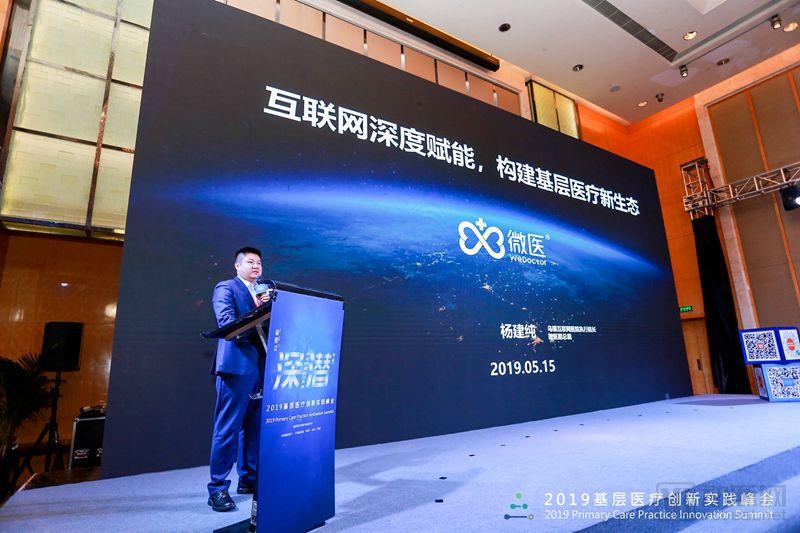 Yang Jianchun, Executive Dean of Wuzhen Internet Hospital
Yang Jianchun noted that in 2013, he visited several county-level hospitals where medical equipment was fairly advanced and 800–1,000 obstetric surgeries were performed annually. However, four years later, with the advancement of urbanization, an increasing number of people flocked to large cities and chose to give birth at tertiary Grade A hospitals, rendering the obstetrics departments in these county-level hospitals virtually defunct.
To address this situation, Yang Jianchun leveraged the Wuzhen Internet Hospital platform to establish dual online and offline channels, connecting top-tier tertiary hospitals and physician groups in first-tier cities with grassroots medical institutions, thereby channeling high-quality medical resources down to support county-level hospitals.
The cooperation content for supporting county-level hospitals basically includes four modules,First, to help county-level hospitals establish an integrated service network spanning the county, township, and village levels.By establishing a medical consortium system and providing supporting equipment and expert resources, real-time guidance and assistance are offered to doctors at village clinics or township health centers.
Second, it provides services in diagnostic and therapeutic technologies.The primary focus is on establishing disciplinary systems for weaker departments in hospitals. Physicians from tertiary hospitals mentor those at lower-tier hospitals through various methods, including on-site teaching, remote lectures, and online guidance, to enhance the competencies of grassroots physicians. Additionally, surgical simulation VR systems are employed to train surgeons in procedural steps and operational standards. Furthermore, via teleconsultation platforms established at grassroots hospitals, primary care physicians can initiate consultation requests to facilitate multidisciplinary expert consultations and provide guidance on treatment plans, enabling patients to access high-quality medical services comparable to those offered by major hospitals while remaining at the grassroots level.
In terms of expert resources, Wuzhen Internet Hospital boasts a network of 280,000 physicians and over 7,500 multidisciplinary expert teams. It has established specialized consultation centers led by 12 academicians from the Chinese Academy of Sciences and/or the Chinese Academy of Engineering, and has independently built seven major specialty physician groups. By fully leveraging these high-quality medical resources, the hospital transforms their professional expertise into standardized service products, fostering collaborative partnerships between its medical consortium system and hospitals across China. All data is integrated through a cloud-based Hospital Information System (HIS) as the core infrastructure, thereby maximizing temporal efficiency and value creation.
Third, establish standardized specialty departments.Standardized diagnosis and treatment protocols are compiled across dimensions such as system, anatomical site, surgical technique, surgical risk stratification, basic procedure type, approach, key steps, required equipment and consumables, staffing configuration, and estimated duration, serving as an operational guide for primary care medical personnel. Currently, these protocols cover 46 disease entities across specialties including ophthalmology, urology, general surgery, gynecology, and gastroenterology (including hepatology).
Fourth, the application of AI technology.Wuzhen Internet Hospital has leveraged platform data to optimize and develop AI systems, driving the standardization of specialized diagnosis and treatment for specific diseases. This initiative enhances the diagnostic and therapeutic capabilities of primary care hospitals, implements a tiered diagnosis and treatment system, and ensures that 90% of patients receive care within their county. In Inner Mongolia, a county-level hospital with previously insufficient ophthalmic care capabilities partnered with Wuzhen Internet Hospital. Within three months, its monthly volume of ophthalmic surgeries exceeded 100 cases, despite no upgrades to its medical equipment.
Taking the Xiangdong District Hospital of Traditional Chinese Medicine in Jiangxi Province as an example, the hospital hopes that, through collaboration, its core physicians will be able to independently manage certain acute and critically ill patients with relatively low risk.
Both parties have established clear collaborative objectives, with explicit stipulations regarding the surgical competency levels to be achieved by physicians at different tiers. In response to the specialized development needs in three key areas, Wuzhen Internet Hospital has dispatched three experts respectively. These experts conduct ward rounds during concentrated periods, participate in preoperative discussions, provide intraoperative guidance, and offer postoperative medication management and rehabilitation instruction.
In addition to providing technical mentorship, dispatched physicians also teach local doctors how to maintain patient communities in the internet era, utilize digital tools, and build their personal professional brands.
Yang Jianchun stated that, for county-level hospitals, the specialized development solution offered by Wuzhen Internet Hospital is the “1+X” model, where “1” refers to the internet hospital and “X” denotes medical specialties. Hospitals can tailor their approach by integrating either a single specialty or multiple specialties with the internet hospital platform, thereby achieving platform-based integrated operations across online and offline channels.
In rural China, home to a population of over 500 million, high-quality medical resources are extremely scarce. To address healthcare delivery at the grassroots level, Wuzhen Internet Hospital offers remote outpatient services to village doctors. By leveraging medical consortium equipment, it provides them with examination and consultation systems. The results are transmitted to specialists on the Wuzhen Internet Hospital cloud platform, who provide timely feedback on the findings, thereby assisting village doctors in making prompt and effective diagnoses.
In addition, Yang Jianchun introduced that they also provide a family doctor contract service system in rural areas. By leveraging cloud platforms and mobile cloud clinic vehicles, they effectively implement the “contracting” and “service delivery” aspects of family doctor care. This is primarily achieved through collaboration with local governments, which purchase these services to establish the family doctor contract service system. The mobile cloud clinic vehicles travel to grassroots communities to conduct health examinations for residents. By scanning identity cards to generate QR codes, all test and examination data—except for X-rays—are automatically transmitted to the cloud platform without requiring manual entry by physicians. All contracted services and related data within the region are clearly displayed on the platform, enabling local governments to monitor in real time the health status, contracting rates, and service delivery of their jurisdiction’s population. This approach fundamentally resolves the issue of “contracts without actual services,” ensures the effective implementation of public welfare policies, and significantly enhances residents’ sense of benefit and satisfaction.
In rural areas of Henan, Shandong, and other provinces, cloud-based mobile clinic vehicles drive into villages, and long queues form as soon as the doors open. Equipped with ultrasound machines, biochemical analyzers, urinalysis devices, and other equipment, these vehicles can deliver health screening services covering 7 major categories and 49 specific items. They fully meet the requirements of basic public health services, effectively bringing the diagnostic and testing capabilities of a secondary hospital onto wheels.
This model was first implemented in Jia County, Henan Province. Last November, the Leading Group for Deepening the Reform of the Medical and Healthcare System under the State Council issued a special briefing to promote the “Jia County Model” nationwide, commending WeDoctor for “weaving a robust network, building a solid platform, leveraging a key link, and operating an effective vehicle.”
Currently, there are over 300 cloud-based mobile clinic vehicles in operation, with a plan to add 3,000 more this year, covering a population of nearly 100 million. This represents a new model for primary healthcare, wherein WeDoctor leverages its internet hospital framework to explore an internet-based medical consortium system. By integrating an internet-based specialized disease diagnosis and treatment system with a single mobile clinic vehicle serving rural areas, it establishes a new service model tailored for healthcare institutions.
From rural areas to county-level cities, and then to major metropolitan centers, WeDoctor has leveraged technology to build a new internet-based tiered diagnosis and treatment system. This enables both urban and rural populations to benefit from advances in medical technology, helping diverse user groups gradually shift from a “healthcare-centered” model to a “health-centered” approach.