

CWI and Xuanwu Hospital of Capital Medical University Forge Strategic Partnership in Lifestyle Medicine
According to the Report on Cardiovascular Diseases 2017, cardiovascular and cerebrovascular diseases currently rank as the leading cause of death among both urban and rural residents in China. This indicates that the social and economic burden attributable to these conditions is increasingly severe, making them a major public health issue that demands urgent attention. In the Outline of the “Healthy China 2030” Plan issued by the Central Committee of the Communist Party of China and the State Council in 2016, it was explicitly stated that efforts should begin with “the most widespread determinants of health” to achieve “comprehensive, full-lifecycle protection of people’s health.”
Nowadays, with the improvement of living standards and the awakening of public health awareness, people have gradually come to realize that improper lifestyles are the main triggers for various chronic diseases. How to strengthen disease prevention and health management through lifestyle medicine has become an urgent issue for the healthcare system to address, as well as a key direction for the future development of medical and health institutions at all levels.
In response to the national call, Xuanwu Hospital, as a leading institution in the diagnosis and treatment of cardiovascular and cerebrovascular diseases in China, has long been committed to a disease management model that integrates prevention with treatment, while actively collaborating with advanced medical institutions and research institutes both domestically and internationally. The experience and model of Seven Oaks General Hospital, a top-ranked hospital in North America, in using lifestyle medicine as the basis for intervening in and treating chronic diseases align closely with the development philosophy and direction of Xuanwu Hospital. Meanwhile, Xuanwu Hospital’s ischemic preconditioning technology has gained recognition and recommendation from the Center for Innovation in Chronic Care at Seven Oaks General Hospital, providing a valuable opportunity for collaboration to promote Xuanwu Hospital’s advanced clinical techniques and translational research on the global stage.
Building on this foundation, the “Signing Ceremony between Xuanwu Hospital of Capital Medical University and the Canadian Health Management Center & Academic Forum on the Translation of Ischemic Preconditioning Technology Achievements,” co-hosted by Xuanwu Hospital of Capital Medical University and the Canadian Health Management Center, was held on May 17 in the lecture hall of the China National Institute of Neuroscience at Xuanwu Hospital. This event marked a significant step by Xuanwu Hospital to support the National Million Disability Reduction Initiative, aiming to reduce the incidence, recurrence, and mortality rates of cardiovascular and cerebrovascular diseases, and to better extend the benefits of ischemic preconditioning technology and lifestyle medicine-based health management models to the Chinese population.
On that day, Ms. Carrie, President of Seven Oaks General Hospital in Canada and Global CEO of the Canadian Wellness Institute (“CWI”), and Professor Ji Xunming, Vice President of Xuanwu Hospital of Capital Medical University, attended the conference and signed a comprehensive strategic cooperation agreement on behalf of both parties. In the future, the two sides will engage in all-around cooperation in clinical research related to lifestyle medicine, discipline construction, training, and translation of achievements.
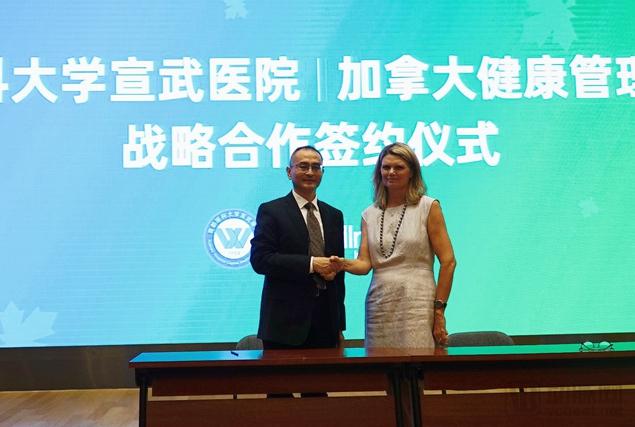
From left: Ms. Carrie, President of Seven Oaks General Hospital in Canada and Global CEO of the Canadian Health Management Center,
Professor Ji Xunming, Vice President of Xuanwu Hospital, Capital Medical University
Meanwhile, at this conference, experts and medical technicians from Xuanwu Hospital of Capital Medical University and CWI engaged in in-depth discussions on the translational achievements of ischemic preconditioning technology, as well as its application in the intervention and rehabilitation of various chronic diseases. Additionally, Ms. Carrie delivered a speech titled “Latest Advances in Lifestyle Medicine Research.”
CWI leverages advanced medical fitness facilities, an interdisciplinary team, a research foundation grounded in evidence-based medicine, and scientifically rigorous health assessment and risk screening processes to develop personalized lifestyle medicine prescriptions for healthy individuals, those in a sub-health state, and patients with chronic diseases. Its outstanding efficacy in the prevention and intervention management of chronic conditions such as hypertension and diabetes has earned global acclaim.
The CWI model emphasizes systematic lifestyle medicine services that span the entire life cycle, providing personalized, continuous intervention and management for the general population across multiple dimensions, including exercise, nutrition, stress, sleep, and psychology. Since its debut in China in 2014, the CWI model has garnered extensive attention and recognition from both academic and industry circles, and has established close collaborative relationships with relevant domestic industry associations, medical institutions, enterprises, and research institutes.
In March 2018, the Canada Wellness Institute (China) was officially established through a joint venture between CWI and Miao Jiankang, a pioneering brand in online health management. Building upon CWI’s existing model, the center developed a digital health management platform centered on lifestyle medicine intervention programs. By integrating CWI’s extensive offline clinical expertise with Miao Jiankang’s internet-based health management capabilities, the platform combines health behavior data, lifestyle medicine-based health management, and artificial intelligence to explore innovative models of health management.
CWI (China) plans to operate 400 offline lifestyle medicine centers across China in the future, with the first one scheduled to open in Beijing this May. Currently, Miao Health has accumulated over 60 million users. The strong partnership between the Chinese and Canadian parties will provide high-quality and efficient chronic disease management and rehabilitation services to more people in China.
This strategic partnership with Xuanwu Hospital has laid a solid foundation for localization and academic support for CWI’s development in China. In the future, by joining hands with leading medical institutions represented by Xuanwu Hospital, CWI (China) will continue to meet the growing and upgrading demand for health management services among Chinese residents, while exploring ways to enhance the disciplinary capabilities of domestic medical institutions in areas such as chronic disease rehabilitation. This effort aims to support the government-led healthcare system reform shifting from a disease-centered to a health-centered model, and to strive continuously toward achieving the strategic objectives outlined in China’s “Healthy China 2030” Planning Outline.