

Tongxin Medical Alliance Files IPO Prospectus: Pioneering Healthcare Innovation Through Complex Coordination Inspired by Peter Thiel’s 'Zero to One'

Sophmind
Internet Medical Examination Platform
The positioning of medical innovation enterprises has always been ambiguous. People are accustomed to defining them simply as technology- or service-oriented, or as asset-light versus asset-heavy companies, based on a binary framework. However, for some companies, such definitions are inaccurate.
If you have read Zero to One, you are likely familiar with its author, Peter Thiel. In fact, compared to that startup-focused book, the model of corporate monopoly proposed by Peter Thiel is even more worthy of contemplation. This is—Complex Coordination.
By definition, if startups can engage with various stakeholders such as engineers and regulators, effectively integrate diverse cross-boundary resources, and operate in the right manner, they can generate a new “product” known as “complexity collaboration.”
For example, the iPhone did not require any major technological breakthroughs in its individual components; however, Apple successfully integrated various elements—such as hardware, the operating system, and the App Store—to establish a new value chain, thereby achieving success.
In China, Tongxin Yilian, an internet healthcare company, has not only attracted investment from prominent firms such as Legend Star, Junlian Capital, Matrix Partners China, and CICC Capital through its unique approach to complex collaboration, but has also become one of the few self-sustaining enterprises in the domestic medical innovation industry.
How Does Sophmind Build Complex Collaboration?
The figure below presents a coordinate-based visualization of the company’s business model by Liu Weiqi, CEO of Sophmind.
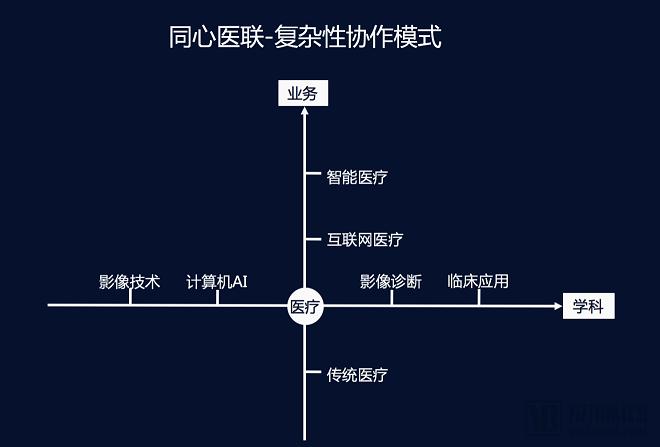
As shown in the figure, Sophmind’s complex collaborative model vertically spans traditional healthcare, internet-based healthcare, and intelligent healthcare. The horizontal axis is anchored in medical imaging, integrating imaging technologies with AI to cover radiology as well as clinical specialties such as surgery, neurology, and cardiology, thereby achieving interdisciplinary integration.
According to Liu Weiqi, they did not initially plan to engage in complex collaboration; rather, it gradually evolved through a process of trial and error and summarization during their development.
In May 2014, Sophmind was officially established. At that time, Sophmind primarily focused on chronic disease follow-up management. The hospital departments sought to consolidate patient medical records to both support scientific research and facilitate patient management during follow-ups. To address this need, Sophmind developed a mobile app and a web-based platform to help physicians connect with their patients.
However, during implementation, Liu Weiqi discovered that services meeting the requirements for medical prognosis management often conflicted with patients’ lifestyle habits, making them difficult to implement effectively. Consequently, in 2015, Tongxin Medical Alliance developed an imaging sharing and examination platform tailored to the clinical needs of hospitals.
At the time, his idea was to identify hospitals with underutilized resources and help them make better use of their idle imaging equipment. On the other hand, it would connect doctors and patients in need with these resources. Sophmind serves all three parties.
However, Liu Weiqi soon discovered that the biggest challenge in healthcare was not simply leveraging the internet for basic connectivity, but rather a severe shortage of qualified supply-side resources. Consequently, although Tongxin Medical Alliance referred numerous patients to hospitals at the time, some hospitals, due to insufficient capacity, were even unwilling to accept them.
Throughout the service process, Sophmind, as an intermediary with limited control, easily turned into a loss-making, cash-burning venture. Although it received revenue shares from hospitals at the time, these were insufficient to cover the overall operational costs.
In summary, Liu Weiqi believes that any business model failing to effectively improve the supply side of healthcare has no future within the medical system. In contrast, emerging services and technologies, such as third-party imaging centers and AI, can truly and effectively address supply-side challenges.
However, the preliminary efforts of Sophmind were not in vain. During this process, the company honed its team’s ability to effectively identify core medical needs and built capabilities to serve both physicians and patients. In Liu Weiqi’s recollection, these constitute the foundation for managing complex collaborations.
In 2016, Tongxin Medical Alliance invested in offline heavy assets by purchasing equipment, establishing imaging departments, and building its own teams of physicians, technicians, and nurses.
On the other hand, Sophmind has developed an imaging cloud platform. It integrates all hospital imaging data onto the cloud, covering appointment scheduling, examinations, diagnosis, report delivery, and remote consultations.
Patients from anywhere in China can undergo examinations, with Sophmind Medical Alliance employing centralized diagnostics by storing medical records on a cloud platform. Radiologists from top-tier (Grade 3A) hospitals in Beijing then perform the diagnosis and release the results.
To date, Sophmind has established eight self-operated imaging centers in first-tier cities and partnered with over 300 imaging centers. The company’s years of expertise in cloud-based imaging, medical data cloud storage, and intelligent healthcare have enabled it to accumulate a wealth of high-quality medical resources both domestically and internationally.
The Ultimate Synthesis of Complex Collaboration: The Tech-Medical Platform and the Gewu System
The online management of medical records, centralized diagnosis, and interoperability, combined with the operation of offline physical radiology departments, have enabled Sophmind Medical Alliance to hone its capabilities in market acquisition, department establishment, and operational management. With all these elements in place, the value of complex collaboration has naturally emerged.
Seizing this opportunity, Sophmind has integrated all of its business operations to launch a comprehensive tech-driven healthcare platform tailored for patients with major and chronic diseases, such as cardiovascular and cerebrovascular conditions and cancer.
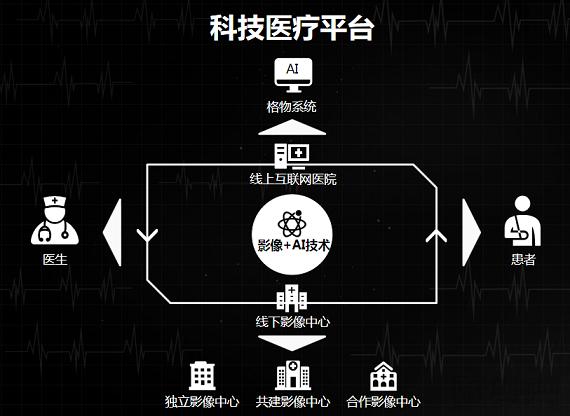
Across the entire platform, Tongxin Yilian leverages the imaging center’s advantage of direct engagement with physicians and patients to deliver differentiated services and expand into additional service scenarios. By integrating third-party imaging centers with internet hospitals, focusing on specific disease types, and addressing clinical needs, the company utilizes advanced AI-powered imaging technology to design specialized examination packages and provide tailored diagnostic and treatment solutions.
As shown in the figure above, internet hospitals and offline imaging centers serve as carriers and entry points, enabling doctors and patients to access the service system through online and offline scenarios, thereby enjoying the high-quality, premium services provided by Tongxin Medical Alliance. It is precisely this model of complex collaboration that makes Tongxin Medical Alliance unique both domestically and internationally, with no comparable counterparts.
Nowadays, patient volumes at public hospitals are gradually reaching saturation. Although the number of private hospitals has become significant, their capacity is not yet sufficient to shoulder the responsibility of diverting patient flow. The visible trend suggests that by 2030, China’s healthcare structure will undergo fundamental changes, with approximately 50% of patients expected to shift to the private healthcare system.
For enterprises, how to accommodate this patient population is a critical issue that must be addressed. In Liu Weiqi’s view, the complex collaboration model of Sophmind represents the optimal development direction, serving as the best alternative to both asset-light internet healthcare models and asset-heavy chain clinics and hospitals.
He believes that, at present, the core of healthcare and its application scenarios in China are fundamentally embedded within the public, non-market-oriented, welfare-based system. Only by possessing end-to-end control capabilities can enterprises successfully implement their solutions within this system. With a framework for complex collaboration established, Sophmind can go further to explore the concept of open and win-win cooperation, which embodies the philosophy of the “Gewu System.”
“Being large and all-encompassing is by no means the mission or goal of Tongxin Medical Alliance; creating a closed-loop service ecosystem is what truly matters. The ‘Gewu System’ is not merely a data connectivity medium, but rather a reliable and continuously evolving AI software platform and data center. By integrating with internet hospitals and third-party imaging centers, Tongxin Medical Alliance can leverage the ‘Gewu System’ to build a medical ecosystem that combines high-quality medical resources with artificial intelligence applications,” said Liu Weiqi.
Characteristics of Complex Collaboration
What are the characteristics of complex collaboration compared to non-complex collaboration?
First, there is the aggregative nature of the service. Unlike tangible products such as Apple’s iPhone, Tongxin Medical Alliance represents an integration of healthcare services; it is not a concrete, visualizable product but rather a service experience.
For example, internet hospitals—encompassing mobile apps, websites, and mini-programs—integrate a wide range of medical services, such as appointment scheduling, laboratory testing, diagnostic examinations, and consultations. Underpinning these platforms are diverse medical resources. In other words, complex collaboration does not mean that Sophmind handles every aspect of care; rather, it aims to enhance patient experience across different stages, including pre-consultation, during consultation, and post-consultation. It functions more as an aggregator of healthcare services.
Another characteristic of complex collaboration is openness. In other words, when enterprises engage in complex collaboration, they should ideally design and build any components that lack sufficient market competition themselves.
Take Tesla, the electric vehicle company founded by Elon Musk, as an example. Musk’s philosophy is that if a particular automotive component has only one supplier, he will opt to build in-house production capacity rather than purchase the part from that sole-source supplier. This is because a monopoly held by an exclusive supplier would leave Tesla without bargaining power, placing it in a highly disadvantaged position in procurement.
Therefore, companies should collaborate with external suppliers in areas where there is sufficient competition among them, leveraging such competition to drive down prices. Adhering to this business philosophy, Tesla manufactures a large number of components in-house. To support this, the company has established an extensive manufacturing supply chain, continuously improving its products and production capabilities. Once a company effectively integrates various resources and establishes complex collaborative systems, its impact on the world will be profound.
This point also applies to Sophmind. The imaging centers established through Sophmind’s partnerships initially avoided heavy asset investment in equipment, instead leveraging and sharing idle resources within hospitals. However, due to the current state of hospital operational management systems, it has been difficult for the company to maintain effective control. This challenge became the primary motivation for Sophmind to independently build its own third-party imaging centers.
Within the technology-driven healthcare platform built by Tongxin Medical Alliance, certain core components are difficult to outsource. Taking information-intensive services such as Imaging Cloud and Internet Hospitals as examples, these involve vast amounts of patient data that reflect sensitive personal privacy. In the event of medical record loss or patient data breaches, the enterprise would face significant liability and medical ethics issues. Therefore, Tongxin Medical Alliance cannot reliably outsource such services and must choose to develop them in-house.
Fortunately, Sophmind Medical Consortium, which operates with a hybrid model of both asset-heavy and asset-light components, has now generated sufficient revenue to achieve self-sustainability. Compared to projects that merely burn cash, Sophmind Medical Consortium, underpinned by a complex collaborative system, appears to be on a more steady and solid path.
When evaluating complex collaboration, Peter Thiel noted that establishing such collaboration requires startups to invest significant time and possess strong capabilities, creating high barriers to entry that competitors cannot easily replicate in the short term. This is a way to achieve monopoly power, which had previously been overlooked by investors.
Sophmind also faces such barriers. By integrating asset-light and asset-heavy models, achieving vertical industry coverage, and penetrating horizontally across medical departments, Sophmind has built a service closed loop characterized by “clinical orientation, cross-boundary integration, and open, win-win collaboration” within just a few years. However, neither its form nor its business model is the primary focus for Sophmind. “Enterprises should delve into the core needs of healthcare; driven by these requirements, your organizational form will naturally evolve accordingly,” said Liu Weiqi.