

Tencent Medpedia Unveils AI-Powered Smart Q&A Assistant and 3D Visualizations to Humanize Medical Education

Tencent
Internet Comprehensive Service Provider
What Changes Will the Integration of Innovative Technology and Medical Science Popularization Bring? From May 21 to 23, the Tencent Global Digital Ecosystem Summit was held in Kunming, Yunnan Province. At the Smart Healthcare session, Tencent Medipedia officially unveiled two pioneering initiatives in the field of medical science popularization: an intelligent Q&A assistant that leverages a systematic medical knowledge graph and deep semantic analysis to meet the precise and personalized information needs of patients and their families; and 3D visualization displays that make complex, specialized medical knowledge more accessible and tangible, thereby improving communication efficiency between doctors and patients and infusing warmth into science popularization through technological innovation.
In recent years, the rapid proliferation of the internet has provided fertile ground for the development of medical science popularization, making it an effective supplement to the front-end segments of the broader healthcare system. A survey by Penguin Intelligence shows that 39% of users first search online when they fall ill. Meanwhile, after progressing through two phases—debunking common myths and providing superficial information on common diseases—medical science popularization is now entering “deep waters,” extending toward systematic, in-depth education on critical and rare diseases.

Tong Jing, Director of Tencent’s Medical Information Product Center, Shares On-Site: Empowering the Construction of a Smart Medical Science Popularization System
“We have found that although users have a strong demand for learning and understanding medical information, cognitive barriers make it difficult for them to efficiently obtain the popular science knowledge they seek through existing search interfaces,” said Tong Jing, Director of Tencent’s Medical Information Product Center, at the Tencent Global Digital Ecosystem Summit. “On one hand, many users are unable to accurately and specifically describe the problems they encounter. On the other hand, most existing search platforms rely on keyword matching and lack the ability to judge users’ true intent, leading to frequent instances of irrelevant answers. For example, when a user asks ‘what to do’ in a certain situation, the search results often provide information on ‘what is happening’ instead.”
To bridge the “last mile” in users’ access to medical information, the Tencent Medical Dictionary team began exploring the application of artificial intelligence (AI) technologies to medical science popularization and has launched intelligent Q&A assistants for lung cancer and breast cancer. “The development of the intelligent Q&A assistant primarily consists of two components: first, building a medical Q&A knowledge base based on deep semantic analysis and information extraction technologies; second, leveraging natural language processing and deep learning techniques to accurately identify user intent, guide users to provide additional relevant information through follow-up questions, and deliver precise answers,” introduced Tong Jing.
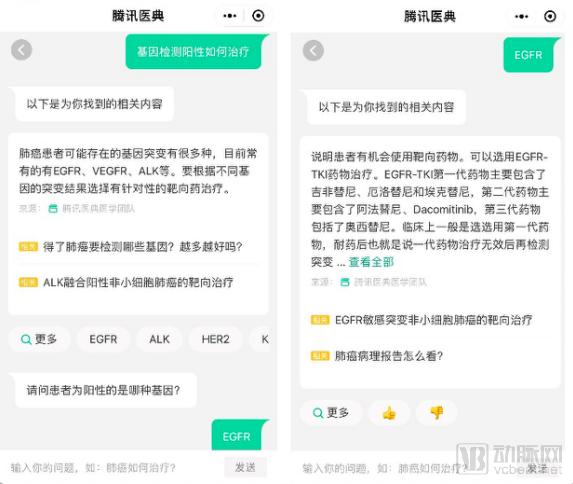
Tencent Medical Encyclopedia Intelligent Q&A Assistant Interface
For example, on the lung cancer topic page, when a user asks, “How should positive genetic test results be treated?” the intelligent Q&A assistant provides information on types of gene mutations in lung cancer patients and further prompts, “Which specific gene tested positive?” It then delivers a tailored response based on the patient’s reply. Additionally, the assistant includes highly relevant content related to the user’s query in its response, significantly improving the efficiency of information retrieval for users.

Tong Jing also noted that behind the intelligent Q&A assistant’s ability to meet users’ personalized information needs lies Tencent Medpedia’s extensive and systematic accumulation of medical knowledge. Since its inception, Tencent Medpedia has established a strategic focus on delivering in-depth, professional science-based content on diseases, differentiating itself from general public health information platforms.
From AI-driven analysis of massive datasets and in-depth interviews with patients and physicians for content planning, to the aggregation of high-quality domestic and international medical resources for content production and multi-tier review, and further to continuous content iteration based on user feedback, Tencent Medical Dictionary has established a pathway for delivering professional health education across the entire disease lifecycle. Taking the oncology section of Tencent Medical Dictionary as an example, it currently covers 15 cancer types, including lung cancer, breast cancer, and cervical cancer, with more than 8,400 articles published in total, averaging over 500 articles per cancer type.
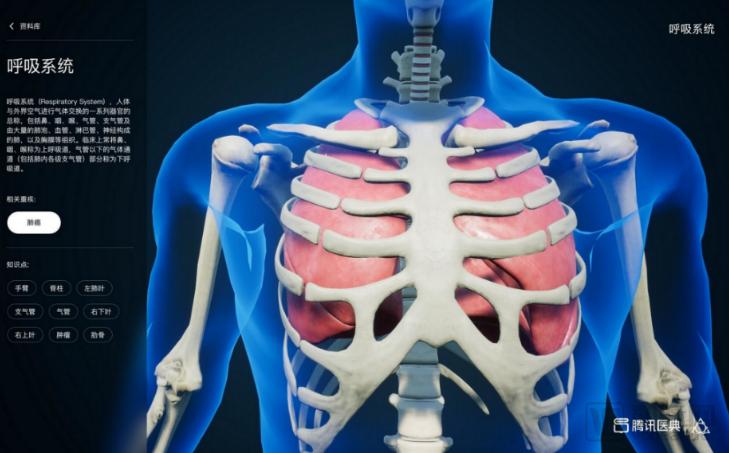
After reaching users, how to make complex disease knowledge more accessible and relatable has been a persistent question for the Tencent Medical Dictionary team. In addition to using illustrated formats such as comics and videos, and given the nature of medical knowledge, Tencent Medical Dictionary pioneered the application of 3D human visualization models for patient-oriented health education in China.
“During our interviews, one user mentioned that her doctor had recommended a breast biopsy, but she had no idea what it entailed. Hearing other patients describe it as terrifying—wondering what would be extracted and whether it would harm her body—she remained completely uninformed and thus too afraid to proceed,” said Tong Jing. “Consequently, our design team reflected on whether 3D visualization technology could be leveraged in the creation of medical illustrations and videos to help patients better understand the procedural principles and alleviate their concerns.”
According to Tong Jing, the 3D visualization technology developed by the team primarily features three levels of display: the macro level, showcasing the human body and internal organs; the micro level, detailing the interior of organs; and the molecular level, presenting cells and smaller components, supplemented by scene design and animated explanations. Currently, the device is mainly operated via client-side touchscreens and displayed on large screens. Future plans include integrating the technology into the Tencent Medical Dictionary product, as well as exploring cutting-edge technologies such as medical image reconstruction and surgical procedure simulation, to provide users with efficient, intuitive, and visual methods of information presentation.
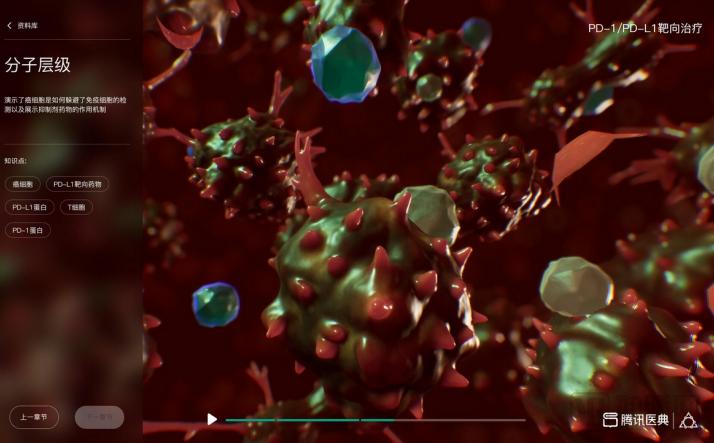
“The value of 3D visualization lies in connectivity. By rendering medical content visually, it bridges the gap between patients and physicians, enabling complex, specialized medical information to be viewed, understood, and even manipulated and simulated by a broader audience. This helps narrow the distance between the general public and abstruse medical knowledge. We hope to leverage technological innovation to infuse medical science communication with greater warmth, alleviate information asymmetry, and provide tangible comfort and assistance to patients and their families throughout the diagnosis and treatment process,” said Tong Jing.