

Tencent Deepens Healthcare Integration with 270 Million AI-Assisted Imaging Reads and 4.7 Million Intelligent Triage Services

Tencent
Internet Comprehensive Service Provider
“Over the past year, Tencent Medical Encyclopedia has covered 1,000 diseases; its AI triage system has been integrated into nearly 300 hospitals, delivering a cumulative total of 4.7 million precise triage services; in terms of supporting physicians and hospitals, AI-assisted imaging has helped doctors interpret 270 million scans, serving nearly 1.6 million patients and flagging 210,000 high-risk cases; AI-assisted diagnosis has analyzed over 8 million outpatient medical records, identifying 160,000 high-risk cases...”
In the region south of the colorful clouds, Ding Ke, Vice President of Tencent, summarized Tencent’s endeavors in the healthcare sector with a series of impressive figures, kicking off the healthcare track of the Tencent Global Ecosystem Conference.
By that time, Tencent’s healthcare ecosystem will have largely matured, comprising B-side services underpinned by internet infrastructure and C-side services leveraging Tencent Medical Encyclopedia to build brand influence. Artificial intelligence permeates both segments, driving simultaneous improvements in healthcare workflows.
So, what is driving Tencent’s continuous advancement in healthcare? Following the Tencent Global Ecosystem Conference, VCBeat sought to uncover the answers behind the numbers.
Guided by the principle of “convenience” and leveraging “connectivity” as its means, Tencent employs Internet thinking to integrate patients, doctors, and hospitals.
The electronic health card is a key component in establishing the patient-hospital relationship.
“Every time we visit a hospital, we are required to register for a hospital-specific medical card and receive a personalized medical record book. However, these cards are not interoperable across different hospitals. As we visit more hospitals, the number of medical cards and record books in our possession grows, making the healthcare experience increasingly frustrating,” sighed He Bo, General Manager of Tencent’s Medical Health Application Product Center. “Our colleagues in smart tourism have enabled travelers to explore Yunnan Province with just a smartphone. Could smart healthcare similarly achieve a ‘one-card-for-all’ solution for patients?”
In fact, the national government began addressing the issue of “public inconvenience” last year. On December 13, 2018, the General Office of the National Health Commission issued the “Opinions on Accelerating the Promotion and Application of Electronic Health Cards,” emphasizing the need to raise awareness of the importance of popularizing and applying electronic health cards. The document stated that promoting the use of electronic health cards helps resolve the bottleneck problem of “multiple hospitals issuing multiple non-interoperable cards,” facilitates real-name-based medical consultations, advances “Internet + Healthcare” services that are convenient and beneficial to the public, and promotes the aggregation, integration, open access, and sharing of health and medical big data.
In January this year, Tencent once again entered into a strategic partnership for innovative applications of the Electronic Health Card with the Statistical Information Center of the National Health Commission. He Bo stated that both parties will jointly establish an open platform for WeChat Electronic Health Cards. Tencent will provide residents with end-to-end services covering card registration, issuance, and usage, leveraging Tencent’s security assurance system to safeguard data. Ultimately, this initiative aims to link the national master patient index for electronic health records with WeChat IDs and hospital visit IDs, enabling residents to seek medical care across different hospitals using only a single Electronic Health Card.
Internet Hospital Solutions is another key area of focus for Tencent, which aims to support public hospitals in building their internet hospitals from the following two aspects.
The first is connectivity. For most users, healthcare is a low-frequency application scenario. For such low-frequency applications, it is necessary to consider how to connect users to the platform, thereby achieving user-platform engagement. Leveraging WeChat, which boasts 1.1 billion monthly active users, Tencent can rapidly reach its user base.
Regarding the implementation of connectivity, Tencent leveraged medical consortium blockchain technology to achieve interoperability of patient information; utilized Enterprise WeChat to facilitate information exchange between doctors and patients, as well as among healthcare providers; and employed WeChat Pay and WeChat Medical Insurance Payment to enable payment processing and medical insurance settlement for internet hospitals.
The second aspect is security. Doctors and patients verify their identities online via facial recognition to prevent impersonation by fake doctors or patients. Blockchain technology is employed during data transmission to ensure the security of patients’ medical records, examination results, prescriptions, and other data. In terms of information system construction, Tencent effectively safeguards the overall security of its systems through products such as Yudian, Yujie, and Yujian.
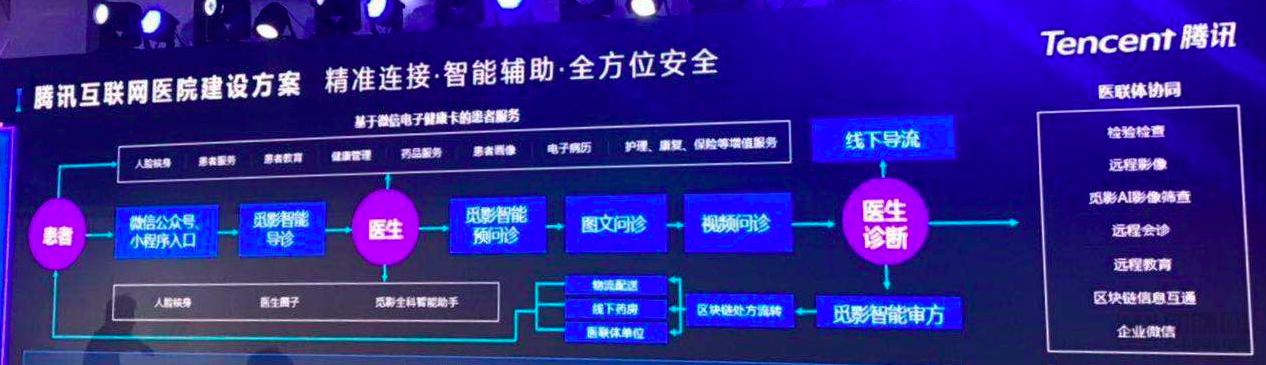
Tencent Internet Hospital Construction Plan
Furthermore, to promote the development of medical consortiums, Tencent is also leveraging AI technology to drive innovation within county-level medical communities. The most renowned example is the “Deqing Model” in Deqing County, Zhejiang Province—a new model pioneered by Tencent that prioritizes the health of local residents and uses healthcare insurance payment reform as a lever.
Deqing, located on the periphery of Shanghai and Hangzhou, faces a severe problem of patient outflow. How to retain patients locally and leverage the value of local medical resources is a difficult challenge for the government to address. There are two issues that need to be resolved: one is the flow of information between hospitals; the other is the quality of care in primary healthcare.
Driven by the proactive efforts of the Deqing County Government, the Deqing Medical Community was rapidly established. However, despite its formation, primary care institutions remained unable to access upstream resources, and patients continued to flock to the three major hospitals.
Artificial intelligence can address this pain point, with Tencent supporting Deqing County through its Imaging-Assisted Diagnostic System and Clinical Decision Support System. The Imaging-Assisted Diagnostic System covers CT, endoscopy, and mammography; the Clinical Decision Support System provides pre-consultation support forSelf-service triage for patients, assisted electronic medical record (EMR) entry during consultations with standardized clinical pathways, and post-consultation treatment recommendations for physicians.
Under this model, patients can undergo imaging examinations at local health stations. The imaging data is transmitted to the county-level imaging center, where experts interpret the results and send the reports back to the health stations. Through this process, patients no longer need to travel dozens of kilometers; they can receive their diagnostic reports close to home.
Meanwhile, Tencent has been continuously assisting doctors in Deqing County in learning AI-related technologies, enhancing primary healthcare resources, promoting the development of medical communities, and laying a solid foundation for medical consortia.
Within Tencent’s broader smart healthcare ecosystem, Tencent Yidian stands out as an “unusual” product. Viewed solely through an industrial lens, this consumer-facing, encyclopedia-style platform offers little apparent monetization potential. Yet when examined in the context of everyday life, it appears to be subtly reshaping the healthcare market in a non-commercial manner.
The heated debate over “996” some time ago reflects labor issues in Chinese society. Whether among highly educated internet professionals or grassroots food-delivery riders, working individuals find it extremely difficult to set aside time for proactive health management. By the time they seek medical care, their conditions have often progressed beyond their control.
Such healthcare-seeking habits have placed immense pressure on the national medical insurance payment system. By the time patients experience pain and seek to regain their health, substantial medical expenses become inevitable.
Relying solely on the state’s vigorous promotion of basic public health services can treat diseases but cannot address their root causes. Only when residents possess health awareness and are able to weigh the pros and cons of illness will passive healthcare-seeking behavior transform into proactive healthcare-seeking behavior.
Tencent Medical Encyclopedia serves to provide health education to residents.
This “mobile” encyclopedia, rooted in mobile apps and WeChat Mini Programs, perfectly aligns with modern lifestyles—offering countless ways to avoid hospital visits while allowing people to browse their phones during work breaks.
This effectively addresses the issue of information asymmetry. By using Tencent Yidian for inquiries, patients can compare their chief complaints and symptoms during intervals in their daily lives. Tencent Yidian not only leverages artificial intelligence to provide users with information correlation services but also offers reference recommendations to guide their next steps in decision-making.
On the other hand, if a user has already been diagnosed with a specific disease, they can use this encyclopedia to gain an in-depth understanding of their condition. This significantly facilitates communication between patients and physicians, as well as subsequent treatment and rehabilitation. By enhancing disease literacy, patients are empowered to manage their condition and actively participate in medical decision-making regarding their own care.
After reaching users, how to make complex disease knowledge more accessible and relatable has been a question the Tencent Medical Dictionary team has been contemplating. In addition to using text-and-image-rich formats such as comics and videos, Tencent Medical Dictionary, leveraging the unique characteristics of medical knowledge, pioneered in China the application of 3D human body visualization models for patient-oriented health education.
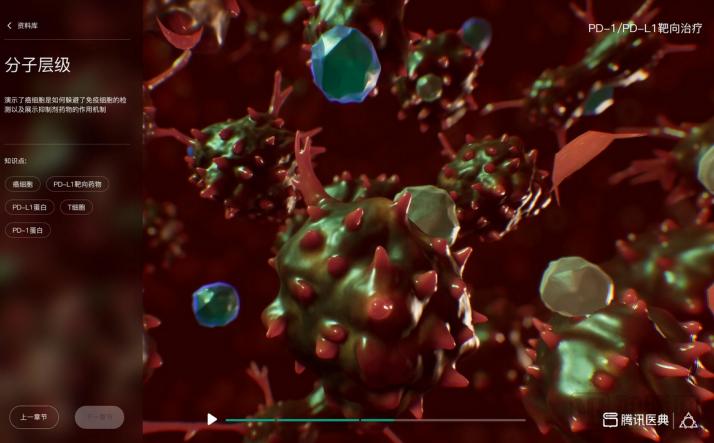
Image source: Tencent Medical Encyclopedia
As for why such a platform was created, Tencent has its own reasons.
Baidu’s paid-search ranking for medical services has made Tencent realize the importance of establishing a neutral, third-party platform for popularizing medical science. Tencent is committed to building a new, high-quality, and reliable medical science communication platform that is not driven by traffic or profit motives.
Therefore, Tencent places great emphasis on the promotion of Tencent Medical Dictionary, and its collaboration with Season 2 of "The Human World" reflects the warmth of Tencent Medical Dictionary.
“Medicine often comes across as cold and impersonal. Statistically, the incidence of bone tumors is three per million people. Yet for each affected family, the impact is not a mere three in a million, but 100 percent.” According to Zhang Meng, Vice President of Tencent Medical, early detection of any disease and the tangible experience of compassionate care during treatment can significantly improve individual survival rates and family quality of life—especially in cases of critical and rare diseases. How medical science communication can address these two challenges is the key to breaking through in the “deep waters” of healthcare education. This is precisely what Tencent Yidian aims to explore jointly through its collaboration with The Human World.
In addition to facilitating public access, Tencent has spared no effort in empowering hospitals with AI. Among the 100 global leaders in medical AI, only three are from China, two of whom are Fan Wei, Dean of Tencent’s Medical Artificial Intelligence Research Institute, and Zheng Yefeng, Director of Tencent Youtu Laboratory.
Tencent’s emphasis on medical technology is evident. In fact, Tencent’s three major AI institutions—the Tencent Medical Artificial Intelligence Research Institute, Tencent Youtu Laboratory, and Tencent AI Lab—have categorized the applications of AI in healthcare into three distinct areas, each fulfilling its specific role to systematically address and overcome challenges in medical AI.
“Some phenomena cannot be measured directly; you must devise methods to measure them, ensuring that what can be measured is measured accurately. This is a fundamental principle of science.” This insight comes from the Tencent Medical AI Lab, where “measurement” refers to the analysis of patient movement.
In daily life, there are numerous exercise-related disorders. The most prevalent conditions include Parkinson’s disease and stroke, while multiple sclerosis, cerebral palsy, scoliosis, heart disease, sports injuries, and fall-related ailments among the elderly also significantly impact the well-being of countless families. In China, the average expenditure for Parkinson’s patients accounts for 48% of household income. According to Dr. Fan Wei, Dean of Tencent Medical AI, these diseases share a common characteristic: their pathological status can be precisely quantified through movement assessment, thereby providing objective standards for medication/treatment, efficacy evaluation, and drug development/therapeutic regimen design.
This is one of the current research directions of Tencent’s Medical Artificial Intelligence Research Institute: capturing patients’ movement information via video and smartphone sensors, collecting patients’ voice signals through smartphones, analyzing the data using artificial intelligence, and conducting a comprehensive assessment of patients’ conditions by combining AI analysis with expert ratings.
This means that patients with limited mobility no longer need to make frequent hospital visits for follow-up consultations. By leveraging artificial intelligence to provide objective measurement standards, akin to blood pressure monitors, glucometers, and thermometers, physicians can manage patients’ conditions simply by interacting with them via mobile phones. This approach ensures that patients receive the most appropriate medications at optimal dosages, helps maintain their motor function, and reduces the burden on their families.
In addition, Dr. Fan Wei introduced a psoriasis diagnostic system. In small-scale clinical trials, its accuracy surpassed that of experienced clinicians, achieving 100% accuracy in actual testing with 13 patients. For radiotherapy planning, the organ delineation system launched by the research institute reduced the time required from seven days for manual contouring to 0.21 seconds using artificial intelligence.
Tencent Youtu Lab has focused its research on AI applications in medical imaging, with key areas including fundus examination, cervical cancer, pulmonary nodules, breast cancer, stroke, and liver cancer. It can be described as the laboratory closest to an AI medical imaging startup.
To date, Youtu Lab has secured 160 AI patents, published 100 papers in top-tier journals, developed 10 major product solutions, and handles up to 3 billion service calls per day.
Ophthalmology AI solutions are currently the most mature offerings from Youtu Lab. While the vast majority of AI algorithms are limited to detecting a single disease, Youtu’s AI technology enables specific detection for 30 diseases, covering the majority of clinical scenarios and approaching comprehensive coverage across all disease types.
Youtu’s next strategic focus will be on research projects such as few-shot learning for long-tail diseases. Zheng Yefeng, Director of Tencent Youtu Lab, stated, “When training AI algorithms, we can access tens of thousands of cases of diabetic retinopathy, whereas for conditions like Morning Glory Syndrome and optic disc pigmentation, we only receive a very limited number of cases. This category of research will be one of Youtu’s future directions.”
Tencent AI Lab’s healthcare initiatives place relatively greater emphasis on the entire patient care journey, featuring a suite of products that span the full spectrum of disease diagnosis and treatment, including intelligent triage, AI-powered pre-consultation, AI-assisted diagnosis, and smart medication management.
Yao Jianhua, Chief Scientist at the AI Lab Medical Center, highlighted the application of AI in pathology at the conference. As early as last December, Tencent partnered with Huayin Health to promote the research and development and application of “AI + Pathology.”
Yao Jianhua stated at the conference that the AI Lab would conduct further exploration in pathology, focusing on three research directions: AI-based pathological diagnostic models, AI-based pathological prognostic prediction models, and quantitative analysis of pathomics.
In addition to the aforementioned achievements, Tencent Miying has launched a new AI product—the “Tencent Miying” AI Electronic Colposcope-Assisted Diagnostic System. This system addresses the challenges physicians face in diagnosing high-risk cervical cancer patients, including difficulties in identifying the location and type of the cervical transformation zone and distinguishing between cervical cancer and precancerous lesions, which hinder the reliable formulation of precise biopsy and quality assurance plans.
Through this AI application, Tencent Miying can assist gynecologists in rapidly identifying the cervical transformation zone and distinguishing lesion locations, thereby bridging the “last mile” of the cervical cancer prevention chain.
Furthermore, “Internet + Healthcare” also faces threats to information security, with ransomware attacks, APT (Advanced Persistent Threat) attacks, and data breaches emerging as the three major security challenges in the healthcare industry. In response, Tencent Security has established a “Security Triangle” encompassing data, products, and services, creating an intelligent healthcare security system that integrates security incident response and situational forecasting, real-time threat detection and discovery, and intelligent analysis and attribution.
Looking at the overall healthcare landscape, Tencent has not directly entered the field of informatization, which is key to addressing modern medical challenges.
In fact, in a market already carved up by numerous mature health IT vendors, Tencent needs to engage with core hospitals indirectly through partnerships or by identifying suitable investment targets, with Tencent Cloud providing critical support in this endeavor.
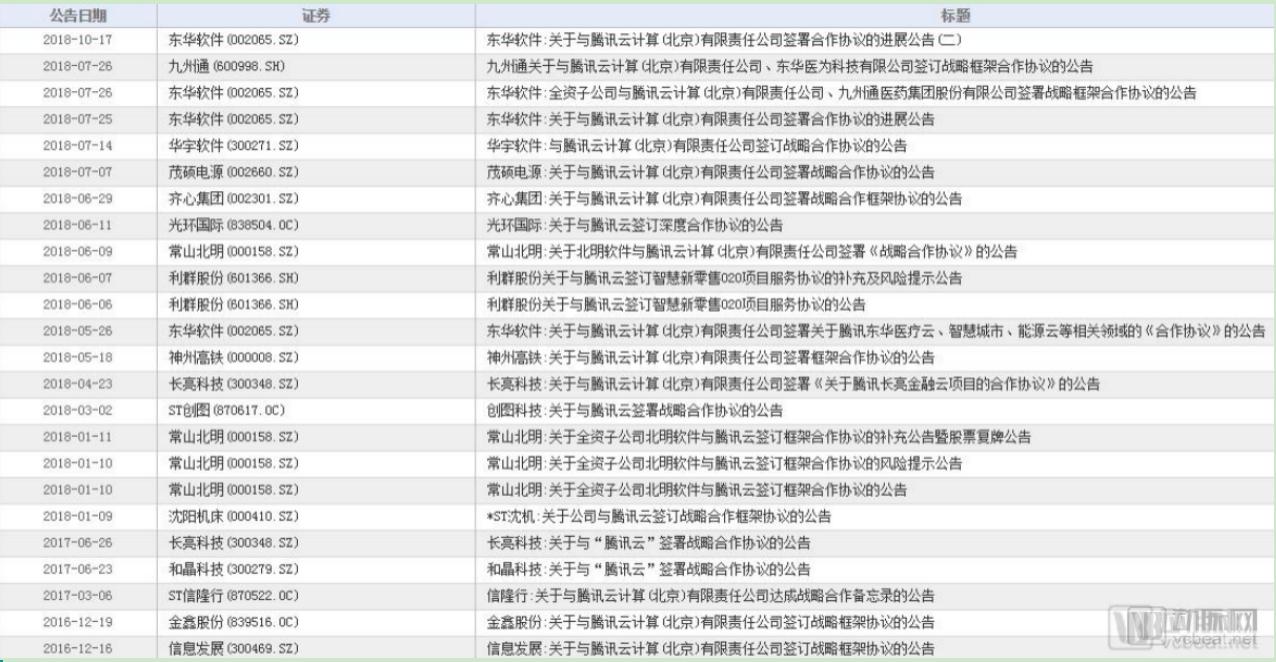
As shown in the figure above, Tencent has publicly announced collaborations with Donghua Software and Jointown Pharmaceutical Group in the healthcare sector. In June 2018, Tencent announced a capital injection of RMB 1.266 billion into Donghua Chengxin, thereby acquiring a 5% stake in Donghua Software.
As a traditional healthcare IT vendor, Donghua Software can provide Tencent’s smart healthcare initiatives with B-end and G-end resource support. Coupled with Tencent’s own traffic advantages, this partnership can rapidly advance the development of joint projects such as internet hospitals and AI-assisted diagnosis.
Specifically, Donghua Yiwei and Tencent jointly proposed the “One Chain, Three Clouds” strategy: using the Health Chain as a bridge to connect three clouds—the Health Administration Cloud (targeting government entities such as Health Commissions and Healthcare Security Administrations), the Medical Care Cloud (targeting healthcare institutions of all levels and types on the business side), and the Personal Health Cloud (targeting patients on the consumer side).
As for internet healthcare services such as prescription outflow, although there are national guidelines and regulations on "Internet + Drug Distribution," Jiuzhou Tong is a good partner due to its sensitivity to policies.
At this conference, Tencent welcomed new friends into its partnership ecosystem. Partners such as Donghua Medical Information, Dingxiang Doctor, Haodafu, Kingdee Medical, Penguin Almond, WeSure, WeDoctor, Siemens, Medlinker, and Zhiye joined Tencent’s “Digital Healthcare Innovation Alliance.” Within Tencent’s healthcare strategy, the company has a clear understanding of what it should and should not do.
“If it’s not something we need to do, why bother doing it?” Ding Ke said with a smile.
Practice has shown that no one can succeed in the internet healthcare business by merely persuading doctors; hospital support is crucial. Therefore, from a holistic strategic perspective, Tencent continues to leverage its internet strengths to serve the B-side, aiming to provide hospitals with services such as informatization, intelligent solutions, and external prescription fulfillment, while cultivating an internet-oriented mindset among C-side users regarding medical consultations.Tencent has integrated artificial intelligence technology into every business line, encompassing both To B and To C segments.
Thus, Tencent is leveraging its consumer-facing strengths to infuse soul into internet healthcare; when the time is right, paths that once proved impassable may well become avenues to stardom.
Yet even so, the AI sector, despite being a key strategic focus, has yet to establish a stable and sustainable business model, naturally leading some to question its development prospects.
Ding Ke did not deny the challenges of commercial monetization: “Not every bullet hits its target, and scientific research has never guaranteed a 100% return. Tencent’s healthcare products do generate revenue, but that is not our primary focus. We are reluctant to let commercial imperatives compromise the potential for our technology to reach higher levels.”
This is how it should be. As the pace of AI development in medicine gradually slows, we must reflect on whether the issue lies with AI itself or with the trajectory of its development. Years of uninterrupted, rapid growth may have been too fast for AI, a technology that still requires substantial scientific research and innovation. AI needs a brief pause to consolidate its research foundation, contemplate commercial translation, and re-examine its integration with the healthcare industry. As long as it addresses genuine pain points, commercial success will naturally follow.