Chinese Biotech Sounuo Biosciences Files IPO Prospectus to Revive Failed Drugs Using Biomarkers for Global First-in-Class Therapies
Before meeting with investors from Yuexiu Industrial Fund, Dr. Luo Wen had already engaged in discussions with numerous investment institutions. Initially, domestic investors harbored significant doubts about his entrepreneurial vision and business model. Questions such as “Are you really confident in your ability to successfully identify biomarkers?” and “Can you succeed where multinational pharmaceutical companies have failed?” lingered in Dr. Luo’s mind. He had a clear understanding of the company he founded. Their technology was sound, and they had already secured licensing rights for Eli Lilly’s drug; all that remained was capital support to advance the Phase III clinical trials.
After a brief exchange of pleasantries, an investor from Yuexiu Industrial Fund posed his first question to Suoyuan: “Why did you choose to launch your startup by focusing on the development of ‘failed drugs’?” This was not the first time Luo Wen had heard this question; many people were curious about his choice of entrepreneurial direction. Although there had been successful cases where biomarkers changed the fate of Iressa (gefitinib), no one had previously turned the development of “clinically failed drugs” into a business model before Suoyuan Biomedicine.
During Luo Wen’s tenure at Ligand Pharmaceuticals, the company had a drug candidate that failed to meet its endpoints in a Phase III clinical trial. In multinational pharmaceutical companies, such candidates are typically abandoned outright. However, as a mid-sized biotechnology firm, Ligand sought to retain this pipeline asset. Under Luo Wen’s leadership, Ligand developed a platform technology for biomarker discovery and successfully identified a biomarker for the drug using this platform.
However, despite being listed on NASDAQ for nearly two decades, Ligand remained unprofitable. Driven by capital market pressures, the company underwent a major restructuring, and the drug in question was sold to Eisai Co., Ltd. This experience of corporate divestiture and asset sale convinced Luo Wen that the biomarker platform he had developed could help restore value to drugs that had failed in clinical trials. After Ligand’s acquisition, Luo Wen purchased the rights to this biomarker platform technology as a service invention and founded Suoyuan Biomedicine.
Luo Wen had recounted this story to investors many times, but the investor before him seemed to react differently from previous audiences. He paused for a few seconds and then calmly shared his own experience: “The first company I worked for abroad was also engaged in pharmaceutical R&D. At that time, we had a Phase II clinical trial project, which was the company’s sole pipeline asset. We had even prepared champagne the day before the results were released, as we were fully confident of success. However, the next day, the clinical outcomes came back negative. By the third day, the office was completely deserted, with even the office supplies having been removed.”
“Although I was merely a minor player in the company at the time, this incident left a profound impression on me. I had never realized that the traditional model of new drug development carried such high risks. Simply due to the failure of one clinical trial, years of investment by the company, valuable clinical data contributed over many years by numerous participating physicians and patients, as well as the R&D experience related to the drug and its novel target, were all wasted. Therefore, I greatly admire what you are doing and am very optimistic about the future development prospects of Suoyuan Biomedicine.” Luo Wen felt a sense of resonance with this seasoned pharmaceutical investor. He believed that these drug pipelines that had failed in clinical trials should not simply be shelved. With the aid of appropriate biomarkers, many drugs that failed in clinical trials could find their suitable patient populations.
This is precisely what Suoyuan Biomedicine has been doing since its establishment six years ago. By assembling a team of seasoned veterans from the pharmaceutical industry, the company acquires drug pipelines that have failed in clinical trials from other pharmaceutical firms. Leveraging its proprietary biomarker discovery platform, Suoyuan Biomedicine helps precisely identify patient populations for these “failed drugs,” enabling renewed clinical trials within these targeted groups and ultimately breathing new life into them.
For all targeted therapies, whether small-molecule chemical drugs or large-molecule antibody drugs, their initially designed molecular configurations determine their ability to bind to specific targets and thereby exert therapeutic effects.
However, the human body is exceedingly complex, and drugs may produce varying effects when administered to patients in real-world clinical settings. For some drugs, factors within the patient’s internal environment may reduce the efficiency of drug–target binding, ultimately resulting in insufficient efficacy in the pre-specified target population and failure to pass clinical trials. For such drugs, the appropriate patient population can be identified through suitable biomarkers. Therefore, identifying appropriate biomarkers for these drugs has become a critical issue and lies at the core of precision medicine.
Historically, a well-known drug successfully overcame its challenges with the aid of biomarkers. AstraZeneca’s Iressa (gefitinib) initially received accelerated approval from the U.S. Food and Drug Administration (FDA) in 2003. As required, AstraZeneca proceeded with a Phase III clinical trial involving 1,700 participants. However, this clinical trial was declared a failure at the end of 2004.
Under the FDA’s Accelerated Approval Program, if post-marketing clinical studies fail to verify clinical benefit, the FDA has the authority to withdraw the drug from the market. Therefore, the failure of this clinical trial pushed Iressa to the brink of survival. AstraZeneca devoted significant efforts to identifying a biomarker for Iressa. Although it was AstraZeneca’s own developed drug, they were unable to identify a suitable biomarker on their own. Ultimately, with the assistance of two Harvard University professors, EGFR mutations were successfully identified as a biomarker to select the responsive patient population, thereby revitalizing Iressa. Thanks to this breakthrough, Iressa survived and remains one of the best treatment options for lung cancer patients to this day.
What AstraZeneca failed to achieve, Suoyuan Biomedicine actually aims to industrialize. The key to this lies in the fact that Luo Wen is one of the few individuals who possesses deep expertise in genomics and bioinformatics research while also having hands-on, end-to-end involvement in drug development. Over two decades ago, Luo Wen joined Sugen, a company renowned for its kinase inhibitors (later acquired by Pfizer; many of Pfizer’s oncology drug pipelines originate from Sugen, including the well-known sunitinib).
In 2000, following the completion of the Human Genome Project, Luo Wen joined Incyte Genomics, then the world’s largest genomics company, where he participated in numerous big-data projects in genomics and proteomics. This unique background enabled him to lead the development of the Biomarker platform at Ligand and gave him an in-depth understanding of the advantages this platform offers in driving new drug discovery and development.
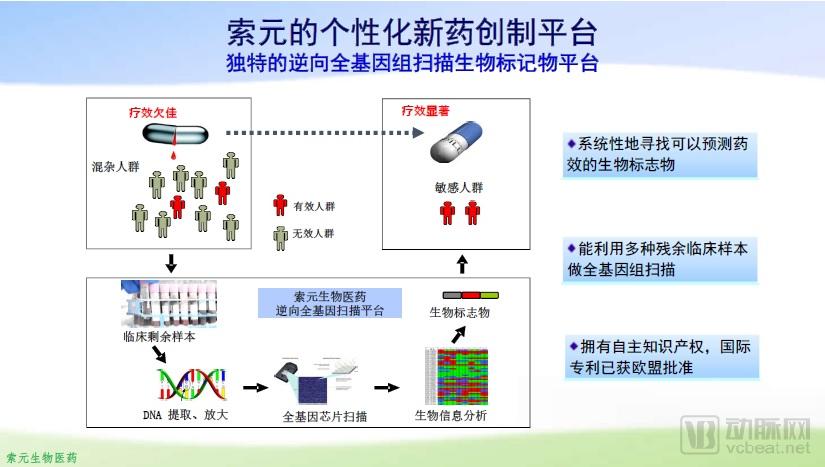
Suoyuan Biomedicine's Biomarker Development Platform
During the analysis process on the Biomarker platform, a whole-genome scan is first performed on retained clinical trial patient samples to identify single nucleotide polymorphisms (SNPs) for each patient. Patients are then categorized based on their clinical efficacy. By comparing SNP differences between responders and non-responders, pharmacogenetic profiles associated with drug sensitivity in effective patients are identified. Once this “suitable population” is defined, Suoyuan Biomedicine can precisely target these patients in further clinical trials, aiming to demonstrate higher treatment response rates. This approach not only reduces the enrollment of patients who would otherwise experience treatment failure and delayed care, but also improves the overall success rate of clinical trials, achieving a dual benefit.
The Biomarker platform, based on whole-genome scanning, requires a large number of patient samples obtained from clinical drug trials for its operation. This means that the platform is only applicable to drugs that have already entered Phase IIb or Phase III clinical trials. Therefore, Suoyuan’s business model is directly determined by the operational mechanism of this platform. Only this business model, which targets “failed drugs,” can maximize the value of the Biomarker platform.
Suoyuan Biomedicine’s business model dictates that it will enter the drug development industry from a completely new angle, rather than starting from scratch solely on its own. For most biopharmaceutical companies, the first step after establishment is to define their product roadmap. However, for Suoyuan Biomedicine, the first priority is to acquire licensed drugs.
When Suoyuan Biomedicine was founded, the team initially intended to provide analytical services to pharmaceutical companies as a CRO. However, after in-depth engagement with these companies, they realized that it was nearly impossible to persuade pharmaceutical firms to pay directly for “failed drugs.” For startup biopharma companies, the failure of a single pipeline could lead to immediate collapse. These enterprises often lack both the resources and, potentially, the financial capacity to continue paying for such “failed drugs.” Meanwhile, large pharmaceutical companies maintain extensive clinical pipelines; if one pipeline fails, it is promptly abandoned.
Furthermore, Suoyuan Biomedicine’s biomarker development services are so cutting-edge that it is difficult to gain the trust of pharmaceutical companies at the outset. These factors have instead driven the company to pursue a higher-risk, yet higher-reward strategy: acquiring drug assets and leading their independent development. Since this approach starts with new drugs already in Phase IIb or Phase III clinical trials, Suoyuan Biomedicine’s R&D cycle is significantly shorter than the 10–15 years typically required for traditional new drug development.
The first drug targeted by Suoyuan Biomedicine was Targretin (bexarotene), which had previously failed in clinical trials conducted by Ligand. This medication marks the beginning of the entire story and has long been a lingering concern for Luo Wen. In October 2006, Ligand sold Targretin to Japan’s Eisai Co., Ltd. Subsequently, Eisai transferred the commercial rights for the drug in Japan to Minophagen, a Japanese pharmaceutical company.
Targretin had already received approval for one indication while it was still under Ligand’s ownership, specifically for the treatment of relapsed or refractory cutaneous T-cell lymphoma (CTCL). Although CTCL represents a very small patient population, Targretin has been launched in dozens of countries worldwide, generating annual sales in the tens of millions of US dollars. Consequently, the drug’s price point was unaffordable for Suoyuan Biomedicine, which was just getting started. After thorough due diligence, Luo Wen had no choice but to abandon Targretin. Nevertheless, they retained the pipeline code DB101 for Targretin, serving both as a memento and a source of motivation.
After abandoning Targretin, Suoyuan Biomedicine began searching for other suitable drug pipelines. At this point, Eli Lilly’s Enzastaurin came into their sights. In May 2013, Eli Lilly announced that it would halt the development of Enzastaurin due to its failure in a previous late-stage clinical trial.
Enzastaurin is a small-molecule targeted therapy. Prior to discontinuing its development, Eli Lilly had invested hundreds of millions of U.S. dollars in this drug, conducted more than 60 clinical trials, and enrolled over 3,000 patients who received the medication. Furthermore, as a leading global pharmaceutical company, Eli Lilly ensures high-quality clinical data.
Such a “failed drug” with abundant clinical data was tailor-made for Suoyuan Biomedicine. Therefore, shortly after Eli Lilly announced the discontinuation of its development, Suoyuan Biomedicine quickly approached Eli Lilly with an offer to acquire Enzastaurin. Although the drug had been abandoned, Eli Lilly remained cautious in its dealings with Suoyuan.
First, Suoyuan Biomedicine’s business model was unprecedented for Eli Lilly; second, handing over hundreds of millions of dollars in investment and more than a decade of R&D achievements to another party is a difficult decision even for a company of Eli Lilly’s scale. Nevertheless, Eli Lilly ultimately chose to place its trust in Suoyuan Biomedicine.
In September 2014, 16 months after Eli Lilly announced the discontinuation of Enzastaurin development, Suoyuan Biomedicine acquired the global rights to Enzastaurin. Since then, Enzastaurin has been rebranded as DB102 by Suoyuan Biomedicine.
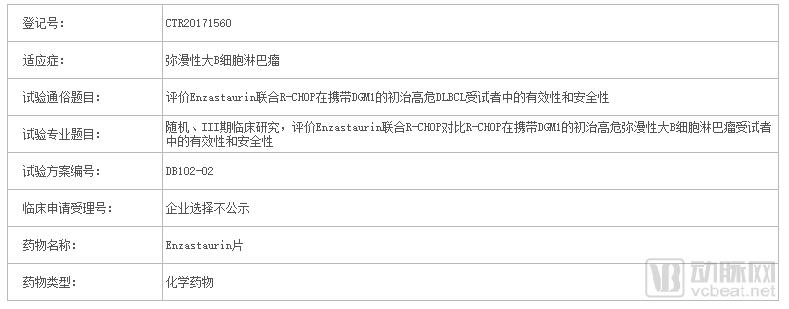
Clinical Trial Information of DB102 Registered in China
Subsequently, Suoyuan Biomedicine rapidly initiated biomarker exploration for DB102. Following analysis of retained samples and clinical data collected by Eli Lilly, Suoyuan Biomedicine identified a novel biomarker, which it named DGM1 (Denovo Genomic Marker 1). Patients positive for DGM1 exhibited higher response rates to DB102 treatment, indicating a strong correlation between DGM1 and the therapeutic efficacy of DB102.
Following the identification of the biomarker, the design and preparation for the first clinical trial of DB102 were promptly initiated. In October 2017, the international Phase III ENGINE study of DB102 for the treatment of diffuse large B-cell lymphoma (DLBCL), submitted by Suoyuan Biomedicine to regulatory authorities in both China and the United States, received approval from both countries’ drug regulatory agencies. The first subject was enrolled several months later, and the trial is currently in an active enrollment phase.
DB102 subsequently reported a series of breakthroughs. In June 2018, a research team at Stanford University identified a new indication for DB102: pulmonary arterial hypertension. By late 2018, findings demonstrating that DB102 enhances efficacy when combined with BTK inhibitors were accepted by the Chinese Society of Clinical Oncology and the American Society of Hematology Annual Meeting. In May 2019, an Investigational New Drug application was submitted in the United States for a Phase II clinical trial of DB102 in the treatment of glioblastoma. If any of the clinical trials of DB102 ultimately achieves its prespecified endpoints, it will become a blockbuster drug in the international biopharmaceutical industry and the first First-in-Class therapy originating from China.
Han Yingying, Head of Clinical Development in China at Suoyuan Biomedicine, informed us that the first patient enrolled globally in the ENGINE study, an international multicenter trial of DB102, was recruited in China. Currently, the pace of patient enrollment for DB102 in China is even faster than that in the United States.
“We are truly fortunate to be operating in such a favorable era. The acceleration of clinical trial approvals has brought us tremendous convenience. We received clinical trial approvals for DB102 in both China and the United States almost simultaneously, which was unimaginable in the past. Previously, domestic clinical trials in China lagged significantly behind those conducted abroad. Now, we can fully leverage China’s clinical resources, enabling patients in China to access first-in-class novel drugs like DB102 at the earliest opportunity,” said Han Yingying. During the clinical trials, Professor Zhu Jun, a leading authority in lymphoma at Peking University Cancer Hospital, along with other participating research institutions, highly recognized and provided substantial support for the Suoyuan model.
Before pursuing his Ph.D. in the United States, Luo Wen studied clinical medicine at Peking Union Medical College, which offers an eight-year program. However, he discovered that despite the advancements in the pharmaceutical industry to date, there are still many diseases, such as certain malignant tumors and mental disorders, for which no appropriate therapeutic drugs are available.
Without effective medications, even the most skilled physicians are left helpless. Therefore, Luo Wen made the resolute decision to pursue advanced studies in molecular biology and biochemistry in the United States before completing his eight-year program at Peking Union Medical College. He firmly believed that only by developing new drugs could more patients and families be saved. As Suoyuan achieved successive breakthroughs with DB102 and DB103, the company received numerous inquiries from domestic and international patients and their families expressing deep concern regarding treatments and clinical plans for diffuse large B-cell lymphoma (DLBCL), glioblastoma, and schizophrenia, along with a strong desire to participate in clinical trials. The patients’ urgent need for new therapies has become the driving belief behind the Suoyuan team’s unwavering commitment to advancing the development of innovative drugs.
After acquiring the Biomarker platform from Ligand, Luo Wen reached out to his close friend in San Diego, Dr. Fang Xiangming, inviting her to co-found a startup with him. Dr. Fang is a serial entrepreneur holding both Ph.D. and M.D. degrees. Following her postdoctoral research at the MD Anderson Cancer Center, she entered the pharmaceutical industry and has since held positions at multiple biotechnology companies, accumulating over 20 years of experience in biomedical R&D and product development. The key factors that led Dr. Fang to join Suoyuan Biomedicine were the Biomarker platform technology and the unique business model built upon it. As a seasoned veteran with more than two decades in the biomedical field, she trusts her judgment regarding the potential of this platform.
To facilitate better communication with pharmaceutical companies, Luo Wen recruited his former colleague at Ligand, Dr. Michael Haller, to serve as the company’s Chief Business Officer. Dr. Haller previously spent many years at McKinsey & Company, where he provided solutions to complex healthcare challenges for numerous Fortune 500 enterprises. After leaving McKinsey, Dr. Haller held key business leadership roles at several biopharmaceutical companies. During his tenure at Halozyme, he managed the company’s partnerships with Roche Pharmaceuticals and Baxter Healthcare, playing a pivotal role in the commercial launch of multiple drugs, including Herceptin, Rituxan, and HyQvia.
In the process of advancing the clinical trials of DB102, in September 2016, Suoyuan Biomedicine invited Ms. Han Yingying to serve as the Head of China Region. Ms. Han has worked in the field of drug development for many years and has held positions at multinational pharmaceutical companies such as Boehringer Ingelheim, AstraZeneca, Actelion, and Kyowa Kirin.
Prior to joining Suoyuan Biomedicine, Han Yingying spent eight years at Covance, serving as the Director and Head of China Operations for the Clinical Development Department. When she first joined Covance, the company had not yet fully expanded its business in China. She single-handedly led the establishment, expansion, and management of Covance’s entire clinical operations team in China, earning a strong reputation within the industry. Before Han Yingying joined Suoyuan Biomedicine, the company’s core team members were primarily based in the United States. Her recruitment was aimed at leveraging her expertise to build a pragmatic clinical team with deep understanding of the local environment, thereby fully utilizing domestic clinical resources and making significant contributions to accelerating global R&D efforts.
Due to Suoyuan Biomedicine’s unique clinical development model, its inaugural clinical trial was a Phase III study. For a startup like Suoyuan, conducting a Phase III clinical trial requires leadership from a seasoned expert with extensive experience in CMC (Chemistry, Manufacturing, and Controls). Therefore, Suoyuan Biomedicine engaged Dr. Lu Xiaoxiong as a CMC expert consultant, and he officially joined the team as Chief Technology Officer in February 2018. With over 30 years of experience in the biopharmaceutical industry, Dr. Lu previously served as Vice President of Technical Operations at Arena Pharmaceuticals and Balance Therapeutics, possessing profound expertise in pharmaceutical CMC. His appointment addressed Suoyuan Biomedicine’s previous gaps in CMC capabilities, thereby enhancing the company’s confidence in subsequent clinical trials.
In January 2019, Suoyuan Biomedicine, which had already assembled a team of seasoned veterans from the pharmaceutical industry, welcomed another heavyweight figure—Dr. Zhang Lei, as its Chief Medical Officer. Prior to joining Suoyuan, Dr. Zhang served as Global Executive Medical Director and Head of Planning at Celgene Corporation. He has also overseen clinical trial medical registration and market launch activities for multiple multinational pharmaceutical companies, including Eli Lilly and Novartis. During his more than ten-year tenure at Celgene, Dr. Zhang was responsible for securing the marketing approval of the blockbuster drug Revlimid for the treatment of mantle cell lymphoma.
More critically, Zhang Lei serves as the principal investigator for the global Phase III clinical trial of Revlimid in the treatment of diffuse large B-cell lymphoma (DLBCL). DB102 is currently undergoing an international, multicenter Phase III clinical trial targeting this same indication. Zhang Lei’s profound understanding and first-hand experience in this field have significantly strengthened Suoyuan Biomedicine.
Suoyuan Biomedicine’s management team comprises a group of biopharmaceutical elites with an average industry experience of over 20 years, which stands in stark contrast to the prevailing trend of increasingly younger leadership teams among startups across many sectors. While younger professionals certainly bring greater drive and energy, the experience of seasoned veterans is invaluable in the field of drug development. This is particularly true for Suoyuan Biomedicine, which has adopted a unique business model that requires its team to bypass preclinical and early-stage clinical phases and directly engage in Phase II/III clinical trials.
While the drive of young professionals is commendable, in an industry fraught with formidable challenges, it is the experience of seasoned veterans that better enables Suoyuan Biomedicine to navigate one hurdle after another.
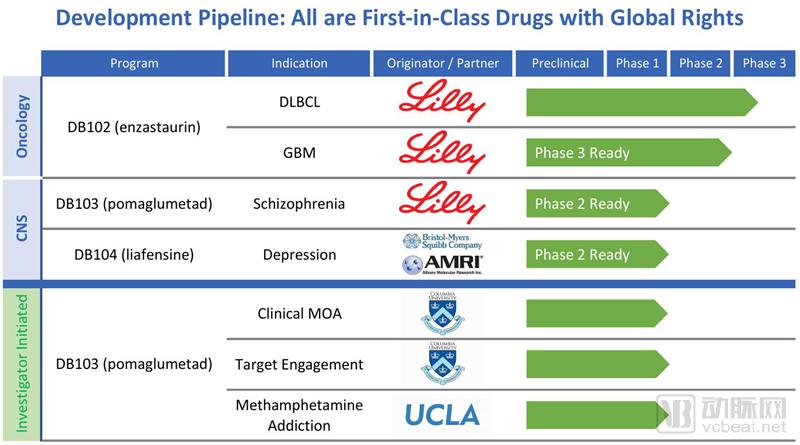
Suoyuan Biomedicine's Clinical Pipeline
In 2015, following DB102, Suoyuan Biomedicine licensed another drug from Eli Lilly: the schizophrenia medication Pomaglumetad, assigned Suoyuan’s internal code DB103. DB103 had shown promising results in earlier Phase II clinical trials but ultimately failed in Phase III trials. Eli Lilly conducted 37 clinical trials for this drug, enrolling more than 3,800 participants.
Suoyuan has identified a patient subgroup with significant therapeutic efficacy through a retrospective analysis of previous clinical trials of the drug. The application for an international multi-center clinical trial for DB103 was approved by the NMPA, and the prospective clinical trial study was officially launched in 2019.
In 2017, Suoyuan Biomedicine entered into an agreement with Bristol-Myers Squibb/AMRI to license Liafensine, a triple-target drug for the treatment of major depressive disorder (MDD). Currently, therapeutic options for MDD remain limited. Although Johnson & Johnson’s esketamine nasal spray, Spravato, was approved in February this year, it has been mired in controversy due to its severe side effects and the addictive potential associated with ketamine.
“Currently, small-molecule drugs for major depressive disorder have not demonstrated satisfactory efficacy. This issue extends beyond depression to the treatment of psychiatric disorders as a whole, including schizophrenia. We believe that the field of psychiatry is currently in the ‘darkness before dawn.’ Ten years ago, oncology faced a similar predicament. However, the advent of targeted therapies based on biomarkers such as PD-1, EGFR, and HER2 has significantly transformed cancer treatment. We are confident that biomarkers will play a similarly pivotal role in the treatment of psychiatric disorders,” said Luo Wen.
Suoyuan Biomedicine is currently primarily focused on the fields of oncology and psychiatric disorders. “Suoyuan’s business model dictates that it must target major disease indications,” an investor in Suoyuan Biomedicine told us. Suoyuan aims to develop First-in-Class therapies, many of which are drugs that have previously failed in clinical trials, inherently entailing significant risk. Focusing on rare or niche indications would mean a smaller market size and even greater risk. Moreover, their target patient population requires screening via biomarkers, which further narrows the eligible patient pool. Therefore, for Suoyuan Biomedicine at its current stage, focusing on major disease indications is an inevitable strategic choice.
Domestic new drugs have experienced explosive growth in recent years, and a large number of companies focusing on biopharmaceuticals have emerged. However, behind the prosperity, this rising industry has also exposed obvious problems. Most domestic new drug projects are Me-too drugs and biosimilars.
Although “Me-too” drugs appear to carry significantly lower risks than first-in-class therapies, their development tracks often become congested. If a me-too drug fails to keep pace with the leading candidate, its R&D investment will likewise be wasted.
For instance, in the current domestic PD-1 monoclonal antibody sector, nearly 20 different drugs are competing, with six already marketed or having submitted marketing applications. The currently marketed drugs hold a first-mover advantage, leaving minimal opportunity for those PD-1 monoclonal antibodies still in preclinical or Phase I/II clinical trials. However, such market challenges do not exist for First-in-Class drugs.
Investors’ considerations in this matter are largely based on return on investment (ROI). “Me-too” drugs appear to have a mature market, offering more stable returns. In contrast, while “First-in-Class” drugs entail higher R&D risks, these high risks are accompanied by the potential for exceptionally high returns. This is because true First-in-Class drugs target the global market, which can be more than twenty times larger than the domestic Chinese market. Moreover, the first drug in its class to reach the market can capture a substantial share of the market by leveraging its first-mover advantage.
For instance, if Suoyuan’s DB102 is successfully launched, its peak sales are projected to reach $3 billion. This represents a market potential that no domestic product has ever achieved. Therefore, First-in-Class drugs, with their substantial growth prospects, also merit investors’ attention.
Once the Phase III clinical trial results of a blockbuster first-in-class new drug are released, the drug pipeline or the company itself may be quickly acquired by major pharmaceutical companies at a high price. For example, Eli Lilly acquired Loxo for $8 billion, and Celgene acquired Receptos for $7 billion. Moreover, current trends indicate that major pharmaceutical companies are accelerating their acquisition timelines. Recently, Merck acquired Peleton, which had completed Phase I/II clinical trials, for $2 billion. This situation suggests that investors focusing on new drugs should also consider advancing their investment stages, paying more attention to drugs in early clinical or even preclinical stages.
While the industry continues to debate how to develop its own First-in-Class drugs, Suoyuan Biomedicine has carved out a unique path by leveraging its globally leading Biomarker platform to build a global pipeline of First-in-Class innovative therapies addressing multiple major unmet clinical needs. In the future, several blockbuster drugs are expected to emerge from Suoyuan Biomedicine, propelling China’s innovative pharmaceuticals from followers to leaders. As more First-in-Class projects are launched in China, billion-dollar acquisition or collaboration deals are certain to emerge in the years ahead.
A completely new model is inevitably subject to skepticism. “When Suoyuan was raising its angel round, many questioned whether we could acquire drug pipelines from major pharmaceutical companies. After securing the pipelines, doubts arose as to whether we could identify biomarkers. Now that the biomarkers have been identified, we continue to advance steadily according to our established roadmap.” The team at Suoyuan Biomedicine has remained remarkably composed in the face of such skepticism. They are confident that once they ultimately reach the pinnacle of success, all doubts will naturally dissipate.