

SenseTime Unveils AI Healthcare Strategy and SenseCare Platform Empowering Hospital-Wide Clinical Workflows with High-Concurrency 3D Rendering
In May 2019, Sensetime successfully held its second Artificial Intelligence Summit, themed “Boundless AI,” in Beijing. The company’s latest AI products and solutions spanned five major sectors: smart cities, smart healthcare, smart retail, education, and augmented reality (AR).
In addition to the widely acclaimed Edge AI Capability Center, SenseTime’s newly launched “Smart Healthcare” product series has, as expected, become the focal point of attention. This marks SenseTime’s first public disclosure of its AI technology applications in the smart healthcare sector, a milestone for which the company prepared for an entire year.
In fields such as security and autonomous driving, SenseTime has pushed computer vision technology to its limits. However, entering the auxiliary diagnosis market—a sector already dominated by major AI startups—at this juncture does not appear to be a rational choice. In fact, SenseTime has no such intention; instead, it has chosen an alternative path to overtake competitors by “empowering clinical practice across the entire hospital.”
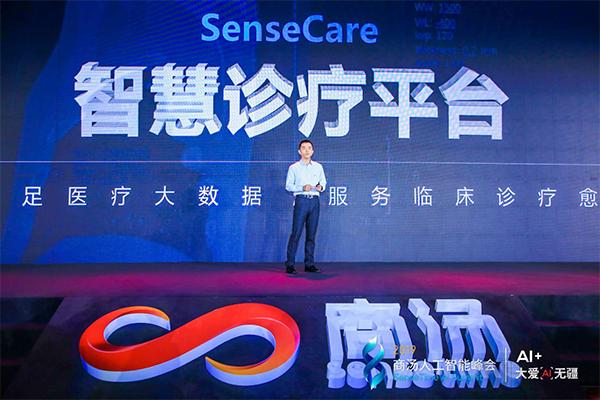
Vice President of Sensetime, Zhang Shaoting
Sensetime defines its SenseCare intelligent diagnosis and treatment platform as a tool that empowers the entire clinical workflow, encompassing diagnosis, treatment, and recovery. In short, Sensetime is not only focused on radiology but also directs its efforts toward clinical departments, aiming to empower clinical practice across the entire hospital.
Why Focus on Clinical Practice? Zhang Shaoting, Vice President of SenseTime and Head of SenseTime Smart Health, believes that over the past few years, most of the more than 100 AI healthcare companies that have emerged have largely focused on assisted diagnosis. While these efforts have effectively aided doctors and patients, they represent only the tip of the iceberg in the complex hospital environment. Beneath the surface, many clinical departments remain insufficiently supported and overlooked, despite their needs spanning the entire continuum of care—from diagnosis and treatment to recovery.
For instance, during the treatment phase, many clinicians still rely on personal experience for surgical planning due to a lack of convenient and intelligent tool support. However, as clinical treatment plans directly impact patient prognosis, scientific surgical planning can effectively improve treatment outcomes.
Therefore, SenseTime hopes that artificial intelligence can assist clinicians who lack adequate tool support, thereby enhancing the quality of resources across the entire healthcare system—products that address critical pain points and meet essential needs will naturally find a market.
Respiratory Medicine, Cardiology, Orthopedics, Neurosurgery… There are numerous clinical departments, each facing a wide variety of challenges. Zhang Shaoting has summarized the prevalent pain points into three key areas.
The first pain point stems from data security concerns. In hospitals, data are typically stored in the Departments of Radiology and Information Technology. When clinicians in clinical departments need to analyze such data—for instance, for clinical treatment planning and implementation—there are generally two approaches to accessing it: one is to enable data interfaces that transmit raw data to clinical departments or even third parties; the other is to use physical methods, such as copying data onto CDs. Both approaches carry risks of patient information leakage and disorganized data management. Many healthcare companies struggle to meet clinicians’ needs for data analysis while simultaneously ensuring data security.
The second pain point lies in the support for 3D capabilities. Medical images typically consist of a series of stacked 2D slices, and image diagnosis usually only requires layer-by-layer examination. However, in clinical scenarios such as treatment planning, clinicians need to conduct analysis and design protocols based on the patient’s 3D anatomical structure. Currently, most 3D data post-processing tools available on the market are standalone workstations, making it difficult for hospitals to purchase such workstations for every department or even for each individual physician.
The third pain point is the need for support from artificial intelligence algorithms. Taking bone tumors as an example, before surgery, doctors hope to analyze factors such as the location, size, and morphology of the bone tumor, and further proceed with 3D model printing and surgical analysis planning. The process of delineating the bone tumor may take several hours, imposing a significant burden on physicians. With the support of AI algorithms, both efficiency and accuracy can be substantially improved.
With the resolution of three key pain points as its R&D objective, Sensetime has developed the SenseCare Intelligent Diagnosis and Treatment Platform by leveraging deep learning algorithms and advanced medical image post-processing technologies. The platform’s dual engines—high-concurrency 3D rendering and scalable clinical AI applications—have truly made it possible to address the pain points faced by physicians across all departments in a hospital.
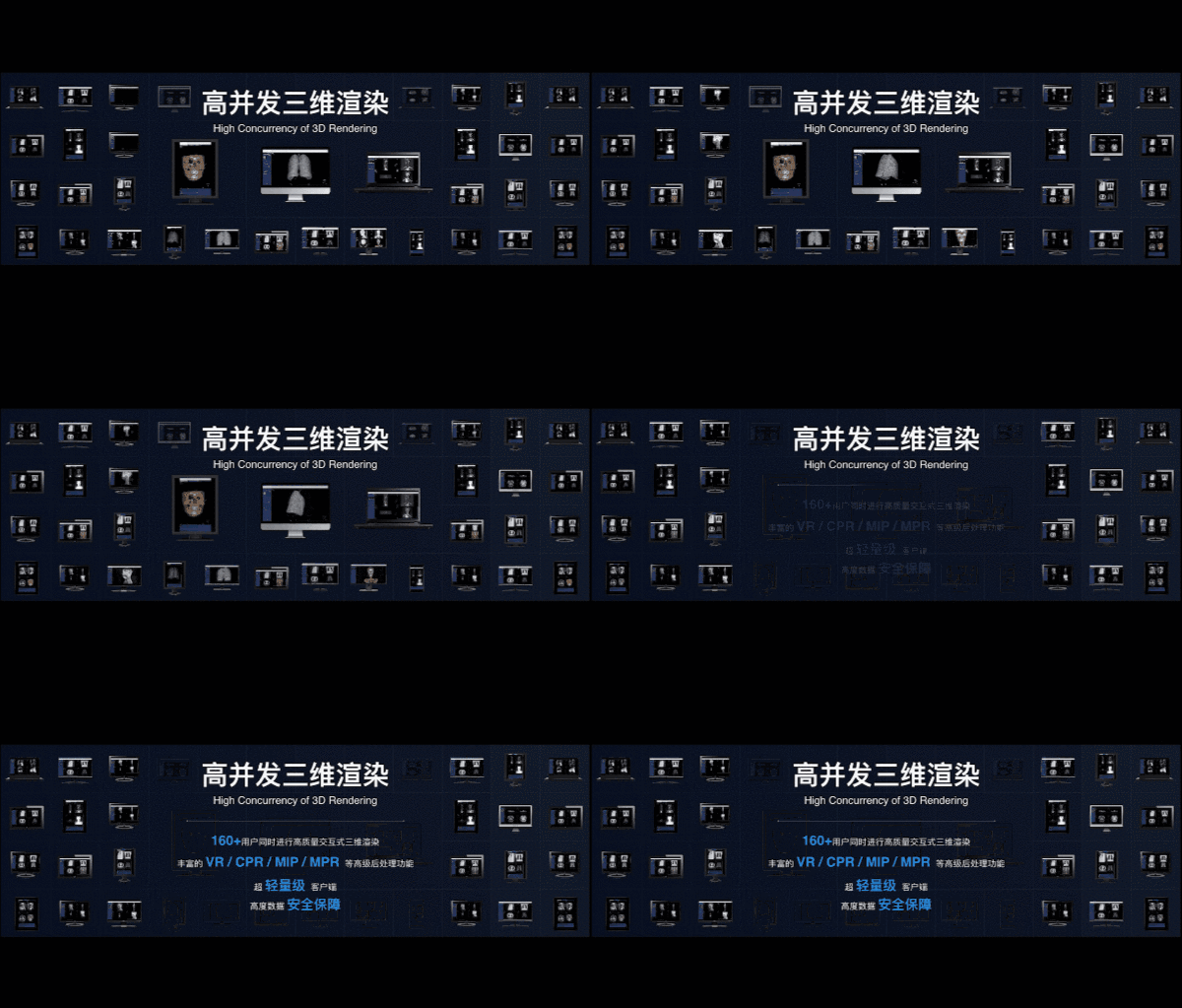
The high-concurrency 3D rendering engine serves as the foundation of the SenseCare Intelligent Diagnosis and Treatment Platform. Deployed within the Department of Radiology or the Department of Information Technology, this platform provides clinicians with an ultra-lightweight web-based client without requiring data to leave these departments. Clinicians can access imaging data and perform 3D reconstruction analysis directly in their web browsers, without any plugins, simply by logging in—delivering an experience comparable to using a local workstation. Throughout the entire process, data remains within these departments; instead, it is rendered visually and presented to end-users via high-concurrency 3D rendering technology.
To illustrate how this works, Zhang Shaoting provided an example: “More than a decade ago, we needed to download movie files to our local hard drives and use media player software to watch them. Today, we stream content online using ‘streaming technology plus network bandwidth.’ With streaming technology, online movie rental providers such as Netflix allow customers to watch films via web browsers, while the movies themselves remain protected on central servers, thereby safeguarding copyright. The concept of high-concurrency rendering technology is similar; however, it must technically address more complex three-dimensional data and provide clinicians with real-time interaction and comprehensive post-processing capabilities.”
At present, Sensetime’s high-concurrency 3D rendering technology can support various types of terminals. A single SenseCare unit can enable over 160 clinicians to simultaneously perform high-quality, real-time 3D rendering and interaction, while ensuring data security.
The second engine comprises scalable AI clinical applications. Built upon the SenseCare platform, Sensetime has developed a series of vertical clinical AI applications. Taking pulmonary AI applications as an example, Sensetime’s AI solutions not only perform traditional detection and analysis of pulmonary nodules but also provide assisted preoperative planning for bronchoscopic surgeries. The bone tumor AI application assists physicians in generating more accurate tumor segmentation results and 3D models through the analysis of multimodal data, thereby facilitating subsequent 3D-printed surgical planning and implant design. Furthermore, in pathological examination, regarded as the “gold standard” for disease diagnosis, pathology AI can precisely analyze histopathological and cellular-level abnormalities, aiding physicians in making further clinical judgments.
Currently, SenseCare has deployed algorithms and clinical applications in orthopedics, respiratory medicine, cardiology, and other specialties, truly serving as a platform to empower clinical practice across the entire hospital. Taking bone tumors as an example, Sensetime has collaborated with expert teams at Shanghai Ninth People’s Hospital to significantly improve the efficiency, accuracy, and outcomes of 3D printing-based treatment planning for bone tumors. In the field of radiotherapy, Sensetime has established a deep partnership with Yinuo Medical. Leveraging Yinuo’s radiotherapy system, Sensetime has developed a series of algorithms for organ and target volume delineation, thereby empowering radiation oncologists. By enhancing the productivity of the limited number of radiation oncologists, these innovations benefit a broader population of patients, particularly those in primary care settings.
The healthcare industry cannot be built overnight; it requires long-term dedication and accumulation. It is difficult for any single enterprise to comprehensively address all needs and perfect its products solely through its own efforts. Zhang Shaoting stated, “SenseTime advocates win-win cooperation and hopes to work together with hospitals, medical institutions, and high-quality enterprises to deeply cultivate the healthcare sector, enabling AI-powered healthcare to benefit a broader population.”
In the future, SenseTime will allocate more resources to smart healthcare. With the collaboration of industry partners, it is entirely possible for SenseTime to forge a distinctive path in AI-driven healthcare through multi-party cooperation—only time will tell.