

Jizhi Medical Aims to Bring Affordable, Modular Rehabilitation Robots to Homes and Communities with Digital Assessment as Entry Point
A common saying in the rehabilitation industry is, “Rehabilitation begins with assessment and ends with assessment,” underscoring the critical role of rehabilitation assessment throughout the rehabilitation treatment process.
Due to the slow development of China’s rehabilitation industry in the past, rehabilitation assessment has largely relied on rating scales. Although digital assessment products can offer more precise evaluation solutions, they have not yet been widely adopted.
In fact, sandwiched between “starting with assessment and ending with assessment” is the patient’s rehabilitation training process. Currently, many rehabilitation equipment manufacturers and rehabilitation startups are developing rehabilitation robots, aiming to leverage these technologies to address challenges such as the shortage of rehabilitation therapists and low rehabilitation efficiency.
Currently, the application of rehabilitation robots is constrained by factors such as space requirements, cost, and operational convenience, making it difficult to cover the three-tier rehabilitation network. However, rehabilitation for many diseases is a long-term process, with treatment needing to extend beyond hospital discharge. This necessitates that rehabilitation products penetrate down to communities and households, requiring breakthroughs in product design and application.
There is a group of people,Graduating with degrees in Biomedical Engineering from Tsinghua University, they subsequently pursued advanced studies and worked at the former Chicago Rehabilitation Research Center for several decades. Over the past 20 years, they have been dedicated to research in rehabilitation medical engineering. During this period, the team recognized the importance of digital assessment of rehabilitation functions and the expansion of the rehabilitation robotics market, particularly identifying a gap in modular rehabilitation robots designed for home and community use. This insight led them to establish Jizhi Medical.。
Digitalized assessment of rehabilitation functions and modular rehabilitation robots affordable for families and communities are still novelties in China’s rehabilitation market. However, VCBeat has learned that Jizhi Medical’s products are already in use in all provinces except Tibet, Jiangxi, and Guizhou. To gain deeper insights into the company, VCBeat interviewed Ren Yupeng, founder of Jizhi Medical.
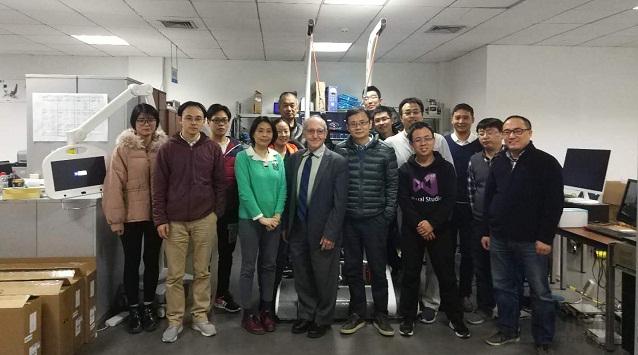
Jizhi Medical Team
Ren Yupeng told VCBeat that many teams in the rehabilitation industry have transitioned from other sectors, whereas the founding team of Jizhi Medical is different: they have been engaged in research in the field of rehabilitative medicine since their undergraduate studies, with some founders boasting over 20 years of R&D experience in rehabilitation.
Ren Yupeng introduced that in 2001, while studying biomedical engineering at Tsinghua University, he began conducting research related to China’s first rehabilitation robot under the National High-Tech Research and Development Program (the “863” Program). His research topics at the time were brain-computer interfaces and rehabilitation robotics. This was a completely new field then, with limited public awareness. It was only after his supervisor returned from the United States that rehabilitation medical engineering was introduced to China.
At that time, China had not yet established a comprehensive rehabilitation system, and there were very few rehabilitation medical device companies; the few that existed primarily manufactured rehabilitation aids and physiotherapy products.
Thus, after graduating from Tsinghua University in 2004, Ren Yupeng went to the Rehabilitation Institute of Chicago in the United States for further studies and subsequently remained there to devote himself to research in rehabilitation medical engineering. VCBeat has previously published a series of reports on this institution. The Rehabilitation Institute of Chicago, now renamed Shirley Ryan AbilityLab, has topped the list of best rehabilitation hospitals for 28 consecutive years, according to the hospital rankings by the authoritative U.S. magazine U.S. News & World Report.
Rehabilitation engineering is an interdisciplinary field that integrates technologies such as software, hardware, robotics, and sensors. During my time studying and working in the United States,Ren Yupeng learned that intelligent products in rehabilitation medical devices are divided into two major categories: one is human-machine interaction training equipment used to replace manual labor, and the other is assessment equipment for scales and data collection.。
Digital assessment of patients is critically important. While it has gained widespread adoption abroad, its use remains limited in China. Rehabilitation physicians strongly desire precise digital quantification of assessments to enable tailored solutions and support research data generation.
Seeing market opportunities, Ren Yupeng decided to initiate the commercialization process. He aims to start with digital rehabilitation assessment equipment to promote the development of rehabilitation evaluation, while leveraging hospital-based and home-use rehabilitation robots to enhance therapeutic outcomes. In particular, he seeks to develop affordable, high-quality modular rehabilitation robots for home and community use, thereby filling a gap in this market.
To this end,Building on Jizhi Medical, founded in 2014 by alumni of the Department of Biomedical Engineering at Tsinghua University, Ren Yupeng established Litaike Technology Co., Ltd., integrating resources within the Tsinghua alumni rehabilitation network and dedicating efforts to the accumulation of related technologies.
By 2016, the company had secured personal angel investment from a prominent internet industry leader and Pre-A round funding from the Tsinghua-Mindray medical network., while the national medical insurance scheme has also increased the number of reimbursable rehabilitation items to 29. The increased healthcare investment in rehabilitation funding has given the team confidence that China’s rehabilitation sector is entering a period of robust growth.
As a sub-brand of Litech, Jizhi Medical focuses on the research, development, and promotion of rehabilitation robots for home and community settings, as well as products for brain function diagnosis and treatment, alongside digital rehabilitation assessment medicine. The company aims to provide intelligent rehabilitation assessment solutions that enable early screening and early intervention in orthopedic rehabilitation, quantitative neurological rehabilitation, smart home-based rehabilitation, and computer-aided diagnostic technologies for brain functional behavior.
The work at the Chicago Rehabilitation Research Center enabled the founding team to recognize the importance of quantitative assessment in medicine.
Currently, a significant proportion of rehabilitation therapies employed in clinical practice are primarily based on functional training. How should the efficacy of such training be evaluated? Assessments based solely on the perceptions of patients and their families are overly subjective and lack standardized criteria, which hinders clinical analysis and summarization. In this context, it is particularly important to conduct quantitative assessments of functional status using unified standards.。
Rehabilitation departments and rehabilitation hospitals in China all have assessment protocols, but rehabilitation assessments lack digital quantification.
Rehabilitation physicians currently rely primarily on scoring via selection-based assessment scales. The granularity of these scales is relatively coarse, often lacking in objectivity, and fails to provide quantitative functional data on patients’ physical conditions that would be truly helpful for formulating treatment plans.
These data and metrics are typically collected only by researchers during studies, and their adoption in clinical practice remains limited. Although rehabilitation physicians have a strong need for such data, the market lacks commercialized devices that enable more granular, quantitative assessments.
Hangzhou Jizhi Medical Technology Co., Ltd.’s products provide rehabilitation therapists with quantitative assessment data.
To develop a personalized treatment plan for patients, doctors must first understand their physiological function indicators and data.For example, to enhance a patient’s proprioceptive motor function in the lower limbs, a sports rehabilitation physician must first identify the underlying cause of the functional impairment—whether it stems from changes in the joint’s physiological structure or from a deficit in proprioception. Such information cannot be obtained through medical imaging equipment.
Jizhi Medical utilizes robots and sensors to engage in quantitative interaction with the human body, acquiring functional physiological data for further assessment.。
In addition to proprioception, Jizhi Medical’s assessment devices can also capture functional rehabilitation evaluation data, including movement coordination, neurobehavioral responses, and attention.
In addition to data acquisition, the interpretation of data also requires accumulated experience.. For instance, many hospitals today are equipped with CT scanners capable of acquiring CT images; however, while experts can identify suspicious lesions from these images, some physicians lack this skill.
Ren Yupeng stated that the application of artificial intelligence and big data technologies in healthcare is already quite widespread, and these two technologies hold significant potential in the field of rehabilitation assessment medicine.
However, to achieve automated AI assessment, it is first necessary to have hardware devices capable of acquiring patient functional data. The widespread application of AI in medical imaging stems from the ease of acquiring data such as CT and MRI scans; technical teams need only leverage this data to iteratively refine their algorithms.
However, in the field of rehabilitation assessment, both data acquisition and interpretation are lacking.First, there is a lack of equipment in the market capable of acquiring indicators and data on patients’ functional impairments. Second, once the data is acquired, it remains unclear how to interpret and utilize it to guide rehabilitation training. Due to the late development of the rehabilitation industry in China, both areas remain largely unaddressed domestically.。
Currently, Jizhi Medical is capable of interpreting certain human functional data and providing recommendations to patients. For instance, Jizhi Medical’s robotic devices can analyze biomechanical data to potentially assist physicians in selecting more precise rehabilitation strategies and evaluating the expected outcomes of botulinum toxin injections before and after treatment.。
Rehabilitation robots are not a novel concept in China; VCBeat has previously profiled more than ten rehabilitation robotics companies, some of which already have products on the market.
Ren Yupeng told VCBeat,Rehabilitation is a long-term process; after discharge, patients need to undergo continuous training using rehabilitation robotic devices to improve their quality of life.
Currently, rehabilitation robot devices on the market are basically designed for hospitals, with prices ranging from hundreds of thousands to even millions, which most patients cannot afford.However, the significant benefits of rehabilitation are realized through daily therapeutic intervention. Current rehabilitation robots on the market merely address in-hospital rehabilitation needs, failing to adequately meet patients’ long-term personal rehabilitation requirements.。
Jizhi Medical’s robotic system is designed to meet patients’ needs throughout the entire rehabilitation cycle. Featuring a modular design, it allows patients to add functional modules according to their specific stage of recovery, thereby addressing varying rehabilitation requirements across different phases. The rehabilitation robot has broad application scenarios, including orthopedic and neurological rehabilitation. Currently, the product is available in two versions: a hospital edition and an affordable universal edition.
Long-term rehabilitation takes place in home and community settings; therefore, it is crucial to provide these patients with high-quality, affordable rehabilitation robotic products that are available for purchase or lease.Jizhi Medical’s modular, consumer-facing rehabilitation robots serve as a supplement to the rehabilitation robotics industry; currently, many households in China are trialing Jizhi Medical’s home-use rehabilitation robots.。
Five series of single-degree-of-freedom rehabilitation robots for joint rehabilitation have obtained CFDA certification, with annual revenue exceeding RMB 10 million. The registration application for multi-degree-of-freedom complex rehabilitation robots is expected to be submitted this year.。
Litaike, the parent company of Jizhi Medical, completed a Pre-A financing round worth tens of millions of yuan in 2016, with investors including Fenxiang Investment and Pengrui Capital.
The company is currently undertaking its next round of strategic financing to fund market promotion and product research and development.