

Has AI Truly Addressed Clinical Doctors' Pain Points? Tongxin Medical's IPO Filing Offers Answers

Sophmind
Internet Medical Examination Platform
The boom in medical artificial intelligence has lasted for more than two years, with products from various companies gradually being deployed in major hospitals across China. In some hospitals, radiology departments have adopted around ten AI solutions; however, in practice, radiologists regularly use only a few of them.
The underlying reason is that current products fail to adequately address the needs and pain points of radiologists, while few products are developed with the needs of clinicians in mind.。
In the field of medical AI, how can innovative companies make their products appealing to physicians? What kind of products can truly address the challenges faced by clinicians? And how can companies stand out in a highly competitive landscape? These are all critical questions that market entrants must resolve.
In response, Sophmind has carved out its own development path by leveraging artificial intelligence to assist physicians in diagnosis. By integrating its online (internet hospital) and offline (physical imaging centers) services with an open imaging + AI platform, Sophmind helps improve the accuracy and efficiency of medical diagnoses while providing patients with one-stop diagnostic and treatment solutions.

Liu Weiqi told VCBeat,Sophmind leverages imaging + AI technology to assist clinicians in solving practical problems, rather than competing with radiologists on diagnostic accuracy.. This product positioning can be illustrated by an aneurysm solution for a 7-year-old boy.
Sophmind’s offline imaging center once treated a 7-year-old patient with an aneurysm. Following the traditional diagnostic and treatment workflow, radiology technologists first acquired the patient’s images. Radiologists then reviewed the scans and identified that the boy had an aneurysm. The radiologists’ primary focus was to identify the location, morphology, and size of the aneurysm and to issue an imaging diagnostic report, thereby completing their work.
However, this imaging report does not fully address the clinicians’ concerns. What clinicians are most concerned about is not the location and size of the aneurysm, but whether it will rupture, whether surgical intervention is required, and whether failing to treat it would pose safety risks to the boy’s daily life.
"In fact, treating an aneurysm is not difficult; it can be eliminated through surgery or interventional procedures. However, for a 7-year-old boy, this constitutes a major operation. Regardless of the approach taken, the procedure will have a significant impact on his physical growth and intellectual development."
The ideal solution sought by physicians is to leverage relevant technologies to help clinicians assess aneurysm wall stability in a more quantitative and precise manner, thereby guiding treatment decisions. Otherwise, clinicians would have to rely solely on their subjective experience and speculation. If the aneurysm is stable, surgical intervention can be deferred in favor of observation and follow-up.
"If the boy's aneurysm remains stable, wait until surgery can be performed without causing significant trauma to him."
Traditional hospital radiology departments are unable to provide recommendations on aneurysm stability in response to clinicians’ needs; indeed, this issue falls outside the scope of radiologists’ focus.
In response to this situation, Sophmind’s aneurysm-assisted diagnostic product offers its solution. First, with the assistance of the system, physicians perform magnetic resonance imaging (MRI) to acquire brain images.
Subsequently, image AI technology is employed to automatically and precisely segment the vascular structures and aneurysm regions from the acquired images. By comparing imaging data of the same anatomical site from the same patient at different time points, it is determined whether the aneurysm has enlarged between the two periods, and this change is digitally quantified using computational methods.
Based on the results of this quantitative analysis, the system leverages big data analytics to assess the risk of aneurysm rupture and predict the most likely site of rupture, thereby assisting clinicians in formulating subsequent surgical plans.
Sophmind’s aneurysm-assisted diagnostic product can not only evaluate the maximum diameter and neck of an aneurysm, but also assess the relationship between the aneurysm and its parent artery, as well as detect inflammation in the aneurysm wall.。
Currently, many quantification and risk assessment methods still rely on manual design based on expert experience. How to leverage data-driven approaches to accurately learn these morphological quantitative features and model the long-term evolution patterns of lesions, thereby enabling accurate and precise assessment of aneurysms, remains a key area for future exploration.。
This is the design philosophy of the Tongxin Medical Union product, which integrates four specialties: imaging technology, AI analysis, image diagnosis, and clinical application.Provide truly valuable diagnostic and therapeutic recommendations for physicians and patients, thereby genuinely aiding clinicians in subsequent diagnosis and treatment.
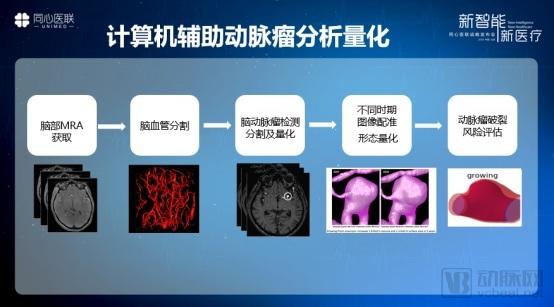
The intelligent aneurysm diagnostic product is just one of Sophmind’s 38 AI-assisted diagnostic products.Sophmind's AI products are clinically oriented and disease-centric, designed to address the practical challenges faced by clinicians.。
Liu Weiqi told VCBeat that, in the current healthcare environment, the number of public hospitals is continuously declining, while the entry barriers for private medical institutions remain high. The training cycle for physicians is lengthy, yet their legitimate professional income is low relative to the high occupational risks they face. The existing professional title evaluation system is predominantly research-oriented, placing insufficient emphasis on clinical competence.
For the post-90s and post-00s generations, the arduous journey of medical education is ill-suited to the era’s individualistic pursuit of freedom... These factors will make it even more difficult to cultivate an adequate supply of qualified healthcare professionals.
Given these challenges, it is unlikely that traditional approaches can meet the public’s growing and increasingly personalized healthcare demands. Only by leveraging new technologies aligned with clinical needs, and applying them to rapidly enhance physicians’ clinical skills, can we improve the supply of medical services.
Meanwhile, as physicians lead the clinical workflow, medical products must serve physicians and align with their actual work processes; only then can innovative products be effectively implemented in practice.
However, many AI products fail to achieve this. For instance, numerous pulmonary nodule detection systems can only identify nodules from lung CT scans while failing to recognize other lesions, which does not align well with clinicians’ workflow.
Patients undergo chest CT scans, but radiologists are often unaware of the specific clinical conditions beforehand. Consequently, the interpretation of chest CT images must account for all potential pathologies. Given that there are at least a dozen common pulmonary diseases, limiting the assessment solely to pulmonary nodules offers limited diagnostic value.
In particular, physicians are required to import medical images from the PACS system into the AI system and then feed the diagnostic results back into PACS, a process that is excessively cumbersome. The actual need of radiologists is for AI to flag all suspected lesions in specific anatomical regions, allowing physicians to simply review and verify these findings without having to re-examine each image individually.
To this end, Sophmind has taken a path that runs counter to that of most AI companies: it first focused on building infrastructure through offline imaging centers and an imaging cloud platform to accumulate imaging data and ensure data quality, thereby leveraging its own data to support algorithm optimization; and through openThe platform integrates variousProduct, enabling comprehensive auxiliary diagnosis for multiple diseases。
To facilitate the practical implementation of AI technology, Tongxin Yilian integrates four specialized domains—imaging technology, AI analysis, image diagnosis, and clinical application—to provide truly valuable diagnostic and therapeutic recommendations for physicians and patients.。
Cross-disciplinary integration faces significant challenges, as it spans the knowledge gaps across four distinct fields: biomedical engineering, computer AI, diagnostic imaging, and clinical needs. Without the resources and capabilities for cross-boundary integration, the difficulty is substantial.
Sophmind operates both an online internet hospital and offline medical imaging centers, supported by its own technical and radiologist teams. It is this ownership of professional resources and infrastructure that enables cross-sector integration.
Due to the specialized nature of medicine, it is impossible for any single team to cover all diseases; articular cartilage and Alzheimer’s disease belong to entirely different fields. Many experts, despite years of research, have only delved deeply into a few conditions within a single direction.
"Patients cannot predict the type of disease they have when seeking medical attention, so doctors prefer comprehensive solutions."
In this context, it becomes crucial to establish an open and mutually beneficial platform that enables professionals from various disciplines to leverage their respective areas of expertise, thereby integrating their specialized strengths into a comprehensive solution.
To this end, Sophmind has established the Gewu System, China’s first open application platform for imaging and AI tailored to clinicians (an Imaging AI App Store). Leveraging the extensive patient medical records accumulated on the Sophmind Cloud Platform, the company develops imaging technologies and trains AI algorithms based on clinical needs, then packages them into applications for integration into the Gewu System. Sophmind has forged close partnerships with nearly 100 world-class universities and research institutions, including Tsinghua University, Peking University, and the Chinese Academy of Sciences, leveraging their respective expertise to better apply new technologies in clinical practice.
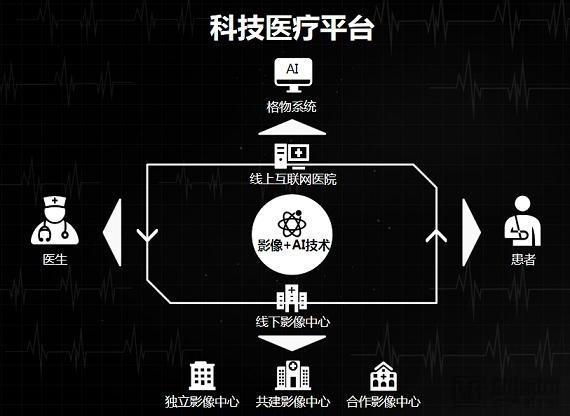
In addition to AI-assisted diagnostic products, Tongxin Yilian, positioned as a tech-driven healthcare platform, has integrated online services (internet hospital) with offline facilities (physical imaging centers) and an imaging cloud platform, thereby simultaneously serving clinical physicians, patients with specialized conditions, physical imaging centers, and imaging AI experts.
Currently,Sophmind has established business operations in internet platform development, medical service operations, physical imaging center construction, imaging cloud platform promotion, internet hospital development, and the integration of an open Imaging + AI platform., completing the development of foundational capabilities for its technology-driven healthcare platform.
After obtaining the internet hospital license in 2018, Tongxin Yilian, in compliance with national requirements for internet hospitals, provides whole-course disease management for patients with cardiovascular, cerebrovascular, and oncological conditions. This includes services such as follow-up consultations, imaging examinations, pharmaceutical care, and follow-up management, thereby extending the value chain and creating additional revenue streams. In the future, the company plans to collaborate with commercial insurance providers to deliver closed-loop medical services for patients with chronic diseases by leveraging its offline and online capabilities, thus offering insurers a basis for product development and cost-control capabilities.