

Fujian Cancer Hospital Pioneers AI-Driven Quantitative Analytics to Advance Precision Medicine
VCBeat (WeChat ID: vcbeat) has learned that on May 18, 2019, the 2019 Annual Conference of the Pathology Branch of the China International Exchange and Promotive Association for Medical and Health Care, the First Huaxia Pathology Forum, and the Continuing Education Workshop on Advances in Pediatric Pathology were held in Fuzhou, Fujian Province. At the conference, Dr. Chen Gang, Director of the Department of Pathology at Fujian Provincial Cancer Hospital, delivered a keynote presentation titled “Practice of an Artificial Intelligence-Based Big Data Analytics Platform for Tumor Immune Diagnosis and Treatment.”
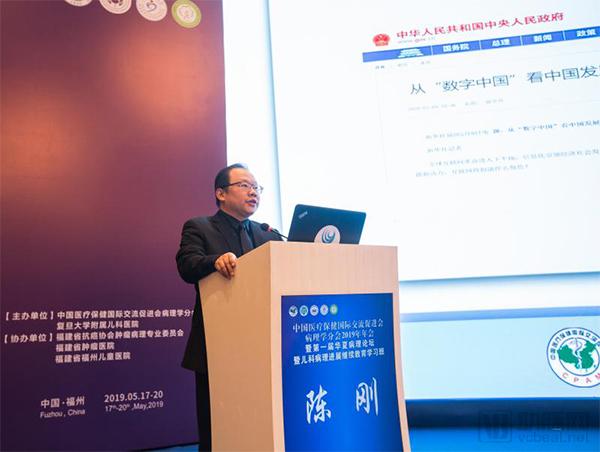
Director Chen Gang Delivered a Report at the Conference
As is well known, the two scientists who researched “cancer therapy and suppression of immune negative regulation” were awarded the 2018 Nobel Prize in Physiology or Medicine. Currently, PD-1 and PD-L1 inhibitors have been formally incorporated into the NCCN Guidelines. Precision testing based on the tumor microenvironment and genomics has made it possible to develop optimal combination regimens centered on cancer immuno-diagnosis and therapy, in conjunction with chemotherapy, radiotherapy, and targeted therapy.
As Academician Bian Xiuwu has proposed, “Next-generation Diagnostic Pathology” is highly likely to be an integrated diagnostic approach combining tumor pathological phenomics, genomics, and imaging.
Predicting the efficacy of tumor immunotherapy requires precise quantification of the immune microenvironment and key genomic indicators; however, pathology departments currently generally employ qualitative or semi-quantitative methods to detect tumor microenvironment-related markers.
The integration of artificial intelligence has begun to transform these challenges. Fujian Provincial Cancer Hospital has leveraged Genome Wisdom’s “Intelligent Phenotype Cloud” platform to perform joint analysis and quantitative calculations on multiple immunohistochemistry slides. This approach enables the quantitative assessment of the PD-L1 positive proportion in tumor cells, the ImmunoScore, and mismatch repair deficiency (dMMR).
For the quantitative analysis of key immunotherapy biomarkers in tumor genomics, such as tumor mutational burden (TMB), neoantigen burden (TNB), and microsatellite instability (MSI), Fujian Provincial Cancer Hospital utilizes Genome Wisdom Inc.’s “iGenome®Cloud” system to rapidly calculate quantitative metrics including TMB and MSI, and to provide information on relevant therapeutic agents.
In addition, pathology departments face significant challenges in data governance, bioinformatics analysis, and report interpretation. The “Smart Gene Cloud” system effectively helps hospitals address three major pain points encountered in conducting next-generation sequencing (NGS) testing on-site: difficulties in data quality control and localized management, low accuracy and efficiency in data analysis, and the lack of standardized databases, knowledge bases, and reporting logic.
Precision medicine in China is advancing rapidly, and the integration of artificial intelligence (AI) has the potential to bring disruptive changes to this field. Today, "Digital China" has become a new national development strategy, with Fujian Province serving as a model region for this initiative. As the only tertiary Grade A hospital specializing in oncology in Fujian Province, Fujian Provincial Cancer Hospital has long been actively deploying AI-related initiatives, which have received support from major special projects funded by the Fujian Provincial Department of Science and Technology.
In December 2018, the Fujian Provincial Engineering Research Center for Precision Oncology Diagnosis and Immunotherapy, led by Fujian Provincial Cancer Hospital in its application, was approved by the Fujian Provincial Development and Reform Commission. The project will integrate multiple sectors, including industry, academia, research, clinical practice, and application, to conduct scientific innovation and translational research in precision cancer diagnosis.
Professor Zheng Xiongwei, President of Fujian Provincial Cancer Hospital and Vice Chairman of the CSCO Pathology Committee, also expressed high expectations for the development of artificial intelligence technology in healthcare and pathology.
Following the conference, President Zheng Xiongwei stated that, as the host institution for both the Fujian Provincial Engineering Research Center for Precision Diagnosis and Immunotherapy of Tumors and the Fujian Provincial Institute of Technological Innovation in Precision Medicine Industry, Fujian Provincial Cancer Hospital has established an intelligent big-data research and development platform dedicated to precision oncology. This platform will integrate multi-omics big data—including genomics, pathomics, and radiomics—and leverage artificial intelligence technologies to facilitate the implementation and advancement of precision cancer care.