

Infervision Showcases China's AI Healthcare Innovation at World Health Assembly, Accelerating Global Expansion

Infervision
Artificial Intelligence Product Developer
VCBeat (WeChat ID: vcbeat) has learned that the 72nd World Health Assembly was held in Geneva, Switzerland, from May 20 to 28, 2019, with representatives from all 194 member states of the World Health Organization in attendance.
The World Health Assembly is the highest decision-making body of the World Health Organization (WHO), primarily responsible for reviewing the WHO Director-General’s work report and the WHO budget report, as well as discussing a range of hot-button issues related to global public health.
The “Health Innovation Exchange Forum” held during the World Health Assembly brought together outstanding “innovative enterprises” from around the globe, along with policymakers, investors, representatives of international organizations, and implementers. The event attracted more than 3,000 participants, including over 100 health ministers from countries worldwide. The forum aimed to provide a platform for innovation-driven companies in the health sector to showcase their achievements, engage in mutual learning, and foster a robust innovation ecosystem.
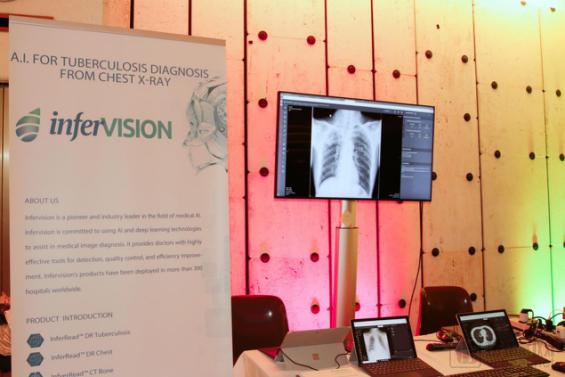
Infervision Booth
The forum organizer stated, “Since the official launch of the United Nations’ 2030 Agenda for Sustainable Development on January 1, 2016, countries around the world have been striving to achieve the 17 Sustainable Development Goals. In this process, the large-scale implementation of new technologies, the provision of innovative service models, and financing solutions are indispensable. In the field of health, innovation in new technologies is closely linked to the goals of sustainable development. We hope to foster connections among innovation, technology, and national needs through forum exchanges, and to link innovation with appropriate funding and investment to expand impact, thereby establishing a well-functioning innovation ecosystem.”
According to reports, this marked the first time the World Health Assembly opened its doors to global “outstanding enterprises.” After undergoing rigorous selection and evaluation by the organizers, Infervision emerged as one of the 20 distinguished innovative companies in the field of global health, and was the only Chinese high-tech medical enterprise to receive this recognition. Subsequently, Infervision was invited to attend the 72nd World Health Assembly and participated in the interactive exhibition at the “Health Innovation Exchange Forum.”
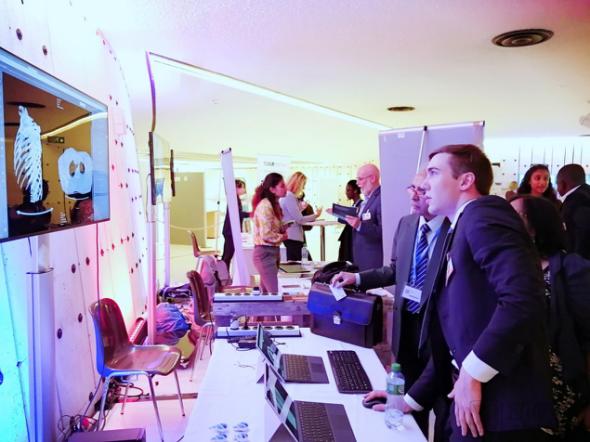
Introducing Infervision’s AI Medical Products to Attendees
Today, Infervision’s innovative AI medical imaging products—including the lung-assisted screening solution InferRead CT Lung, the chest-assisted screening solution InferRead DR Chest, the stroke-assisted screening solution InferRead CT Stroke, and the medical imaging deep learning platform InferScholar Center—have been successfully deployed in hospitals. At this conference, these products were all showcased, representing China’s cutting-edge intelligence.
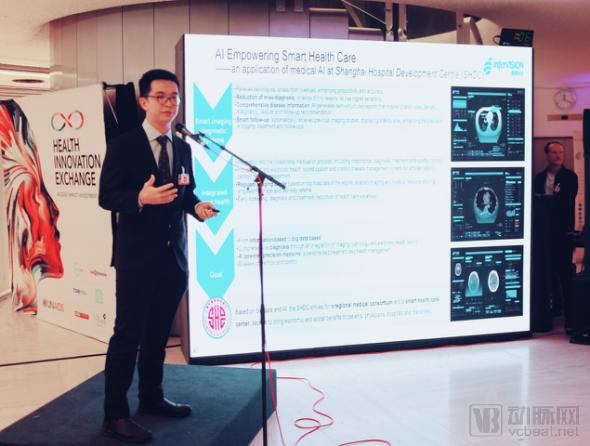
Infervision Founder and CEO Chen Kuan Delivers Keynote Address
Chen Kuan, Founder and CEO of Infervision, specifically highlighted four renowned hospitals that have established in-depth collaborations with the company during his keynote address at the forum: Shanghai Changzheng Hospital, Shenzhen Third People’s Hospital, Mianyang Central Hospital, and the Third Affiliated Hospital of Jinzhou Medical University. Through these partnerships, Infervision’s AI-powered medical products have been deeply integrated into frontline clinical workflows, while physicians’ understanding and utilization of AI technologies have become increasingly sophisticated.
Many physicians have stated that Infervision’s AI healthcare products have significantly improved their work efficiency and image interpretation throughput, freeing them from cumbersome tasks. Meanwhile, with the support of Infervision’s AI solutions, hospitals have gradually established pulmonary nodule outpatient centers, thereby accelerating the development of lung cancer diagnosis and treatment centers and positioning themselves as the preferred choice for local residents seeking lung cancer screening.
Infervision’s deep learning-based AI algorithm for chest X-ray screening can rapidly and accurately identify tuberculosis lesions, significantly enhancing hospitals’ TB screening efficiency, shifting prevention and control efforts upstream, and effectively reducing the transmission and incidence rates of tuberculosis.
In the future, Infervision’s AI-powered medical products will not only be applied to the screening, prevention, and treatment of diseases such as lung cancer and pulmonary tuberculosis but will also shine in a broader range of clinical areas.
During the forum, Infervision not only fully showcased its scientific research and innovation capabilities to attendees but also shared its experience in using AI for tuberculosis (TB) prevention and control. This provided new insights for TB prevention and control in China and around the world, drawing significant attention from over 100 health ministers from various countries, as well as officials from the World Health Organization (WHO) and the Joint United Nations Programme on HIV/AIDS (UNAIDS).
Data indicates that tuberculosis is an ancient disease. To this day, it remains one of the top ten causes of death worldwide. This is partly because the disease continues to “evolve”; globally, the treatment success rate for multidrug-resistant tuberculosis (MDR-TB) is only 55%. Furthermore, the spread of acquired immunodeficiency syndrome (AIDS) has led to a resurgence of tuberculosis. Among HIV-positive individuals, the incidence of tuberculosis is 30 times higher than in HIV-negative individuals, and the case fatality rate for those co-infected with both diseases is as high as one-third. By exacerbating the threat of tuberculosis, AIDS endangers the health of people worldwide.
In China, the threat of tuberculosis (TB) cannot be underestimated. Due to its large population base, China has the second-highest number of TB patients globally and is one of the 30 high-burden countries for TB worldwide, making TB prevention and control a significant and long-term challenge. The "13th Five-Year National Tuberculosis Prevention and Control Plan," issued by the General Office of the State Council, clearly points out that China still faces issues such as inadequate diagnostic and treatment conditions in some designated TB medical institutions, insufficient facilities and equipment required for prevention and control, weak grassroots prevention and control capabilities, and difficulties in detecting and managing TB among the floating population.
However, with technological advancements, increasingly mature artificial intelligence and deep learning technologies have been deeply integrated into the healthcare industry, providing significant support for tuberculosis (TB) prevention and control efforts. Chen Kuan, Founder and CEO of Infervision, stated in his speech, “One of the greatest values of AI lies in addressing the shortage of medical resources. Poverty-stricken areas with insufficient medical resources and prevention capabilities, as well as densely populated regions with high population mobility, represent weak links in the TB prevention and control system. In these areas, if TB patients are not screened and diagnosed at an early stage, they are highly likely to unknowingly spread Mycobacterium tuberculosis, leading to regional outbreaks. Therefore, early and efficient screening of TB patients is a critical step in TB prevention and control.”
It is precisely on this basis that Infervision has chosen to leverage AI to combat tuberculosis. Its deep learning-based intelligent chest X-ray screening algorithm can rapidly identify pulmonary tuberculosis, addressing diagnostic shortcomings in underdeveloped regions and certain primary healthcare institutions while significantly improving screening efficiency. By shifting prevention and control efforts upstream, it reduces transmission and incidence rates, thereby alleviating the national burden of tuberculosis prevention and control.
“Chest X-ray screening for tuberculosis offers numerous advantages, including high sensitivity, low cost, and widespread availability of equipment. Data show that the use of chest X-rays can increase the tuberculosis diagnosis rate by 30%–40%. The application of AI technology acts as a booster for chest X-rays—the most common and widely used method for examining thoracic and pulmonary diseases—thereby enhancing tuberculosis prevention and control efforts and enabling AI to assist humanity in winning the critical battle against tuberculosis,” said Chen Kuan.
The rapid development of artificial intelligence (AI) has created opportunities across numerous scenarios, and the integration of AI into various industries has become an inevitable trend. Technological innovations and applications, along with the emergence of new business and service models, are bringing about profound changes to all sectors. In this process, healthcare has emerged as one of the fields benefiting most from AI technology, with AI providing new breakthroughs and development opportunities for the traditional medical and health industry.
As Chen Kuan, Founder and CEO of Infervision, stated, “AI has been inextricably linked with medicine since its inception, and technological innovation brings new opportunities and challenges to the traditional healthcare industry.” In Chen’s view, innovation has always been the driving force behind Infervision. Within just four years, Infervision has successfully partnered with more than 300 hospitals worldwide, ensuring the practical deployment of its products and fulfilling its commitment to “originating from clinical practice and returning to clinical practice.” This achievement underscores Infervision’s unwavering dedication to innovation in thinking, technology, products, and services.
According to Chen Kuan, Infervision currently not only offers AI-powered medical imaging products to assist physicians in diagnosis but has also established the “iCR-InferVision Global Clinical Collaboration Research Institute,” formally entering the field of clinical research in medical imaging AI. This move aims to further advance the development of clinical disciplines in medical AI. Looking ahead, Infervision will remain committed to its belief in innovation, closely integrating technology, products, and services with clinical medical practice, deeply exploring the clinical application value of artificial intelligence in medical imaging, and continuously empowering healthcare through AI-driven innovation.