

29 Companies Secure Internet Hospital Licenses: Highlights of Ningxia's 'Internet + Healthcare' Development
On May 28, the National Health Commission held a press conference in Yinchuan, Ningxia. The session was moderated by Liu Zhefeng, Director of the News and Network Division under the Department of Publicity of the National Health Commission, who introduced the development of “Internet + Healthcare” in the region.
At the conference, participating guests included Tang Yonglin, Director of the Big Data Office under the Department of Planning of the National Health Commission; Ruan Yuesheng, Deputy Director of the Health Commission of Ningxia Hui Autonomous Region; Ma Xiaofei, Director of the Health Commission of Yinchuan City, Ningxia Hui Autonomous Region; Du Yong, Vice President of the General Hospital of Ningxia Medical University; and Feng Xu, Director of the Cloud Computing and Big Data Development Bureau of Zhongwei City, Ningxia Hui Autonomous Region. They each spoke about how Yinchuan, as a demonstration base for “Internet + Healthcare,” has in recent yearsConstruction, Application, Products, Services, and Other SegmentsVCBeat (WeChat ID: vcbeat) has edited and organized the key highlights of the achievements made.
According to Ruan Yuesheng, Deputy Director of the Health Commission of Ningxia Hui Autonomous Region, since the approval of Ningxia as a demonstration zone for “Internet + Healthcare” in July 2018, its development has primarily focused on the following areas:
First, the People's Government of the Autonomous Region and the National Health Commission jointly signed a strategic cooperation agreement on the demonstration zone.Established a leadership group and set up a co-construction mechanism., jointly formulated the construction plan for the demonstration zone and coordinated its implementation.
Next, focus on top-level design to establish the “12354” development framework for the demonstration zone.Specifically, this involves consolidating a foundation for interconnectivity; establishing two major centers—the Health and Medical Big Data Center and Industrial Park, and the Regional Medical Center; strengthening three safeguards—Party building and professional conduct, integration of research and application, and innovative industry policy support; and constructing five major platforms—the National Population Health Information Platform, Internet Healthcare Platform, Internet Diagnostic Platform, Internet Pharmaceutical Platform, and Internet Operational Supervision Platform. The goal is to achieve demonstrative innovations in four areas: interconnectivity, integrated application services, industry cultivation, and policy mechanisms. Currently, all related initiatives are being steadily implemented within this framework.
Finally, promote interconnectivity.Adhering to the holistic, region-wide strategic approach, we have coordinated and advanced the cross-regional, cross-departmental, and cross-level integrated application and deep fusion of data in healthcare, social security, and poverty alleviation. We have established the “Health Cloud” National Health Information Platform, integrating systems for public health and medical management, and constructed a five-tier telemedicine service system extending down to the village level.
The Autonomous Region’s Telemedicine Service Platform has established upward connections with 30 national-level medical institutions and downward connections with 225 medical institutions at the autonomous region, municipal, county, and township levels, initially achieving interoperability of information such as residents’ health records, family doctor contract services, and “one-stop” settlement for health poverty alleviation.
Currently, the Autonomous Region’s Population Health Information Platform has aggregated more than 10 million electronic medical record (EMR) entries, integrated over 110 million health insurance records, and linked more than 5.7 million public security household registration records.Real-time monitoring of the entire vaccine distribution process, integrated management of blood collection, testing, preparation, supply, and allocation, unified dispatching of 120 emergency medical services across the region, and interconnected operations between public traditional Chinese medicine (TCM) hospitals and grassroots TCM clinics.
In building a new model of diagnosis and treatment services, the autonomous region has equipped all township health centers with imaging equipment such as DR or CR, as well as telemedicine information devices including static ECG and audio-video terminals. Across the entire region, all townships, along with community health service centers and village clinics that meet the necessary conditions, have comprehensively promoted remote medical services for consultation, imaging, ECG, ultrasound, and pathology, thereby establishing a basic diagnostic and treatment mechanism characterized by “primary-level examination, superior-level diagnosis, and regional mutual recognition.”
Leveraging multiple teleconsultation networks, including those for remote imaging and remote electrocardiography (ECG), primary healthcare institutions can complete the upload, diagnosis, and transmission of reports for various medical images and ECGs within 20 minutes. Compared with 2017, the number of outpatient visits and inpatient admissions at primary healthcare institutions increased by 12.5% and 13.7%, respectively, in 2018.
Family Doctor Contract ServiceBy establishing a unified chronic disease management system across the entire district and forming family doctor teams that integrate specialists with general practitioners, we provide residents with multi-channel online and offline services, including online access to health records and health management. These efforts aim to significantly enhance chronic disease management capabilities and address the insufficiency of health services for common and frequently occurring diseases among the public. Through this new mechanism, the standardized management rates for hypertension and diabetes patients at the primary care level reached 83.71% and 82.54%, respectively.
Meanwhile, Yinchuan City and Zhongwei City are accelerating the construction of the National Health and Medical Big Data Center and Industrial Park.More than 40 internet companies have established operations in the industrial parks of the two cities, with 29 internet healthcare companies obtaining medical institution practice licenses. The total number of online physicians registered in Yinchuan has exceeded 30,000, providing cumulative services to over 13 million patient visits.More than 10 policy documents, including the “Implementation Measures for the Administration of Internet Hospitals in the Ningxia Hui Autonomous Region,” have been issued, and a region-wide online regulatory platform for internet hospitals has been established to provide end-to-end oversight of online medical service activities.
Currently, the "Internet + Healthcare" service model in Yinchuan City,Comprising five application systems and five safeguard measures, it has achieved three key outcomes.According toMa Xiaofei, Director of the Yinchuan Municipal Health Commission of Ningxia Hui Autonomous Region, introduced, Five Application Systemsis the main practice of Yinchuan City,The details are as follows:
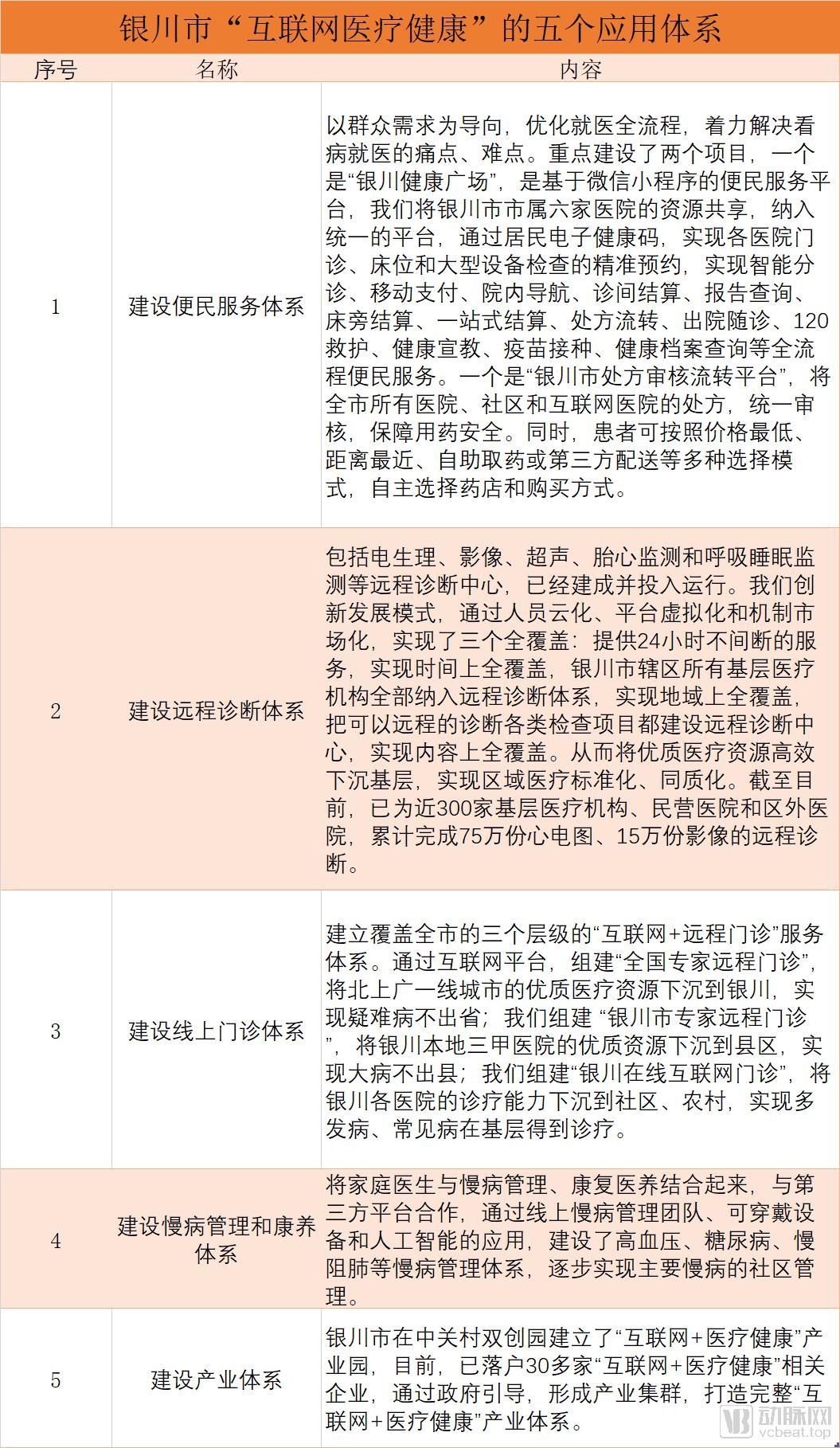
In terms of safeguard measures, it includes policy safeguards, regulatory safeguards, standardization safeguards, service safeguards, and technical safeguards.
Policy Support:Over the past two years, Yinchuan City has successively introduced 16 supporting policies, establishing a relatively comprehensive regulatory framework that clarifies behavioral boundaries and promotes standardized development.
Regulatory Safeguards:China took the lead in establishing the “Internet Healthcare Supervision Platform,” which went live last April. Leveraging the comprehensive traceability of online diagnosis and treatment activities, the platform enables full-process, all-encompassing, and fully automated real-time online supervision, thereby ensuring medical quality and data security.
Standard Coverage:Established admission criteria and procedural specifications for internet-based diagnosis and treatment to ensure the standardization and homogenization of online medical practices.
Technical Support:More than a year ago, we established the “Yinchuan Internet + Medical Health Application Research Center,” bringing together more than ten leading companies across China to provide technical support for the development of medical and healthcare services in Yinchuan.
Service Guarantee:Bringing together more than 40 leading internet healthcare enterprises across China, establishing an Internet Healthcare Industry Association, formulating industry self-regulatory guidelines, exploring norms and standards for internet healthcare, and promoting its standardized development.
Currently, Yinchuan City’s “Internet + Healthcare” has achieved results in three areas:
First, by decentralizing resources, it has alleviated the difficulties, high costs, and inconveniences that the public face in seeking medical care;
Second, leveraging internet-based approaches to advance healthcare reform;
Third, a relatively complete set of low-cost, replicable “Internet + Healthcare” service models has been developed.
At the hospital level, according to Du Yong, Vice President of General Hospital of Ningxia Medical University, in accordance with the unified planning of the Health Commission of Ningxia Hui Autonomous Region, General Hospital of Ningxia Medical University has actively developed a remote diagnosis platform. It has established the Ningxia Regional Imaging Diagnosis Center, Pathology Diagnosis Center, and Remote Consultation Platform, providing medical services such as remote diagnosis for complex imaging cases, remote consultations, remote education, and remote outpatient services to secondary and tertiary hospitals across the region.
Currently, the hospital has established connections with 30 national-level medical institutions, including the Chinese PLA General Hospital. Within its region, it covers seven autonomous region-level hospitals, 22 municipal and county general hospitals, 196 township health centers, and 100 village clinics (community health service stations). To date, a total of 328 remote consultations have been conducted; there have been more than 50 instances of remote surgical guidance and tele-education, with over 4,000 participants from 172 hospitals attending online lectures.
Over the past two years, the hospital has leveraged information technology to improve services across multiple stages, including pre-consultation, during consultation, and post-consultation.
1. Appointment services cover the entire patient journey.The hospital has launched a range of convenient registration services through both online and offline channels, including time-slot-based online appointment booking and in-clinic scheduling. Patients who book appointments online can arrive at the designated consulting room at their scheduled time for consultation. Currently, 100% of appointment slots are precisely released. In 2018, the appointment rate exceeded 60%, with time-slot precision down to 30-minute intervals. Registration time has been reduced to under four minutes. Appointments for all major medical equipment examinations can be scheduled for specific time slots. Pilot programs for inpatient bed reservations and day-surgery bookings are currently underway; these initiatives will be fully rolled out in 2019, aiming to reduce patient waiting times for medical consultations and treatments.
2. Real-time Query of Examination and Test Results.The hospital has deployed cloud-based imaging and reporting systems, enabling remote access to images and reports. Patients can use their mobile phones to query test and examination results, self-print reports and films, and view daily inpatient billing statements.
Third, real-time settlement of various fees has been achieved.A variety of payment methods have been implemented, including self-service kiosk payments, point-of-care payments, inpatient ward payments, and mobile terminal payments. Both self-pay and insurance-covered patients can complete real-time settlement of various fees anytime and anywhere. The pilot bedside settlement service allows patients to handle all procedures from admission to discharge directly in their hospital rooms, reducing the time required for discharge processing from an initial 40 minutes to just 5 minutes.
Fourth, the application of artificial intelligence has been effectively advanced.Centralized storage and archiving, centralized image interpretation, and centralized report issuance services have been implemented for the PACS system across the hospital group. Full coverage of mobile nursing has been achieved, enabling nurses to complete a series of nursing tasks through bedside scanning. Additionally, the Mobile Physician App has been launched, allowing doctors to query consultation records, patient examination and test reports, and other information anytime via their mobile phones, significantly improving work efficiency.
Since last year, the hospital’s radiology department has implemented an intelligent medical imaging diagnosis system for the screening and diagnosis of pulmonary nodules. To date, nearly 20,000 cases have been screened using artificial intelligence, significantly improving physicians’ work efficiency. The hospital is also rolling out an intelligent speech recognition system, enabling reporting physicians to complete report documentation simply by using handheld voice input devices, thereby further enhancing operational efficiency.
In 2018, the National Health Commission officially approved Ningxia’s establishment of an “Internet + Healthcare” demonstration zone, making it the sixth province-level region in China to host a National Health and Medical Big Data Center and Industrial Park, following Jiangsu, Fujian, Shandong, Anhui, and Guizhou.
Centered on the Health and Medical Big Data Center, Zhongwei City is committed to building a health and medical big data center characterized by the coexistence, joint construction, and shared use of multi-cloud platforms. Relying on unified cloud management, cloud scheduling, and network management platforms, it focuses on diverse scenarios, business operations, and data. Taking Zones A, B, and C as examples: Zone A primarily hosts the government cloud and medical cloud; Zone B operates as a market-oriented medical cloud; and Zone C serves as a data center integrating multi-cloud and cloud management capabilities. Through a comprehensive “integrated” big data infrastructure platform and a multi-cloud computing resource management platform, these three zones achieve centralized resource control and integrated capabilities.
Currently, Zhongwei City has established a dedicated medical cloud zone, deploying 24 servers, including two GPU-based cloud hosts and 2,000 GB of cloud storage space. It features public IP addresses and load balancing capabilities, and has achieved interconnectivity with the Autonomous Region’s Public Government Cloud Platform and the Electronic Government Extranet. This infrastructure meets the requirements for hosting healthcare big data and related business systems. This summarizes the basic status of the Medical Big Data Center.
Meanwhile, Feng Xu, Director of the Cloud Computing and Big Data Development Bureau of Zhongwei City, Ningxia Hui Autonomous Region, stated that the construction of a medical big data industrial park leverages the Military-Civilian Integration Industrial Park. Focusing on areas such as national health, integrated county-level healthcare, applications of medical and health big data, remote diagnosis and treatment bases, health management, pharmaceutical services, integration of medical and elderly care, and the AI-driven medical industry, the initiative aims to establish a national-level medical big data industrial park. This effort seeks to create a comprehensive medical demonstration zone integrating “production, research, innovation, and public benefit.” To date, more than 10 enterprises have signed agreements to settle in the industrial park, with continued efforts to intensify investment promotion in the future.To date, the data center has provided cloud services to 13 medical institutions within the region.
In terms of industry, Ma Xiaofei proposed two years ago that new business models should drive the development of new industries.
One key initiative is the development of an internet hospital platform. Without the support of various platforms, it would be difficult for internet healthcare to develop. This is also why Yinchuan City has collaborated with a large number of third-party internet healthcare platforms. At this stage, good results have been achieved, and some mainstream enterprises have been nurtured.
Second is artificial intelligence. By leveraging large volumes of data, various AI applications have been developed. Currently, AI applications in Yinchuan City have permeated multiple sectors, including the public convenience service system, remote diagnostic system, remote consultation and treatment system, and chronic disease management system.
Third is the extended supporting industries. For instance, in chronic disease management, the widespread use of wearable devices combined with internet-based healthcare has given rise to new “Internet + Healthcare” industries.
“We are building industrial parks and creating industry clusters, with the ultimate goal of forming a complete industrial chain,” said Ma Xiaofei.
In summarizing the experience of Ningxia,Tang Yonglin stated that the first aspect is the spirit of reform and innovation in Ningxia.The development of big data in internet-based healthcare is, first and foremost, a matter of perception; the level of understanding achieved determines the extent to which its potential can be realized. As an inland province in western China, Ningxia has proactively emancipated its mindset and updated its concepts despite relatively scarce medical resources. It has transformed the potential energy derived from regional disparities in medical resources into kinetic energy for developing “Internet + Healthcare.” By leveraging the advantages of the Internet in transcending time and space constraints, Ningxia has addressed the challenge of resource scarcity and pioneered a pathway for western regions to catch up and surpass.
The second aspect: Ningxia’s explorations in systems and mechanisms.Internet-based healthcare is a positive development, yet it faces challenges regarding implementation and sustainable growth. It is essential to transform previously unpaid, aid-oriented services into standard medical activities that benefit doctors, patients, hospitals, and enterprises alike. This requires reasonable pricing, allocation, and cost-sharing mechanisms. Ningxia has pioneered such approaches by establishing distribution mechanisms that mobilize stakeholder enthusiasm without increasing the financial burden on patients. As a result, patients who previously traveled to Beijing for care can now receive treatment within Ningxia, and those seeking care in Ningxia can access services at the district and county levels. This not only facilitates patient access and promotes equity by extending high-quality resources to the broader public but also enables local hospitals to retain patients and helps local physicians enhance their professional capabilities, thereby creating a win-win situation for all parties involved.
The third aspect is to coordinate and leverage resources from all parties.At the State Council executive meeting on May 22, Premier Li Keqiang specifically emphasized the need to support collaboration between social medical institutions and public healthcare facilities in developing internet-based healthcare services. The advancement of internet healthcare requires concerted efforts from government, industry, academia, research, and end-users. In this regard, Ningxia has paid careful attention to defining the roles of government and the market: the government proactively fulfills its responsibility to ensure basic healthcare services, while market-oriented mechanisms are established to mobilize social resources to meet non-basic healthcare demands. Emphasis is placed on leveraging the resource-aggregation advantages of platforms, such as Ningxia’s remote diagnosis services and family doctor contract signing programs, thereby driving new industries through emerging business models.
According to preliminary statistics based on publicly available data, as of last month, 27 provinces had issued specific measures for implementing Document No. 26 of the General Office of the State Council, 26 provinces had released documents on “Internet + Medical Health” initiatives to facilitate and benefit the public, and 30 provinces had introduced relevant supporting policies. A total of 4,326 hospitals provided online services such as time-slot appointment booking, sharing of monitoring and test results, and mobile payments. On May 8, the Ningxia Hui Autonomous Region and ten other provinces—Tianjin, Jiangsu, Zhejiang, Anhui, Fujian, Shandong, Hubei, Guangdong, Sichuan, and Guizhou—signed a strategic cooperation agreement titled “Jointly Building Internet Medical Health Demonstration Provinces,” with the primary aim of further advancing the development of these demonstration provinces.
According to Tang Yonglin,Key Priorities for the Next Phase in Building Demonstration ProvincesThe following initiatives will be advanced:
First, explore the policy framework for “Internet + Healthcare.” Further efforts should be made to investigate issues related to information sharing, data security, pricing and fees, regulatory models, payment methods, and benefit distribution. Establish and improve the policies, mechanisms, standards, and norms governing the development of “Internet + Healthcare.”
Second, promote the industrial application of internet healthcare and health big data, carry out the construction of big data centers and industrial parks, focus on medical services as the core, and cultivate and foster new business formats that drive industrial development;
Third, enhance the level of regional medical services, promote the effective flow of high-quality medical resources, and fully leverage new "Internet Plus" models to establish regional medical centers that integrate medical services, scientific research and teaching, and the health industry. This will drive improvements in medical service capabilities within the demonstration province and surrounding areas. On this basis, it is essential to heighten safety awareness, strictly implement relevant standards and requirements, ensure that "Internet Plus Healthcare" adheres to medical principles, prioritizes medical quality, safeguards patient safety, maintains orderly medical practices, and firmly upholds the baseline for safety.
Ma Xiaofei concluded by stating that, in terms of overall planning, five strategic highlands should be established: a policy highland, an innovation highland, an application highland, an industrial highland, and a service highland.
Its objective is to promote the deep integration of the internet with healthcare, thereby establishing a comprehensive “Internet + Healthcare” ecosystem. Through the development of this system, we aim to achieve full coverage for the public across prevention, health maintenance, medical treatment, elderly care, and the entire life cycle.
In terms of in-depth development, the focus was previously on healthcare itself, addressing surface-level issues. Now, we must leverage the Internet to transform medical models, thereby changing the internal operations, core mechanisms, and behaviors within the healthcare industry. The most critical issue is breaking through and innovating these mechanisms. For instance, we are currently exploring the establishment of a citywide unified supply chain platform and integrated medical services, a citywide unified regional prescription review and circulation platform, and a citywide unified diagnosis and treatment service platform. This approach treats the entire city as a single entity, coordinating all municipal medical resources to advance healthcare reform. This is the core objective for achieving in-depth development.
Building on our previously established and mature framework, we are expanding the scope of services with a focus on disease prevention, chronic disease management, and the integration of medical care with elderly care. A key priority is ensuring comprehensive coverage in the areas of prevention, chronic disease management, community-based services, and elderly care services. From the second half of this year through next year, we plan to implement grid-based screening and management for the city’s population of over 2 million, ensuring that all residents have access to “Internet + Healthcare” services. This city-wide, coordinated approach aims to provide universal health coverage for all citizens. This is undoubtedly a long-term endeavor that cannot be achieved overnight.
Furthermore, building on the currently established system, we are based in Yinchuan, serve Ningxia, extend our reach across Northwest China, and support the “Belt and Road” Initiative. Hospitals in Inner Mongolia and northern Shaanxi have established collaborations with Ningxia’s platform, with outreach extending as far as Africa. Ningxia’s overseas medical aid teams have achieved considerable maturity in providing remote diagnostic services and surgical guidance.