

Rotex Medical Advances Flexible Electronics for Next-Gen Skincare: Files IPO Prospectus
In April this year, a research team led by Dr. Hu Xuefeng, Chief Scientist at RouDian YunKe, published their latest findings in the world-leading biomaterials journals Acta Biomaterialia and Journal of Materials Chemistry B (as a cover article). They pioneered an electrical stimulation technique based on flexible electronic materials to promote the treatment of chronic wounds, drawing widespread attention from the industry. In fact, this marks another high-profile appearance for RouDian YunKe, following the feature of its electronic skin product on the CES website homepage two years ago.
In the article, Hu Xuefeng’s team applied a specialized treatment to common hydrogel wound dressings, thereby addressing the issue of reduced electrical conductivity in weakly alkaline physiological environments. Results from in vitro scratch assays and in vivo animal studies demonstrated that the treated hydrogels could prevent bacterial adhesion and protein absorption, helping to reduce the risk of infection and secondary injury during dressing changes, with performance superior to that of the commercial Hydrosorb dressing.

In fact, the two papers published this time are only phased achievements of Hu Xuefeng’s team after years of research. Some of the preliminary results of the research are undergoing industrial translation and are about to achieve mass production.
Dr. Hu Xuefeng holds a Ph.D. in Chemistry and Biomolecules from the National University of Singapore and has conducted extensive research in the fields of novel biomaterials and medical devices. Dr. Hu told VCBeat New Medicine that his research revealed that microcurrents can significantly enhance the bactericidal efficacy of antibiotics against bacterial biofilms. This discovery excited him, as tightly packed bacteria secrete an extracellular matrix to form a protective coating, preventing antibiotics at safe concentrations from penetrating the biofilm and killing the bacteria. The application of an electric field facilitates the penetration of antibiotics through this bacterial coating, reaching the deeper layers of the bacterial population.
In 2016, Dr. Hu Xuefeng was formally recruited by the National Engineering Research Center for Biomaterials at Sichuan University, where he became a young core professor. At that time, his undergraduate classmate, Yang Zeyu, had already registered his own company, focusing on research into flexible electronic product solutions. The two parties engaged in in-depth discussions on applications of electrical stimulation and transdermal drug delivery based on flexible electronic technology. Subsequently, Dr. Hu joined this company, named Roudian Yunke (Chengdu Science And Technology Co.,Ltd.), as Chief Scientist.
Hu Xuefeng and Yang Zeyu envision that the first application scenario for flexible electronic materials to promote tissue repair through electrical stimulation is chronic wound healing. Clinically, chronic wounds are typically defined as wounds caused by various factors that fail to heal after more than one month of treatment and show no tendency toward healing. Patients with diabetes and individuals requiring long-term bed rest are high-risk populations for chronic wounds. Currently, there are no effective clinical treatments available; prolonged exposure of the wound significantly increases the risk of infection, which can be life-threatening in severe cases.
Chengdu Science And Technology Co.,Ltd. uses conductive materials to create dressings for chronic wounds, stimulating the growth and differentiation of cells at the wound site with microcurrents to promote healing. "This treatment method is easy to operate and has few side effects. It was recognized by many domestic experts in chronic trauma during the research phase."
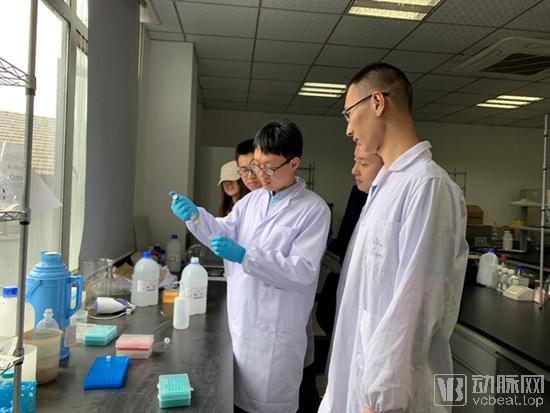 Dr. Xuefeng Hu’s Laboratory at the National Center
Roudian Yunke swiftly initiated animal studies. After overcoming numerous challenges, the company obtained promising data from these experiments, which formed the basis for the two articles mentioned at the beginning of this piece. Dr. Hu Xuefeng told VCBeat’s New Medicine that Roudian Yunke has completed the clinical trial design for its conductive dressings in humans and expects to apply for a Class III medical device registration certificate within two years, with diabetic foot as the initial indication.
Guo Yi, Chief Operating Officer of Chengdu Science And Technology Co.,Ltd., who accompanied me on this trip, told me that in anticipation of the long R&D cycle for medical devices, they have been commercializing their concurrently developed consumer-grade products. These include the flexible electronic material-based transdermal drug delivery technology, a project initiated in 2017.
The core materials for flexible transdermal drug delivery are the electronic skin technology and infusion algorithms independently developed by RouDian YunKe. This technology enables non-invasive, microcurrent-mediated drug delivery into the skin. Its primary application scenario in the consumer sector is providing raw materials for facial mask production.
According to Dr. Hu Xuefeng, the Young’s modulus of the electronic skin developed by Rou Dian Yun Ke is fully consistent with that of human skin (Note: Young’s modulus is a quantitative indicator characterizing the stiffness or softness of a material). “We are the first in the world to achieve a Young’s modulus for a metal that matches that of human skin.” Although flexible electronic technology has been widely applied in semiconductor materials, it enables flexible conductive materials to possess the characteristics of being repeatedly twisted, folded, and stretched.
According to Guo Yi, the pioneering distinction was hard-won. With no existing reference framework in the market, RouDian YunKe independently designed algorithms during its early R&D phase, refining them through thousands of experiments to strike a stable balance between product efficacy and user experience. “It took us two years to go from finalizing the product concept to conducting animal trials and developing the prototype,” he said.
Both animal experiments and human trials were conducted on the ministerial-level cosmetics testing platform at West China Hospital. During the experiments, Hu Xuefeng led his team in sequentially applying a hydrophilic high-molecular-weight hyaluronic acid solution to the shaved epidermis of rats and rabbits, followed by the application of facial masks and the administration of electrical current. After the electric field was maintained for a specified duration, researchers harvested skin tissue sections from the test animals to assess the depth of hyaluronic acid penetration into the skin.
After numerous attempts, Hu Xuefeng’s team detected that hyaluronic acid could penetrate more than 1 millimeter beneath the epidermis, reaching the dermis, which is densely populated with blood vessels. “This means we have overcome the most challenging aspect of transdermal drug delivery,” as the inability to deliver large-molecule hydrophilic drugs into the skin currently represents the biggest bottleneck in this field. Recalling the moment when they obtained the animal trial data, Hu Xuefeng remains highly excited.
Subsequently, FlexElec CloudTech initiated its friendly user trial program. In reality, the workload involved in refining product design details from animal experiments to human trials remained substantial. For instance, the electronic skin used in human trials covered a larger area than that used in animal studies, necessitating the recalibration of various parameters and updates to downstream manufacturing processes. This phase lasted for one and a half years. Professional testing conducted at the Cosmetic Inspection Platform of the Ministry of Health at West China Hospital yielded encouraging results for the team: compared to conventional facial masks, subjects using FlexElec CloudTech’s electronic skin for ingredient delivery exhibited three times higher skin hydration levels and a 30% reduction in transepidermal water loss rate.
Following the release of experimental data, Guo Yi became even busier than before. Over the past few months, he has met with numerous partners without interruption, as Chengdu Science And Technology Co.,Ltd.’s electronic skin technology has extended its reach into Japan.
As a carrier for beauty and skincare products, facial masks are one of the few cosmetic categories dominated by domestic Chinese brands. In recent years, the Asian facial mask market, led by Japanese and South Korean brands and primarily driven by independent domestic brands, has captured over 70% of the global market share. It is estimated that the domestic facial mask market in China is approaching RMB 40 billion. Facial masks come in various forms, including sheet masks, wash-off masks, leave-on overnight masks, peel-off masks, and compressed travel masks. Sheet masks account for over 70% of the domestic market share, among which those with hydrating and moisturizing as their primary function hold more than 50% of the market.Chengdu Science And Technology Co.,Ltd. does not aim to become a facial mask manufacturer; rather, it seeks to collaborate with brand owners, positioning its technology as a core auxiliary tool to facilitate the delivery of various active essences into the subcutaneous layer for enhanced efficacy. Against the backdrop of consumption upgrading, facial mask brands often seek to incorporate technological elements to escape homogeneous competition. The electronic skin developed by Chengdu Science And Technology Co.,Ltd., validated through scientific quantitative testing, is undoubtedly an ideal choice. “We choose to partner with brand owners, using electronic skin as the base material, while the brand owners provide skincare ingredients such as essences, and jointly bring the products directly to market.”
Guo Yi told me that after brand owners learned about the working principle of the electronic skin developed by Chengdu Science And Technology Co.,Ltd., they expressed their willingness to cooperate. "It is expected that facial mask products equipped with the electronic skin from Chengdu Science And Technology Co.,Ltd. will gradually enter the market in the third quarter of 2019." Guo Yi believes that electronic skin facial masks will soon break through the market, bringing a huge demand.
Currently, Chengdu Science And Technology Co.,Ltd. has established a production facility in the Chengdu High-Tech Zone, employing over 20 full-time staff members primarily engaged in R&D and manufacturing processes. Due to substantial pre-orders from potential customers, the company is already designing new factory facilities to expand its production capacity.
As the visit drew to a close, Guo Yi emphasized that although RouDian YunKe is currently focusing on facial masks as the primary application of its electronic skin technology, its years-long efforts in translating technological achievements into commercial products will not cease. More such outcomes are set to reach the market successively, including motion-capture gloves for controlling toy drones and enabling VR interactions—applications of electronic skin already under collaborative R&D with West China Hospital. Other developments include technologies using electrical stimulation for pain relief and rehabilitative therapy, as well as flexible sensing solutions for detecting human body pressure distribution.
Building on prior scientific research and translational collaboration, FlexElec CloudTech has become a key hub for the commercialization of achievements at the National Center for Biomaterials. Dr. Hu Xuefeng informed me that, as China’s first national-level engineering center for biomaterials, the Center ranks 24th globally and 2nd domestically in R&D strength within the field of soft materials. Moreover, several experts from the National Center have been invited to serve as advisory consultants for medical device reviews by the National Medical Products Administration (NMPA). Additionally, the National Center oversees the Sichuan Provincial Medical Device Testing Center, which is one of only three testing centers in China whose full-suite biosafety test results are globally recognized.
Guo Yi informed me that, through the continuous transformation of technological achievements, RouDian YunKe aims to become a core component supplier in the field of electronic skin. It is understood that in its early stages, RouDian YunKe secured tens of millions in angel-round financing from Shanghai Force Of Investment Management Co., Ltd., initiated the development of its first flexible ECG monitoring product, and launched it into the market in 2018 through collaboration with a well-known domestic medical device enterprise.
“Every new product launch boosts our confidence in the commercialization of scientific achievements,” remarked Guo Yi.
Furthermore, to boost the production capacity of its upcoming electronic skin products and apply transdermal drug delivery technology to medical devices, Chengdu Roudian Yunke has initiated its Series A financing round.