

Deep Learning Model Co-Developed by Changzheng Hospital and Infervision Achieves Robust Pulmonary Nodule Detection Independent of Imaging Variables

Infervision
Artificial Intelligence Product Developer
On May 30, Beijing time, the article titled “
Research findings from “Evaluating a Fully Automated Pulmonary Nodule Detection Approach and Its Impact on Radiologist Performance (全自动肺结节检测方法及其对影像科医生的影响评估)”
This study was jointly conducted by the team led by Professor Liu Shiyuan, Director of the Department of Diagnostic and Interventional Radiology at Shanghai Changzheng Hospital and President-Elect of the Chinese Society of Radiology, in collaboration with the research team from Infervision. The deep learning model proposed in this paper can improve the sensitivity of detecting various types of pulmonary nodules, regardless of radiation dose, patient age, or brand of radiological equipment. Furthermore, the model enhances the sensitivity of manual detection and reduces image interpretation time.
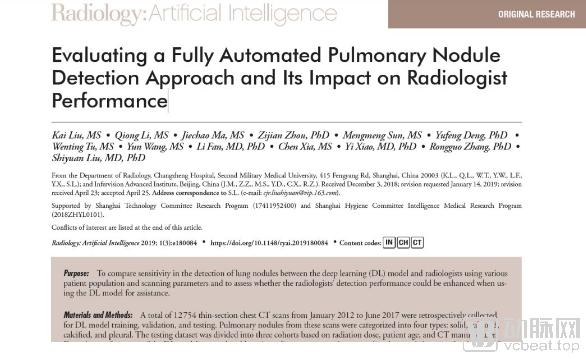
During the study, the collaborative team retrospectively collected a total of 13,159 thin-slice CT images from multiple top-tier hospitals in China. Of these, 12,754 images that met the inclusion criteria were randomly divided into a “training and validation set” (91.1%) and a “test set” (8.9%) to evaluate the deep learning model.
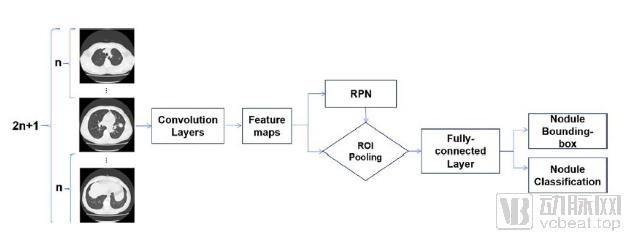
Based on Infervision's AI Scholar Research Platform, InferScholar® Center, researchers combined two CNN models into a deep learning neural network: a DenseNet model serving as the feature extractor and a Faster R-CNN model acting as the detector. In this architecture, DenseNet is utilized for feature extraction and backpropagation.
Unlike conventional CNNs, DenseNet can be directly connected to form a densely connected network, which reduces the number of neural network layers, maintains feature density, and enhances the overall representational power of the model. During the research process, the test data included cohort designs that exist in real-world clinical settings:Different radiation doses (low dose and standard dose), patient age (three age groups), and radiological equipment brands (four brands of equipment).
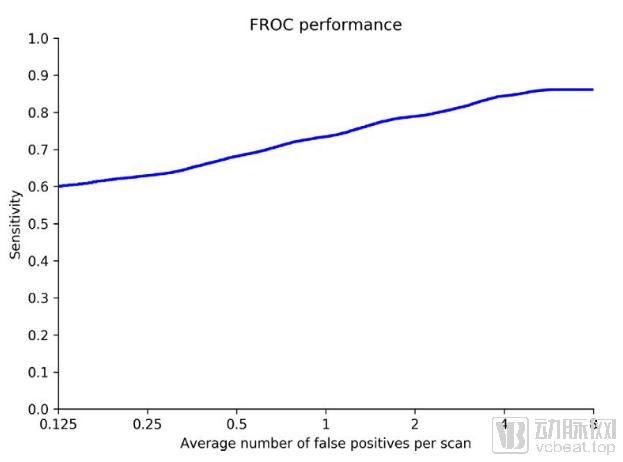
Compared with the gold standard established by double-blind experiments involving senior physicians, the deep learning model proposed in this paper demonstrates improved sensitivity over manual detection of pulmonary nodules. The free-response receiver operating characteristic (FROC) curve shows a sensitivity as high as 0.86 (with eight false positives per scan). Furthermore, the model’s average performance exhibits no statistically significant correlation with radiation dose, patient age, or equipment brand.
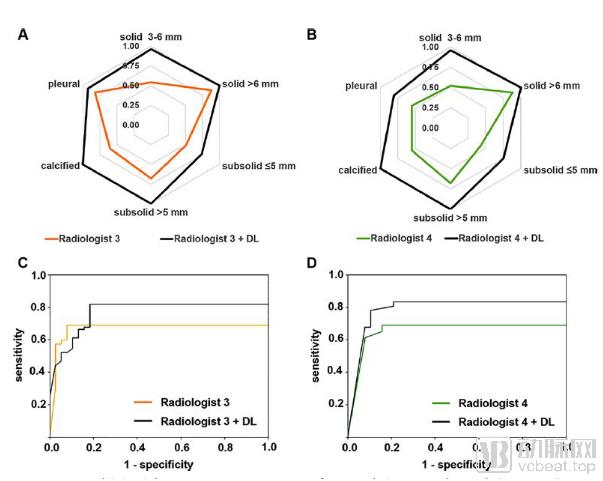
Furthermore, the study compared the performance of radiologists assisted by a deep learning model. Two independent radiologists first interpreted the images individually without using the deep learning model, and then used the deep learning model as an aid during the second reading session.
Testing revealed that the sensitivity of nodule detection by two radiologists improved across all nodule types when using a deep learning model; furthermore, their reading times were shorter compared to those of radiologists not using the deep learning model.
Meanwhile, the LROC curve analysis at the reader level demonstrated that deep learning assistance improved radiologists’ diagnostic sensitivity, while maintaining high specificity and sensitivity.
The publication of these research findings signifies that the deep learning model jointly developed by Shanghai Changzheng Hospital and Infervision not only delivers exceptional performance, serving as an auxiliary tool to substantially enhance radiologists’ workflow efficiency and diagnostic accuracy, but more importantly, minimizes the impact of external factors (such as radiation dose, patient age, and equipment brand), demonstrating robustness. This holds significant implications for reducing radiation-related harm to patients and lowering healthcare costs.
Overall, this study once again demonstrates the importance of customized deep learning models in addressing practical clinical challenges, which is precisely the mission of InferScholar, Infervision’s academic research platform.®The Mission of the Center.
About InferScholar® Center
InferScholar® Center is an AI omics integrated research platform independently developed by Infervision. It features intelligent multi-modal data management, intelligent data annotation, self-training of deep learning models, multi-model radiomics, and integrated hardware platforms. Committed to providing customized deep learning models for clinical application scenarios, it enables physician-led AI model training, allowing AI to genuinely assist in solving practical clinical problems. Infervision believes that physicians are the key drivers in the continuous optimization and clinical application of AI models, and is dedicated to helping physicians overcome AI adoption challenges by focusing on usability, accessibility, safety, and effectiveness.