

Tech Giants' Healthcare Moves: Amazon, Google, Apple, Microsoft and BAT's Strategic Advances in the Past Six Months

Microsoft
Computer software development, manufacturing, licensing, and service provider

Apple
Designers, manufacturers, and sellers of electronic products such as personal computers and software

Tencent
Internet Comprehensive Service Provider

AliHealth
Medical and Health Services Network Service Provider
Tech Giants’ Cross-Industry “Heist” of Healthcare Is Nothing New
According to the Flash News Channel of VCBeat (WeChat ID: vcbeat)VCBeatAccording to incomplete statistics, in the past six months, the four tech giants—Amazon, Google, Apple, and Microsoft—were involved in a total of 27 new developments in the healthcare sector, while Baidu, Alibaba, and Tencent recorded 32. Specific activities included strategic investments, business upgrades, new product launches, and commercial partnerships.
VCBeat has found that, in terms of technology, foreign tech giants remain steadfastly committed to AI and big data.
In terms of products, Amazon’s vision is realized through Alexa; Apple plays its patent trump card; Google’s smartwatch wins FDA approval, with Verily stepping into the spotlight as the driving force behind it; while Microsoft has solidified its transformation by shifting to the B2B track.
After a round of tentative forays, China’s BAT giants are gradually shifting their focus toward core technologies, resembling amateurs turning professional.
Specifically:
1. Leveraging its online retail expertise, Amazon developed the AI assistant Alexa and intensified its efforts in smart health hardware;
II. Apple transforms consumer products into patient-centric medical devices, leveraging multiple patents to build an intelligent health monitoring ecosystem;
III. Leveraging its dominance in data storage and analytics, and backed by Verily, Google has made deep inroads into the AI healthcare application market;
4. Microsoft has shifted its focus from the consumer (C-end) to the business (B-end), developing medical robots for healthcare organizations while continuing to deepen its engagement in the field of precision medicine;
V. The three domestic tech giants—Baidu, Alibaba, and Tencent (BAT)—are deepening their exploration in the healthcare sector, shifting from business model innovation to technology-driven innovation underpinned by core technologies.
(Data source: VCBeat’s Dongguan Channel)
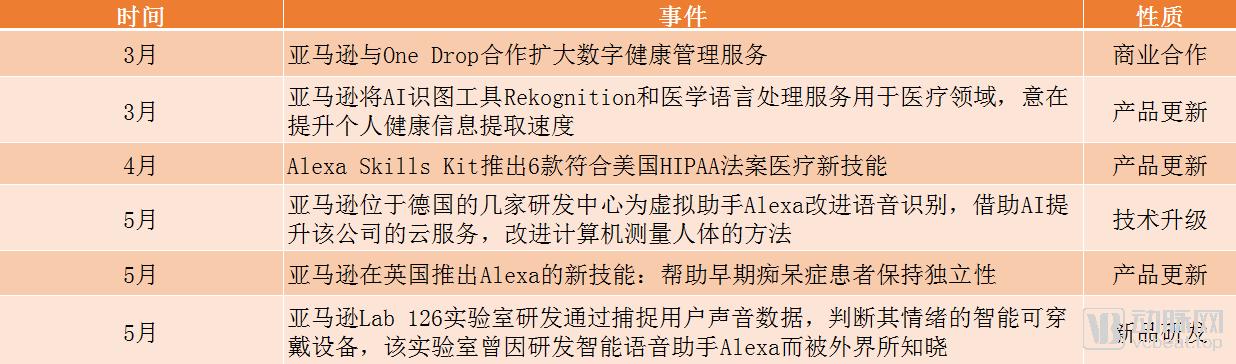
AI Technology Is Inescapable in Discussions of Amazon’s Foray into Healthcare: This Remained the Case in 2019, According to the Latest Updates Compiled by VCBeat’s Dongguan Channel.
Alexa, the AI-powered product, continues to be a key asset in Amazon’s healthcare strategy. As 2019 approached, Amazon announced that it had sold more than 100 million devices equipped with Alexa, including both Amazon-produced devices and third-party devices with built-in Alexa.
Now, as 2019 is nearly halfway through, Amazon’s strategy demonstrates continuity, with the company continuing to increase its investment in this strategic product designed to unlock the AI-driven medical market.
What is Alexa?
“Alexa won’t replace doctors anytime soon, but artificial intelligence can help hospitals improve efficiency,” said Taha Kass-Hout, Amazon’s Senior Leader for Healthcare and AI, in a recent interview with foreign media.
Alexa is Amazon’s cloud-based AI voice service and the “brain” behind devices including the Echo series, Fire TV, Fire tablets, and third-party devices with built-in Alexa, primarily serving consumers.
In the healthcare sector, Amazon leverages Alexa as a medium to serve consumers while connecting developers.
On the one hand, Amazon’s Alexa intelligent voice service not only reminds elderly individuals to take their medications and manage their blood pressure at home, but also enhances the experience for hospitalized patients by facilitating the purchase and management of insurance claims. Meanwhile, Alexa plays a significant role in helping users understand medical terminology and key health-related information, as well as access information on medication dosages and common diseases.
On the other hand, Alexa provides development tools and open-source interfaces that allow third-party developers to integrate skills. This move lowers the technical barrier to entry, attracting a large number of healthcare developers into its ecosystem to build voice-based medical experiences for patients.
Alexa's Latest Updates
In the first half of 2019, Amazon primarily focused on two initiatives: updating its AI technology and expanding Alexa’s capabilities.
On the technical front, several of Amazon’s R&D centers in Germany are busy breaking through with new technologies:
The R&D team in Aachen, Germany, is working to improve Alexa’s speech recognition capabilities; the Dresden-based R&D team is striving to enhance the company’s cloud services through AI technology; and the Tübingen R&D team is attempting to teach machines to understand causal relationships while improving how computers measure the human body.
In terms of products, Alexa is constantly acquiring new skills:
In April 2019, Amazon announced the launch of six HIPAA-compliant Alexa medical skills, developed by six different healthcare organizations, specifically including:
1. Members of the pharmacy services provider Express Scripts can check the status of their home-delivered prescriptions via Alexa. Members receive notifications from Alexa when their prescription orders are shipped.
2. Cigna members can manage their health via Alexa and increase their chances of earning personalized health rewards.
3. Parents and caregivers of children participating in the Enhanced Recovery After Surgery (ERAS) program at Boston Children’s Hospital can provide their care team with up-to-date information on their child’s recovery and receive information regarding postoperative appointments.
4. Swedish Health Connect patients can use Alexa to locate the nearest urgent care center and schedule a same-day appointment. The healthcare organization operates 51 hospitals and 829 clinics across seven U.S. states.
5. Atrium Health customers in North Carolina and South Carolina can also locate the nearest urgent care site and schedule a same-day appointment. Atrium Health operates more than 40 hospitals and 900 care locations across North Carolina, South Carolina, and Georgia.
6. Members of Livongo, a digital health consumer company, can query blood glucose readings and trends via Alexa, and receive personalized data analytics and health tips. The company primarily targets patients with chronic diseases to create an entirely new healthcare experience.
In May, Amazon launched a new Alexa skill in the UK—My Carer Alexa—to help individuals with early-stage dementia maintain their independence. Developed jointly by the Alzheimer’s Society, marketing agency McCann Worldgroup, and digital studio Skilled, this skill enables users to set reminders for daily tasks, such as doctor’s appointments and meal preparation.
The addition of new HIPAA-compliant skills for Alexa means it will play a greater role, such as monitoring patient medication adherence and sending medication reminders. Amazon holds patents for monitoring patients’ blood flow and heart rate via cameras, which could allow Alexa’s applications to expand into fall detection or gait monitoring in the future.
In addition to targeting consumer-facing customers, Amazon is considering developing an ecosystem of third-party medical applications for Alexa. The Alexa platform currently hosts lightweight medical apps from institutions such as the Mayo Clinic and Libertana, which can answer health-related questions, send alerts in emergencies, and connect users with caregivers.
Why Is Alexa So Hardcore?
Since entering the healthcare sector, Amazon has been able to closely center on AI technology and continuously expand the capabilities of its strategic product, Alexa, thanks to the following advantages:
1. Dual Advantages of Technology and Talent
Amazon operates four R&D centers in Berlin, Dresden, Aachen, and Tübingen, Germany. The Tübingen center is Amazon’s first facility dedicated to visual AI research, employing hundreds of AI researchers. This R&D center has also established a partnership with the Max Planck Institute, which manages and licenses thousands of patents, granting Amazon access to its key technologies as a collaborator.
2. Financial Support
With its core businesses—AWS cloud services and Prime membership—generating profits, Amazon is well-resourced in the healthcare sector and can focus solely on its “Alexa Everywhere” strategy.
3. Channel Advantages
Amazon has direct channels connecting manufacturers, brands, retailers, and consumers, along with its own supply chain, retail stores, and product delivery teams. Amazon can not only build a smart assistant ecosystem around Alexa by integrating it into more third-party products, but its large base of Prime members also provides a distribution foundation for Alexa-related products.
(Data source: VCBeat Insight Channel))
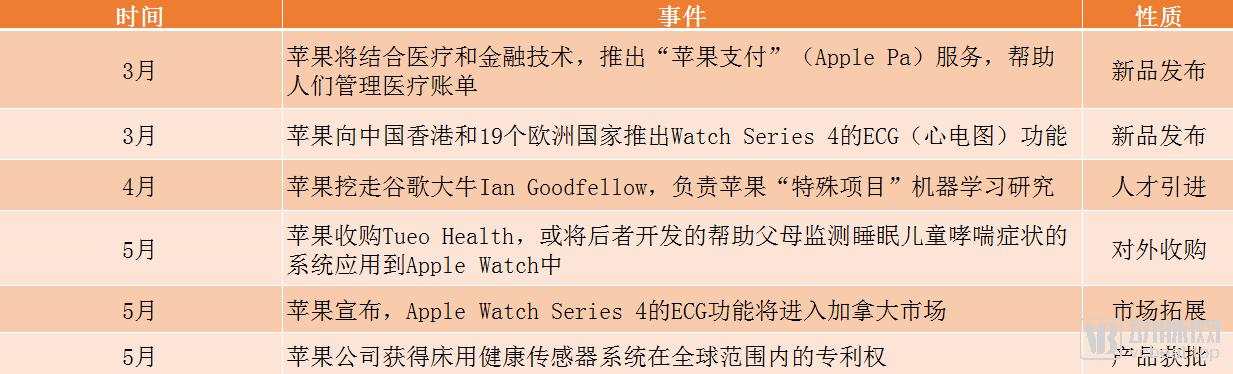
In the first half of 2019, Apple’s keywords were: Apple Watch ECG, patents, and health monitoring.
According to statistics from VCBeat’s Dongguan Channel, the single-lead ECG feature of the Apple Watch was promoted in an increasing number of countries and regions during the first half of 2019. Meanwhile, patents related to health monitoring have become one of the core pivots for Apple to disrupt the healthcare market.
With More Patent Leverage, Apple Can Move the World
VCBeat noted that in May, Apple secured global patent rights for a bed-based health sensor system. This patent has been registered with the European Patent Office. The patent covers non-invasive diagnostic medical devices, software systems, and operational methods that enable monitoring of users’ health conditions during sleep and management of patients’ chronic diseases without the need for smart devices such as the iPhone, iPad, or Apple Watch.
This patent includes sensors placed beneath the user’s mattress or pillow to monitor individual patient, environmental, physiological, and other parameters. These data are transmitted to a processor for analysis to provide personalized assessments of disease control (e.g., asthma), which can then be used by patients, their families, or healthcare professionals to improve clinical outcomes.
According to information published by the U.S. Patent and Trademark Office, Apple was granted a patent on May 28 for monitoring technology in smart athletic apparel, capable of tracking users’ health, biometric data, and environmental conditions.
Furthermore, Apple, dubbed the “Patent King” by some media outlets, secured multiple patents related to healthcare in 2019.
On April 23, Apple was granted a new patent for facial recognition using its TrueDepth camera system, referred to as the “vision system,” which is supported by specialized bracket components. Apple’s A11 and A12 Bionic processors convert users’ facial depth maps into mathematical representations via infrared images, thereby enhancing the accuracy of facial recognition.
One Month Later, Apple’s TrueDepth Camera Secures New Patent: Standalone 3D Mapping Equipment and Confocal Detection System. The iterative updates to the TrueDepth camera system have undoubtedly bolstered health monitoring capabilities for Apple’s related products.
Apple’s various moves indicate that, following its entry into the wrist-worn wearable device market, the company will develop smart monitoring hardware in new niche segments, thereby establishing a comprehensive health monitoring ecosystem.
Just recently, Apple acquired Tueo Health, a startup developing mobile applications. The company is building an app that works with commercial respiratory sensors to help monitor asthma symptoms in children. If a child’s breathing patterns change at night, the app sends alerts to their parents. Reports suggest that following the acquisition, Tueo Health’s asthma monitoring features may be integrated into the Apple Watch.
Apple CEO Tim Cook said, “Apple carries out several such small-scale acquisitions each year, with the aim of acquiring talent and intellectual property.”
Clearly, whether through in-house R&D or direct acquisition, Apple’s decisions are driven by strategic considerations regarding technology patents.
Why Apple Is So Hardcore
Leveraging patents as a fulcrum and centering on smart hardware devices, Apple has pried open the health monitoring ecosystem chain, enjoying the following advantages:
1. In terms of software technology, Apple is a major proponent of FHIR (Fast Healthcare Interoperability Resources) technology.
FHIR establishes standards for diverse data elements, enabling developers to build application programming interfaces (APIs) that access datasets from disparate systems. This technology enhances interoperability among hospitals, physicians, and other stakeholders. Difficulty in accessing structured data has long been a major challenge in the healthcare sector. By leveraging FHIR technology, Apple integrates software and hardware to provide a platform that addresses this issue.
2. In terms of hardware technology, Apple has brought chip manufacturing in-house, with its A12 chip optimized for running AI applications.
Apple is also developing better medical-grade sensors. In addition, features such as lighting, cameras, and machine vision on the iPhone can enhance facial recognition, monitoring, and diagnostic capabilities.
3. The brand is Apple's stepping stone to building a health monitoring system.
Although tech giants such as Google, Microsoft, and Amazon also enjoy global renown, Apple—which built its empire on smartphones and boasts a large base of loyal fans—clearly holds the upper hand in prioritizing user experience and privacy protection. Apple is integrating daily health and medical data, enabling users to engage with this ecosystem on a high-frequency basis, thereby creating a virtuous cycle.
4. In terms of funding, Apple is also well-capitalized.
(Data source: VCBeat Dongguan Channel))
First, Google also has smartwatches. Second, Google's watches are different from the Apple Watch.
Study Watch is a prescription-only device designed to record, store, transmit, and display single-channel ECG rhythms. This product is not directly available to consumers; patients can only obtain the Study Watch from their physicians for cardiac monitoring when specifically prescribed by a doctor.
The single-lead ECG capability of the Study Watch can be used for individual patient care as well as for population-based research. The device is designed to help researchers gain deeper insights into physiological processes occurring within patients, particularly those with heart disease.
The seemingly impressive Study Watch is backed by the Verily team, which is no stranger to notable achievements.
About Verily
Recap. In a bid to aggressively capture the healthcare market, Google restructured in 2015 and established its parent company, Alphabet. Following integration, Google Ventures (GV), Verily, and Calico became subsidiaries under Alphabet responsible for healthcare operations.
Among them, Verily is Google’s flagship initiative in the healthcare sector. The company has assembled a multidisciplinary team comprising physicians, engineers, chemists, data scientists, and other experts, dedicated to improving people’s health through big data analytics tools, intervention support, research, and other methods.
Jared Josleyn, Global Head of Verily, once positioned the company as follows: Verily is a healthcare data company that continuously collects high-fidelity data from healthcare systems and applies it to patients’ daily lives, thereby improving treatment outcomes.
Verily Latest News
In 2019, Verily was at the height of its prominence, backed by substantial funding and equipped with multiple projects.
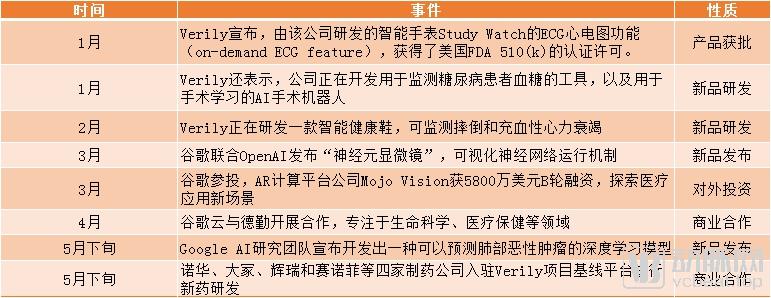
In January 2019, Verily raised billions of dollars for medical innovation. The company places particular emphasis on AI-driven solutions, with research projects including software capable of diagnosing diabetic retinopathy. This software is currently being used in India.
Shortly after securing investment, Verily announced that the ECG (electrocardiogram) feature of its self-developed smartwatch had received FDA 510(k) clearance. The smartwatch referred to here is the Study Watch.
Furthermore, Verily stated that the company is leveraging machine learning algorithms and AI technologies developed by Google to create tools for monitoring and screening blood glucose levels in diabetic patients, as well as AI-powered surgical robots for surgical training.
In late May, Google announced new strategic partnerships with four pharmaceutical giants—Novartis, Otsuka, Pfizer, and Sanofi. These companies will leverage Verily’s Baseline platform to expand the size and diversity of study populations by making it easier for participants to enroll and share their health data.
Why Is Google So Hardcore?
By examining Google’s strategic footprint in the healthcare sector, it becomes evident that artificial intelligence (AI) serves as the core focus for Google and its subsidiary Verily in their efforts to expand and dominate the healthcare market. In this regard, Google possesses the following advantages:
1. Leveraging its massive search portal, Google has amassed health data from billions of users, which serves as a major strategic asset for its entry into the medical AI sector.
2. By collaborating with academia and commercial healthcare organizations, Google can access new, more valuable clinical medical data. These data, along with other user information collected by Google itself, can be used to train algorithms to identify patterns across the continuum between health and disease.
For example, Google previously collaborated with Duke University and Stanford University on a project called Project Baseline, which aimed to track 10,000 volunteers for up to four years, observing their genes and microbiomes, monitoring their sleep, physical exercise, and overall mental state, in order to find clues for the early prevention of diseases such as cancer and heart disease.
Google executives stated that collaboration with academia and the healthcare industry is key to the company’s continued advancement in the medical field.
(Data source: VCBeat Insight Channel))
In fact, Microsoft also has smartwatches. However, they are pretty much “dead.”
In the consumer market, Microsoft began considering a withdrawal last year due to the poor performance of its consumer-facing products. In 2019, Microsoft’s exit from the consumer market became more pronounced.
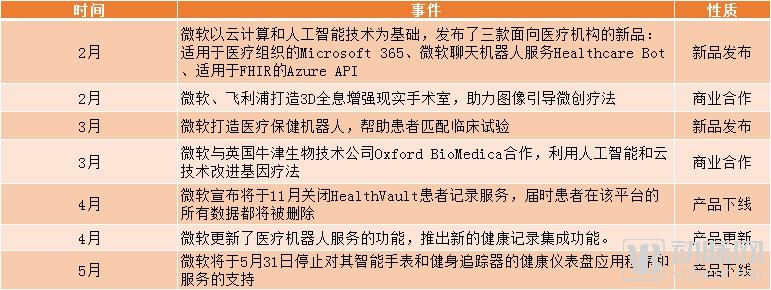
In April, Microsoft announced that it would shut down its HealthVault patient record service in November, at which point all patient data on the platform would be deleted. The company advised users to migrate their data to other personal health record service platforms, such as Get Real Health and FollowMyHealth.
Around the same time, Microsoft executives announced that the company would exit the consumer wearable device market and cease support for the Health Dashboard application and services for Microsoft smartwatches and fitness trackers on May 31.
What Happened in the B2B Sector
Microsoft has decided to change course, shifting its business focus from the consumer market to the enterprise application market.
In the B2B sector, Microsoft is striving to develop products that appeal to healthcare organizations—including healthcare enterprises and institutions—by leveraging its cloud services and artificial intelligence technologies, while continuously updating and upgrading these offerings.
Since its promotion on Microsoft’s Azure Marketplace last year, Microsoft announced in 2019 that the Healthcare Bot service was generally available.
The Healthcare Bot service leverages Microsoft’s Azure digital platform and its natural language processing technologies. Its language model is capable of handling interruptions, topic shifts, human errors, and complex medical inquiries. In addition to built-in healthcare intelligence and natural language capabilities, the service allows developers to customize and extend its functionalities.
This service complies with industry-recognized and globally accepted safety and compliance standards, and provides tools that help developers create HIPAA-compliant solutions. In other words, healthcare institutions can leverage this service to offer intelligent and compliant virtual medical assistants and chat services.
For example, insurance companies can deploy robots to enable customers to easily check claim statuses and ask related questions; hospitals can equip robots with symptom checkers to triage patient conditions, answer patient inquiries, and assist patients in locating the nearest physician.
In April 2019, Microsoft updated the functionalities of its healthcare robot services, launching new health record integration capabilities. Microsoft stated that the company would collaborate with partners to roll out robots developed for the following scenarios: preparing for doctor appointments or examinations, answering pregnancy-related questions, tracking prenatal appointments, and browsing detailed information on pediatric treatments.
Furthermore, precision medicine is another key focus for Microsoft in the B2B healthcare market. Since 2019, Microsoft has launched a series of medical services and computational biology projects, including next-generation precision medicine, genomics, immunomics, CRISPR, and research support tools for cellular and molecular biology.
Currently, no other tech giants have ventured into the field of precision medicine.
Why Microsoft Is Changing Course
Regarding the strategic shift to capture key B2B markets, Peter Lee, Corporate Vice President of Microsoft Research and Head of Healthcare NexT, stated, “We aim to leverage Microsoft’s research technologies and hyperscale cloud services to help our partners achieve success in the healthcare sector.”
Microsoft’s adjustment may stem from the following reasons:
1. The target customer base is the primary reason why Microsoft chose to avoid the consumer market.
Microsoft has accumulated a large base of healthcare organization clients over the years. According to a report by Morgan Stanley, more than 25,000 U.S. health organizations are currently using Microsoft Cloud. This market position provides Microsoft with opportunities to upsell to its existing healthcare customers and establish new partnerships.
2. In terms of technology, cloud computing and artificial intelligence are the foundational strengths of Microsoft.
As the world’s largest provider of computer software, Microsoft possesses inherent advantages in computer vision, speech recognition, image recognition, natural language processing, and expert systems, enabling its products to seamlessly transition into the healthcare sector.
Unlike foreign tech giants, which have focused on developing products centered on core technologies since entering the healthcare industry, China’s “BAT” trio—Baidu, Alibaba, and Tencent—adopted a more cautious approach in the early stages of their foray into the medical field. They primarily entered the healthcare sector as “service providers,” striving to deliver model-based services to healthcare organizations or consumers through their existing platforms.
However, over the past two years, BAT’s exploration in the healthcare sector has gained significant momentum. The company is not only trending toward core technologies such as AI but has also found its own rhythm within the healthcare industry.
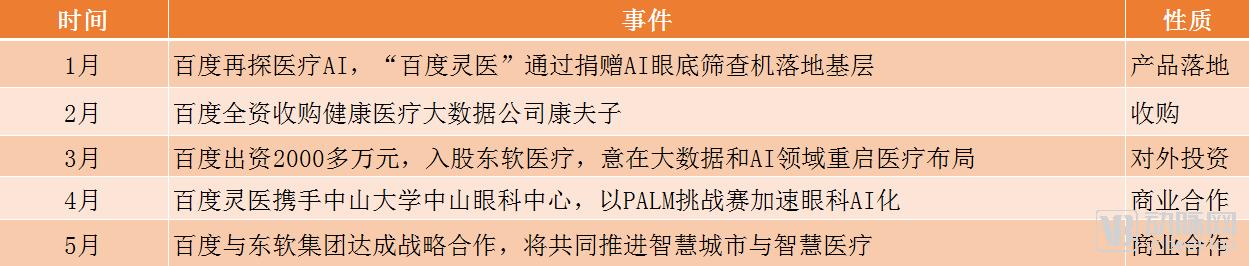
According to statistics from VCBeat’s Dongguan Channel, the three tech giants—Baidu, Alibaba, and Tencent (BAT)—made a total of 32 new moves in the healthcare sector in 2019. Baidu’s high-frequency keywords were “AI,” “big data,” and “investment”; Alibaba’s were “pharmaceutical e-commerce,” “collaboration,” and “investment”; while Tencent’s were “AI,” “collaboration,” and “insurance.”
(Data source: VCBeat's Dongguan Channel)
Let's start with Baidu.
Baidu President and CEO Robin Li stated, “Baidu’s investment in the healthcare sector will shift from medical advertising to technology- and AI-driven healthcare services, such as intelligent appointment scheduling, smart diagnosis and treatment, genomic data collection, and pharmaceutical R&D.”
Since the establishment of its AI innovation business unit, “Baidu Lingyi,” last year, Baidu has continued to capture the medical market through this division in 2019. Leveraging medically interpretable algorithmic architectures and deep learning algorithms, Baidu Lingyi performs fundus examination-based diagnostics, enabling screening for major blinding diseases such as diabetic retinopathy, glaucoma, and macular degeneration.
In January 2019, Baidu Lingyi’s AI fundus screening device was deployed at the grassroots level. In the following months, whether through external acquisitions or investments, Baidu’s focus remained on AI and big data.
(Data source: VCBeat Dongguan Channel)
Now, let's turn to Alibaba.
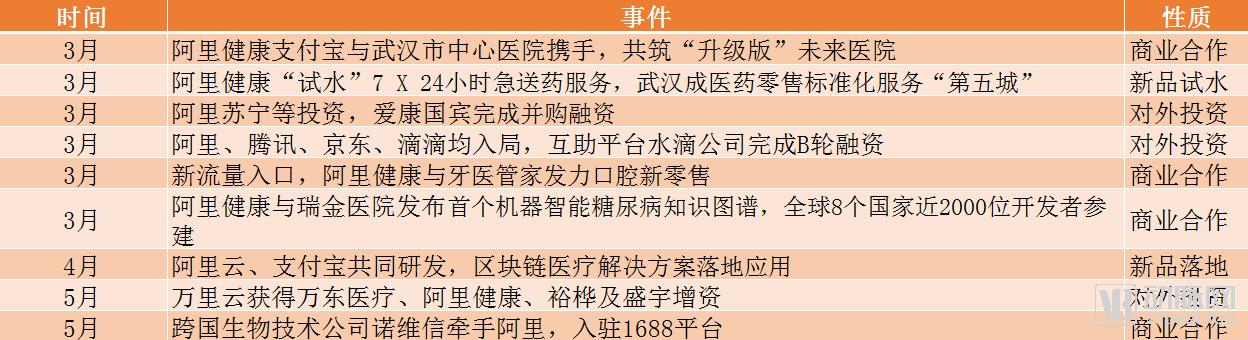
AliHealth is Alibaba Group’s implementation and execution platform for its expansion into the broader healthcare sector. According to statistics from VCBeat’s Dongguan Channel, AliHealth was involved in approximately nine major developments in the first half of 2019, with business collaborations, external investments, and new product launches each accounting for one-third of these activities.
Alibaba, with its e-commerce roots, has always carried the DNA of platform building. Therefore, even when launching new products, AliHealth tends to focus on platform services. For example, in March 2019, AliHealth piloted a 7x24-hour emergency medicine delivery service in Wuhan, leveraging its operational service capabilities and the deep integration between Alibaba and local pharmacies.
However, Alibaba is attempting to find new growth engines through technology.
In April, Alibaba Cloud announced that its blockchain-based healthcare solution, jointly developed with Alipay, has been officially implemented for electronic prescriptions at Wuhan Central Hospital. Built on Alibaba Cloud’s Blockchain as a Service (BaaS) and Alipay’s Ant Blockchain technology, the solution integrates multiple stages of the prescription workflow, including prescription issuance by physicians, pharmacist review, drug delivery, payment processing, and regulatory oversight.
(Data source: VCBeat Dongguan Channel)
Finally, let's look at Tencent.
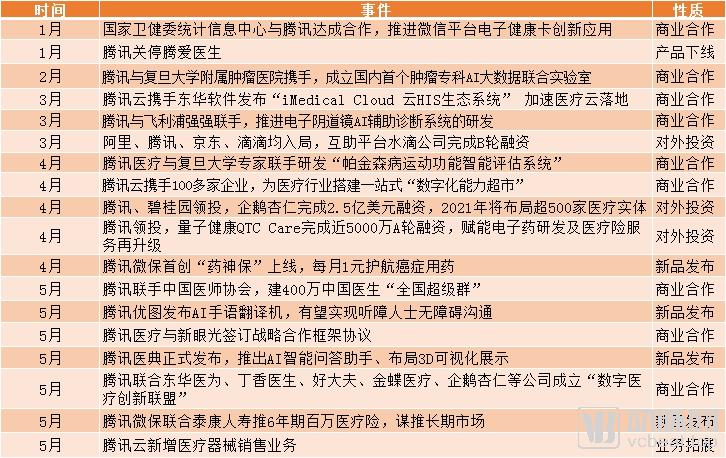
According to statistics from VCBeat’s Dongguan Channel, in the first half of 2019, 10 out of Tencent’s 18 new developments in the healthcare sector involved business collaborations. This further demonstrates that Tencent places greater emphasis on connectivity within the healthcare industry. Nevertheless, while connecting various stakeholders, Tencent also prioritizes the application of AI technology in healthcare.
For example, in February 2019, Tencent collaborated with Fudan University Shanghai Cancer Center to establish China’s first joint laboratory for AI and big data specialized in oncology; in April, Tencent Healthcare joined forces with experts from Fudan University to develop the “Intelligent Assessment System for Motor Function in Parkinson’s Disease”; in May, Tencent Youtu launched an AI sign language translator to facilitate barrier-free communication for the hearing-impaired.
Industry analysts at Chilmark Research, a U.S. healthcare IT market analysis firm, recently stated, “The healthcare sector accounts for 20% of the U.S. gross domestic product. For any tech giant, it is difficult to ignore this massive market opportunity.”
Undeniably, this is a key reason why leading domestic and international tech giants have been entering the healthcare sector.
From the current state of development in the medical industry, it is not a bad thing for giants to cross over into healthcare.
Tech giants, with their substantial financial resources and robust R&D capabilities, are not only disrupting the healthcare sector but also bringing new perspectives to its development.
Gurpreet Singh, U.S. Health Services Leader at consulting firm PwC, stated that technology companies can help healthcare providers better tailor their services to meet the unique needs of patients. Healthcare organizations can also achieve cost savings and support their services by partnering with tech giants, thereby further exploring opportunities for technology’s integration into the healthcare sector.
(Cover image source: www.pexels.com)