

China National Medical Products Administration Releases Detailed 2018 Annual Report on Medical Device Registrations
On May 31, VCBeat (WeChat Official Account: vcbeat) learned that the National Medical Products Administration (NMPA) had officially released the “2018 Annual Report on Medical Device Registration” (hereinafter referred to as the “Report”). The Report provides a detailed overview of medical device registration activities, including the acceptance of registration applications, review and approval processes, and the registration and approval of innovative medical devices.
The following are several representative achievements in the medical device registration process:
Over the past year, the National Medical Products Administration (NMPA) revised and consolidated the three previously released catalogs of medical devices (including in vitro diagnostic reagents) exempt from clinical trials, and issued the newly revised Catalog of Medical Devices Exempt from Clinical Trials, granting clinical trial exemptions to a total of 1,254 product categories.
In November 2018, the National Medical Products Administration (NMPA) revised the Special Review Procedures for Innovative Medical Devices. Twenty-one innovative medical devices, including orthopedic surgical robots, were approved for market launch, thereby reducing clinical treatment costs. In accordance with the Requirements for Priority Review of Medical Devices, priority review was granted to medical devices included in national major science and technology projects or key research and development programs, as well as those in urgent clinical need. Five products subject to priority review, including the Rubella Virus IgG Antibody Test Kit (Fluorescence Immunochromatography), were approved for market launch to meet urgent clinical needs.
Advance the pilot program for the Medical Device Registrant System. In accordance with the State Council’s guidelines on comprehensively deepening reform and opening-up in Pilot Free Trade Zones, pilot initiatives for the Medical Device Registrant System were launched in the Shanghai, Guangdong, and Tianjin Free Trade Zones. These efforts aim to accumulate experience and lay a practical foundation for the broader implementation of the Medical Device Registrant System across China.
As of the end of 2018, there were a total of 1,618 currently effective medical device standards in China, including 219 national standards and 1,399 industry standards. The coverage and systematic nature of the standard system have improved year by year, and the consistency between Chinese medical device standards and international standards has reached over 90%.
As of the end of 2018, a total of 676 clinical trial institutions had been registered nationwide.
Acceptance Status of Medical Device Registration Applications
In 2018, the National Medical Products Administration (NMPA) accepted a total of 6,608 applications for initial registration, renewal registration, and registration of changes to permitted matters for medical devices in accordance with its responsibilities, representing a 3.3% decrease compared to 2017.
(I) Overall Situation
Accepted 2,382 applications for registration of Class III medical devices domestically and 4,226 applications for registration of imported medical devices.
By registered product category, there were 4,529 medical device registration applications and 2,079 in vitro diagnostic reagent registration applications.
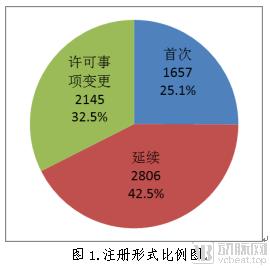
By registration type, there were 1,657 applications for initial registration, accounting for 25.1% of all medical device registration applications; 2,806 applications for renewal registration, accounting for 42.5%; and 2,145 applications for registration of changes to licensed items, accounting for 32.5%. The distribution by registration type is shown in Figure 1.
(II) Itemized Details
1. Acceptance of Registration Applications for Class III Medical Devices in China
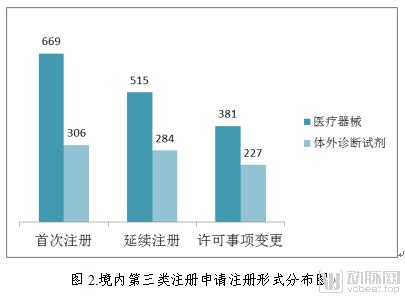
A total of 2,382 applications for registration of Class III medical devices manufactured in China were accepted, representing a 3.1% decrease compared with 2017. Of these, 1,565 were applications for medical device registration and 817 were applications for in vitro diagnostic (IVD) reagent registration.
In terms of registration type, initial registrations accounted for 975 items, representing 41.0% of all domestic Class III medical device registration applications; renewal registrations accounted for 799 items, representing 33.5%; and changes to licensed items accounted for 608 items, representing 25.5%. The distribution of registration types is shown in Figure 2.
2. Acceptance of Registration Applications for Imported Class II Medical Devices
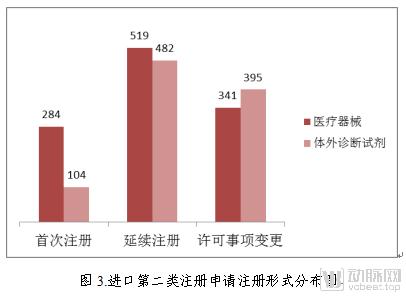
A total of 2,125 applications for the registration of imported Class II medical devices were accepted, representing a 3.3% increase compared with 2017. Among these, there were 1,144 applications for medical device registration and 981 applications for in vitro diagnostic (IVD) reagent registration.
In terms of registration type, there were 388 initial registrations, accounting for 18.3% of all import registration applications for Class II medical devices; 1,001 renewal registrations, accounting for 47.1%; and 736 registrations for changes to licensed items, accounting for 34.6%. The distribution of registration types is shown in Figure 3.
3. Acceptance of Registration Applications for Imported Class III Medical Devices
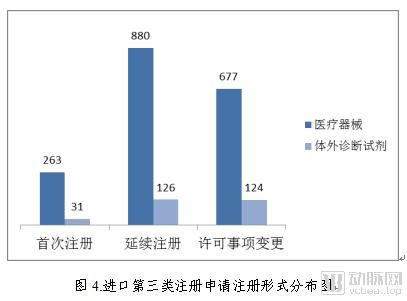
A total of 2,101 applications for registration of imported Class III medical devices were accepted, representing a 9.4% decrease compared with 2017. Among these, there were 1,820 applications for medical device registration and 281 applications for in vitro diagnostic (IVD) reagent registration.
In terms of registration type, there were 294 initial registrations, accounting for 14.0% of all import Class III medical device registration applications; 1,006 renewal registrations, accounting for 47.9%; and 801 registrations for changes to permitted items, accounting for 38.1%. The distribution of registration types is shown in Figure 4.
Status of Medical Device Registration and Approval
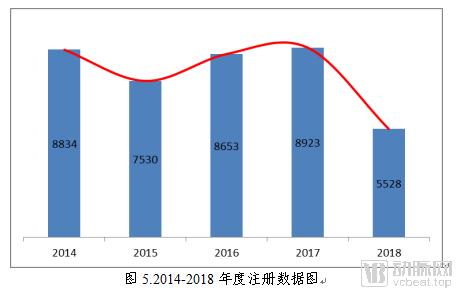
In 2018, the National Medical Products Administration approved a total of 5,528 medical device registrations, including initial registrations, renewal registrations, and modification registrations. This represents a 38.0% decrease in the total number of approved registrations compared to 2017. Among these, there were 1,128 initial registrations, 2,150 renewal registrations, and 2,250 registrations for modifications to licensed items.
In 2018, the National Medical Products Administration denied registration for 118 medical device registration applications, while enterprises voluntarily withdrew 238 applications.
Figure 5 shows the medical device registrations approved by the National Medical Products Administration over the past five years.
(I) Overall Situation
In 2018, the National Medical Products Administration approved 1,709 registrations for domestically produced Class III medical devices, a 48.2% decrease from 2017, and 3,819 registrations for imported medical devices, a 32.1% decrease from 2017.
By registration category, there were 3,734 medical device registrations, accounting for 67.5% of the total; and 1,794 in vitro diagnostic (IVD) reagent registrations, accounting for 32.5% of the total.
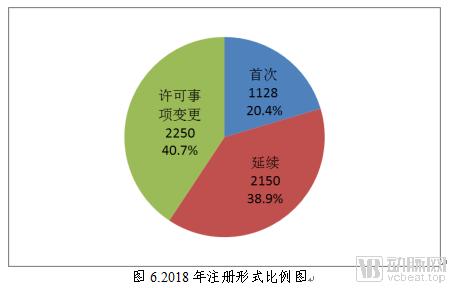
By registration type, there were 1,128 initial registrations, accounting for 20.4% of the total number of medical device registrations; 2,150 renewal registrations, accounting for 38.9%; and 2,250 registrations for changes to licensed items, accounting for 40.7%. The distribution by registration type is shown in Figure 6.
(II) Itemized Details
1. Approval Status for Registration of Class III Medical Devices in China
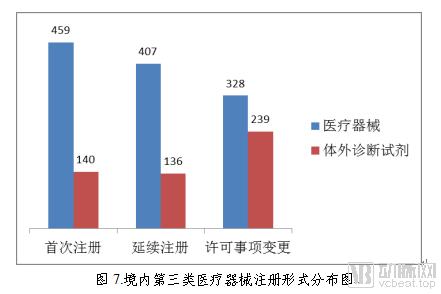
1,709 registrations for Class III medical devices within China. Of these, 1,194 were medical devices and 515 were in vitro diagnostic reagents.
In terms of registration type, there were 599 initial registrations, accounting for 35.0% of the total number of domestic Class III medical device registrations; 543 renewal registrations, accounting for 31.8%; and 567 registrations for changes to licensed items, accounting for 33.2%. The distribution of registration types is shown in Figure 7.
2. Registration and Approval Status of Imported Class II Medical Devices
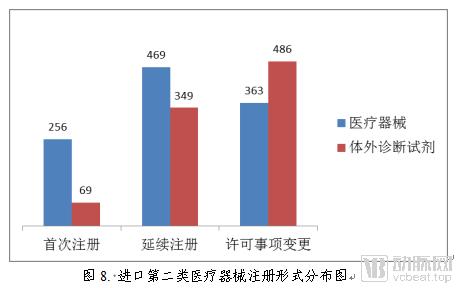
1,992 registrations for imported Class II medical devices. Among them, there were 1,088 registrations for medical devices and 904 registrations for in vitro diagnostic reagents.
In terms of registration type, initial registrations accounted for 325 items, representing 16.3% of the total number of registered imported Class II medical devices; renewal registrations accounted for 818 items, representing 41.1%; and registrations for changes in licensed items accounted for 849 items, representing 42.6%. The distribution of registration types is shown in Figure 8.
3. Approval Status for the Registration of Imported Class III Medical Devices
A total of 1,827 Class III imported medical devices were registered, including 1,452 medical device registrations and 375 in vitro diagnostic (IVD) reagent registrations.
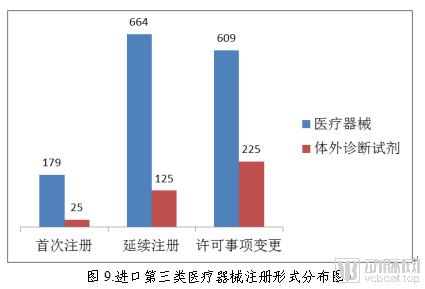
In terms of registration type, there were 204 initial registrations, accounting for 11.2% of the total number of registered imported Class III medical devices; 789 renewal registrations, accounting for 43.2%; and 834 registrations for changes to licensed items, accounting for 45.6%. The distribution of registration types is shown in Figure 9.
(III) Monthly Approval Status of Initial Registration Items
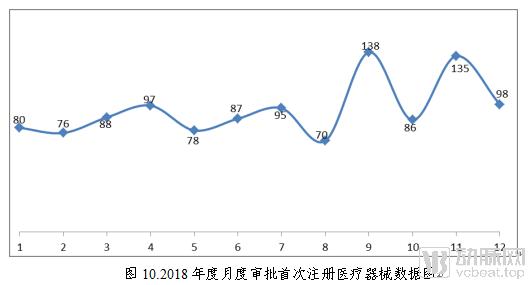
In 2018, the National Medical Products Administration approved a total of 1,128 initial registrations for medical devices; the monthly approval details are shown in Figure 10.
(4) Analysis of Specific Approved Product Categories
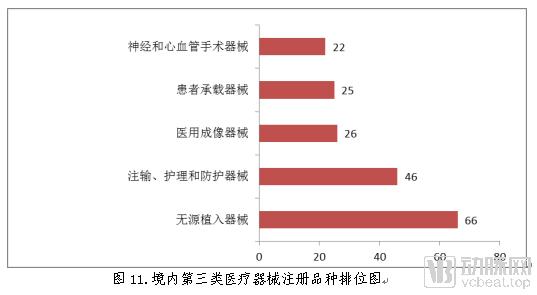
Since the implementation of the new version of the “Medical Device Classification Catalog” on August 1, 2018, registered domestic Class III medical devices, excluding in vitro diagnostic reagents, have involved products from 17 subcategories within the “Medical Device Classification Catalog.”
The top five domestically registered Class III medical devices are: passive implantable devices, infusion, nursing, and protective devices, medical imaging devices, patient support devices, and neurosurgical and cardiovascular surgical devices.
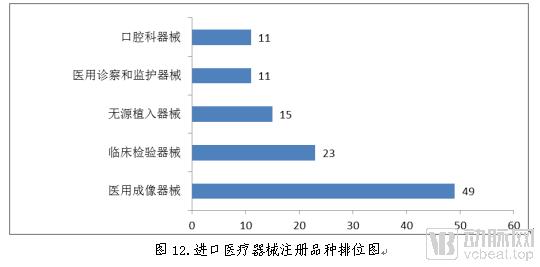
Since the implementation of the new version of the “Medical Device Classification Catalog” on August 1, 2018, registered imported medical devices, excluding in vitro diagnostic reagents, have involved products from 19 subcategories within the “Medical Device Classification Catalog.”
The top five categories of imported medical devices by registration volume are primarily: medical imaging devices, clinical laboratory devices, passive implantable devices, medical diagnostic and monitoring devices, and dental devices.
(V) Country of Origin for Imported Medical Devices
In 2018, the United States, Germany, Japan, South Korea, and Switzerland ranked as the top five countries in terms of the number of initial registrations for imported medical devices in China. The number of registered products from these countries accounted for approximately 75.6% of the total number of initial registrations for imported medical devices in 2018, representing a slight increase compared to 2017.
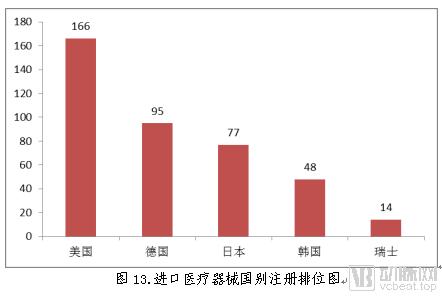
(VI) Provincial Analysis of Domestic Class III Medical Devices
Based on the registration data for Class III medical devices in China in 2018, manufacturers of these registered products were primarily concentrated in economically developed coastal provinces. Beijing, Jiangsu, Guangdong, Shanghai, and Zhejiang ranked as the top five regions by number of initial registrations for domestic Class III medical devices, accounting for 68.4% of the total initial registrations in 2018, representing a slight increase compared to 2017.
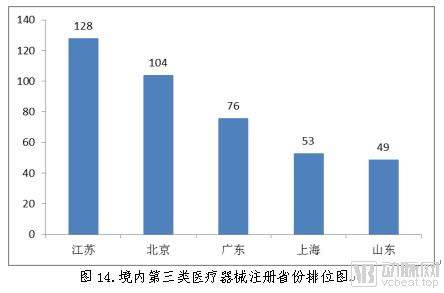
IV. Registration and Approval Status of Innovative Medical Devices and Other Products
In 2018, the National Medical Products Administration continued to carry out reviews of innovative medical devices in accordance with the Special Review Procedures for Innovative Medical Devices, and approved the market launch of certain innovative medical device products.
In 2018, the National Medical Products Administration (NMPA) received a total of 316 applications for special examination and approval of innovative medical devices, and completed the review of 310 applications (including those submitted in 2017), determining that 45 products would enter the special examination and approval channel for innovative medical devices. Twenty-one innovative medical device products were approved for market launch. Among these, there were 7 active medical devices, 5 passive medical devices, and 9 in vitro diagnostic reagents, representing an increase of 8 products compared to 2017.
Other Registration Management Details
(I) Approval Status for Registration of Class II Medical Devices in China
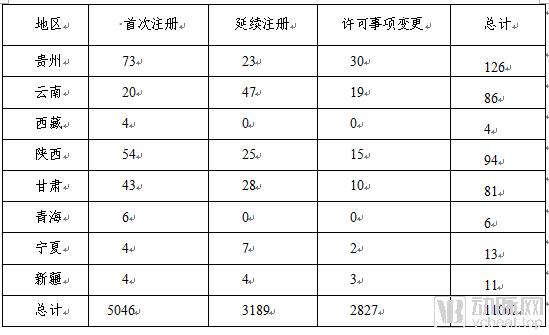
In 2018, provincial-level drug regulatory authorities across China approved a total of 11,062 registrations for domestically produced Class II medical devices, representing a 40.5% decrease compared with 2017. Among these, 5,046 were initial registrations, accounting for 45.6% of the total number of domestic Class II medical device registrations; 3,189 were renewal registrations, accounting for 28.8%; and 2,827 were registrations for changes to licensed items, accounting for 25.6%. Figure 15 shows the breakdown of registrations for domestically produced Class II medical devices.
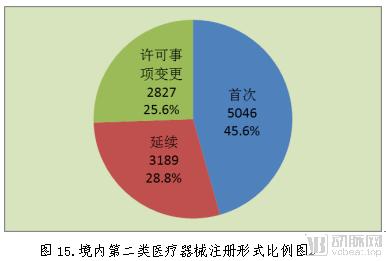
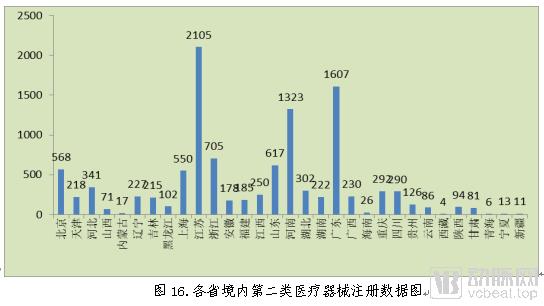
From the registration data, Jiangsu, Guangdong, Henan, Zhejiang, Shandong, Beijing, and Shanghai—the seven provinces (municipalities directly under the Central Government)—have a relatively large number of registered domestic Class II medical devices. Specific data on Class II medical device registrations are shown in Table 1 and Figure 16.
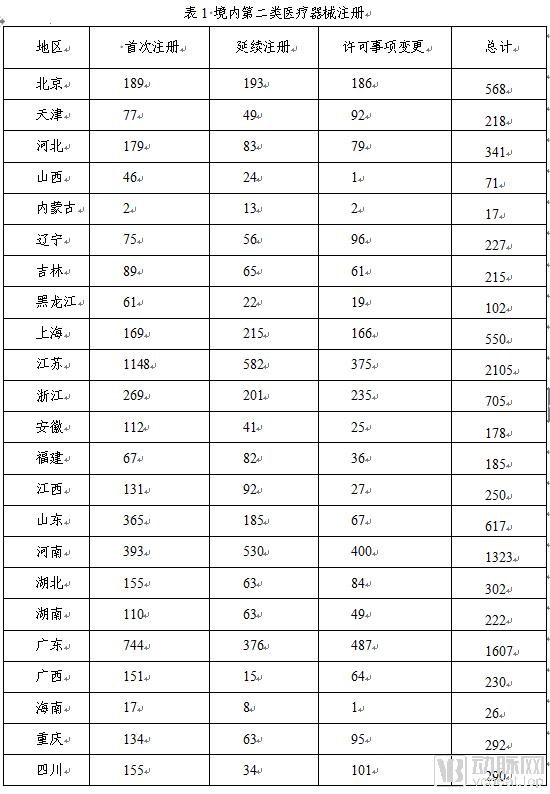
(II) Filing Status of Class I Medical Devices
In 2018, the National Medical Products Administration (NMPA) processed a total of 1,744 filings for imported Class I medical devices in accordance with its responsibilities, representing a 24.7% decrease compared to 2017. Across China, municipal-level drug regulatory departments in cities divided into districts processed a total of 17,177 filings for domestically produced Class I medical devices in accordance with their responsibilities, representing a 30.1% increase compared to 2017.
(3) Changes to Registration Items
In 2018, the National Medical Products Administration (NMPA) processed a total of 7,661 registration changes for imported Class II and III medical devices and domestically produced Class III medical devices in accordance with its responsibilities, representing a 47.9% increase compared to 2017.
Among these, there were 1,598 changes to registration details for domestic Class III medical devices, and 6,063 changes to registration details for imported Class II and Class III medical devices.
Provincial-level drug regulatory authorities, in accordance with their respective responsibilities, processed a total of 6,354 changes to registration matters for Class II medical devices manufactured within China, representing a 0.4% increase compared to 2017.
Note: The data in this report are compiled from January 1, 2018 to December 31, 2018.
Below is the link to the original official article:
http://www.nmpa.gov.cn/WS04/CL2056/338093.html?from=timeline&isappinstalled=0