

Clinical Value ≠ Commercial Value, Innovation ≠ Entrepreneurship: Key Considerations for Medical Robotics Industrial Translation

TINAVI
Orthopedic Surgical Robot Developer
At the recently held 2019 Second International Forum on Innovative Development of Medical Robots, participants discussed strategies and pathways for innovation-driven development in medical robotics. Among them, Professor Zhang Songgen and Professor Wang Tianmiao shared their insights on how to translate innovative achievements into industrial applications within the medical robotics sector and the broader healthcare industry. VCBeat (WeChat ID: vcbeat) has compiled their viewpoints.


In recent years, the global market size for medical robots has grown rapidly. In 2021, the market size for medical robots is projected to reach $20.7 billion. The compound annual growth rate (CAGR) from 2014 to 2021 is expected to be 30%, with surgical robots accounting for 60% of the entire medical robot market.
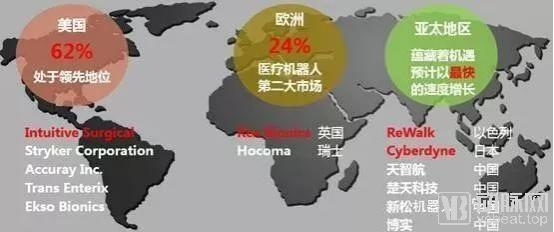
The United States holds a leading position in the global layout of the medical robotics industry, while the Asia-Pacific region is in a stage of rapid development.
The research, development, and application of surgical robots can be broadly categorized into two directions:One category is for hard tissue surgery, and the other is for soft tissue surgery.. Due to different application scenarios, the fundamental design schemes for these two directions are entirely different.Robots for soft tissue surgery, whether single-port or multi-port systems, operate on the principle of replacing the surgeon’s eyes and hands to perform intracorporeal maneuvers. In contrast, the core function of robots for hard tissue surgery is to assist physicians with positioning, while progressively incorporating milling capabilities.。
In the field of soft-tissue surgical robotics, the da Vinci system has achieved tremendous success. In contrast, TINAVI is currently the most representative company in the realm of hard-tissue surgical robotics.According to VCBeat, TINAVI has already achieved profitability, becoming the second surgical robotics company globally to attain profitability in commercial operations, following da Vinci.
According to statistics, the global volume of robotic surgeries has increased from 25,000 cases in 2005 to over 1.3 million cases in 2018, representing a 52-fold growth over 13 years. In particular, 80% of prostatectomies are performed using the da Vinci Surgical System. It is by securing such indications that the da Vinci system has maintained its solid market position.
The rapid growth of the surgical robot market,It is not only closely related to technological advancements, but also a result of patient needs driving clinical progress.
As patients’ awareness of minimally invasive surgery continues to grow, hospitals that do not offer such procedures or physicians who lack the requisite skills risk losing patients to other institutions. This trend is driving hospitals to acquire surgical robotic systems and encouraging physicians to advance their expertise by learning new technologies.
However, robots are merely tools; even the most advanced surgical robots require experienced surgeons to achieve optimal outcomes. Another role of surgical robots is to extend the “prime years” of surgeons. The prime years refer to the period when a surgeon’s technical skills, experience, and physical stamina are at their peak throughout their career.
A surgeon’s prime years are, in fact, quite brief. At the outset of their medical career, physicians require several years to hone their skills; even after mastering surgical techniques, they need additional time to adapt to the physical and mental toll of prolonged operations, which can manifest as hand tremors, foot swelling, and other symptoms.
As physicians age, their physical stamina begins to wane, and various factors are shortening their prime professional years. The emergence of surgical robots can address the issue of physical endurance, extend surgeons’ prime career span, and thereby increase the availability of high-quality medical resources.
In addition to patient demand, the efforts of researchers are also driving the development of medical robots in China. There are two particularly distinct advantages to the research and development of medical robots in China. First,Doctors at major hospitals in China possess extensive clinical experience, enabling them to rapidly comprehend and integrate researchers’ ideas, while encouraging scientific personnel to conduct animal or clinical trials within ethical frameworks.
Second,Most physicians demonstrate strong enthusiasm for research involving the integration of medicine and engineering.. Some doctors are driven by the need to publish academic papers, while others are motivated by personal interest and a desire to engage with the latest technological frontiers.
Whichever the driving factor, it is a positive development for medtech entrepreneurs. Medtech ventures require multi-party collaboration among industry, academia, research institutions, and healthcare providers; in particular, the support of medical institutions and the participation of physicians play a decisive role in product development and subsequent commercialization.
China’s development of surgical robots has its own advantages, but there are also significant gaps. First, although R&D on surgical robots is being conducted across various fields, the number of companies that have successfully developed products and achieved industrial commercialization remains very limited.On one hand, the groups currently undertaking national projects are relatively fragmented, involving hospitals, universities, and research institutes. They innovate based on their own needs and publish papers, but when it comes to specific productization and commercialization, there is no complete implementation model, and no mature enterprises are willing to take them on.
On the other hand, the commercialization of the surgical robot industry often takes more than 10 years: it requires five years to go from project initiation to product development, and another approximately five years to obtain regulatory approval. This process demands financial support of at least $100 million, with little likelihood of return on investment. How can entrepreneurs persevere?
Additionally,Whether surgical robots can achieve commercial implementation is often closely related to the overall strength of the collaborating clinical departments.. At present, the surgical robot sectors in China that have achieved initial breakthroughs are orthopedics, neurosurgery, and cardiothoracic surgery. These specialties are among the highest revenue-generating departments in hospitals.
Regarding rehabilitation robots, there are many mature products on the market. However, the development of rehabilitation medicine in China has been relatively slow, and departmental revenues remain modest. Although the rehabilitation industry has experienced rapid growth in recent years, widespread adoption of rehabilitation robots will still take time.
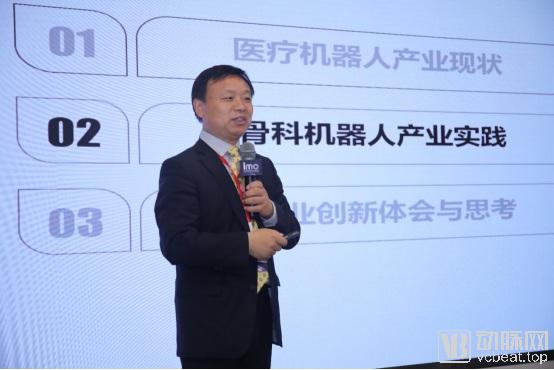
Chairman of TINAVI Medical Technologies Co., Ltd.,
Chairman of the Zhongguancun Medical Device Industry Technology Innovation Alliance,
Zhang Songgen, Chairman of the Beijing Medical Robot Industry Innovation Center
To bring surgical robots to clinical practice, in addition to investments of time and money, practitioners’ mindsets must also keep pace with the times. To this end, Professor Zhang Songgen shared his views.
First,Clinical Value ≠ Commercial Value. Many technologies and applications can address clinical needs, but they do not necessarily possess commercial value. For instance, in pelvic surgery, there is clinical demand and the technology is feasible; however, the market volume is small, and the market size is insufficient to cover R&D and operational costs, making it difficult to commercialize such innovations.
Secondly,Innovation ≠ Entrepreneurship. Many universities conflate innovation with entrepreneurship. Technology-based entrepreneurship encompasses multiple dimensions, including technological innovation, industrial commercialization, and business operations. In contrast, innovation mostly refers to research conducted in laboratories or hospitals, which often remains purely academic and unrelated to commercialization. Therefore, innovation is innovation, and entrepreneurship is entrepreneurship; they belong to distinct categories and should not be conflated.
Again,Project ≠ Company. Similarly, projects and companies are distinct entities. A project may involve researchers applying for funding from national, provincial, municipal, or institutional sources; the government provides the funds, and researchers deliver research outcomes—indeed, even the absence of tangible results may be acceptable. In contrast, for a company, research constitutes only one aspect of its operations. The company must also address critical considerations such as effective team management, efficient corporate operations, profitability, and accountability to both employees and investors.

Wang Tianmiao, Doctoral Supervisor at Beihang University and Honorary Director of the Robotics Institute
The National Bureau of Statistics, the Ministry of Science and Technology, and the Ministry of Finance jointly released the “Statistical Bulletin on National S&T Expenditure in 2017,” which showed that China’s total expenditure on research and experimental development (R&D) exceeded RMB 1.76 trillion in 2017, a year-on-year increase of 12.3%.
Professor Wang Tianmiao stated that 90% of the basic research and 90% of the patents underlying scientific and technological achievements originate from universities and research institutes, which also account for 80% of such achievements.Despite the vast volume of scientific research output, the rate of translation into practical applications remains remarkably low, raising three critical issues for consideration.
First, the positioning of scientific research and innovation.。A more appropriate positioning for scientific research and innovation should be “bookshelves” and “store shelves.””。
"Bookshelf"It refers to scientific papers and theories that possess sufficient originality to even warrant publication as books, thereby providing support and assistance to subsequent researchers and students, enabling them to advance rapidly by standing on the shoulders of giants.
“Shelf” means that R&D achievements can be commercialized and gain customer recognition.
The current situation is that the work of many researchers falls somewhere in between, lacking originality and disconnected from industrial applications. These research outputs have become "chicken ribs"—of little value yet too wasteful to discard—shelved by universities, with their apparent worth remaining unrecognized.
Second is to resolve the issue of property rights.. If an R&D project is positioned for commercialization (“going on the shelf”), then market validation of its value is required, necessitating the involvement of a CEO with strong business acumen. This inevitably raises issues related to intellectual property rights.
Regarding intellectual property rights, the state has already issued corresponding guidelines. Relevant authorities have publicly stated that 70% of the rights to research outcomes belong to the individual researchers. Only after property rights are clearly defined can a legal entity be properly established to pursue commercialization.
It is understood that Shanghai Jiao Tong University and Peking University Third Hospital are currently among the institutions performing well in the translation of scientific research into practical applications.
Third, long-term, trustworthy partners are essential. The medical industry features prolonged translation cycles and involves numerous stakeholders. R&D can take approximately ten years, resulting in an extended timeline for commercialization. During this period, disagreements may arise among the R&D team, clinical practitioners, and other participants. If these issues are not properly managed, the project is unlikely to sustain its momentum.
Many domestic projects have failed due to team dissolution midway through development; therefore, it is crucial to find a partner who is willing to listen and tolerant of shortcomings. Fortunately, during the more than ten-year R&D process of the Tianni Orthopedic Surgical Robot, stakeholders from industry, academia, research, and clinical practice collaborated closely. Although there were differing opinions internally, all parties were willing to listen to one another, ultimately becoming trusted allies fighting side by side.
Certainly, the commercialization of medical robots requires coordination among industry, academia, research institutions, and healthcare providers. This collaborative model should also apply to the translation of scientific research into industrial applications in other areas of medicine: identify partner hospitals and teams, commit fully, fulfill respective responsibilities, and maximize the conversion of research outcomes stored away into commercial value.
In the future, VCBeat will also focus on medical technology innovations by enterprises, hospitals, and universities, providing support in terms of resources, capital, and channels for their industrial translation. Those who need coverage can contact us.