

Jawoos Builds a One-Stop B2B Procurement Platform for Private Dental Clinics by Transforming the Supply Chain
For distributors in the circulation chain, whether operating through offline or online models, profits are derived from information asymmetry. Zou Jin, however, aims to lift the veil and foster transparency, shifting the focus to generating revenue through services.
In 2016, Zou Jin returned to China with over a decade of experience in supply chain management and consulting at well-known overseas listed companies. That same year, Jiawosi was established, positioning itself as a one-stop B2B procurement platform for the private healthcare sector. In October 2017, Jiawosi’s one-stop B2B procurement platform went live.
Jiawosi CEO Zou Jin (Photo provided by the interviewee)
On the eve of the launch of the Jiawosi platform, an interesting incident occurred. After learning about Jiawosi’s B2B platform model, Mr. Amir Aghdaei, Global President of the KaVo Group, immediately invited Zou Jin to KaVo’s headquarters to serve as a “shadow apprentice” for one week. He closely accompanied Mr. Aghdaei to various senior management meetings within the company, with the sole requirement being that he take no notes.
During an interview lasting over an hour, a reporter from VCBeat (WeChat ID: vcbeat) sought to uncover the reasons why Mr. Amir Aghdaei had taken a favorable view of Jiaowosi.
In 2016, when Zou Jin returned to China, the State Council issued the “Outline of the ‘Healthy China 2030’ Plan.” Following earlier measures that encouraged physicians in public hospitals to practice at multiple sites, the policy further encouraged doctors to open their own practices at multiple locations during their spare time. The introduction of this policy undoubtedly added fuel to the rapid expansion of private healthcare in recent years.
According to publicly available data from the National Health Commission, the compound annual growth rate of private healthcare reached 14.7% from 2012 to 2017, while that of public hospitals was only 5.8%.
Among these rapidly growing sunrise industries, the dental sector is advancing at the fastest pace. According to data from the National Health Commission, the market size of China’s dental medical industry had grown to RMB 90 billion by 2017. Private hospitals and clinics account for half of this market.
The industry is booming with unstoppable momentum, but participants quickly discovered that the fierce tiger of private dental healthcare, once unleashed, still has a chain around its neck: the supply chain system.
With the rapid development of oral healthcare, the upstream market for dental consumables has surged in tandem, reaching a scale of tens of billions of yuan. In contrast to large public hospitals, which are “well-endowed” and wield absolute bargaining power within the supply chain, private medical institutions appear relatively “marginalized and voiceless.”
The complexity of the supply chain in private dental healthcare is reflected in two aspects: first, the wide variety of consumables required; second, the low volume of demand.
The total number of SKUs for dental consumables is approximately 100,000, among which around 10,000 are commonly used. Even the smallest family-run dental clinics typically maintain a stock of 1,000 to 2,000 SKUs. Consequently, a single clinic usually needs to procure hundreds of different types of supplies each month.
There is a wide array of dental consumable brands, and private dental clinics have diverse demands for these supplies, ranging from hundreds to even thousands of categories. General manufacturing enterprises are typically unable to handle such extensive supply requirements. As a direct consequence, multiple layers of distributors—ranging from first- to fifth-tier agents—have emerged between clinics and manufacturers.
This is not only a pain point for the dental industry, but also for the entire private healthcare market.
“Once, the ratio of private medical distributors to end-users in the market reached 1:1; you can imagine the inefficiency involved,” described Zou Jin.
Private dental clinics require a wide variety of consumables from numerous brands, yet the demand volume for each is small, which further complicates their procurement processes.
Typically, within a single procurement cycle, a small clinic’s consumption demand for a specific category of disposable medical supplies may amount to only one or two hundred yuan. This significantly limits the bargaining power of dentists in dental clinics within the supply chain market. However, if these materials, worth just one or two hundred yuan, cannot be procured, dentists will be unable to proceed with patient treatment.
In Zou Jin’s words, the stakes involved are both complex and critical.
The complexity of the supply chain determines the plight of “small doctors” in the traditional offline supply chain model:
1. Limited selection. The range of options for doctors in private clinics largely depends on the inventory sourcing capabilities of local “suitcase traders.”
2. Opaque pricing. The relationships between distributors and manufacturers are intricate, with severe issues of territorial demarcation and regional protectionism.
The emergence of e-commerce platforms for medical consumables has slightly alleviated the contradictions in these two areas. The long-tail effect has taken hold, online prices have become public, and the pricing of mainstream products in the industry has begun to turn transparent.
In Zou Jin’s view, merely shifting the offline distributor model online may alleviate the aforementioned two issues to some extent, but numerous challenges would remain that a pure e-commerce platform model cannot resolve. These include how to integrate supply chain information so that upstream manufacturers can gain insights into market demand and product distribution flows, as well as how to unleash downstream productivity and enable “physician entrepreneurs” to refocus on patient care services.
Jotting down notes and sketches on paper while thinking is Zou Jin’s habit. After several months of field visits to grassroots dental clinics, she roughly outlined the framework for Jiawosi: an internet-based platform centered on the supply chain, designed to create a transparent, convenient, and effective material management system that integrates upstream and downstream industries.
If e-commerce platforms can address the issues of limited choice and opaque pricing faced by private medical institutions during transactions, what Zou Jin aims to do is extend services to both ends of the transaction process, thereby creating an organically evolving supply chain ecosystem for the entire industry.
In traditional private procurement processes, staff typically need to spend a significant amount of time on tasks such as inventory counting, product selection, price comparison, online ordering, logistics tracking, data recording, and receiving and warehousing.
Zou Jin’s business philosophy, learned at the Wharton School, is to focus a company’s attention on its core competencies—namely, its primary business. Any non-core activities or tasks with relatively low value-added should be minimized or reduced as much as possible.
In her view, for private clinics, patient services constitute the core business, while materials management is a non-core activity.
“We believe that no one in a clinic should spend more than 30 minutes on material management-related tasks. Yet currently, healthcare personnel need to devote dozens of hours each month to material management. This is clearly unreasonable,” she said.
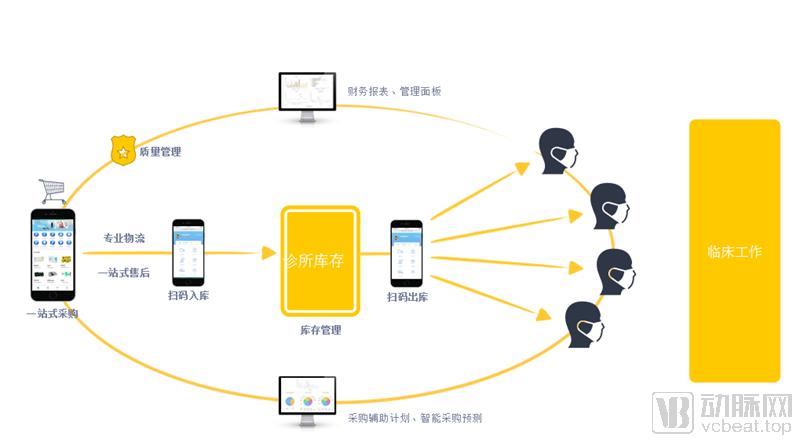
Jiawosi Intelligent Steward Flowchart (Photo provided by the interviewee)
In response, Jiawosi has developed a B2B one-stop procurement system specifically tailored for private healthcare institutions, leveraging artificial intelligence algorithms. Powered by AI, the system can automatically track the inbound and outbound status of products.
Once physicians set the procurement cycle, the system leverages algorithms to forecast clinic material requirements and automatically converts these forecasts into purchase orders. Medical staff need only confirm and pay for the orders, after which Jawors’ logistics service will deliver the products to the ordering healthcare institution on schedule.
“Upon product delivery, medical staff scan a QR code to compliantly integrate our products into their inventory system. Each consumed device is recorded in real time online. Through the management panel on the app, medical personnel can monitor material inventory and usage at any time. Throughout the entire process, healthcare institutions do not need to use paper or pen for record-keeping,” said Zou Jin. Meanwhile, the system generates detailed financial reports based on procurement and consumption data from private institutions to facilitate settlement.
For upstream manufacturers, all transaction and customer information on the Jiawosi platform is presented in an open and transparent manner. Upstream suppliers can track their product sales destinations and market share within the industry through dedicated interfaces.
Zou Jin told VCBeat that Jiavos’s revenue model primarily relies on technical service fees charged to members and transaction rebates. In 2018, the transaction volume on the Jiavos platform was approximately RMB 200 million. The transaction volume for 2019 is projected to reach around RMB 400 million.
Earlier this year, Jiavos just completed its Series A financing. The company has expanded from a team of three or four people at its inception to one with over 100 employees. Zou Jin hopes that while the team is rapidly expanding, it can continue to consolidate and maintain its existing "wolf culture" without dilution, in order to ensure the team's execution capability.
She stated that Jiawosi will invest tens of millions of yuan to build a highly efficient, automated supply chain service system for the entire industry, while accelerating research and development in artificial intelligence.
To date, the platform has listed over 8,000 private medical institutions.