

Chinese Medical Experts Achieve Breakthrough in Malignant Pleural Effusion Treatment with Drug-Loaded Vesicle Technology Featured on Cover of Science Translational Medicine
Chinese Medical Experts Achieve Major Technological Breakthrough in the Treatment of Malignant Pleural Effusion!
On September 7, at the Chinese Thoracic Society Annual Meeting (CTS-2019) held in Wuhan, Hubei Province, Professor Jin Yang from Wuhan Union Hospital unveiled a novel oncology treatment approach that organically combines immunotherapy with biochemotherapy.
According to Professor Jin Yang, his team is currently employing the world’s first “drug-loaded vesicle therapy for tumors” to treat malignant pleural effusion. Their clinical translational research findings have been published in Science Translational Medicine, a specialized subsidiary journal of Science, and were featured on the cover of that issue.
The paper by Jin Yang’s team, titled “Autologous tumor cell–derived microparticle-based targeted chemotherapy in lung cancer patients with malignant pleural effusion,” has an impact factor of 16.710.
The release of this clinical translational research achievement provides a novel solution for conquering cancer-induced pleural effusion in China, promising to address the current clinical challenge of lacking effective treatment options and emerging as a breakthrough therapeutic technology.
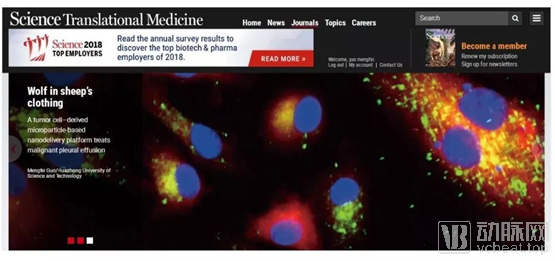
The article was also featured with an editorial cover commentary in *Science Translational Medicine*, further highlighting the academic value of drug-loaded vesicle technology for tumor treatment.
Cracking the Challenge of Pleural Effusion Treatment
Malignant Pleural Effusion (MPE), also known as pleural effusion, refers to the accumulation of fluid in the pleural cavity caused by primary malignant tumors of the pleura or metastasis of malignant tumors from other sites to the pleura. Nearly all types of malignant tumors can lead to pleural effusion. Lung cancer is the most common cause, accounting for approximately one-third of MPE cases, followed by breast cancer and lymphoma. The prognosis for MPE is poor, with a median survival time of only 4 to 7 months.
“There is currently no specific gold-standard method or effective treatment for pleural effusion in China,” pointed out Professor Jin Yang. The currently recommended treatment options primarily include talc pleurodesis and indwelling thoracic catheter drainage. However, talc pleurodesis carries certain safety risks, requires surgical intervention, and has a relatively high failure rate. Patients often experience pleuritic chest pain and fever postoperatively. Moreover, there are currently no domestic manufacturers in China producing medical-grade talc powder suitable for intrapleural injection. In addition, indwelling thoracic catheter drainage may lead to complications such as re-expansion pulmonary edema and catheter-related infections, with a high recurrence rate.
In summary, both of the aforementioned methods are palliative treatments targeting symptoms, addressing the manifestations rather than the underlying cause. Therefore, the unified treatment goal for pleural effusion cited in current major guidelines is to alleviate or eliminate dyspnea caused by pleural effusion with minimal trauma, which constitutes symptomatic palliative care.
“Malignant pleural effusion is a common complication in patients with advanced-stage malignancies, adversely affecting their quality of life and survival duration.” According to Professor Ma Fei, Deputy Director of the Department of Medical Oncology at the Cancer Hospital of the Chinese Academy of Medical Sciences, without timely treatment, the median overall survival for these patients is only approximately 3.3 months.
In response to this clinical dilemma, the emergence of drug-loaded vesicle therapy for tumors has offered patients greater hope. Several years ago, Professor Jin Yang’s team applied this novel technology to the treatment of pleural effusion and conducted a clinical trial.
According to data from a paper published in *Science Translational Medicine*, 11 patients with malignant pleural effusion (MPE) received treatment using the “drug-loaded vesicle tumor therapy” technique in a clinical study. The results showed that 4 patients achieved complete response, 6 achieved partial response, and 1 showed no response. The objective clinical response rate was 90.91%. The mean time to achieve pleurodesis was 7 days, with 4 patients achieving complete response in just 5 days. The median survival time for the 11 patients was 240 days.
In terms of safety, only six mild adverse events were recorded among the 11 patients throughout the study period, including dizziness, fever, nausea, and vomiting, indicating an overall favorable safety profile.
Furthermore, this clinical trial project provides a detailed account of a 48-year-old patient with lung adenocarcinoma complicated by pleural effusion. The patient had been diagnosed with lung adenocarcinoma for over eight months and had undergone various tumor immunotherapy regimens at multiple hospitals. However, post-treatment control of the pleural effusion was suboptimal, necessitating regular thoracentesis, and the patient continued to experience intermittent chest tightness, chest pain, cough, and hemoptysis. Following treatment with the "Drug-Loaded Vesicle Tumor Therapy" technology in the clinical trial, the patient’s pleural effusion was significantly controlled, and their quality of life improved markedly. Pulmonary CT scans and pleural fluid color Doppler ultrasound confirmed that this technology exerts both anti-tumor effects and promotes pleural adhesion. To date, the patient has survived for more than 800 days, substantially exceeding the typical survival time associated with malignant pleural effusion (MPE).
The Jinyang team believes that this study demonstrates that drug-loaded vesicle therapy for tumors is safe and feasible. In animal experiments and early-stage clinical trials, it effectively controls pleural effusion, kills tumor cells and tumor-associated macrophages, and reverses the immunosuppressive environment within the thoracic cavity. Widespread application of this technology will fill the clinical gap in China where there are currently no effective treatments for malignant pleural effusion, thereby advancing China’s clinical diagnosis and treatment technologies for malignant pleural effusion to a world-leading level.
The Fourth-Generation Cancer Therapy Technology Holds Profound Academic Value
“Drug-loaded vesicle therapy for cancer is an internationally innovative theory and technology, as well as a novel integrated targeted cancer treatment model,” pointed out Professor Jin Yang. It organically combines targeted therapy, bioimmunotherapy, and chemotherapy, leveraging the precision of targeted delivery alongside the rapid tumor cell-killing effect of chemotherapy to achieve swift remission. Meanwhile, bioimmunotherapy activates specific anti-tumor immunity, generating durable tumor surveillance to prevent recurrence, thereby offering hope for long-term cancer remission.
Vesicles are membrane-bound structures enclosed by a single lipid bilayer, ranging in size from tens to hundreds of nanometers. They primarily facilitate intracellular transport between various membrane-bound organelles. The discovery that elucidated the existence of this vesicular transport system within cells earned three scientists from the United States and Germany the 2013 Nobel Prize in Physiology or Medicine.
Professor Jin Yang’s innovative therapeutic technique leverages the vesicle transport mechanism. Specifically, it involves stripping away the outer layer of tumor cells—namely, their vesicles—and loading these vesicles with a small amount of chemotherapy drugs, effectively turning them into “explosive” carriers. These drug-loaded vesicles are then administered to the patient. By mimicking the original tumor-derived vesicles, they can precisely target the “enemy’s fortress”—the tumor site. Acting like a “Trojan horse,” they bypass the “city gates”—the tumor cell membrane—through camouflage, and subsequently release the “explosives”—chemotherapy drugs—near the “fortress headquarters”—the cell nucleus, thereby efficiently eliminating the “enemy forces”—tumor cells.
In a commentary by the editorial board of *Science Translational Medicine*, this drug-loaded vesicle technology for tumor treatment was vividly likened to “a wolf in sheep’s clothing.” The editors noted that “although various microparticle and nanoparticle materials have been developed in the past, each with its own advantages and limitations, this approach employs vesicles derived from patients’ own tumor cells to encapsulate chemotherapeutic agents, thereby improving intratumoral drug delivery. It has demonstrated successful outcomes in both mouse models and patients with malignant pleural effusion associated with lung cancer.”
The application of drug-loaded vesicle technology in cancer treatment is not limited to malignant pleural effusion; it has also become one of the representative fourth-generation cancer therapies in China, with gradual clinical adoption and promotion in the management of malignant ascites, cholangiocarcinoma, lung cancer, and other malignancies along with their complications.
According to reports, in addition to Professor Jin Yang’s team, large-sample clinical trials on the use of drug-loaded vesicles for the treatment of malignant pleural effusion have also been conducted in China. Currently, this technology has received pricing approval as a newly added medical service item in four provinces and municipalities: Anhui, Hubei, Shenzhen, and Tianjin. It has already been implemented in the Department of Respiratory and Critical Care Medicine at the Second Affiliated Hospital of Anhui Medical University, where it is being pioneered for the treatment of malignant pleural effusion.