

Imfinzi Demonstrates Significant Survival Benefit and Durable Efficacy in Extensive-Stage Small Cell Lung Cancer, Highlights from CASPIAN Phase III Trial

AstraZeneca Investment China
Pharmaceutical Manufacturer
Today, AstraZeneca announced detailed clinical data from the Phase III CASPIAN trial, demonstrating that Imfinzi (durvalumab) significantly improves overall survival in patients with extensive-stage small cell lung cancer who have not received prior systemic therapy.
Compared with the standard treatment for small cell lung cancer, which consists of up to six cycles of chemotherapy and optional prophylactic cranial irradiation, durvalumab combined with four cycles of standard chemotherapy (etoposide plus cisplatin or carboplatin) significantly improves overall survival, with both statistical and clinical significance.
The median overall survival (OS) was 13.0 months in the durvalumab plus chemotherapy group versus 10.3 months in the standard-of-care group, representing a 27% reduction in the risk of death (HR=0.73). The 18-month survival rate was 33.9% in the durvalumab plus chemotherapy group compared with 24.7% in the standard-of-care group.
Durvalumab in combination with chemotherapy demonstrated benefits over standard therapy across all efficacy endpoints. The results showed a significant advantage in the 12-month progression-free survival rate (17.5% vs. 4.7%), a 10.3% improvement in the objective response rate (67.9% vs. 57.6%), and a longer duration of response (12-month rate: 22.7% vs. 6.3%).
The above clinical data were presented at the plenary session of the 2019 World Conference on Lung Cancer, held in Barcelona, Spain, and hosted by the International Association for the Study of Lung Cancer (IASLC).
José Baselga, Global Executive Vice President and Head of Oncology R&D at AstraZeneca, stated, “We are delighted to see that more than one-third of patients with small cell lung cancer (SCLC) were still alive 18 months after treatment with durvalumab in combination with chemotherapy. This is a remarkable outcome for such an aggressive form of SCLC. Notably, these data provide evidence for clinicians to choose durvalumab combined with cisplatin- or carboplatin-based chemotherapy for the treatment of patients with SCLC. We look forward to working closely with regulatory authorities to make durvalumab available to patients with SCLC worldwide as soon as possible.”
Professor Luis Paz-Ares, Director of the Medical Oncology Department at Doce de Octubre University Hospital in Madrid, Spain, and principal investigator of the CASPIAN clinical trial, stated: “Treatment options for patients with small cell lung cancer (SCLC) are very limited, with a 5-year survival rate of only about 6%. The CASPIAN clinical trial demonstrated that durvalumab combined with four cycles of chemotherapy yields superior outcomes compared to conventional chemotherapy, significantly improving patient survival. This represents a new option and hope for patients with SCLC.”
Small cell lung cancer is a rapidly growing malignant tumor that, despite its sensitivity to platinum-based chemotherapy, tends to recur quickly and progress rapidly.
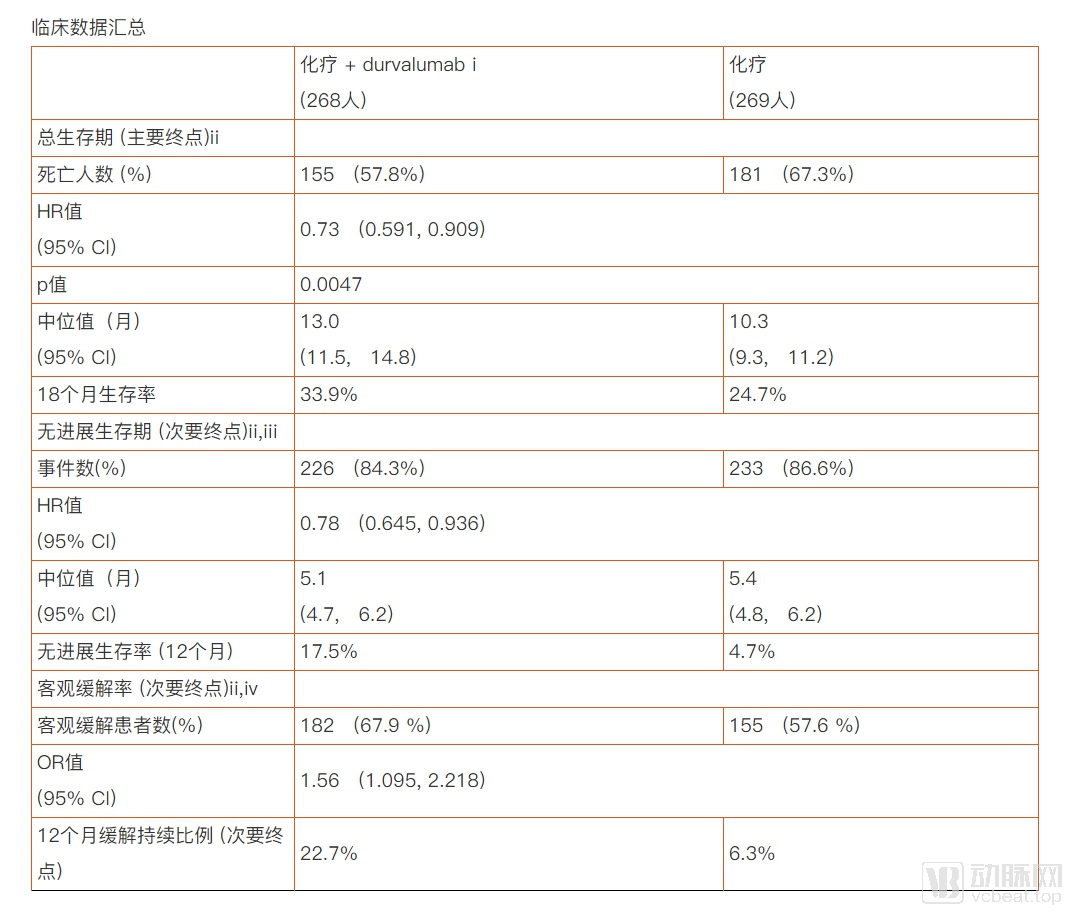
i Etoposide + investigator’s choice of cisplatin or carboplatin
ii. Data for overall survival, progression-free survival, and objective response rate were censored as of March 11, 2019.
iii. Progression-free survival has not yet undergone statistical analysis.
The confirmed objective response rate was assessed by investigators according to RECIST v1.1 criteria.
The safety and tolerability of durvalumab combined with etoposide and platinum-based chemotherapy were consistent with previous trial results. Clinical data showed that the incidence of grade 3–4 adverse events was 61.5% in the durvalumab plus standard-of-care group and 62.4% in the standard-of-care group, with similar rates of treatment discontinuation due to adverse events in both groups (9.4% vs. 9.4%).
For limited-stage small cell lung cancer, the Phase III clinical trial ADRIATIC is evaluating the efficacy of durvalumab following concurrent chemoradiotherapy.
Based on the results of the phase III PACIFIC trial, durvalumab has been approved in 49 countries, including the United States, Japan, and the European Union, for consolidation therapy following chemoradiotherapy in patients with unresectable stage III non-small cell lung cancer (NSCLC) treated with curative intent.
About CASPIAN
The CASPIAN study is a randomized, open-label, global, multicenter Phase III clinical trial evaluating first-line treatment for patients with extensive-stage small cell lung cancer (ES-SCLC). The trial comprises three arms: durvalumab combined with standard chemotherapy (etoposide plus cisplatin or carboplatin), durvalumab plus tremelimumab (an anti-CTLA-4 antibody) and chemotherapy, and a control arm receiving chemotherapy alone. In the experimental arms, patients receive up to four cycles of chemotherapy. In the control arm, patients receive up to six cycles of chemotherapy, with prophylactic cranial irradiation administered as clinically indicated. The trial will continue until survival data for the durvalumab plus tremelimumab and chemotherapy combination arm reach maturity.
This clinical trial was conducted at more than 200 centers across 22 countries worldwide, including the United States, Europe, South America, Asia, and the Middle East. The primary endpoint of the clinical trial was overall survival.
About Small Cell Lung Cancer
Lung cancer has become the leading cause of cancer-related death in both men and women, accounting for approximately one-fifth of all cancer deaths. Lung cancer is typically classified into non-small cell lung cancer (NSCLC) and small cell lung cancer (SCLC), with SCLC comprising about 15% of cases. Approximately three-quarters of patients with SCLC are diagnosed at the extensive stage, where cancer cells have already spread within the lungs or metastasized to other tissues or organs. The prognosis for SCLC is poor, with a 5-year survival rate of only around 6%.
About Durvalumab
Durvalumab is a human-derived PD-L1 monoclonal antibody that blocks the binding of PD-L1 to PD-1 and CD80, thereby inhibiting tumor immune escape and restoring suppressed immune responses.
Durvalumab has been approved in 10 countries worldwide, including the United States, for the treatment of patients with previously treated advanced bladder cancer.
As part of new drug development programs, durvalumab is currently being investigated as monotherapy or in combination with the CTLA-4 antibody tremelimumab and other novel agents to explore its therapeutic potential in non-small cell lung cancer, small cell lung cancer, bladder cancer, head and neck cancer, liver cancer, cervical cancer, cholangiocarcinoma, and other solid tumors.
AstraZeneca's Research in the Field of Lung Cancer
AstraZeneca has multiple approved drugs or those in late-stage clinical development, suitable for lung cancer patients at different stages, treatment phases, and with varying mechanisms of action. We address the unmet treatment needs of EGFR mutation-positive non-small cell lung cancer (NSCLC) patients through marketed drugs such as Iressa and Tagrisso, ongoing Phase III clinical trials (ADAURA, LAURA, FLAURA, and FLAURA2), and exploratory combination Phase II clinical trials (SAVANNAH and ORCHARD). Approximately 10%-15% of NSCLC patients in Europe and America, and about 30%-40% of Asian NSCLC patients, will benefit from these treatments.
Meanwhile, AstraZeneca’s extensive oncology immunotherapy portfolio has also advanced to late-stage clinical development, targeting patients with lung cancer lacking known genetic mutations, who account for approximately three-quarters of all lung cancer cases. The anti-PD-L1 antibody durvalumab is currently being investigated in patients with advanced lung cancer (including the Phase III trials POSEIDON, PEARL, and CASPIAN) and in those with earlier-stage disease where curative intent is possible (including the Phase III trials AEGEAN, PACIFIC-2, ADRIATIC, ADJUVANT BR.31, PACIFIC-4, and PACIFIC-5). These studies evaluate durvalumab as monotherapy or in combination with tremelimumab and/or chemotherapy.
AstraZeneca's Research Strategy in Oncology Immunotherapy
Tumor immunotherapy is a treatment strategy that activates the patient’s immune system to attack tumors. Our portfolio of immunotherapeutic agents is designed to overcome tumor-mediated immunosuppression. For the majority of cancer patients, we believe immunotherapy will offer unprecedented therapeutic opportunities.
For cancer patients with varying types, stages, and treatment histories, we are exploring the use of durvalumab monotherapy or durvalumab in combination with the CTLA-4 antibody tremelimumab, leveraging PD-L1 expression as a predictive biomarker to deliver optimal treatment strategies tailored to different patient populations. Furthermore, our immunotherapies, when combined with radiotherapy, chemotherapy, and small-molecule targeted agents from our company and partners, hold the potential to provide new therapeutic options for a broader range of cancer patients.
AstraZeneca's Oncology Research
AstraZeneca has a long-standing heritage in oncology research. Our rapidly expanding portfolio of novel medicines is transforming patients’ lives and unlocking immense potential for the company’s future growth. With the launch of at least six new drugs between 2014 and 2020, and a robust R&D pipeline enriched by investigational small molecules and biologics, we are committed to establishing oncology as one of AstraZeneca’s six core business platforms, focusing our research on cancers of the lung, ovary, breast, and blood. In addition to leveraging our core capabilities, we actively pursue innovative partnerships and external investments to accelerate the realization of our strategy, such as our investment in Acerta Pharma to advance hematology research.
By leveraging four major scientific platforms—cancer immunotherapy, driver genes and resistance mechanisms in tumors, DNA damage repair, and antibody-drug conjugates—and advocating for the development of personalized combination therapies, AstraZeneca aims to redefine cancer treatment and ultimately conquer cancer in the future.
About AstraZeneca
AstraZeneca is a science-led global biopharmaceutical company dedicated to the research, development, manufacturing, and marketing of prescription medicines, with a primary focus on three major therapeutic areas: oncology; cardiovascular, renal, and metabolism; and respiratory diseases. Operating in over 100 countries, AstraZeneca’s innovative medications benefit millions of patients worldwide.
Disclaimer: Durvalumab is currently still in the research and development stage and has not yet been approved in China. The information provided in this material should not be construed as treatment or usage advice under any circumstances, nor is it intended for promotional purposes.
References
1. Kalemkerian GP, et al. Treatment Options for Relapsed Small-Cell Lung Cancer: What Progress Have We Made? Journal of Oncology Practice, volume 14, issue no. 6 (June 1, 2018) 369-370.
2. World Health Organization. International Agency for Research on Cancer. Available at http://globocan.iarc.fr/Pages/fact_sheets_population.aspx. Accessed May 2019.
3. LUNGevity Foundation. Types of Lung Cancer. Available at https://lungevity.org/for-patients-caregivers/lung-cancer-101/types-of-lung-cancer. Accessed May 2019.
4. Cancer.Net. Lung Cancer - Small Cell. Available at https://www.cancer.net/cancer-types/33776/view-all. Accessed May 2019.
5. Szumera-Ciećkiewicz A, et al. EGFR Mutation Testing on Cytological and Histological Samples in Non-Small Cell Lung Cancer: a Polish, Single Institution Study and Systematic Review of European Incidence. Int J Clin Exp Pathol. 2013:6;2800-12. Accessed July 2019.
6. Keedy VL, et al. American Society of Clinical Oncology Provisional Clinical Opinion: Epidermal Growth Factor Receptor (EGFR) Mutation Testing for Patients with Advanced Non-Small-Cell Lung Cancer Considering First-Line EGFR Tyrosine Kinase Inhibitor Therapy. J Clin Oncol. 2011:29;2121-27. Accessed July 2019.
7. Ellison G, et al. EGFR Mutation Testing in Lung Cancer: a Review of Available Methods and Their Use for Analysis of Tumour Tissue and Cytology Samples. J Clin Pathol. 2013:66;79-89. Accessed July 2019.
8. Pakkala, S, et al. Personalized therapy for lung cancer: striking a moving target. JCI Insight. 2018;3(15):e120858.