

How to Innovate in Healthcare Payments? 15 Overseas Companies Show the Way

ABILITY Network
Medical Insurance Service Provider
Humana
Health Insurance Service Provider

Alan
Medical Insurance Service Provider
nThrive
Healthcare Revenue Cycle Management Software Service Platform

Carrum Health
Medical Payment Service Platform

Clover Health
Health Insurance Service Provider
AxiaMed
Medical Payment Enterprises
Centene
Health Insurance Company

Stride Health
Medical Insurance Recommendation Service Platform
Healthcare payment is not a new topic. The three longstanding issues—high costs, low efficiency, and limited accessibility of healthcare expenditures—have yet to be systematically resolved. The healthcare industry has been continuously seeking breakthroughs. Practitioners across all segments of the industry must keep pace with, or even drive, technological advancements and the establishment of new industry standards, leveraging their respective strengths to chart a viable path forward.
VCBeat (WeChat ID: vcbeat) periodically compiles a list of innovative companies in the healthcare payment sector both domestically and internationally. Recently, it selected 15 distinctive overseas enterprises and analyzed their innovation strategies through case studies, aiming to provide reference experiences for practitioners in China.
VCBeat attempts to interpret these companies from the following dimensions:
I. How to Drive Self-Development Through Technological or Business Model Innovation.
II. How to Achieve Growth with Capital Support; How to Leverage Capital to Mobilize More Resources and Attract Numerous Partners for Collaborative Advancement.
III. How to Align with Major Policies, Adjust Product Direction, and Seize Emerging Opportunities.
For detailed case study collections, please see“Exploring Emerging Trends in Healthcare Payment Innovation”. The following is a brief summary of the special topic:
Technology is the core driver of corporate development. Among the 15 innovative overseas companies in the healthcare payment sector curated by VCBeat, nine have garnered attention for their technological innovations. Big data, cloud computing, digitalization, and machine learning are frequently cited terms in payment innovation, aligning closely with the technological focus of domestic payment enterprises in China.
Among them, the following five companies are leveraging big data for innovation.
Big Data
Case 1 Stride Health: Big Data Algorithms Provide Personalized Health Insurance Plan Recommendations for Patients
Big data algorithms provide the technological foundation for Stride Health’s consumer-facing health insurance services. The company’s algorithms cross-reference users’ private data—such as age, gender, medical conditions, medications, smoking habits, and preferred physicians—with government information sources, including the FDA’s drug database and CMS Medicare reimbursement data.
Based on the comparison results, Stride Health’s algorithmic system generates a recommended list of health insurance plans that may meet user needs. The top-ranked option is the “Best Health Insurance Plan,” followed by the “Second-Best Health Insurance Plan.”
For each health insurance plan, Stride Health calculates the consumer’s projected annual costs, monthly premiums, deductibles, and out-of-pocket expenses for physician visits and prescriptions. The entire process takes just 10 minutes from start to finish.
Currently, Stride Health has filed a patent application for its algorithm.
Case 2 nThrive: Data Analytics Platform Provides Comprehensive CRM Outsourcing Services
nThrive is an analytics-driven, technology-enabled company that provides comprehensive revenue cycle management (RCM) outsourcing services. In addition to conventional RCM outsourcing, the company leverages its robust data analytics platform and team of experts to deliver business consulting, analytical, and educational training services to healthcare providers—a key differentiator that sets it apart from its peers.
Centered on revenue cycle management, nThrive has developed a comprehensive, end-to-end CRM service portfolio, specifically including patient access solutions, mid-revenue cycle solutions, patient financial solutions, value-based care solutions, healthcare consulting services, and healthcare education services. This service ecosystem enables patients to focus on their care, physicians to concentrate on clinical consultations, and healthcare providers to transform into high-performance engines capable of sustainable operations.
Case 3 Clover Health: Big Data + Deep Learning Algorithms to Proactively Identify Patient Health Risks
Traditional insurance companies often intervene only after a claim has been filed, whereas Clover Health aims to shift the point of health management intervention to before claims occur. By leveraging data analytics and deep learning algorithms to identify patients’ risk of complications, it enables early intervention.
Clover Health’s data processing workflow is highly complex. The company first collects data—including public health records, electronic medical records, laboratory and diagnostic test results, medication histories, and insurance claims—to ascertain members’ medical histories. It then cleans and processes this data, matching it against models established in its database to predict potential complications. This enables the identification of high-risk patient populations and the provision of targeted intervention solutions to help them improve their health outcomes.
Clover Health has developed a product to predict which patients are most likely to be hospitalized within the next 28 days. It is claimed that its accuracy rate is as high as 85%, surpassing even the data models of the Google Brain team.
Case 4 Centene Corporation: Big Data Analytics Reduce User Healthcare Expenditures
Centene Corporation leverages precise medical big data analytics to identify potential health risks among patients. The team collects users’ medical histories from their past health insurance claims data and matches this information with models established in its database to identify high-risk populations and help them improve their health outcomes. Intervening in users’ health conditions before disease onset can reduce the company’s payout costs for health insurance programs.
Case 5 Humana: Big Data + Machine Learning, Services Covering Nearly the Entire Industry Chain
Humana has adopted emerging technologies such as robotic process automation, machine learning, cloud-native application platforms, and open innovation architectures. Its technological scope is comprehensive, ranging from big data processing and IoT-enabled device interactions to electronic health records, digital, mobile, and cloud-based systems, as well as traditional IT-related technologies.
In the healthcare services sector, Humana offers preventive care programs to assist individuals seeking to improve their health outcomes. The company leverages intelligent analytics technology and collaborates with clinicians to focus on the social determinants of health, providing members with network resources and online services to help them understand the latest health benefit plans.
Other hotspots of technological innovation include:
Machine Learning
Case Study: Cotiviti Holdings—Machine Learning and Natural Language Processing Enhance Payment Accuracy
As costs in the U.S. healthcare industry continue to rise, industry participants face increasingly complex clinical and financial risks. Cotiviti Holdings’ core mission is to help clients optimize financial performance, improve payment efficiency, and enhance overall healthcare value.
Cotiviti Holdings has deployed clinical research leveraging natural language processing (NLP) and machine learning, and has engaged analytics experts, over 1,000 certified coding professionals, and more than 450 retrieval specialists to provide health plans with comprehensive, end-to-end prospective and retrospective risk adjustment services and support. By integrating expertise in NLP, artificial intelligence, and data analytics, Cotiviti Holdings ensures the optimization of risk-related revenue while maintaining appropriate compliance.
With its payment accuracy solutions, Cotiviti Holdings recovered $2.7 billion in losses for its clients in 2015, propelling the company to prominence in the healthcare payments sector.
Cloud Computing
Case Study: ABILITY Network—“Cloud Computing + Healthcare” Simplifies the Claims Process
ABILITY Network is a typical representative of innovative payment companies in the “cloud computing + healthcare” sector. By connecting payers and providers through its SaaS-based myABILITY® software platform, ABILITY Network simplifies payers’ online access to claims processing and reimbursement management.
Meanwhile, ABILITY Network has also developed a range of online technology products that have gained customer recognition due to their specialized functionalities. Furthermore, ABILITY Network provides users with comprehensive solutions, with its platform supporting real-time healthcare services from pharmaceutical companies, device manufacturers, and diagnostic firms all the way to the point of patient care. Its primary focus areas include facilitating convenient payments, optimizing claims processing and reimbursement, and enhancing the quality of care management.
Digitalization
Case Study: Alan—Digital Platform Enhances User Insurance Experience
Alan has achieved 100% digital online operations. Through its partner PayFit’s digital online management platform, the company helps employer clients integrate employee payroll with supplemental health insurance policies.
When purchasing Alan insurance, users can send documents via smartphone or upload them through the PC website, and make payments online.
Alan automatically handles all paperwork on its behalf and sends the data directly to the company’s payroll management platform. Before seeking medical care, users can review information such as insurance plan coverage and reimbursement policies on the Alan platform. When claiming medical expenses, users can submit their medical bills to the Alan platform and communicate directly with Alan regarding claims; customer service representatives will respond within two minutes.
This process not only simplifies corporate payroll and human resources management procedures, but also helps employers reduce health insurance management costs by optimizing insurance purchasing and claims processes and making reimbursement policies transparent.
If “healthcare + cloud computing” and big data algorithms are the core guarantees for the successful implementation of healthcare payments, then encryption technology during the payment process serves as the safety belt for healthcare payments. There is no shortage of representative enterprises in the fields of payment encryption and natural language processing (NLP).
Payment Encryption
Case Study: AxiaMed – Encryption Technology Safeguards Payment Security
Healthcare fintech company AxiaMed has developed a PCI-certified point-to-point encryption technology and applied it to medical payments.
AxiaMed partners with independent software vendors (ISVs) to deliver secure patient payment solutions within their healthcare applications. By expanding the payment options available to patients, this solution streamlines administrative workflows, reduces bad debt, and effectively enhances the financial performance of healthcare providers, making patient payments more convenient.
AxiaMed’s payment convergence technology platform fully integrates payment card functionality into electronic health record (EHR) systems, practice management systems (PMS), revenue cycle management (RCM) solutions, and patient engagement applications. By enabling accurate and timely updates to accounting systems and ledgers, this payment convergence technology can be embedded into existing healthcare workflows to accelerate patient payments and streamline administrative processes.
Business model innovation is a key strategy for healthcare payment companies seeking growth drivers. Among the 15 innovative healthcare payment enterprises reviewed by VCBeat, five have explored new business models from perspectives such as payment methods, payment channels, and product design. However, in this sector, Chinese companies appear to demonstrate greater creativity.
Payment Method Innovation
Case 1 Carrum Health: Bundled Payments Reduce Billing Management Complexity
Bundled payments based on value-based care are the hallmark of Carrum Health. Through its bundled payment programs, Carrum Health connects self-insured corporate employers with high-quality healthcare providers both locally and across the United States.
Under this mechanism, Carrum Health first aggregates a large-scale insured population by partnering with multiple small and medium-sized enterprises (SMEs), thereby establishing significant market influence. Subsequently, Carrum Health negotiates prices for specific medical services with healthcare providers on behalf of these SME employers and enters into bundled payment contracts.
For employers, Carrum Health utilizes pre-determined bundled payment prices, eliminating price variability and unpredictability. Employees typically only need to pay a small out-of-pocket amount. Partnered healthcare providers can gain additional patient volume through Carrum Health without having to negotiate individual bundled payment contracts with each employer, significantly reducing the complexity of billing management.
Case 2 AccessOne: Applications Accepted Even with Poor Credit, the “Huabei” of Healthcare
AccessOne is a medical credit card company that offers loan programs to patients facing financial strain due to high out-of-pocket costs and high deductibles. AccessOne does not reject any patient applicants and does not utilize a credit scoring system.
When patients apply for loans, AccessOne evaluates their credit histories and develops suitable repayment plans based on their individual circumstances.
When a patient is about to become delinquent, they will receive a payment reminder from AccessOne. If patients with interest-free loans fail to repay on time, their accounts will be converted to interest-bearing accounts until the outstanding balance and accrued interest are fully paid off. For patients with low-interest loans, the interest rate on overdue payments will increase to 18%. If a patient stops or refuses to make payments, AccessOne will not report the delinquency to credit bureaus, unlike other medical credit card companies; instead, it will return the patient’s account to the healthcare provider where the services were rendered.
To ensure repayment rates, AccessOne leverages its platform’s predictive analytics tools to assess patients’ payment propensity in advance and adjust repayment amounts, keeping them within the range that patients can afford on a monthly basis.
Payment Channel Innovation
Case Study: OODA Health—Real-Time Payments, the “Alipay” of Healthcare
Third-party medical payment platform OODA Health seeks to establish a real-time payment system that enables physicians, patients, and insurers to fulfill their respective roles without worrying about bill payments.
OODA Health has partnered with Blue Shield of California to jointly develop a cloud-based software platform. This platform streamlines claims adjudication, medical billing, and patient information collection processes, while providing intuitive patient medical bills.
Meanwhile, OODA Health partners with healthcare providers and acts as an intermediary in processing billing documents, helping them exit the business process of bill collection. After patients receive treatment, OODA Health’s software platform pays healthcare providers immediately based on the content in electronic health records. Any unresolved payment issues are no longer handled directly by healthcare providers but are instead managed by OODA Health through negotiations with patients.
Within the newly established healthcare payment system, OODA Health serves more as a “lubricant” among healthcare providers, payers, and patients.
Product Design Innovation
Case 1 Health IQ: Individuals with High Health Literacy Can Enjoy Premium Discounts
Health IQ is a life insurance agency that serves both B2B and B2C markets, leveraging data-driven insights to offer premium discounts exclusively to policyholders with high health literacy.
Health IQ assesses individuals’ health awareness through online health literacy tests. If policyholders prioritize health and pass various assessments, their life insurance premiums can be up to 33% lower than average. By purchasing a 30-year term life insurance policy, policyholders can save nearly $10,000. According to Health IQ’s official website, 76% of applicants who apply for insurance through Health IQ are rated by insurers as being in the best underwriting classes, such as Preferred Plus and Preferred Best.
Health IQ dares to offer such substantial discounts and remains profitable through its large customer base because the company built a massive database from the outset, which has become its moat in competing in new markets.
Case 2: Sempre Health: Patients with High Adherence Can Enjoy Prescription Drug Discounts
Sempre Health has established a prescription drug discount payment platform designed to enhance patient adherence to care plans. Comprising payers and pharmaceutical manufacturers, the platform aims to lower prescription drug prices and reduce patients’ medical expenditures.
Sempre Health’s platform dynamically adjusts payment structures based on individual adherence and behavior, ensuring that medication regimens align with users’ financial and clinical schedules.
The Sempre Health platform operates on a registered membership model. To ensure patients fill their prescriptions promptly and purchase medications on schedule according to their dosage dates, Sempre Health has established a dedicated discount program for its members. Furthermore, to facilitate timely medication purchases at nearby pharmacies, the Sempre Health platform strives to integrate with networked pharmacies across the United States, thereby maximizing convenience.
When a Sempre Health member completes their first payment, in addition to triggering an update to their health plan, they receive another message encouraging them to promptly schedule their next medication refill and calculating the corresponding discount based on the timeframe.
In summary, Sempre Health’s approach not only helps patients save money but also encourages them to take their medications on time.
In the context of capital, Clover Health and Humana have demonstrated two distinct paths to becoming industry giants.
Case 1: Clover Health—$900 Million Raised in Six Years, Capital Propels It to Unicorn Status
Clover Health was founded in 2013. Leveraging its core technologies in big data and deep learning algorithms, along with its differentiated competitive advantages, the company has consistently been favored by investors.
In September 2015, Clover Health raised $100 million in its Series A financing round, followed by $35 million in its Series B round in December of the same year; in May 2016, it secured $160 million in its Series C financing.
In May 2017, Clover Health raised $130 million in its Series D financing round. With this funding, the company’s valuation reached $1.2 billion, propelling it into “unicorn” status.
In January 2019, Clover Health secured $500 million in Series E financing. To date, the company has raised a total of $925 million.
Over six years, Clover Health completed six major funding rounds, rapidly becoming a unicorn in the industry. Its investors included prominent firms such as GV (Alphabet’s venture capital arm), Sequoia Capital, Floodgate, Bracket Capital, and First Round Capital.
Case 2 Humana: Acquisitions + Cross-Industry Collaboration
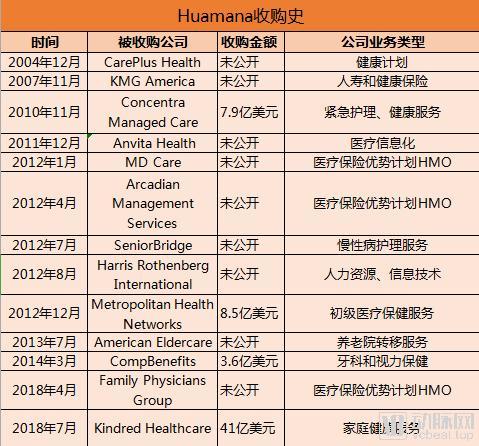
In July 2018, Humana, together with two other companies, completed the acquisition of Kindred Healthcare for $4.1 billion. This acquisition continued the trend of insurers acquiring healthcare providers and extended Humana’s reach into the post-acute care sector.
According to Crunchbase’s official website, Humana has completed 13 mergers and acquisitions since its establishment:
In addition to mergers and acquisitions, Humana is also continuously collaborating with external enterprises of all sizes.
Since October 2010, Humana and Walmart have joined forces to provide services for Medicare Part D (prescription drug coverage).
In 2012, the two parties reached another agreement under which the two companies would offer a co-branded prescription drug plan and provide exclusive discounts on health-related food products to select Humana customers at Walmart stores.
In June 2018, Humana announced a partnership with Walgreens, the leading U.S. pharmacy retail chain. Five months later, the two companies planned to expand their existing partnership and take cross-equity stakes in each other.
In September 2018, Humana announced an expanded partnership with Fitbit, the global leading brand in wearable health devices, to help Humana members adopt and implement healthy behaviors for the prevention and management of chronic diseases.
On March 15, 2019, Humana announced a partnership with its peer company, Accolade. The two companies will integrate their respective capabilities to create differentiated healthcare and benefits experiences for consumers.
It is precisely these acquisitions and partnerships that have established Humana’s current status as a giant in the healthcare payment sector.
As Amazon founder Jeff Bezos said, “Embrace trends, and you will ride the wave.” With policy guidance leading the way, some companies have successfully seized the opportunity.
Case 1 Centene Corporation: Upholding the Affordable Care Act
The Affordable Care Act, implemented since 2010, aims primarily to expand health insurance coverage and control healthcare expenditures. Measures include providing subsidies for low-income individuals, mandating employers to purchase insurance for employees, prohibiting insurers from denying coverage or raising premiums due to pre-existing conditions, and offering more comprehensive insurance plans covering screenings, medications, surgeries, and other services.
Since taking office, Trump has been attempting to modify the Affordable Care Act (Obamacare) and, in October 2017, eliminated government subsidies for health insurance companies known as Cost-Sharing Reduction (CSR) payments. These subsidies were designed to help low-income Americans share the cost of individual health insurance premiums under the Affordable Care Act.
Centene Corporation is a representative of health insurance companies that strategically position their businesses within the United States’ highly market-driven economic environment and under evolving policy orientations.
The company’s success is inseparable from Centene Corporation CEO Michael Neidorff’s grasp of the bipartisan political landscape in the United States.
Michael Neidorff stated during the company’s quarterly earnings conference call, “Centene Corporation will continue to collaborate with members of both parties to stabilize the individual health insurance market and improve the healthcare delivery system. At the same time, we believe that significant systemic changes require bipartisan efforts. Whether from a commercial perspective or a social welfare standpoint, Centene Corporation is committed to delivering the best, cost-effective services to more members.”
Centene Corporation has consistently stated that it will not abandon its individual health insurance business under the Affordable Care Act. On the contrary, the company continues to expand this segment. In 2018, Centene Corporation expanded its individual health insurance market in Kansas, Missouri, and Nevada, and intensified its promotional efforts for this business in six other states where it already had a presence.
Case 2 Alan: Finding Opportunities Amid New Health Insurance Regulations
After more than 50 years of reform and improvement, the French healthcare security system now covers the entire population.
Currently, France’s healthcare security system is primarily divided into two major sectors: basic health insurance (Sécurité sociale) and supplementary health insurance (Mutuelle). In 2016, France introduced new regulations stipulating that, effective January 1, 2016, all employers are required to purchase supplementary health insurance for their employees and cover at least 50% of the premiums.
Alan’s founders recognized that while France’s regulations on supplementary health insurance provided benefits to employees, they also imposed a burden on French small businesses and freelancers, as smaller enterprises and self-employed individuals struggled to bear the high costs of administering and providing these benefits.
Therefore, unlike large insurance companies that pursue multi-line strategies, Alan focuses on providing health insurance services tailored to small and medium-sized enterprises (SMEs) and freelancers, having sequentially launched medical insurance and life insurance products. These two types of insurance feature transparent pricing, relatively low premiums, and detailed reimbursement policies.
Alan is also the only independent health insurance company to have received approval from the French Prudential Supervision and Resolution Authority (ACPR) in France over the past 30 years.
(Cover image source: https://www.pexels.com)