

China's First Diabetes Prevalence Map Based on Physical Examination Big Data Reveals Significant 'Four Highs and Four Lows' Pattern

health 100
Medical Examination Service Provider
In recent years, with rising consumption levels and an aging population, the number of people with diabetes in China has surged. What is the national detection rate of diabetes in China? How strong is its correlation with obesity? And what are its characteristics in terms of distribution by gender, region, age, and season?
On August 28, the China Economic Information Service of Xinhua News Agency and Meinian Onehealth Healthcare Holdings Co., Ltd. jointly released the “Healthy China: Big Data Map of Diabetes from Health Checkups” (hereinafter referred to as the “Map”), with the Meinian Public Health Research Institute of Peking University Health Science Center serving as the academic support unit. Based on an analysis of over 13 million adult records with complete blood glucose data collected from 447 Meinian Onehealth checkup centers across China between April 1, 2018, and March 31, 2019, the diabetes detection rate among the national checkup population was 9.98% (adjusted to 8.63% after calibration against the national population distribution). Diabetes showed a strong positive correlation with obesity, and its distribution exhibited the following characteristics: higher in the north than in the south, higher in males than in females, higher in the elderly than in the young, and higher in winter than in summer.
China’s Diabetes Crisis: Detection Rate Approaches 10%
Diabetes is a common chronic non-communicable disease that has become a serious global public health issue. Data released by the International Diabetes Federation (IDF) shows that in 2017, there were approximately 425 million people with diabetes worldwide, with a prevalence rate of 8.8%. It is projected that the total number of people with diabetes globally will increase to 629 million by 2045.
China is a hard-hit area for diabetes, with an especially severe epidemic situation. The "Opinions of the State Council on Implementing the Healthy China Action" released in June 2019 pointed out that China is one of the countries with the fastest growing prevalence of diabetes. Studies have shown that the detection rate of diabetes in China increased from 0.67% in 1980 (using OGTT as the diagnostic standard) to 10.9% in 2013 (based on fasting blood glucose, HbA1c, and OGTT).
The “map” shows that relying on a single diabetes screening method underestimates the detection rate. When using only fasting blood glucose and prior history of diabetes as diagnostic criteria, the average detection rate is 5.48%, whereas incorporating glycated hemoglobin (HbA1c) testing raises the detection rate to 9.98%. Geographically, the detection rate is more likely to be underestimated in regions with higher diabetes prevalence.
Significant "Four Highs and Four Lows" Characteristics in the Distribution of Diabetes
Studies have shown that the detection rate of diabetes exhibits distinct regional, gender, age, and seasonal variations in its distribution.
Geographically, prevalence exhibits a “higher in the north, lower in the south” pattern. Overall, diabetes detection rates are higher in high-latitude regions. The Inner Mongolia Autonomous Region and Hebei Province rank first and second nationwide, with detection rates both exceeding 15%.
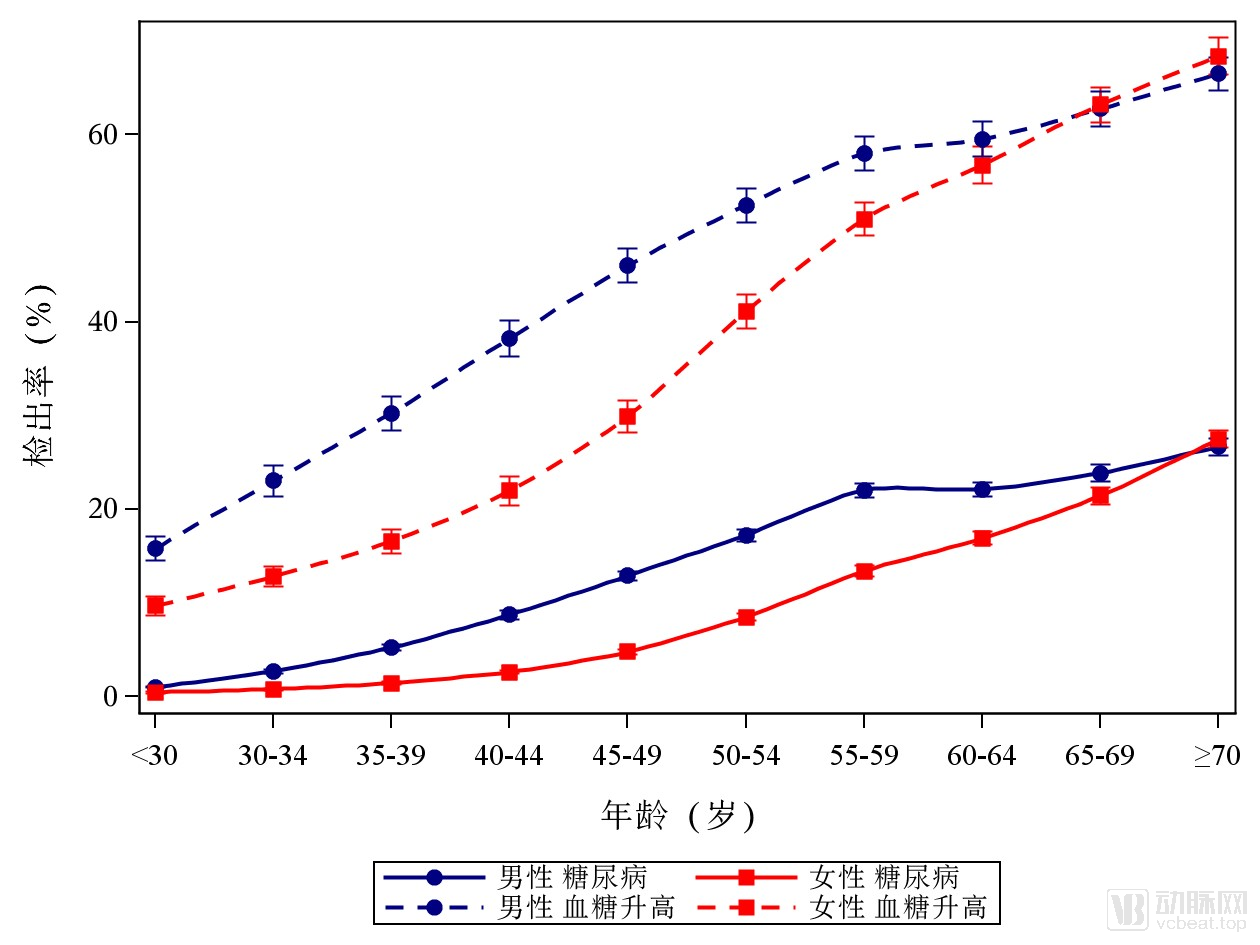
Gender Differences Show "Higher in Males, Lower in Females." The detection rate was 12.29% in males and 7.40% in females. In most age groups under 65 years, the diabetes detection rate was significantly higher in males than in females.
Figure: Detection Rates of Diabetes and Elevated Blood Glucose Among Individuals Aged 30–70 Undergoing Health Checkups
Data source: health 100
The prevalence exhibits a pattern of being higher in the elderly and lower in the young. The detection rate of diabetes increases with age. After the age of 70, the detection rates of diabetes for both men and women approach 20%, while the detection rate of elevated blood glucose exceeds 60%.
Seasonal trends show higher rates in winter and lower rates in summer. The high detection rate of diabetes in winter is associated with factors such as low temperatures, short daylight hours, reduced physical activity, and increased food intake. In addition, fasting blood glucose levels show a significant increase after holidays such as May Day, Dragon Boat Festival, Mid-Autumn Festival, National Day, New Year’s Day, and Spring Festival.
Obesity and Diabetes Are Inextricably Linked: The Path to Disease Prevention and Control Remains Long and Arduous
Studies both domestically and internationally have shown a close relationship between overweight, obesity, and diabetes, with the risk of developing diabetes in overweight individuals being 2-3 times higher than that in people with normal weight. The results of this "map" survey indicate a strong positive correlation between the two.
The “map” shows a higher prevalence of obesity among men, with significant differences between northern and southern regions. The detection rate of obesity in the examined population was 13.58%, with 17.63% for males and 9.44% for females. Hebei Province and Inner Mongolia Autonomous Region, which had the highest detection rates of diabetes, also ranked first and second nationwide in obesity detection rates, at 23.2% and 20.16%, respectively.
Meanwhile, awareness and prevention of diabetes among the national health examination population remain at a relatively low level. The national diabetes awareness rate (the proportion of diagnosed diabetic patients who are aware of their condition) stands at 35.41%, while the national diabetes control rate (the proportion of diabetic patients using glucose-lowering medications who achieve fasting blood glucose levels below 7.0 mmol/L) is 33.18%. Control rates in developed regions are generally higher than those in less developed regions.
Professor Han Jisheng, an academician of the Chinese Academy of Sciences and faculty member at Peking University Health Science Center, believes that the launch of the Big Data Diabetes Map based on health checkups is a cause for excitement and encouragement within China’s healthcare industry. Global research and scientific findings on major chronic diseases can provide new insights for future R&D efforts. For instance, despite the overall trend of higher diabetes detection rates in northern China and lower rates in the south, there are significant differences between Heilongjiang Province and its neighboring Inner Mongolia Autonomous Region, warranting further investigation into the various influencing factors.
Yu Rong, Chairman of Health 100, pointed out that “data + technology” serves as a crucial pillar driving the development of the healthcare industry. By analyzing key indicators such as detection rate, awareness rate, and control rate among diabetic populations within large-scale health checkup data, we can enhance the efficiency of population-based prevention and treatment, as well as standardized and normalized diabetes management. Meanwhile, insights derived from these data “maps” reveal opportunities in prevention and disease control, offering valuable references for industrial development. In the future, Health 100 will continue to leverage its large-scale user base to generate precise data, drive technological innovation through data, and build a comprehensive healthcare ecosystem through technological advancements, thereby safeguarding national health and advancing life science technologies.
According to reports, as early as 2016, Meinian Onehealth (Health 100), in collaboration with the former National Health and Family Planning Commission and leading enterprises in the field of diabetes, jointly launched the “National Diabetes Control Moonshot Initiative.” The initiative aims to establish a robust system for the prevention and control of diabetes as a chronic disease, thereby reducing national healthcare expenditures. Spanning a ten-year period, the plan strives to achieve annual diabetes prevention interventions for 100 million individuals by 2022, alleviate the economic burden of the disease by at least RMB 100 billion, and attain high rates of awareness, treatment, and target achievement.
As the "Healthy China" initiative has been elevated to a national strategy, all sectors of society are increasing their investment in the prevention and control of diabetes, aiming to curb the rising incidence of major chronic diseases and guide diabetic patients in strengthening health management. In the future, China Economic Information Service and Meinian Onehealth (Health 100) will sequentially release big data-driven chronic disease maps for various conditions, including cardiovascular and cerebrovascular diseases, cancer, respiratory diseases, and abnormal liver function. These efforts will support the development of health examination indices and advance the "Healthy China" strategy.