

Ascentage Pharma Announces Updated Clinical Data for APG-115 and APG-1387 at ASCO 2019
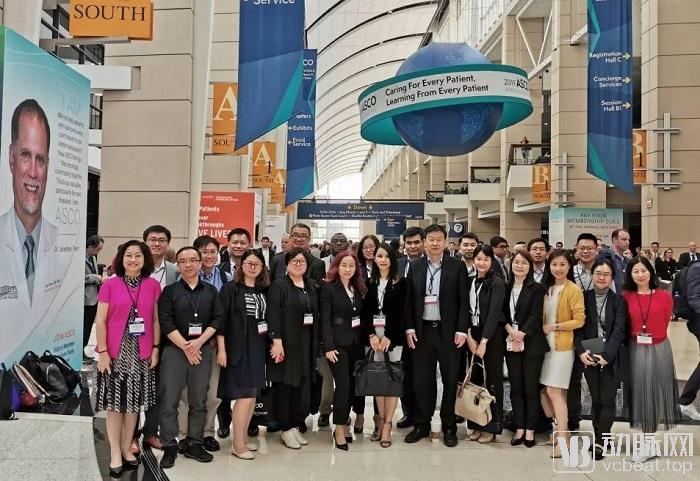
Dr. Yang Dajun, Chairman of Ascentage Pharma (sixth from right), and Dr. Zhai Yifan, Chief Medical Officer (first from left), with their team members at the 2019 ASCO Annual Meeting
On June 4, 2019, VCBeat (biobeat1) learned that Ascentage Pharma, a clinical-stage biopharmaceutical company dedicated to developing innovative drugs in the therapeutic areas of oncology, hepatitis B, and aging-related diseases, announced that it had presented the latest data from three clinical trials of its two investigational apoptosis modulators, APG-115 (an MDM2-p53 inhibitor) and APG-1387 (an IAP inhibitor), at the 55th Annual Meeting of the American Society of Clinical Oncology (ASCO).
ASCO is an annual global oncology conference. The 2019 ASCO Annual Meeting was held in Chicago from May 31 to June 4 (local time), under the theme “Caring for Every Patient, Learning from Every Patient.” As the world’s largest and most academically prestigious clinical oncology conference, this year’s meeting attracted over 40,000 oncologists and related professionals from more than 100 countries and regions worldwide, ushering in an academic feast showcasing the most cutting-edge clinical oncology research achievements globally.
As a “Chinese voice” increasingly active on the international academic stage, Ascentage Pharma presented two datasets detailing the clinical progress of its MDM2–p53 inhibitor APG-115 in China and the United States, respectively. Another study reported Phase I results for APG-1387, a novel IAP inhibitor, as monotherapy or in combination with monoclonal antibodies for the treatment of advanced solid tumors.
Notably, in the monotherapy study of APG-115, one patient with recurrent liposarcoma (TP53 wild-type and MDM2 gene amplification) achieved a partial response (PR) upon tumor assessment after receiving APG-115 treatment, with the best overall response being a 64% reduction from baseline.
Professor Zhang Xing, Chief Physician of the Department of Medical Oncology for Melanoma and Sarcoma at Sun Yat-sen University Cancer Center, stated: “Liposarcoma is a common histological subtype of malignant soft tissue sarcomas, accounting for approximately 15% of all soft tissue sarcomas. It lacks effective treatment options, has a high recurrence rate, and is classified as a ‘cold tumor,’ exhibiting poor response to immunotherapy. APG-115 is a highly potent MDM2-p53 inhibitor. Data from its Phase I clinical trial in solid tumors in China have been impressive in liposarcoma. Among the 14 enrolled patients, 8 had liposarcoma; one patient with liposarcoma achieved a partial response (PR) that persisted after discontinuation of treatment following four cycles. Among other participants, five patients achieved stable disease (SD), including two with liposarcoma, and the drug demonstrated favorable safety and tolerability. We look forward to further data advancements to address this unmet clinical need as soon as possible.”
Promising progress has also been observed in the Phase I study evaluating the novel IAP inhibitor APG-1387 as monotherapy for advanced solid tumors.
Dr. Drew W. Rasco, Deputy Director of Clinical Research at The START Center for Cancer Care in San Antonio, stated: “In the APG-1387 monotherapy group, 3 out of 10 patients with metastatic pancreatic cancer (mPC) achieved stable disease (SD). Among them, one subject in the 45 mg dose group underwent more than 9 cycles of treatment, confirming SD (+6%); another patient in the 60 mg dose group achieved a 16.7% reduction in tumor size after a single dose and maintained this response for 8 months.” He further noted, “These study data are highly significant because metastatic advanced pancreatic cancer typically has a survival period of only 3–6 months, with a 1-year survival rate of merely 8.8%, and there are currently no effective therapeutic agents available. We look forward to more promising data in the future.”
Dr. Yang Dajun, Chairman of Ascentage Pharma, stated: “Both APG-115 and APG-1387 featured in this presentation are key clinical candidates in Ascentage Pharma’s apoptosis-focused product portfolio. Multiple clinical findings demonstrate our further progress in the clinical development of apoptosis-targeting therapies. We look forward to providing more treatment options for oncology patients in the near future.”
Key Points:
Ø Phase I Study of the Novel MDM2-P53 Inhibitor APG-115 for the Treatment of Advanced Solid Tumors in China
• As of April 23, 2019, a total of 14 Chinese patients with advanced solid tumors (including 8 cases of liposarcoma) received APG-115 at varying doses of 100–200 mg. The APG-115 dosing regimen was administered every other day (QOD) for three consecutive weeks, followed by one week off, constituting a 4-week cycle.
• Two investigator-assessed dose-limiting toxicities (DLTs) occurred in the 200 mg dose group, namely thrombocytopenia and febrile neutropenia. APG-115 was well tolerated, with a maximum tolerated dose (MTD) of 150 mg. A safety expansion cohort at 100 mg is currently ongoing. The most common grade ≥3 adverse events (AEs) were hematologic toxicities, particularly thrombocytopenia; however, this toxicity is predictable as it results from TP53 activation in the bone marrow.
• APG-115 exhibited nearly linear pharmacokinetic characteristics in the 100–200 mg dose range.
• One patient with liposarcoma (TP53 wild-type and MDM2 gene amplification) treated with APG-115 150 mg achieved a confirmed partial response (PR), which remained sustained four months after treatment discontinuation.
Ø Phase I Study of the Novel MDM2 Inhibitor APG-115 for the Treatment of Advanced Solid Tumors
• As of April 19, 2019, a total of 29 patients with advanced solid tumors had received treatment with APG-115 at varying doses ranging from 10 to 300 mg.
• The most common treatment-related adverse events (TRAEs) (>10%) were: fatigue, nausea, vomiting, decreased appetite, diarrhea, decreased neutrophil count, thrombocytopenia, and decreased white blood cell count.
• DLTs were determined to be thrombocytopenia, fatigue, and nausea.
• APG-115 was well tolerated at a dose of 100 mg administered every other day (QOD) on a schedule of 3 weeks on and 1 week off. The maximum tolerated dose (MTD)/recommended phase 2 dose (RP2D) of APG-115 monotherapy was 100 mg.
• Preliminary efficacy data indicate that APG-115 exhibits antitumor activity. Among the 19 subjects evaluable for efficacy, 9 achieved stable disease (SD). In the maximum tolerated dose (MTD) cohort, 50% (5/10) of the subjects evaluable for efficacy achieved SD.
• Pharmacokinetic analysis showed that AUC and Cmax increased in a dose-proportional manner over the dose range of 20–300 mg.
• Serum levels of MIC-1 (a biomarker of TP53 activation) showed a dose-dependent increase.
• A study of APG-115 in combination with pembrolizumab for the treatment of patients with advanced solid tumors is ongoing.
Ø Phase I Study of the Novel IAP Inhibitor APG-1387 as Monotherapy or in Combination with Pembrolizumab for the Treatment of Advanced Solid Tumors
• As of April 19, 2019, a total of 24 subjects received APG-1387 monotherapy, and 5 subjects received APG-1387 in combination with pembrolizumab.
• APG-1387 was well tolerated, with manageable adverse events. The most common TRAEs (>10%) were fatigue.
• Two DLTs, namely elevated lipase and facial nerve disorder, were observed in the 60 mg dose group, confirming the MTD of APG-1387 monotherapy as 45 mg.
• In the APG-1387 monotherapy group, 3 out of 10 patients with mPC (metastatic pancreatic cancer) achieved stable disease (SD), including one subject in the 45 mg dose cohort who underwent more than 9 cycles of treatment, confirming SD (+6%).
• Preliminary PK data for APG-1387 indicate that exposure (Cmax and AUC) is dose-proportional within the 20–45 mg dose range.
• APG-1387 significantly induces XIAP reduction in PBMCs and cytokine release in serum (particularly IL-12p40 and IL-10), suggesting potential pharmacodynamic and host immunomodulatory effects.
• APG-1387, either as monotherapy or in combination with pembrolizumab, warrants further investigation for the treatment of advanced metastatic pancreatic cancer.
About APG-115
APG-115 is an orally bioavailable, highly selective small-molecule MDM2-p53 inhibitor under development by Ascentage Pharma. APG-115 exhibits high binding affinity for MDM2 and restores p53 tumor suppressor activity by blocking the MDM2-p53 interaction. Phase I clinical trials are currently underway in China and the United States in patients with adenoid cystic carcinoma (ACC) and other sarcomas. Additionally, a Phase Ib/II clinical trial evaluating APG-115 in combination with pembrolizumab is being conducted in the United States.
About APG-1387
APG-1387 is a novel small-molecule inhibitor of inhibitor of apoptosis proteins (IAPs) under development by Ascentage Pharma. The company is developing APG-1387 globally. It has completed the Phase I dose-escalation trial in patients with solid tumors in China and Australia, and is currently conducting a Phase I trial in the United States evaluating its combination therapy with pembrolizumab. APG-1387 is also undergoing clinical trials in China for the treatment of chronic hepatitis B.
About Ascentage Pharma
Ascentage Pharma is a clinical-stage biopharmaceutical company headquartered in China with a global outlook, dedicated to developing innovative drugs in the therapeutic areas of oncology, hepatitis B, and age-related diseases. The company possesses a proprietary protein-protein interaction (PPI) targeted drug design platform. Ascentage Pharma’s R&D pipeline primarily focuses on inhibitors of key proteins in the apoptosis pathway, such as BCL-2, IAP, and MDM2-p53, to reactivate apoptotic programs in tumor cells, as well as second- and third-generation inhibitors targeting kinase mutations that emerge during cancer treatment. Currently, eight Class 1 novel drugs from the company have entered Phase I-II clinical development in China, the United States, and Australia.