

Nearly 50 Hospitals Nationwide Launch 5G Pilots; Four Key Use Cases Poised for Early Commercial Success
The Long-Awaited Moment Has Finally Arrived! On June 6, China’s Ministry of Industry and Information Technology (MIIT) announced the official issuance of 5G commercial licenses to telecom operators. A total of four 5G licenses were issued, with one each allocated to China Telecom, China Mobile, China Unicom, and China Broadcasting Network. This marks the commencement of commercial 5G services in China.
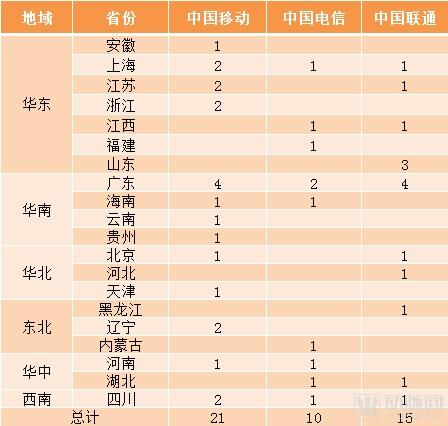
Healthcare is a key sector for the commercial deployment of 5G. Since February 2019, China’s three major telecom operators—China Mobile, China Unicom, and China Telecom—have been working closely with Grade A tertiary hospitals across various provinces and cities. According to incomplete statistics from VCBeat, as of June 2019, a total of 46 hospitals nationwide had successively launched 5G application collaborations, as detailed in the table below:
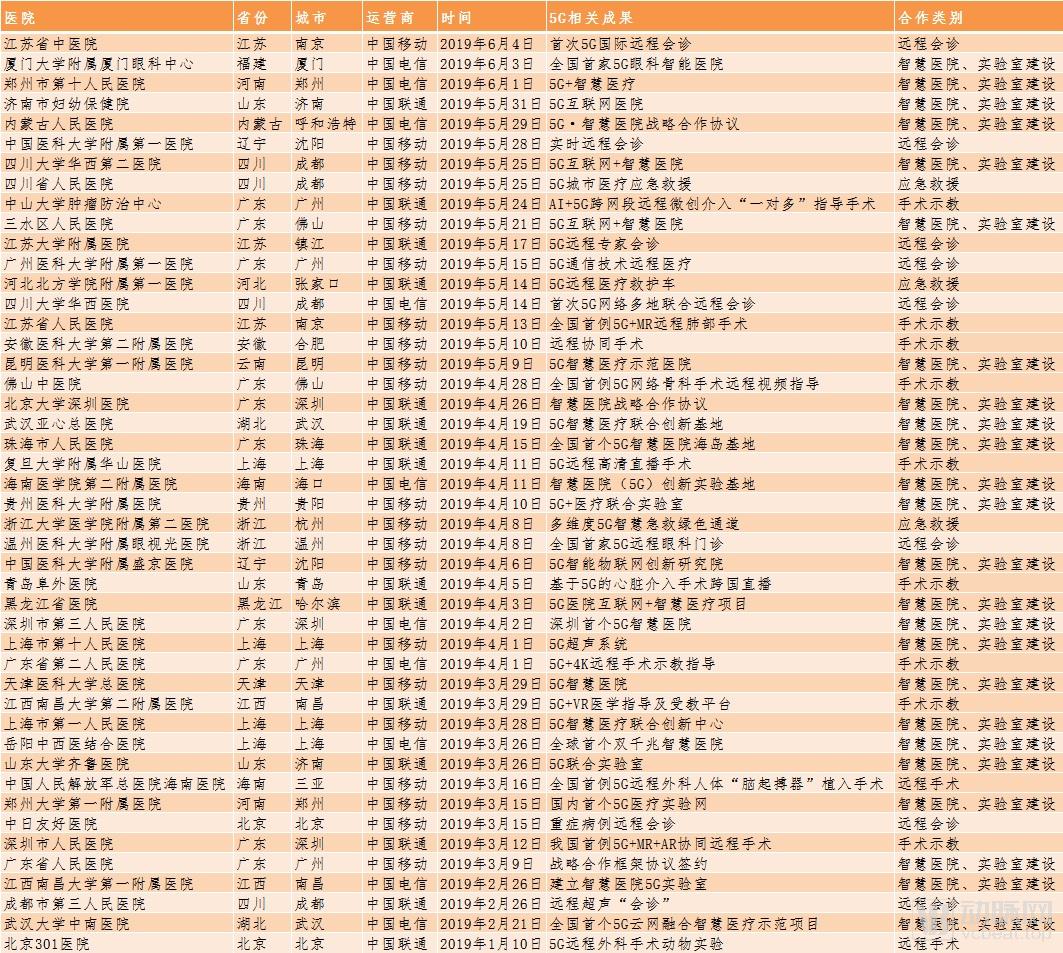
Guangdong Province Hospitals Are the Most Active in 5G Construction
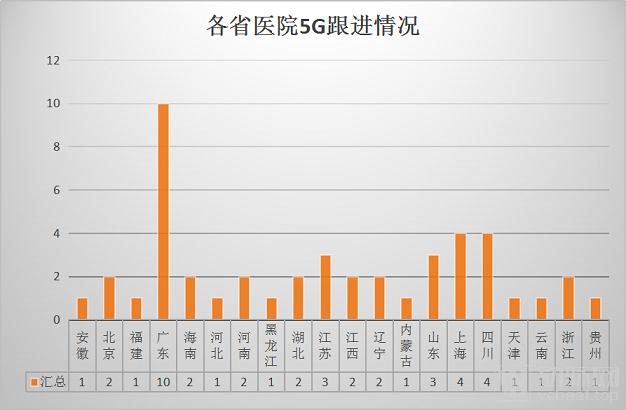
Based on the aforementioned data, VCBeat has compiled and analyzed information across five dimensions. First, regarding the progress of hospital adoption by province, it is evident that Guangdong was the most proactive province in advancing 5G infrastructure construction in hospitals during the first half of this year, followed by Shanghai and Sichuan.
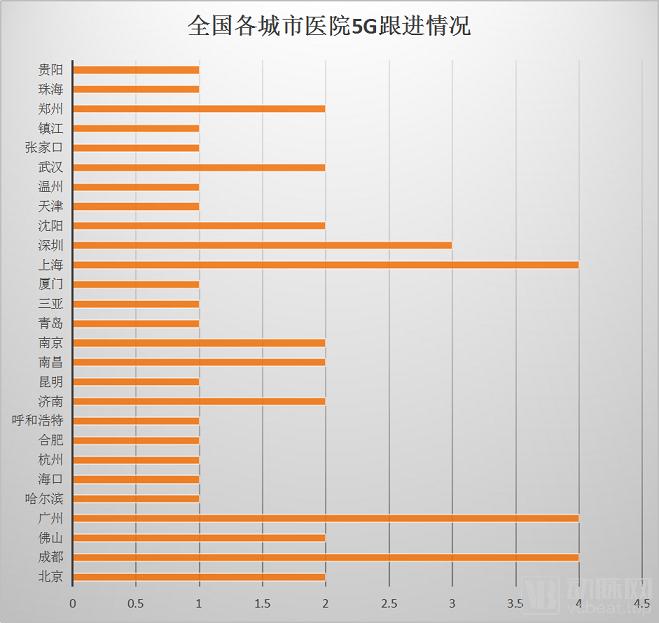
At the city level, hospitals in Shanghai, Guangzhou, and Chengdu demonstrated the most proactive engagement, with four hospitals in each city launching 5G business collaborations, followed by Shenzhen.
Regarding the cities most actively following up, some additional information is warranted. In fact, as early as late 2018, the three major telecom carriers had already finalized the list of the first batch of pilot cities for 5G networks.
China Unicom has selected 16 cities to conduct 5G trials, implement business applications, and establish typical demonstration projects. These cities include Beijing, Xiong’an, Tianjin, Shenyang, Qingdao, Nanjing, Shanghai, Hangzhou, Fuzhou, Shenzhen, Guangzhou, Zhengzhou, Chengdu, Chongqing, Wuhan, and Guiyang.
China Mobile adopted a “5+12” pilot program, designating Hangzhou, Shanghai, Guangzhou, Suzhou, and Wuhan as the first batch of 5G pilot cities, while conducting 5G application demonstrations in 12 other cities, including Beijing and Chongqing.
China Telecom’s 5G pilot cities follow a “6+6” model, comprising six regions: Xiong’an, Shenzhen, Shanghai, Suzhou, Chengdu, and Lanzhou. In total, there are 18 5G pilot cities, as shown in the figure below:
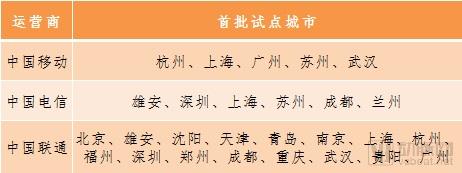
Among these cities, Shanghai is the only pilot city jointly designated by all three major telecom operators. It is no surprise that it became one of the cities with the fastest 5G adoption in the first half of 2019, with four hospitals participating in its infrastructure development. Cities designated as pilot zones by at least two operators include Guangzhou, Shenzhen, Chengdu, Suzhou, Hangzhou, Wuhan, and Xiong’an. Among them, hospitals in Guangzhou, Chengdu, and Shenzhen demonstrated relatively rapid adoption rates; Guangzhou and Chengdu each had four participating hospitals, while Shenzhen had three. The cities where hospital adoption of 5G was the slowest—i.e., those not appearing in the statistical table—include Chongqing, Xiong’an, Lanzhou, Suzhou, and Fuzhou.
China Mobile Temporarily Holds a One-Step Lead
Among the 46 hospitals that have launched 5G pilot services, 47% are China Mobile customers, followed by China Unicom at 32%, with China Telecom ranking last.
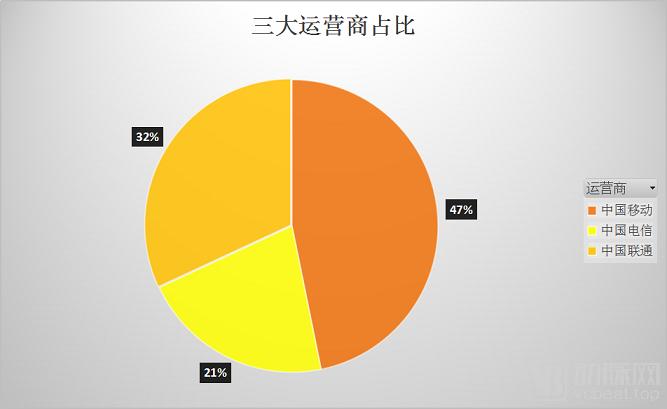
Further analysis reveals that East China, as the region with the most concentrated medical resources in China, remains a key battleground for the three major telecom operators. China Mobile has partnered with seven hospitals, while China Unicom has collaborated with six. Even China Telecom, with only ten partnerships nationwide, has secured three collaborations in East China. China Mobile’s advantages are primarily evident in South China. However, in Guangdong Province, where competition is fiercest, China Unicom has not fallen behind China Mobile. Meanwhile, no significant progress in 5G infrastructure construction has been observed among hospitals in Northwest China.
Four Major Scenarios for 5G Deployment in Hospitals at the Current Stage
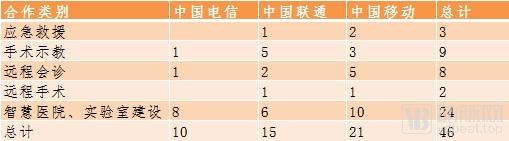
From an overall perspective, the collaboration between 46 hospitals and telecom operators has been carried out in the form of 5G smart hospitals or jointly established laboratories and centers. However, when it comes to specific scenarios, there are still differences in the current stage of cooperation among various parties. There are mainly four scenarios: surgical demonstration, remote consultation, emergency rescue, and remote surgery. According to data analysis, surgical demonstration and remote consultation are currently the most frequently piloted collaborations between the three major telecom operators and hospitals, followed by remote surgery and emergency rescue. Additionally, it can be seen that China Mobile focuses more on remote consultation collaborations, while China Unicom emphasizes surgical demonstration collaborations, with each having slightly different priorities.
The National Engineering Laboratory for Internet Medical Systems and Applications, in collaboration with Huawei Wireless X Labs, the First Affiliated Hospital of Zhengzhou University, the China Academy of Information and Communications Technology, and China Mobile Communications Group Co., Ltd., has categorized wireless medical application scenarios into three major types:
Category 1: Medical monitoring and nursing applications based on wireless data acquisition from medical devices, such as wireless patient monitoring, wireless infusion, mobile nursing, and real-time patient location tracking and monitoring.
Category 2: Medical diagnosis and guidance applications based on video and image interaction, such as mobile ward rounds with real-time access to patients’ imaging diagnostic information, remote ward rounds using medical service robots, remote real-time consultations, emergency rescue guidance, wireless surgical teaching, and wireless specialty diagnosis.
Category 3: Remote teleoperation applications based on video and haptic feedback, such as remote robotic ultrasound examinations, remote robotic endoscopic examinations, and remote robotic surgery.
These three categories of wireless application scenarios have varying requirements for network bandwidth and latency, as detailed in the figure below:
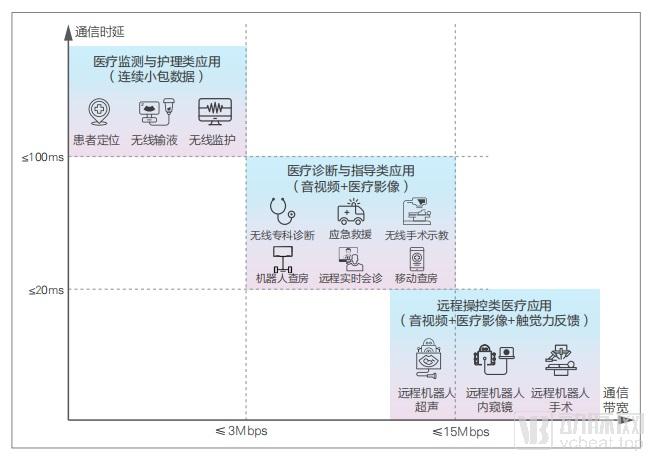
Based on the current four major scenarios of hospital-carrier collaboration—remote consultation, remote teaching, remote surgery, and emergency rescue—hospital demands are primarily concentrated on applications for medical diagnosis and guidance. Applications for medical monitoring and nursing care, as well as teleoperated medical applications, remain relatively uncommon. Below are some typical cases selected by VCBeat based on these four current scenarios:
Relying on China Mobile’s high-quality 5G network and the Qingda Optometry Remote Outpatient Platform, the Eye Hospital of Wenzhou Medical University in Zhejiang Province conducted 4K HD video consultations and provided remote outpatient guidance to the First People’s Hospital of Aksu Prefecture in Xinjiang Uygur Autonomous Region, the People’s Hospital of Wenchuan County in Sichuan Province, the People’s Hospital of Xiaojin County in Sichuan Province, the Tengqiao Community Health Service Center in Lucheng District, Zhejiang Province, and the Xiangyang Health Clinic in Yueqing, Zhejiang Province. This marks the official launch of China’s first 5G-enabled remote ophthalmology outpatient service.
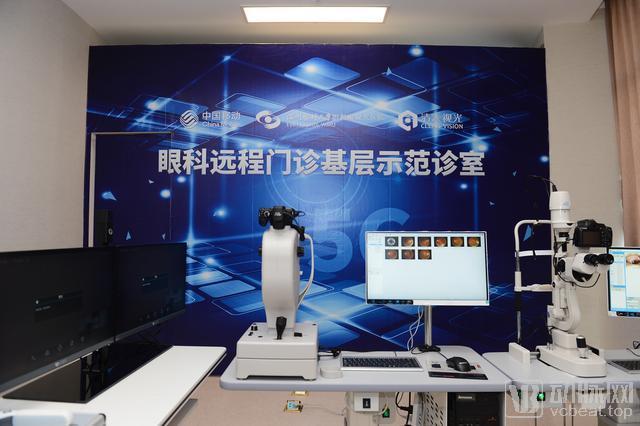
Image source: Zhejiang Kuailan
At the main campus of Wenzhou Medical University Eye Hospital, Dr. Ding from the Eye and Optometry Hospital is watching a 4K high-definition video transmitted via mobile 5G network, providing real-time guidance to doctors at the Wenzhou Tengqiao Community Health Service Center as they conduct eye examinations on patients.
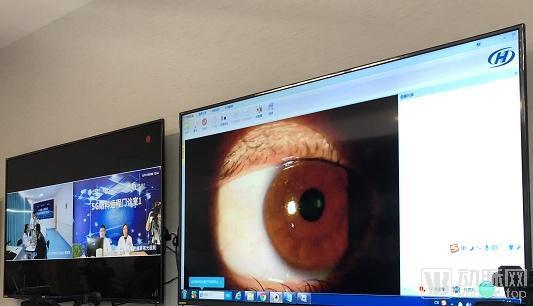
Image source: Zhejiang Kuailan
After completing patient examinations at the Tengqiao Community Health Service Center, Dr. Ding from the Eye Hospital used the large screen of the Wenzhou Medical University Eye Hospital’s remote outpatient platform to carefully observe the process by which clinicians at Wenchuan County People’s Hospital examined a glaucoma patient’s eyes using a slit lamp. Through the screen, he communicated with the doctors on-site in Wenchuan, assisting them in jointly diagnosing the patient’s condition.
On May 24, an AI- and 5G-enabled cross-network remote minimally invasive interventional “one-to-many” guided surgery was being conducted at Sun Yat-sen University Cancer Center.
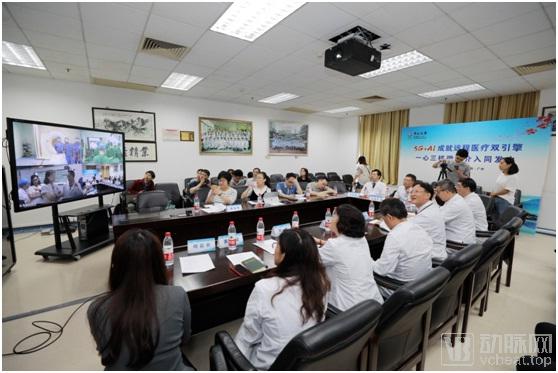
Image source: Official website of Sun Yat-sen University Cancer Center
This marks the first nationwide implementation of AI- and 5G-enabled cross-network remote minimally invasive interventional “one-to-many” guided surgery. This innovation integrally combines minimally invasive tumor therapy with artificial intelligence (AI) and 5G technology, while pioneering a real-time “one-to-many” teleconsultation model, thereby providing a rational and effective solution for the standardization and guidance of remote surgical procedures.
According to Liu Zhuowei, Vice President of Sun Yat-sen University Cancer Center, “In the past, traditional remote live-streamed consultations often suffered from issues such as unclear video quality and latency. These so-called ‘minor errors’ could potentially lead to fatal mistakes during surgery, posing significant risks to both physicians and patients. In contrast, the high-throughput data capabilities of the 5G era can effectively resolve these technical challenges, enabling communication that closely mimics face-to-face interaction.”
On the morning of March 16, with support from the Anesthesia and Surgery Center and the Outpatient Department, the Department of Neurosurgery at the First Medical Center of the Chinese PLA General Hospital in Beijing successfully performed a remote-controlled craniotomy on a patient with severe Parkinson’s disease in collaboration with the Department of Neurosurgery at the Hainan Hospital of the Chinese PLA General Hospital in Sanya, utilizing a 5G network. According to a novelty search report, there had been no prior precedents worldwide for remote human surgery conducted over 5G; thus, this procedure marks the world’s first 5G-enabled remote-controlled craniotomy on a human patient. Within just two months, experts from the Chinese PLA General Hospital successfully achieved the leap from animal experiments to human clinical application of 5G remote surgery, signifying a new height in the application of remote mobile healthcare.
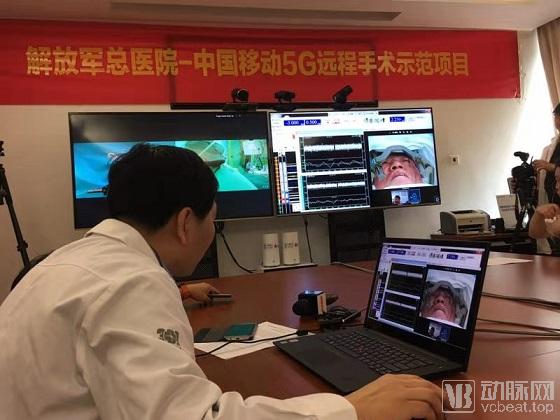
Image source: People's Daily Online
This time, we selected deep brain stimulation (DBS) electrode implantation for Parkinson’s disease, commonly known as “brain pacemaker” implantation, which is among the most challenging procedures in cranial surgery. This procedure requires the highly precise implantation of deep brain electrodes into the therapeutic target—the subthalamic nucleus (STN). Located in the central region of the brain, the STN has a volume of approximately 40 mm³, smaller than a soybean, posing significant challenges for accurate electrode placement.
Following electrode implantation, experts from Beijing conducted intraoperative MRI scans to confirm accurate electrode placement, fully meeting the surgical objectives. On the morning of the 17th, the patient was transferred from the intensive care unit to a general ward, with a favorable postoperative condition.
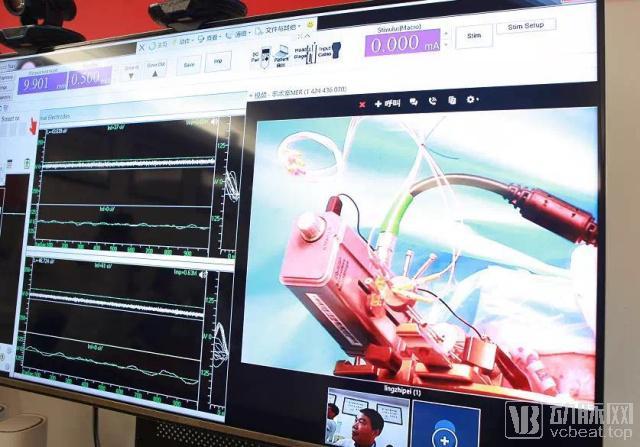
Image source: The Beijing News
As early as November 2018, Zhejiang Mobile partnered with the Second Affiliated Hospital of Zhejiang University School of Medicine to develop a 5G-enabled smart healthcare system, featuring applications such as “remote ultrasound” and “remote emergency care,” through 5G network connectivity.
On February 22, through continuous testing and refinement, 5G networks were applied for the first time to a multi-dimensional smart emergency green channel, encompassing remote vital signs monitoring within 5G-enabled mobile emergency units and the practical implementation of 5G remote ultrasound at primary healthcare service centers.
In the first-floor lobby of the Medical Street at the Binjiang Campus of the Second Affiliated Hospital of Zhejiang University School of Medicine, putting on VR glasses provides a visual experience akin to being inside a 5G-enabled ambulance. Physicians can monitor patients’ vital signs in real time and provide remote resuscitation guidance. By operating the joystick for 5G remote ultrasound in the lobby, clinicians can control the ultrasound robotic arm located several kilometers away at the Xixing Community Health Service Center, thereby enabling remote diagnosis.
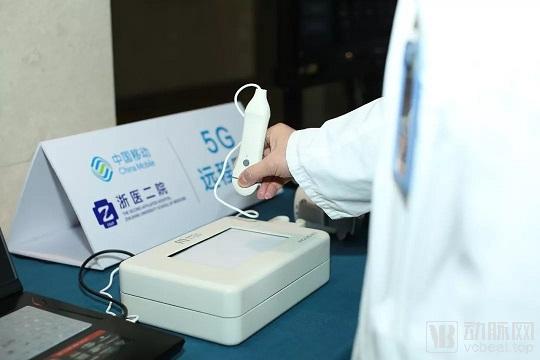
Image source: China Mobile Zhejiang Branch
In practice, the process is primarily divided into five steps: First, sudden medical emergencies are identified and emergency resources are allocated through intelligent monitoring and AI technology within the 5G smart three-dimensional emergency rescue network. Second, 5G-equipped ambulances transmit patients’ vital sign data to the hospital in real time, enabling the hospital team to monitor and provide guidance remotely while preparing in advance for the patient’s arrival; meanwhile, onboard drones, guided by precise 5G navigation, rapidly transport emergency medications, blood products, and samples. Third, leveraging VR technology and remote ultrasound, experts can provide real-time remote guidance regardless of their location. Fourth, upon the patient’s arrival at the hospital, the emergency team can immediately initiate resuscitation efforts, thereby securing precious time for the patient. Fifth, after discharge following diagnosis, treatment, and rehabilitation by specialized teams, patients can conduct online follow-up consultations and seek medical advice via internet hospitals.
Why Are Monitoring and Nursing Applications and Remote-Control Applications Rarely Seen?
VCBeat has consulted relevant experts and practitioners on issues related to 5G-based medical monitoring and nursing applications, as well as remotely operated medical applications.
A practitioner told VCBeat that the immaturity of products is a major factor hindering the current development of the Internet of Medical Things (IoMT). From the perspective of the current market, IoMT is still in its developmental stage, and 5G technology has only just begun to be deployed. Consequently, the industry lacks mature products that can truly address clinical pain points. Most companies’ products require an extended period of validation and transition before they can be familiarized with and accepted by healthcare professionals. Compared with the Industrial Internet of Things (IIoT), which is experiencing robust growth, the development of IoMT is significantly lagging behind.
Regarding remote surgery, Zhai Yunkai, Director of the Telemedicine Center at the First Affiliated Hospital of Zhengzhou University, stated that while he is highly optimistic about its applications, he believes there are still certain medical challenges to address. He argues that the implementation of remote surgery is not merely a technical issue, but more importantly, a medical one. From a technical perspective, 5G communication technology is only one component. In this field, core technical issues such as the research and development of 5G network chips and devices, large-scale deployment of 5G base stations, ultra-high-definition (UHD) video encoding and decoding, 5G network slicing, edge computing, and NFV/SDN must still be resolved. These advancements are necessary to reduce network transmission latency, ensure secure and reliable real-time dynamic querying of high-volume medical information from systems such as HIS, LIS, PACS, and EMR, enable distributed storage of UHD video images, and guarantee the safe and reliable transmission of real-time control commands for smart devices.
Meanwhile, given the substantial variations in preoperative preparations across different surgical procedures, it is necessary to categorize remote surgeries for experimental testing and validation of key indicators and parameters, including foundational conditions, basic workflows, operational standards, and scope of application. Currently, there is a lack of research and practical implementation in this area regarding national policies, technical standards, management systems, and clinical guidelines. Therefore, there is still a long way to go before remote human surgery becomes widely established. The Chinese PLA General Hospital’s attempts at “brain pacemaker” implantation surgery may provide some impetus for the practical implementation of 5G-enabled remote surgery.
Regarding the currently popular pilot projects for “5G+ Healthcare,” Xu Liqun, Chief Scientist at China Mobile Research Institute, also cautioned against blind optimism. This is because 5G network technology, deployment, and operations are still in their early stages. The “5G+ Healthcare” projects reported by the media remain merely at the stage of technical and system feasibility studies, or are limited to point-to-point, small-scale private network pilots, falling far short of true practical application.
In addition, regarding certification and regulatory issues, Xu Liqun believes that the healthcare industry requires a unified and transparent standard and evaluation system. This necessitates the joint formulation of unified regulations and oversight by relevant government authorities—such as the National Health Commission, the National Medical Products Administration, and the Ministry of Industry and Information Technology—and must be completed prior to large-scale implementation.