

Why Small-Scale Outpatient Clinics Will Dominate China's Trillion-Yuan Rehabilitation Market
Regarding the rehabilitation market, the most frequently cited statistic is the 35-fold disparity in market size between China and the United States. The U.S. rehabilitation market exceeds $200 billion, whereas China’s current rehabilitation market stands at only RMB 38 billion.
The market outlook is promising, but the path to closing the gap remains unclear. In its special report on rehabilitation, VCBeat found that discussions about the current state of the rehabilitation industry inevitably revolve around keywords such as “rationality” and “niche.” Domestic rehabilitation companies are still primarily at Series A financing rounds, with few having established mature business models.
Orthopedics and sports rehabilitation are among the most popular sectors within the rehabilitation field. UP Clinic, which specializes in orthopedics and sports rehabilitation, secured Series A+ funding from Matrix Partners China and ZhenFund. Its first clinic achieved break-even within just four months of operation.
In 2018, UP Clinic’s second chain outpatient facility, the Shanghai Jing’an branch, opened. Unlike traditional medical practices, which typically require an average of 18 months to break even, the clinic achieved profitability in its first month, with a net profit margin of 28%, and recouped all initial investment costs within nine months.
At the Primary Care Summit hosted by VCBeat in May, Sun Xiaoyi, founder of UP Clinic, shared the clinic’s growth experience. Additionally, as Vice Chairman of the Sports Rehabilitation Industry Alliance, Sun presented new data on industry development. VCBeat has compiled the content for our readers.
In the sports rehabilitation industry, many people are often asked a question: How large is this market exactly? Previous estimates of market size were based on the assumption that approximately 20% of the population experiences varying degrees of injuries each year, implying that 100 million people require treatment and services for sports-related injuries and conditions. Currently, the theoretical size of China’s sports rehabilitation market could reach approximately RMB 50 billion.
However, Sun Xiaoyi believes this figure is inaccurate. She stated, “Many people ask me about the size of the rehabilitation market. The previously circulated estimates of a RMB 50 billion rehabilitation market or a RMB 18 billion orthopedic rehabilitation market were based on statistics under the current in-hospital payment system, with the majority focusing on neurological and geriatric rehabilitation. Based on the development trajectory of developed countries and survey data from U.S. rehabilitation equipment manufacturers, China’s future orthopedic rehabilitation market should reach RMB 250 billion.”
Why Is There a Fivefold Discrepancy in Market Size Estimates? It Lies in Differing Assessments of the Out-of-Hospital Market.
Based on the current situation within hospitals, there are over 16,500 general hospitals in China, compared to only 5,074 in the United States. In terms of hospital-based rehabilitation departments, China has 3,288, while the U.S. has 758. Regarding the number of rehabilitation physicians, there are approximately 7,000 in China, whereas the U.S. has 9,164. Consequently, in terms of overall in-hospital expenditure, the market size in China stands at RMB 30 billion, while that in the U.S. reaches USD 12 billion.
The gap is even wider in the outpatient market. China has only 11,000 rehabilitation therapists, whereas the United States has more than 200,000. There are merely 50 to 60 rehabilitation clinics in China, compared with approximately 30,000 to 70,000 in the United States. In terms of outpatient expenditure, China spends less than RMB 1 billion, while the U.S. market reaches USD 30 billion.
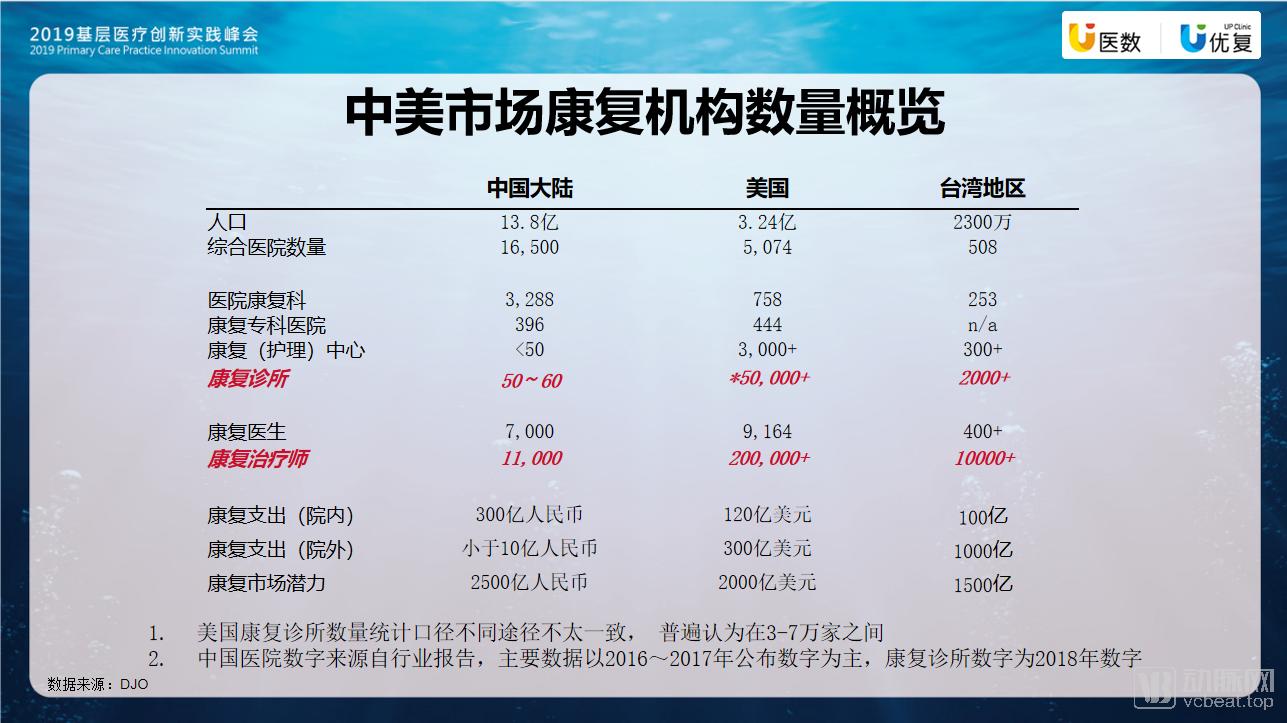
Sun Xiaoyi pointed out, “Compared with rehabilitation clinics in Europe, the United States, and other Asia-Pacific regions, where there are thousands of such facilities, it is regrettable that the number of rehabilitation clinics in China remains in the double digits. Based on global trends, it is evident that the rehabilitation industry, with small-scale outpatient clinics as its primary business model, represents the mainstream direction of development worldwide.”
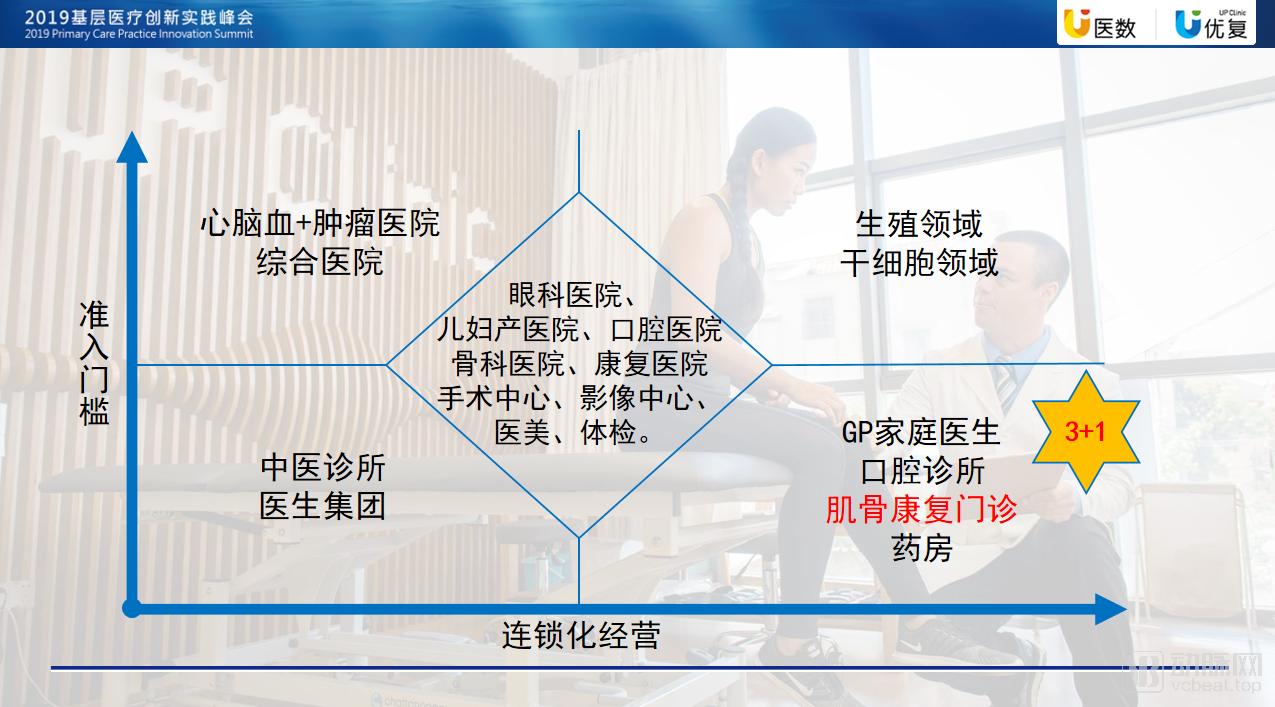
Betting that outpatient care will underpin the future RMB 100 billion rehabilitation market, Sun Xiaoyi not only sees rehabilitation clinics as more flexible than hospital specialties within the rehabilitation industry chain and thus representing the dominant business model of the future, but also recognizes that, compared with other medical sub-sectors, rehabilitation clinics hold greater competitiveness in terms of chain operations and standardization capabilities.
Sun Xiaoyi stated, “This is the ‘3+1’ model I have designed myself, which also incorporates some Chinese-style traditional Chinese medicine (TCM) clinics. In Europe or other foreign countries, what constitutes the ‘3+1’ framework? It invariably includes a family physician, a dentist, and a musculoskeletal rehabilitation outpatient clinic, complemented by a pharmacy. However, musculoskeletal rehabilitation services are currently very scarce, which is precisely why we have shifted from online to offline operations to invest in this initiative.”
Outpatient clinics are poised to proliferate and underpin the entire rehabilitation industry; however, at present, both their quality and quantity remain in a nascent, undeveloped stage.
At the Primary Healthcare Summit, Sun Xiaoyi pointed out: “There are currently 50 to 60 rehabilitation centers. I can responsibly state that these figures are somewhat inflated. As Vice Chair of the Sports Rehabilitation Industry Alliance, we are committed to helping more studios and rehabilitation centers that have not yet obtained qualifications achieve formal recognition as medical institutions and ensure their legalization and compliance.”
In terms of clinic quality, many rehabilitation institutions currently lack medical qualifications, resulting in uneven quality.
Take the qualifications of medical institutions as an example. Sun Xiaoyi has observed many studios and health centers in the industry that operate in regulatory gray areas. She pointed out, “Traditional rehabilitation clinics or outpatient departments mostly focus on neurological rehabilitation or traditional Chinese medicine (TCM) rehabilitation. With policies becoming increasingly open, practitioners are advised to apply for formal medical institution credentials. At UP Clinic, orthopedics and sports medicine are our specialties; therefore, UP Clinic holds surgical qualifications, enabling us to identify and address issues promptly. While UP Clinic advocates for conservative treatment, we also provide services through internationally accredited surgical centers and surgeons when patients genuinely require surgery. Comprehensive medical qualifications and highly qualified medical professionals constitute the core competitiveness of UP Clinic.”
Improving the quality of outpatient clinic development and enhancing capabilities in chain operations and standardization have become widely recognized challenges within the industry. Many physicians have found that while operating a single independent clinic is profitable, adding second and third locations often leads to diminishing returns, or even losses. In contrast, UP Clinic achieved positive cash flow and profitability within its first month of operation, recouping all initial investment costs within nine months. However, those unfamiliar with the company may not realize that its founder, Sun Xiaoyi, is actually an “outsider” to the medical field.
Born into a family of medical professionals, Sun Xiaoyi chose to study law during her university years in Sydney. She subsequently worked in the fields of law, dentistry, and medical aesthetics. It was not until 2014 that she co-founded Yishu, an intelligent orthopedic follow-up platform, with Dr. Ye Tingjun, who brought ten years of clinical experience in orthopedics. In March 2017, the first clinic of UP Clinic officially opened.
In addressing the long-standing challenges of high investment, long payback periods, and difficult patient acquisition in outpatient service development, Sun Xiaoyi has distilled her own solutions through the operational management of UP Clinic.
Regarding how to launch an outpatient clinic, the first piece of advice shared by Sun Xiaoyi is to ensure complete and compliant medical institution qualifications. This is a challenging yet essential path, which has also been proven by UP Clinic to be a “shortcut” for patient acquisition.
When discussing UP Clinic’s patient acquisition channels, Sun Xiaoyi stated, “I once asked many physicians at Shanghai’s Grade 3A hospitals why they referred patients to our clinic. They replied that only we held the proper qualifications, so they would definitely choose us.”
Regarding initial investment, Sun Xiaoyi frankly stated that she does not consider the upfront costs for an outpatient clinic to be substantial. When establishing UP Clinic, the company adapted the “small and beautiful” 100-square-meter clinic model prevalent in Australia and the United States, scaling UP Clinic’s facilities to approximately 300–500 square meters. Compared with investments in retail, dining, and consumer services, the capital required for the clinic is not significant. Sun Xiaoyi proudly noted that the achievement of positive cash flow within nine months has attracted many peers from the retail sector to engage in exchanges.
In terms of operations, Sun Xiaoyi acknowledged that not everyone is born with the ability to manage an outpatient clinic, and cross-industry experience is not necessarily applicable.
She stated, “It is not the case that having previously operated a dental outpatient clinic qualifies one to run a sports medicine clinic. Crossing different specialties involves distinct patient consumption patterns. We have proposed an operational management model called UPSO, where ‘UP’ stands for Youfu (UP Clinic). This model outlines our approach to data-driven management and professional managerial oversight, enabling the replication of all our clinics and outpatient centers.” Sun Xiaoyi said, “None of UP Clinic’s outpatient centers rely on star doctors. If a particular doctor or therapist is absent, we ensure that 80% of their patients will still visit on that day. We can seamlessly transfer these patients to other doctors or therapists, as we place greater emphasis on building a robust clinic platform.”
UP Clinic has not adopted a model in which physicians manage operations themselves. Sun Xiaoyi stated, “In the market, many rehabilitation or medical institutions are founded and operated by physicians. As I am not a physician myself, we have always believed in the principle that specialized skills should be left to specialists. It is crucial to empower professional managers or establish a replicable and operational business model.”
UP Clinic’s operational strategy hinges on data. Sun Xiaoyi revealed, “Through Yishu, a patient follow-up app that currently covers orthopedic departments in 3,800 public hospitals across China, we have access to first-hand clinical big data. This allows us to analyze our customer, consumption, and product data, thereby enabling us to optimize our products.”
Regarding the challenge of patient acquisition, UP Clinic’s channels fall into three categories. Approximately 30% of patients are postoperative cases from public hospitals with essential rehabilitation needs; thus, YiShu has facilitated access to substantial resources from public hospitals.
More importantly, 30% of the customer base comes from word-of-mouth referrals. The UP Clinic team holds weekly meetings to review data on repeat purchases by existing customers. After each outpatient clinic has been in operation for two and a half to three months, referrals from satisfied existing patients can account for 30% of new business, which Sun Xiaoyi considers a healthy channel. Another 30% comes from operational efforts targeting individual consumers (C-end users), specifically through consumer training collaborations between UP Clinic and sports groups.
Overall, outpatient clinics should allocate resources strategically to maximize impact, leverage precise user profiling in operations to reduce trial-and-error costs, and expand acquisition channels while maintaining a foundation of word-of-mouth reputation.
At the end of her speech, Sun Xiaoyi shared a short story with her fellow entrepreneurs. She said, “I came across a new interpretation of Journey to the West. When founders embark on any project, they often feel profoundly lonely and face immense difficulties. Along the way, numerous temptations and challenges inevitably arise. On the journey to retrieve the Buddhist scriptures from the Western Heaven, there is actually only one protagonist: Tang Seng (Tripitaka). Neither Sun Wukong (the Monkey King) nor Zhu Bajie (Pigsy) are independent characters; rather, Sun Wukong represents Tang Seng’s inner demons, while Zhu Bajie embodies his various desires—appetite, lust, emotional attachment, and greed. Since Sun Wukong could reach the destination in a single somersault, his presence symbolizes the mental obstacles Tang Seng must overcome. Therefore, throughout the entrepreneurial journey, despite many difficulties and tempting shortcuts, I hope founders remain steadfast in their convictions, excel at what they set out to do, and never forget their original aspirations. To conclude, I leave you with this saying: ‘Tame the restless mind, and you attain enlightenment (Wukong); rein in the wandering will, and you transform into a dragon.’”