

Huami Showcases AI and Big Data-Powered Full-Cycle Health Management at OCC2019
“By leveraging wearable devices as ‘connection points’ and utilizing big data cloud services and artificial intelligence technologies, it will be possible to achieve patient-centered, full-cycle health management, significantly improving diagnostic and treatment efficiency and helping physicians eliminate burdensome, low-value tasks.”
Recently, VCBeat (WeChat ID: vcbeat) learned that at the Artificial Intelligence and Internet Healthcare Forum of the 13th Oriental Cardiology Conference (OCC2019), Wang Hui, Vice President of Huami Technology, stated that with the rapid development of artificial intelligence and big data, the healthcare industry is undergoing a new round of transformation, and AI + big data will reshape people’s understanding of healthcare management.
The Stanford Medicine 2017 Health Trends Report shows that the global volume of medical big data was 153 TB in 2013 and is projected to reach 2,314 TB by 2020, with an annual growth rate of 48%. As a company possessing vast amounts of exercise and human health data, Huami Technology reported that, as of March 31, 2019, its smart wearable devices had recorded a cumulative total of 64.7 trillion steps, 6.1 billion nights of sleep, and 13.7 billion hours of heart rate monitoring.
Leveraging this big data, Huami Technology has successively released the Exercise White Paper, the Sleep White Paper, and the Heart Health White Paper, each featuring an unprecedented sample size in the tens of millions. Wang Hui stated that wearable devices have enabled humans to seamlessly connect to the internet, providing the first opportunity to conveniently collect authentic, large-scale population data across various categories.

Wang Hui, Vice President of Huami Technology, Invited to Deliver a Keynote Speech
Cardiac discomfort is often transient, making it challenging even for traditional 12-lead ECG monitors to capture electrocardiogram (ECG) data at the onset of abnormalities for early detection and analysis of potential cardiac issues. In response, Wang Hui stated that the Mi Band Health Edition handles such scenarios more effectively, thanks to its 24/7 continuous monitoring capability. When experiencing cardiac discomfort, users can simply press and hold the ECG measurement button on the band to instantly collect real-time ECG data, which is then screened for abnormalities by the AI-powered Mi Health Cloud.
Regarding the role of smart wearable devices, Zhu Fu, Executive Dean of Xuhui Hospital Affiliated to Fudan University, stated that under current circumstances, cardiac patients generally have short hospital stays and observation periods due to various constraints. Furthermore, during medical consultations, patients’ subjective sensations, such as palpitations and cardiac discomfort, are often difficult to quantify. The emergence of smart wearable devices, such as those developed by Huami Technology, provides physicians with more objective and reliable evidence for diagnosis.
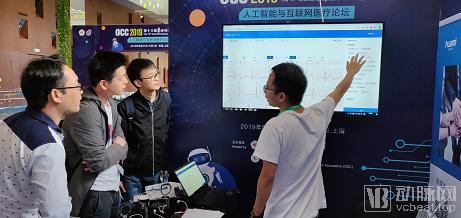
Huami Technology Staff Demonstrates ECG Function
“Moreover, with AI-powered wearable devices as an aid, physicians’ service capacity will grow exponentially, helping them move away from burdensome, low-value tasks.” Wang Hui cited the example of a senior ECG technician at a tertiary hospital who, over a 50-year career, has reviewed approximately 600,000 to 700,000 electrocardiograms—essentially reaching the upper limit of what a single professional can handle.
Huami Technology’s self-developed Mi Health Cloud AI, launched in April 2017, had analyzed a total of 13.148 million electrocardiogram (ECG) records by May 22, 2019. Among these, 19,019 ECGs were identified as atrial fibrillation through AI-assisted screening and subsequent secondary confirmation by physicians. The integration of both approaches will significantly improve diagnostic and treatment efficiency.
Furthermore, intelligent wearable devices can integrate “full-cycle patient management,” serving as a “connector” that places patients at the center and links various stages, including high-risk screening and early warning, assisted diagnosis and analysis, intelligent out-of-hospital and postoperative follow-up, and chronic disease management. This truly achieves closed-loop management spanning from in-hospital to out-of-hospital settings and from online to offline services. Wang Hui stated that this holds significant importance for implementing the Healthy China 2030 initiative, supporting chronic disease management and healthcare cost containment, empowering grassroots healthcare, and benefiting the general public.