

Ping An Healthcare Technology Secures Key National Medical Insurance Platform Project, Pioneering the 'Smart Medical Insurance' Era
VCBeat (WeChat ID: vcbeat) has learned that the bid results for projects related to the construction of the National Healthcare Security Administration’s healthcare security information platform have recently been announced. Ping An HealthCare Technology, a subsidiary of Ping An Group, won the bid for Package 7—the procurement project for the construction of the Macro-Decision Big Data Application Subsystem and the Operation Monitoring Subsystem of the National Healthcare Security Administration’s healthcare security information platform.
It is reported that the construction of the medical security information platform comprises nine major application systems, two cloud platforms, integration services, supervision services, and communication infrastructure. This initiative represents a key measure implemented by the National Healthcare Security Administration following its establishment to execute national decisions and plans aimed at strengthening China’s medical security work.
Notably, Ping An Health Insurance Technology’s winning bid for Package 7 holds significant importance. This project provides specialized and systematic support to the National Healthcare Security Administration (NHSA) in scientific decision-making and refined management, assisting the NHSA in establishing a closed-loop management system encompassing “decision planning, policy implementation, operational monitoring, and analytical feedback.”
Industry insiders state that leveraging the advanced technologies and resource advantages of technology companies with commercial insurance backgrounds, while drawing on the management philosophies and experience of commercial health insurance, will help further advance the “delegation, regulation, and service” reforms in healthcare security and usher in the era of “Smart Healthcare Security.”
Refined management of medical insurance is a key component of the “deepening healthcare reform.” In 2018, China underwent institutional restructuring of the State Council, and the National Healthcare Security Administration (NHSA) was established in May of the same year. The NHSA assumes three major functions—payment, pricing, and supervision—playing a pivotal role as both the “purse string” and the “key lever” to guide more standardized, rational, and effective use of medical insurance funds, revitalize medical resources, and achieve coordinated development among healthcare delivery, medical insurance, and pharmaceuticals (“three-medical linkage”).
Refined management of medical insurance requires support from advanced technological means, a principle that was clearly established at the inception of the National Healthcare Security Administration (NHSA). In November 2018, Hu Jinglin, Director of the NHSA, presided over a director’s office meeting to review and approve the Implementation Plan for the Construction of the Medical Insurance Information Platform of the National Healthcare Security Administration, thereby initiating the development of the medical insurance information platform.
Building the healthcare security information platform is a massive undertaking. The nationally unified healthcare security information platform and its diverse applications will cover nearly 1.4 billion people, 3,260 healthcare security agencies, 120,000 healthcare security staff at all levels, 990,000 medical institutions, 500,000 pharmacies, 7,600 pharmaceutical manufacturers, 26,000 medical consumables manufacturers, and 30 million enrolled entities across China.
Specifically, the Medical Security Information Platform project encompasses the business software components, including the Unified Portal Subsystem, Internal Control Subsystem, Cross-Province Non-local Medical Care Management Subsystem, and Drug and Medical Consumables Procurement and Bidding Management Subsystem; the cloud platform components, involving the construction and integration of the basic cloud platform for the Public Service Zone and the Core Business Zone; as well as procurement projects for overall system integration and related services, and for server room and communication infrastructure.
Detailed List of Projects Related to the Construction of the Medical Security Information Platform
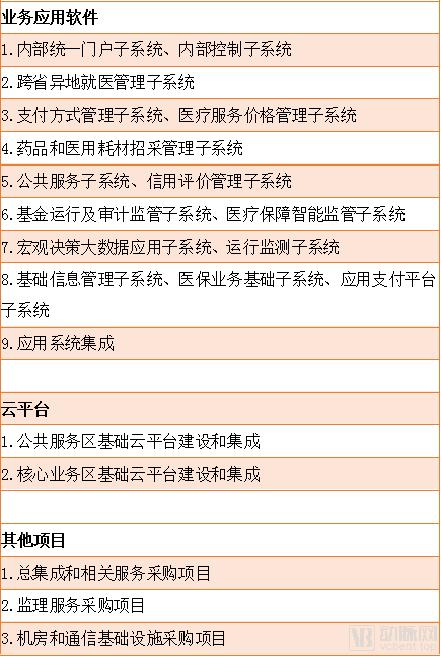
Data source: China Government Procurement Network, compiled by VCBeat
The construction of the information platform holds profound significance. According to a research report by Guosen Securities, the development of top-level platforms will drive provincial and local governments at all levels to increase their investment in such platforms. Furthermore, it will set benchmarks for these governments, thereby potentially driving the informatization of medical insurance platforms at all levels from the top down.
Secondly, the interconnectivity of data across provincial boundaries facilitates the direct settlement of medical insurance claims for healthcare received outside one’s home province. This addresses key pain points for insured individuals, including long travel distances for reimbursement, prolonged processing times for manual claims, complex administrative procedures, and the significant financial burden of out-of-pocket payments.
Meanwhile, the interconnectivity and data sharing among provincial and local medical insurance platforms are expected to generate substantial market demand for software procurement, implementation, and interface integration. Furthermore, the construction of medical insurance information platforms has laid the foundation for integrating commercial insurance settlement systems. Data interoperability on the medical insurance side helps reduce the cost of data verification for commercial insurers, improve settlement efficiency and customer experience, and accelerate the development of a multi-tiered healthcare security system.
In summary, the top-down construction of medical insurance information platforms will give rise to more "Smart Medical Insurance" applications, drive healthcare system reform, and accelerate the comprehensive and healthy development of the healthcare and insurance markets.
Analysis and Decision-Making for the Medical Insurance Fund Are Accelerating into the Era of Intelligence. Today, users can perform online queries on medical insurance policies and fund operations, conduct policy simulations, and export reports simply through human-computer interaction.
For example, if a local healthcare security administration wishes to conduct an analysis of the operation of the medical insurance fund for its province or city, it can directly ask, “How is the outpatient chronic disease fund operating in a certain province?” or state, “I would like to understand the operational status of the outpatient chronic disease fund in a certain city,” and the system will immediately provide an intuitive response.
Furthermore, the system can be instructed to simulate one city’s outpatient chronic disease reimbursement policies in another city and instantly generate reports, providing a quantitative basis for intelligent cost control and scientific decision-making. This sci-fi-like intelligence and convenience is made possible by Ping An Healthcare Technology’s independently developed “Smart Medical Insurance Fund Management and Decision-Making Platform.”
The presence of “Smart Healthcare Security” applications is also evident in the national-level projects won by Ping An Health Insurance Technology—namely, the Macro-Decision Big Data Application Subsystem and the Operational Monitoring Subsystem. A relevant executive from Ping An Health Insurance Technology stated that the “Integrated Smart Healthcare Security Platform” solution currently offered to the market has already been successfully implemented and operational in multiple prefecture-level cities.
“As early as 2014, Ping An collaborated with the medical insurance administrative authorities in Xiamen to jointly develop an industry-leading ‘Intelligent Supervision Platform for Medical Services.’ Since its launch, the platform has achieved remarkable results, comprehensively upgrading the regulatory approach from ‘post-event manual spot checks’ to ‘intelligent, precise monitoring across the entire process—pre-event, during-event, and post-event,’ thereby achieving full coverage of medical and consultation service processes. By the end of 2018, it had achieved seamless integration with 716 medical institutions across Xiamen, effectively preventing various types of non-compliant behavior; costs for key outpatient pharmaceutical and medical services under intensive monitoring were significantly reduced, and the accuracy rate of offline manual audits exceeded 95%.”
According to further introductions, using the Xiamen model as a benchmark, Ping An Health Insurance Technology has, in recent years, tailored refined smart health insurance solutions to meet the needs of cities with varying scales and development models. To date, its business has covered more than 200 cities across China, achieving “seamless integration” with thousands of medical institutions, with annual audits of pooled funds reaching the hundred-billion-yuan level.
It is also understood that, backed by Ping An Group’s robust resources and over three decades of experience, Ping An Healthcare Technology has rapidly established industry-leading technological barriers. In recent years, the company has accumulated a substantial portfolio of patents and software copyrights, and successfully acquired 100% equity of Changtian Technology in September 2018. As one of the original core-qualified enterprises for the Ministry of Human Resources and Social Security, Changtian Technology holds full qualifications for the Golden Insurance Project. This acquisition has added a crucial component to Ping An Healthcare Technology’s ability to provide comprehensive solutions to the National Healthcare Security Administration.
In recent years, numerous national policies have called for further strengthening the construction of medical insurance informatization capabilities and enhancing the intelligent operational management of medical insurance funds. For instance, the "Opinions on Promoting the Development of 'Internet + Healthcare'" explicitly states that intelligent auditing and real-time monitoring of medical insurance should be vigorously implemented by embedding rules such as clinical pathways, rational drug use, and payment policies into hospital information systems, thereby strictly regulating medical practices and associated costs.
The "Key Tasks for Deepening the Reform of the Medical and Health Care System in 2019" points out that we should accelerate the reform of medical insurance payment methods, carry out pilot programs for Diagnosis-Related Groups (DRG) payment, and continue to promote the reform of a diversified and composite medical insurance payment system primarily based on disease types. We will expand the pilot programs for the long-term care insurance system and formulate policy documents on pricing and medical insurance reimbursement for internet-based diagnosis and treatment services.
The prerequisite for the implementation of the aforementioned policies is to empower the operational management of medical insurance through technology and informatization, effectively controlling fraud, abuse, and waste; and to drive supply-side reforms through payer-side reforms, thereby improving operational and clinical efficiency on the supply side and enhancing the utilization efficiency of medical insurance funds.
Payment is the lever, and technology is the engine. As healthcare reform in China enters a “deep-water zone,” many “hard nuts” remain to be cracked. “Smart Medical Insurance,” as an innovative practice and application of medical insurance informatization, will inevitably powerfully promote and accelerate the pace of China’s healthcare system reform, accompanied by the expansion of its scope of application and the enhancement of its functionalities.