

Tangtang Circle Files IPO Prospectus: Aggregating 4 Million Structured T1D Data Points to Build a Global Patient Community
On December 29, 2010, Zeng Xifeng welcomed a new life. Unlike the joy most people feel when becoming fathers for the first time, his child was born as a full-term small-for-gestational-age infant. Weighing less than 2 kilograms, the newborn was admitted to the Neonatal Intensive Care Unit (NICU) before having the chance to be embraced by family members one by one.
Subsequently, the baby was diagnosed with neonatal diabetes and spent six months in the Neonatal Intensive Care Unit (NICU). Before becoming a father, Zeng Xifeng had been working at the Daya Bay Nuclear Power Plant, handling large-scale equipment that harnesses immense energy. However, the birth of this new life completely altered his career and personal trajectory, forging an indelible link between him and type 1 diabetes.

Zeng Xifeng, Founder and CEO of Tangtangquan
Due to the rarity of the condition, information asymmetry was the greatest challenge Zeng Xifeng faced after his daughter fell ill. “At that time, neonatal diabetes was rare in China, and many clinicians had never encountered it, lacking sufficient confidence to confirm the diagnosis and determine the subtype.”
After the DNA sample was sent to the United Kingdom for testing, Zeng Xifeng’s daughter was diagnosed with “neonatal transient diabetes,” a subtype of type 1 diabetes. This condition arises from loss-of-methylation defects and is classified as a rare form of diabetes. According to international literature, patients typically regain partial islet function after 36 months, with an approximately 50% risk of relapse during adolescence.
Type 1 diabetes, an autoimmune disorder, predominantly affects children and adolescents. Patients’ bodies are unable to produce sufficient insulin, predisposing them to ketoacidosis, and necessitating insulin therapy from the onset of the disease.
Most parents give to their children at almost any cost. Because his daughter’s insulin-dependent diabetes required timely care, Zeng Xifeng gave up his job to devote himself entirely to caring for her.
Patients with type 1 diabetes must perform a series of routine tasks after every seemingly ordinary meal, including blood glucose monitoring and insulin injections. According to the American Diabetes Association (ADA) guidelines, individuals with type 1 diabetes should monitor their blood glucose levels 6 to 10 times per day, administer insulin more than four times daily, and adhere to strict dietary requirements. For children with type 1 diabetes, their upbringing may lack much of the “sweetness” that others enjoy.
Zeng Xifeng broke down the costs for us: including medications and devices such as insulin and blood glucose meters, as well as consumables like disposable test strips and needles, the average monthly expense per patient with type 1 diabetes ranges from approximately RMB 1,500 to RMB 3,000.
Most entrepreneurs are driven by the desire to solve their own most pressing pain points, and Zeng Xifeng was no exception when he founded Tangtang Quan. As the saying goes, “a long illness makes a good doctor”; Zeng’s understanding of diabetes stemmed from his extensive literature review and medical consultations for his daughter. He told VCBeat, “I have been dealing with diabetes since the first day she was born.”
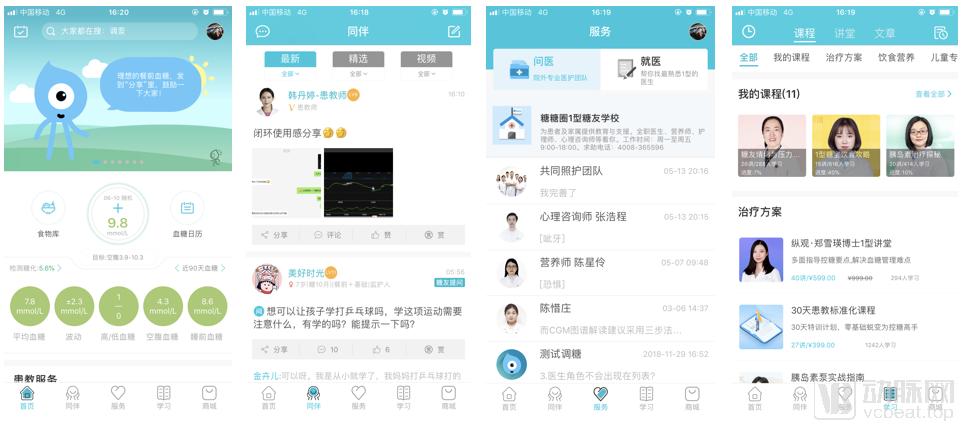
Tangtangquan App Interface
Since 2013, Zeng Xifeng has established a WeChat official account named “Care for Children and Adolescents with Diabetes” (now renamed “Type 1 Diabetes Care Center,” affiliated with the Guangdong Provincial Society for Precision Medicine Application), regularly publishing domestic and international literature and materials he collected. This account gathered a small group of early fans from Tangtang Quan.
Starting in 2014, coinciding with the boom in mobile health, version 1.0 of the Tangtangquan app gradually took shape. Initially, the founder aimed to build Tangtangquan into a social community for patients with type 1 diabetes. The earliest feature enabled patients to record blood glucose levels using self-management tools and share these records within the social community, where fellow patients could provide mutual feedback and comments.
Zeng Xifeng emphasized that this consideration stems from the fact that peer support is most lacking in this population. According to data released by the EASD in 2016, the prevalence of depression among patients with type 2 diabetes in China was 10.8%.
From the initial thousands of followers acquired through traffic diversion from its official WeChat account, Tangtangquan has now gathered over 41,000 individuals with type 1 diabetes or their family members. The Tangtangquan APP leverages a mutual-aid mechanism to encourage users to monitor their blood glucose levels daily and record fluctuations. Newcomers to the Tangtangquan community gradually master blood sugar management techniques with the support of peer assistance.
In the case provided by Zeng Xifeng, we see a six-month blood glucose calendar showing gradual improvement. Red squares indicate poor control on that day, yellow squares indicate moderate control, and green squares indicate good control. This parent of a child with type 1 diabetes also explicitly expressed gratitude in the post for the support from fellow community members with diabetes.
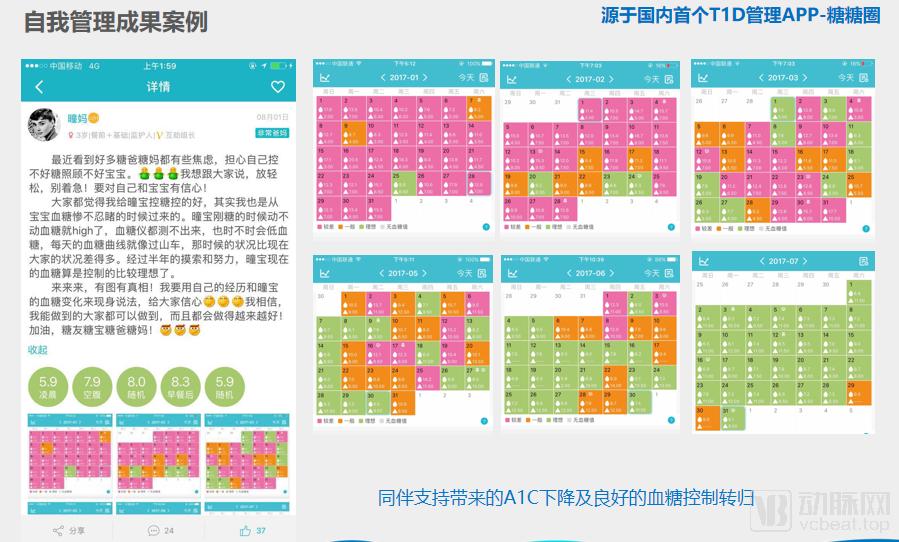
Tangtang Circle: Case Studies in Self-Management Outcomes
With continuous glucose monitoring data, professional management guidance and follow-up become even more indispensable in the management of type 1 diabetes. In terms of educational services, Tangtangquan focuses on out-of-hospital glucose management services and structured paid knowledge courses.
In the physician-facing patient education model, Tangtang Quan leverages mobile apps and web platforms to provide doctors with a comprehensive management platform for type 1 diabetes. It offers features such as real-time doctor-patient communication, patient management logs, bulk knowledge dissemination, follow-up visit reminders, glycemic control profiles, treatment plans/goals, and blood glucose chart data. Through Tangtang Quan, physicians can collect relevant data and patient behavior insights to develop more effective treatment guidelines.
In addition to providing public welfare patient education services for the general population, Tangtang Circle primarily collaborates with insulin pump manufacturers such as Medtronic to deliver professional one-on-one services to patients with type 1 diabetes who have purchased insulin pumps.
The Tangtangquan Patient Education Team consists of 15 members, including physicians, blood glucose education managers, dietitians, and psychological counselors. For each paying user, the team provides a three-month patient education service, during which they closely monitor the patient’s condition management and provide guidance and follow-up care.
In the realm of diabetes management startups, the market is predominantly focused on type 2 diabetes. According to Zeng Xifeng, the key difference between type 1 and type 2 diabetes projects lies in the fact that, although type 2 diabetes affects a broader population, related startups generally face significant data-related challenges.
“Entrepreneurial ventures focused on type 2 diabetes management often rely solely on blood glucose data, which may not even be reliably captured, as patients frequently fail to use smart devices capable of recording such data. In contrast, given the heavy insulin dependence inherent in type 1 diabetes, these solutions can yield more structured and continuous data.”
Zeng Xifeng told VCBeat that in the process of administering insulin injections and measuring blood glucose, patients with type 1 diabetes actually complete three tasks simultaneously: first, monitoring blood glucose levels; second, calculating the carbohydrate content of their meals; and third, administering insulin based on the calculated carbohydrate intake. These are essential steps. In Zeng’s view, this process results in cleaner and more structured data being returned to the app.
The population with type 1 diabetes in China exhibits two distinct characteristics: first, a high degree of concealment, as patients tend to remain hidden due to their lifelong dependence on insulin; second, significant fragmentation, making it difficult for offline channels to centrally manage type 1 diabetes patients nationwide. Consequently, these two characteristics pose challenges for physicians, resulting in poor patient adherence and low follow-up rates.
Zeng Xifeng stated, “We hope to organize patients through the app to assist physicians in continuous follow-up and management, thereby establishing a genuine cohort of hospital-based type 1 diabetes patients for long-term follow-up.”
Regarding epidemiological surveys of type 1 diabetes in China, the earliest initiative was the China National Type 1 Diabetes Study conducted by Professor Weng Jianping from 2013 to 2017. This study involved 505 hospitals across 13 regions nationwide and, through a multicenter observational design, ultimately determined that the overall incidence rate of type 1 diabetes in China is 1.01 per 100,000 population.
Professor Weng Jianping pointed out in a media interview the challenges faced in the treatment of type 1 diabetes: Studies have shown that, compared with Western developed countries, patients with type 1 diabetes in China have an extremely low frequency of blood glucose monitoring. This low monitoring frequency may lead to poor glycemic control and a high incidence of various acute and chronic complications.
In epidemiological research, population-based studies on type 1 diabetes in Europe and the United States began more than a decade ago, whereas China’s first nationwide survey was not conducted until 2013, leaving China nearly a decade behind in this field of research.
While this may appear to be an issue confined to academic circles, it has far-reaching implications for the general public. The lack of supporting epidemiological research has resulted in costs associated with type 1 diabetes being excluded from medical insurance coverage. Furthermore, the absence of population-level data has hindered the widespread dissemination of education and led to inadequate disease awareness among patients after diagnosis.
It is understood that the largest type 1 diabetes program in the United States, the myGlu T1D Exchange, has only slightly more than 20,000 patients. China has a larger population of individuals with type 1 diabetes compared to the United States. Currently, Tangtangquan’s accumulated nearly 4 million sets of structured data provide robust data support for type 1 diabetes research. The project is an important participant in the Chinese Type 1 Diabetes Education and Management Project under the Type 1 Diabetes Group of the Chinese Medical Association, and it also serves as the implementing entity for the Chinese Medical Association’s longitudinal cohort establishment project for type 1 diabetes.
Currently, the majority of Tangtangquan’s revenue is generated from insulin pump sales, supplemented by income from its e-commerce platform, insurance services, and patient education programs. According to Zeng Xifeng’s strategic plan, future revenue will be predominantly derived from data.
With robust data support, Tangtangquan has not only collaborated with the Guangzhou Branch of PICC to develop specialized insurance products for Type 1 diabetes but also partnered with BGI Genomics to provide neonatal diabetes screening services. In the realm of academic research, Tangtangquan is a key member of the Type 1 Diabetes Group of the Chinese Medical Association and the China Type 1 Diabetes Education and Management Project, while actively participating in numerous medical studies on Type 1 diabetes.
In Zeng Xifeng’s vision, he aims to leverage the “Tangtang Circle” project to generate sufficient data to drive advancements in the insurance sector and provide more clinical data to support the precision of medical devices, ultimately achieving standardized solutions. Currently, the project is seeking financing.