

Zhuhai Health Cloud Technologies Files for IPO: A $5B Internet Healthcare Unicorn with Employee Housing Benefits
“In 2012, coinciding with an invitation from the Zhuhai Municipal Government, and following deliberations by senior management, Zhuhai Health Cloud Technology relocated its entire operations from Beijing to Zhuhai,” said Lu Deqing, President of the company, in an interview with VCBeat.
Recalling the situation, he said, “At that time, the company’s core team in Beijing comprised approximately 300 employees. The first priority upon relocating to Zhuhai was to ensure proper settlement for staff. To this end, the company purchased homes for many employees, aiming to foster a sense of belonging within the organization.”
From its origins in Beijing to its expansion into Zhuhai, Zhuhai Health Cloud Technology has not only seen steady growth in its workforce but also achieved a doubling of its business volume. In 2018, the company reached a valuation of RMB 5 billion, successfully joining the ranks of quasi-unicorns in the internet healthcare sector.
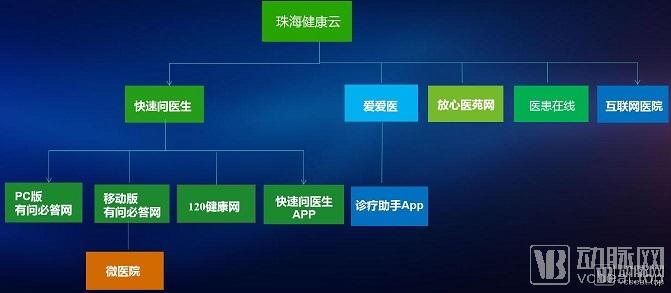
Zhuhai Health Cloud boasts profound technical expertise in internet healthcare products and has created a market scale with hundreds of millions of users through its “Information + Light Consultation” model. It has formed an internet healthcare platform matrix centered on five core products: Youwen Bida Network, 120 Health Network, Aiai Yi Network, Quick Ask Doctor APP, and Diagnosis Assistant APP.
In terms of revenue, the company achieved substantial market returns from 2015 to 2018. The company’s revenue streams primarily consist of four segments: precision technical services, private physician services (paid consultation income), high-quality medical products, and offline medical referral services. The first two segments constitute the company’s core business, while the latter two are developed through open collaboration with partners.
Ai Ai Yi Network is a platform under Zhuhai Health Cloud Technology, primarily serving medical professionals. Its founder, Lu Deqing, was once a physician himself. In his own words, he is a programmer who “stumbled into” the medical profession. From the PC era to the mobile age, Lu has witnessed the evolution of the internet healthcare industry and possesses extensive experience in this field.
As of now, the Aiyi Medical Platform has accumulated over 4.5 million registered members from the medical, healthcare, and technical fields, covering more than 70% of medical personnel across China. The platform’s forums encompass 12 specialized zones, including medicine and pharmacy, with over 100 professional academic sections. It hosts more than 50 terabytes of medical resources and has amassed over 8 million case records. The platform attracts more than 150,000 daily visits from medical professionals, with peak daily traffic exceeding 400,000.
In 2009, AiAiYi was officially integrated into Zhuhai Health Cloud, forming a synergistic partnership with the company’s other business unit, Quick Ask Doctor.
# Quick Ask a DoctorQuick Ask a Doctor is an internet healthcare platform primarily serving the public through a physician-patient Q&A model. Established in 2005, the company offers services across multiple modules, including “Online Consultations,” “Health Experiences,” “Medical Science Popularization,” and “Private Physicians.” Users can consult on health-related issues via the Quick Ask a Doctor platform, with answers provided by on-duty online physicians.
In 2011, the mobile health market began to surge, with a wave of companies emerging in the industry offering services such as medical consultations and appointment registration. Recognizing this trend, the Rapid Doctor Consultation team swiftly recruited over 100 R&D personnel to develop Android and iOS mobile applications. Meanwhile, the company invested heavily in marketing campaigns to attract consumer-end users.
This approach differs fundamentally from Kuaiwen Yisheng’s previous B2B business model. It is primarily patient-centric, enabling physicians to generate income by providing consultations to patients. The consultation fees are subsidized by the company and paid to the physicians, while the service remains entirely free for patients.
It can be said that Kuaisu Wenyisheng (Quick Doctor Consultation) was among the first incubators of online physicians. At that time, doctors were eager to try this novel model of doctor-patient Q&A interactions. As the barrier to entry was low, any physician holding valid practicing credentials could provide online services.
In recent years, in order to deliver more high-quality content, Quick Doctor has raised the requirements for participating physicians, with a particular emphasis on responses provided by doctors from Tier II hospitals and above.
Considering both its product offerings and business model, Zhuhai Health Cloud has expanded its service scope from the B2B sector to the B2C sector.
Taking “Quick Ask a Doctor” as an example, according to Lu Deqing, the platform has accumulated over 100 million doctor–patient Q&A consultation cases, with daily user visits exceeding 15 million. After 13 years of development, it has built several specialized databases, including a doctor–patient Q&A consultation repository, an industry database covering hospitals, physicians, clinical departments, and pharmaceuticals, as well as a health experience database. Driven by vast medical big data, the platform can precisely match doctor and patient resources, enabling users to receive responses from on-duty online physicians within one minute.
Since its official launch in 2011, Quick Ask a Doctor has accumulated over 80,000 contracted online physicians, tens of millions of activated users, and 200,000 daily active users, covering 661 cities worldwide. By connecting and configuring medical supply and demand resources, it is committed to equipping every family with both an intelligent doctor and a real physician.
In terms of technology, Zhuhai Health Cloud primarily features three core technologies:
First, massive cloud computing: the platform supports tens of millions of daily active users (DAU) and hundreds of millions of concurrent connections, ensuring stable and high-speed operational capabilities; secure cloud-based storage of electronic medical records with encryption capabilities, as well as predictive capabilities for disease outbreaks.
Second, big data retrieval: databases for the storage and retrieval of medical and health information (including specialized databases such as physician-patient Q&A consultation repositories, hospital/physician/department/pharmaceutical industry databases, and health experience databases).
Third, in the field of artificial intelligence, we are collaborating with Chengdu Diejia Technology and the Artificial Intelligence Laboratory of Sichuan University to explore the domain of intelligent physicians, aiming to achieve intelligent triage capabilities for patient health issues and intelligent identification of users with specific diseases.
In recent years, it has become common practice for internet healthcare companies to establish internet hospitals. However, policies regarding the acquisition of licenses vary across different local governments. In May 2018, during a visit to Hainan, Lu Deqing had the opportunity to meet with relevant leaders from the Hainan Eco-Software Park and the Hainan Provincial Health Commission. He inquired whether it was possible to obtain an internet hospital license in Hainan. From these officials, he learned that detailed implementation rules for Hainan’s policy would soon be publicly released.
Through persistent effort, and with the collaborative support of the Kuaiwen Yisheng (Quick Ask a Doctor) team and its partners, the company successfully launched Hainan’s first internet hospital in early 2019.
Lu Deqing believes that successfully obtaining an internet hospital license will facilitate the company’s future strategic development, enable the efficient allocation of high-quality resources, accelerate the refinement of internet-based diagnosis and treatment protocols, and deliver superior medical resources to users across China. “I am optimistic about internet hospitals, not only because this aligns with national policy directives, but also because I believe the integrated model of physical medical institutions combined with internet hospitals will enhance the quality of patient services.”
The internet hospital jointly developed by Kuaiwen Yisheng primarily consists of five major modules: remote outpatient consultations, remote specialist consultations, remote imaging, remote electrocardiography (ECG), and remote pathology.
Leveraging the abundant expert resources of its partner hospital, Boao Super Hospital, and its managing entity, the Shulan Medical Group, the internet hospital can further integrate with the vast patient platform of “Quick Consultation with Doctors.” This integration will enable the provision of online consultation services and offline medical services in Hainan under the pioneering “National Nine Measures,” thereby achieving a win-win outcome for experts, patients, hospitals, and the platform.
Zhuhai Health Cloud’s revenue primarily consists of two components: content services, with revenue sharing based on the commercial value generated by the content; and internet-based diagnosis and treatment services. The former accounts for approximately 80% of total revenue, while the latter constitutes 20%.
After more than a decade of development, Zhuhai Health Cloud’s entire product portfolio boasts the following core highlights:
First, the scaled advantage of doctors and user groups. Over 15 million daily active users and 100,000 contracted doctors.
Second, the technological advantage lies in professional talent and upgraded innovation, which supports the platform in handling massive user traffic.
Third, in collaboration with Boao Super Hospital, an internet hospital was established.
In recent years, the company’s comprehensive strength in terms of revenue, user engagement, and traffic has ranked among the top three in China’s industry, thereby achieving a significant leap in valuation from RMB 2 billion in 2016 to RMB 5 billion in 2018.
In 2017, Zhuhai Health Cloud launched another new product, NOCARE. As an open platform aggregating high-quality medical services worldwide, NOCARE aims to enable users to truly benefit from the latest advancements in global medical technology.
Lu Deqing told VCBeat that, in the future, Zhuhai Health Cloud will gradually expand from the domestic market to international markets. By introducing advanced international medical technologies and experts, the company aims to strengthen multi-dimensional development across industry, academia, and research, while committing to integrating high-quality global medical resources to lay the foundation for building a global ecosystem for internet healthcare.