

31 Hospitals Announced in China's 2018 High-Level Electronic Medical Record System Evaluation
Establishing an evaluation and continuous improvement system for the application level of electronic medical record (EMR) systems that is tailored to China’s national conditions has long been a key focus of healthcare policy efforts.
As early as August 2018, the Bureau of Medical Administration and Hospital Management of the National Health Commission issued the “Notice on Further Promoting the Construction of Information Systems in Medical Institutions with Electronic Medical Records at the Core” (Guo Wei Ban Yi Fa [2018] No. 20).
The Notice explicitly requires that by 2020, tertiary hospitals shall achieve full coverage of electronic medical records (EMR) across all informatized diagnosis and treatment service processes, ensure seamless information exchange and interoperability among all clinical workflows within the hospital, and attain Level 4 maturity in the standardized assessment of hospital information interoperability. Authorized personnel shall be able to access relevant diagnostic and therapeutic information from any terminal in any department within the hospital according to their access privileges. For tightly integrated medical consortia, interoperability of EMR information systems among all member healthcare institutions shall be achieved.
In December 2018, the official website of the Bureau of Medical Administration and Hospital Management under the National Health Commission released the “Notice on Issuing the Administrative Measures for Graded Evaluation of Electronic Medical Record System Application Level (Trial) and the Evaluation Standards (Trial)” (Guo Wei Ban Yi Han [2018] No. 1079). The Notice required local health administrative departments at all levels to organize hospitals at secondary level and above within their jurisdictions to participate in the graded evaluation of electronic medical record system functional application levels on schedule, and specified two key milestones: by 2019, all tertiary hospitals were to achieve Level 3 or above in the graded evaluation; by 2020, all tertiary hospitals were to reach Level 4 or above, and secondary hospitals were to reach Level 3 or above.
From this, we learn that the “Standard” classifies the application levels of electronic medical record systems into nine tiers.
Level 0: No electronic medical record (EMR) system has been established.
Level 1: Establishment of Independent Medical Information Systems.
Level 2: Internal exchange within the medical information department.
Level 3: Inter-departmental data exchange.
Level 4: Hospital-wide information sharing and basic clinical decision support.
Level 5: Unified Data Management, Intermediate Clinical Decision Support.
Level 6: Closed-loop management of medical data across the entire process, advanced clinical decision support.
Level 7: Medical Safety and Quality Control, Regional Medical Information Sharing.
Level 8: Integration of health information and continuous improvement in medical safety and quality.
On June 10, 2019, VCBeat (WeChat ID: vcbeat) learned that, in accordance with the spirit of documents issued by the National Health Commission—including the “Notice on Further Promoting the Construction of Information Systems in Medical Institutions with Electronic Medical Records at the Core” (Guo Wei Ban Yi Fa [2018] No. 20), the “Notice on Issuing the Administrative Measures for Graded Evaluation of the Application Level of Electronic Medical Record Systems (Trial) and the Evaluation Standards (Trial)” (Guo Wei Ban Yi Han [2018] No. 1079), and the “Letter from the Bureau of Medical Administration and Hospital Management of the National Health Commission on Carrying Out the 2018 Graded Evaluation of the Application Level of Electronic Medical Record Systems” (Guo Wei Yi Yi Liao Bian Han [2018] No. 458)—the Institute of Hospital Research, under the guidance of the Bureau of Medical Administration and Hospital Management of the National Health Commission, conducted the 2018 graded evaluation of the functional application level of electronic medical record (EMR) systems. This initiative aimed to objectively and scientifically assess the current status and application level of hospital information systems centered on EMRs in China’s medical institutions. Following a review process that included data submission, preliminary system assessment, provincial-level initial verification, blind review of empirical materials, and on-site expert audits, and after concentrated discussion and confirmation by the expert panel, thirty-one hospitals passed the high-level accreditation for the 2018 graded evaluation of EMR system functional application levels. The complete list is as follows:
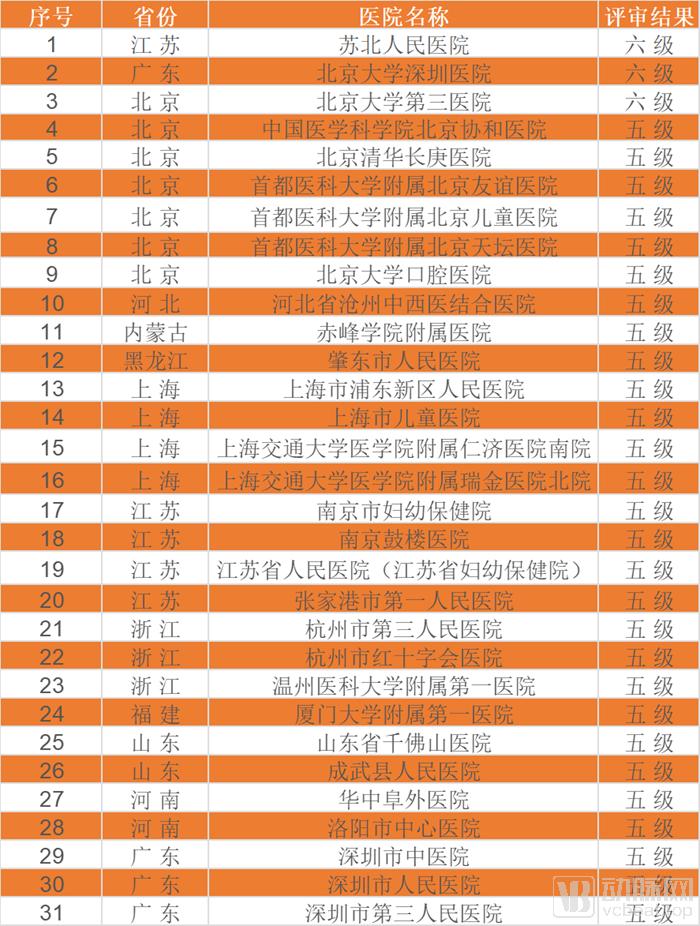
List of High-Level Hospitals That Passed the 2018 Graded Evaluation of Functional Application Levels of Electronic Medical Record Systems
Related Reading:
How Are EMR “Gold Rushers” Showcasing Their Prowess in a Multi-Billion-Yuan New Market? [VB100]