

AI-Powered Early Intervention for Autism: Kunshan Duke University and Da Mi Xiao Mi Launch Joint Research Lab
Recently, VCBeat learned that the joint research laboratory established by Dami and Xiaomi, a professional institution dedicated to rehabilitation training for children with autism spectrum disorder (ASD), and Duke Kunshan University was officially launched today. Both parties will jointly promote the application of technologies such as big data and artificial intelligence in the field of autism intervention, and drive the development of related research with cutting-edge scientific and technological advancements.
Dr. Chang Xiaolin, Vice President for Government Relations at Duke Kunshan University,Jiang Yingshuang, Founder and CEO of Dami and Xiaomi, and Dr. Li Ming, Associate Professor of Electrical and Computer Engineering at Duke Kunshan University, attended the cooperation signing ceremony held in Shanghai.
Duke Kunshan University is a collaborative institution established by Duke University, a top-ten ranked university in the United States, and Wuhan University in Kunshan, Jiangsu Province. It aims to pioneer a world-class comprehensive research university and hosts multiple internationalized research and development centers.
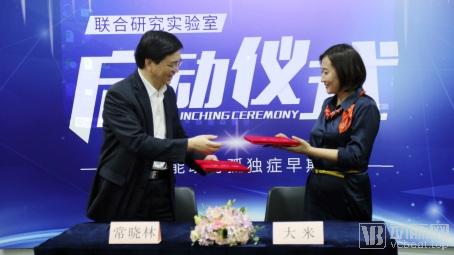
(Kunshan Duke University Vice President Chang Xiaolin (left) and Dami and Xiaomi Founder and CEO Jiang Yingshuang (right) attend the cooperation signing ceremony)
Li Ming, Associate Professor of Electrical and Computer Engineering, has long been dedicated to exploring the applications of artificial intelligence in healthcare and clinical research. In recent years, Professor Li and his team at Sun Yat-sen University, led by Professor Zou Xiaobing, have achieved significant results in their research on AI-based early screening and diagnostic technologies for autism spectrum disorder (ASD), with AI diagnostic accuracy exceeding 80%. According to the collaboration agreement between Duke Kunshan University and Dami and Xiaomi, these preliminary research findings and patents will be applied to ASD assessment and rehabilitation training for children at Dami and Xiaomi.
In the future, both parties will conduct further in-depth research to continue exploring the use of artificial intelligence for the automated analysis and modeling of medical and behavioral data in the fields of speech processing, computer vision, natural language processing, affective computing, and machine learning, thereby expanding the application of AI to more scenarios such as the diagnosis, assessment, and rehabilitation training of children with autism.
Since its founding in 2014, Dami and Xiaomi has been deeply engaged in knowledge services, offline rehabilitation training, support for inclusive education, and system development, growing into a leading support service platform for autism spectrum disorders in China. Currently, Dami and Xiaomi has established a series of rehabilitation training centers and inclusive kindergarten support programs in Beijing, Shanghai, Guangzhou, and Shenzhen. It has served thousands of children and provided online consultation and course services to over 100,000 families.
Leveraging the extensive industry data accumulated by Dami and Xiaomi, along with the relevant technologies and research from Duke Kunshan University, both parties have reached a consensus after multiple rounds of negotiations to further explore the application of artificial intelligence in areas such as assisted diagnosis, intelligent assessment, and training strategies. They aim to leverage cutting-edge technology to benefit more children with autism spectrum disorder and their families in China.
Jiang Yingshuang, Founder and CEO of Dami and Xiaomi, stated, “One of the bottlenecks in autism intervention services in China is the uneven quality of professionals, an imperfect intervention system, and high costs. The introduction of big data and artificial intelligence technologies is expected to alleviate these issues to some extent, enabling more families affected by autism to access scientific and reasonably priced services. We are delighted to participate in research on autism assessment and intervention.”
Dr. Chang Xiaolin, Vice Chancellor of Duke Kunshan University, stated, “We are delighted to collaborate with Dami and Xiaomi in the field of early intervention for autism. The Big Data Research Center at Duke Kunshan University is an international research center with unique advantages in research standards, faculty strength, and interdisciplinary research capabilities.”
“This collaboration leverages the R&D strengths of Duke Kunshan University, combined with the practical experience and advanced concepts of Dami and Xiaomi, to establish an industry-academia-research exchange platform. It is dedicated to applying cutting-edge technologies to drive research and innovation in the field of autism. We look forward to both parties translating these concepts into tangible realities and developing products that serve society.”
Professor Zou Xiaobing, who has been involved in the study since its initial phase, believes that this collaboration exemplifies a productive partnership between research institutions and autism intervention organizations. With the timing being ripe, it will benefit millions of children with autism and their families in China.
“The role that artificial intelligence can play in the early detection and diagnosis of autism is already being applied in clinical settings. I am more hopeful that AI technology will also play a significant role in early intervention. This area requires further in-depth research, and when the time is right, it will greatly promote the developmental outcomes of children with autism spectrum disorder in China.”
Wang Zhanwei, Head of the Dami and Xiaomi Research Institute, and Li Kunhua, General Manager of the Shanghai Center, attended the signing ceremony. Dami and Xiaomi will continue to introduce advanced foreign rehabilitation training technologies and talent. In the future, it plans to open more offline rehabilitation training institutions in second- and third-tier cities across China to provide scientific services to more children with autism spectrum disorder and pervasive developmental disorders.