

Huami Launches First Health-Focused Smartwatch with ECG Atrial Fibrillation Detection Accuracy of 97.24%
Recently, Huami Technology (NYSE: HMI) held its 2019 Summer New Product Launch in Beijing, officially unveiling two flagship products designed for smart calling and health monitoring. Among them, the Amazfit Health Watch is equipped with “Huangshan No. 1,” the world’s first artificial intelligence chip in the smart wearables sector. It supports 24/7 arrhythmia (including atrial fibrillation) monitoring and remote medical guidance services, pioneering a new subcategory of health watches.
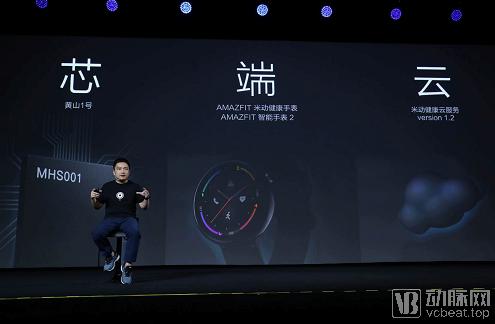
This also marks the full implementation of Huami Technology’s “Chip + Device + Cloud” strategy, which has established a complete business loop through the Huangshan No. 1 chip, the Amazfit Health Watch, and medical health cloud services.
Health smartwatches require the capability for accurate and continuous health data collection. The AMAZFIT Health Watch employs Huami Technology’s self-developed, high-precision bio-tracking optical sensor—the BioTracker™ PPG sensor—which enables uninterrupted 24-hour heart rate data acquisition at a sampling rate of 50 Hz. With shorter detection intervals and higher monitoring accuracy, the AMAZFIT Health Watch ensures that even transient cardiac arrhythmias are not missed.
The AMAZFIT Mi Health Watch is also equipped with an ECG sensor, innovatively adopting a four-sided surround-press design. Metal contacts are integrated into all sides of the watch bezel, allowing users to take measurements in more flexible positions. This design also increases the metal contact area and reduces impedance, resulting in more precise ECG signals.
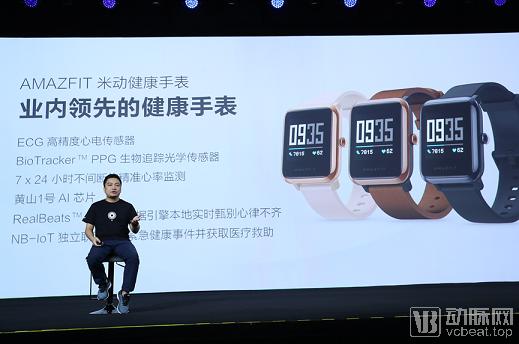
Powered by the RealBeats AI biological data engine of "Huangshan No. 1," the Amazfit Health Watch enables on-device biometric identity recognition, real-time local detection of ECG arrhythmias (including atrial fibrillation), and real-time local detection of PPG arrhythmias (including atrial fibrillation). This enhances the accuracy and efficiency of cardiac health monitoring, delivering results to users in the shortest possible time.
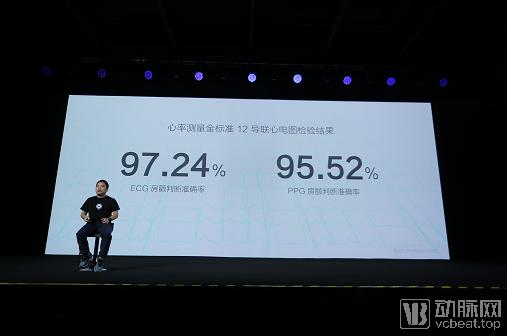
Regarding the issue of monitoring accuracy, which is of greatest concern to users, Huang Wang, Chairman and CEO of Huami Technology, stated that in a study conducted in collaboration with the Department of Cardiovascular Medicine at Peking University First Hospital involving 290 cases, the RealBeats AI biological data engine achieved an atrial fibrillation (AFib) detection accuracy of 97.24% for ECG and 95.52% for PPG, when compared against the 12-lead electrocardiogram, the gold standard for medical heart rate measurement.
Furthermore, this smartwatch features NB-IoT (Narrowband Internet of Things) standalone connectivity, enabling real-time emergency alerts—such as directly notifying family members or medical institutions—without requiring a Bluetooth connection to a smartphone. Thanks to the low-power Huangshan No. 1 chip, the Mi Health Watch can support up to one week of standby time despite its integrated communication module, while locally storing 60 minutes of ECG data, sufficient for one month’s worth of electrocardiogram measurements.
Huang Wang stated that the Amazfit Health Watch has pioneered an entirely new subcategory of health watches by meeting three criteria: continuous 24/7 data collection, real-time local detection of health issues, and support for independent networked reporting of emergency health events to access medical assistance. From monitoring and analysis to data services, Huami Technology has established a complete closed loop of data value through the Amazfit Health Watch.
Meanwhile, another flagship product released simultaneously—the AMAZFIT Smart Watch 2 ECG Edition—also places significant emphasis on the health sector. It adopts a dual-chip solution featuring “Qualcomm Snapdragon” and “Huangshan No. 1,” enabling users to obtain an over-the-counter electrocardiogram (ECG) in just 60 seconds via its ECG sensor.
This smartwatch also integrates the huami-PAI™ health assessment system, which evaluates the contribution of users’ daily effective activity levels to their overall health. In short, it provides a rigorous “scoring” of the user’s physical condition. Huang Wang stated, “If you can maintain a PAI score of 100, your risk of cardiovascular disease can be reduced by 25%, and your life expectancy can increase by an average of five years.”
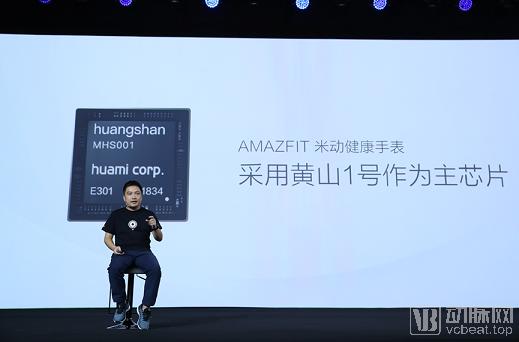
In the “Chip + Device + Cloud” strategy, Huami Technology’s self-developed “Huangshan No. 1” chip plays the most critical role. As early as last September, Huami Technology announced the successful tape-out of “Huangshan No. 1,” the world’s first artificial intelligence chip for the smart wearable sector. It has now been officially deployed in two new flagship products: the AMAZFIT Smart Watch 2 ECG Edition and the AMAZFIT Mi Health Watch.
Huang Wang introduced that “Huangshan 1” is built on the RISC-V open-source instruction set and features three key characteristics: high efficiency, AI migration, and scalability. In terms of high efficiency, its computational performance is 38% higher than that of the ARM architecture. AI migration refers to its integration of an AI biological data engine, enabling rapid local computation for monitoring heart rate, electrocardiogram (ECG), and arrhythmia. Scalability means that it can function either as a main processor or in collaboration with a primary chip; for instance, when combined with Qualcomm Snapdragon processors by Huami, it empowers devices with local health monitoring capabilities.
“Huangshan 1” not only boasts the advantages of low power consumption and high performance, ensuring smooth smartwatch operation with reduced heat generation and energy usage, but also automatically transfers sensor data to internal SRAM, thereby enhancing data transmission performance. Its integrated neural network acceleration module enables on-device processing of AI tasks. Devices equipped with this chip can provide real-time monitoring and analysis of user data such as heart rate.
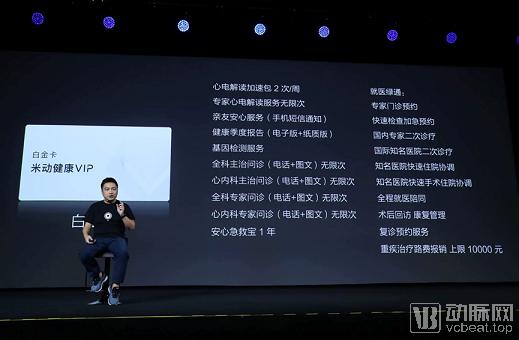
Leveraging wearable devices as “connection points” and harnessing big data and cloud services, Huami Technology strives to help users achieve convenient, full-cycle health management. Huang Wang told the media that, as of May this year, the Mi Motion Health Cloud Service provided by Huami Technology had cumulatively analyzed electrocardiogram (ECG) data, with over 56,000 ECG abnormalities confirmed by physicians. Among these, more than 19,000 ECGs were confirmed as atrial fibrillation through dual screening by AI algorithms and physicians, demonstrating that Mi Motion Health Service is a truly valuable health service.
Guided by this philosophy, Huami Technology has updated its Mi Health Cloud Service to version 1.2 and upgraded the existing cloud service into three tiers of VIP membership—Silver, Gold, and Platinum. These tiers include green-channel medical services such as expert outpatient appointment scheduling and expedited diagnostic testing appointments, helping users access high-quality, convenient medical and health resources.
With the rapid development of artificial intelligence and big data, the healthcare industry is undergoing a new wave of transformation. The integration of smart wearable devices with big data cloud services is reshaping people’s understanding of health and medical management. As the “Cloud + Device + Chip” strategy is implemented, Huami Technology is further refining its layout in the healthcare sector. Leveraging precise wearable hardware, the new Mi Move Health Cloud Service, a comprehensive software experience, and its accumulated expertise in the upstream semiconductor chip industry, Huami will continue to harness the power of technology to enable better sports, health, and medical services for everyone around the world.