

Beijing Launches Medical Service and Consumables Reform to Shift Hospital Compensation Toward Quality Care
At midnight on June 15, Beijing officially launched the comprehensive reform linking medical services and consumables. Last night, nearly 100,000 medical staff in Beijing remained on duty throughout the night.
On the evening of June 14, all 2,624 medical institutions requiring information system upgrades had successfully imported the new prices for medical services and consumables into their systems. They completed contingency plans, including system backup and switchover, standalone version backups, and manual operation procedures, and conducted comprehensive system testing and emergency drills.
Beijing’s Comprehensive Reform Linking Medical Service Prices with Consumable Costs marks another major step in the city’s healthcare reform, following the 2017 comprehensive reform linking drug prices with medical services. Post-reform, healthcare institutions will fundamentally shift their development model from relying on “drug markups to subsidize medical services” and “consumable markups to subsidize medical services” to primarily achieving cost recovery through improvements in medical service delivery.
“Five Ones”Key Points
It is reported that the scope of this comprehensive reform linking medical services and consumables covers public medical institutions operated by government agencies, public institutions, and state-owned enterprises within the administrative area of Beijing, as well as military medical institutions located in Beijing. Socially run medical institutions whose services are purchased by the government, and those designated for basic medical insurance coverage, may voluntarily apply to participate. According to statistics, nearly 3,700 medical institutions across the city have participated in the reform. The policy for this comprehensive reform linking medical services and consumables was formulated and released as early as December 2018.
“Lei Haichao, Director of the Beijing Municipal Health Commission, summarized the main content of this reform as the ‘Five Ones,’ namely ‘one reduction, one improvement, one cancellation, one procurement, and one enhancement.’”
Among these, “one reduction” refers to lowering the prices of laboratory tests performed using instruments and equipment; “one increase” refers to raising the prices of services that reflect the labor value of healthcare professionals, such as traditional Chinese medicine, pathology, psychiatry, rehabilitation, and surgical procedures; “one cancellation” refers to abolishing the 5% or 10% markup policy on medical consumables in healthcare institutions, with charges based on the procurement purchase price of medical consumables; “one procurement” refers to implementing joint procurement of medical consumables and volume-based procurement of pharmaceuticals; “one improvement” refers to enhancing medical services and strengthening comprehensive supervision.
System Upgrade and Cutover Are Critical
To provide robust support for the comprehensive reform of linking medical service prices with consumable costs, the renovation and upgrading of the healthcare reform information system has become a key priority.
A relevant official from the Beijing Municipal Health Commission stated that a total of 2,624 medical institutions across the city were required to upgrade their information systems. Currently, the new prices for medical services and consumables have been fully integrated into the information systems of these institutions. Contingency plans, including system backup and switchover, standalone backup, and manual operations, have been established, and comprehensive system testing and emergency drills have been conducted. All participating institutions have formulated contingency plans for the comprehensive reform linking medical service prices with consumable costs, carrying out nearly 5,000 emergency preparedness drills in total.
On the night of June 14, municipal leaders and relevant departments were on duty at the central command center for the comprehensive reform linking medical services and consumables. Leaders in charge from the 16 districts and their respective departments were stationed at district-level sub-command centers, monitoring in real time the progress of implementing institutional reforms, the outcomes of information system switchover, health insurance settlement operations, and the printing of settlement receipts under the new pricing structure, while coordinating to resolve any issues that arose.
Personnel from the Municipal Health Commission, the Municipal Healthcare Security Administration, and the Municipal Hospital Management Center were deployed to over 70 medical institutions for on-site support, providing end-to-end guidance to resolve issues encountered. Staff from information system development, integration, and operation and maintenance companies were assigned to provide technical support, promptly addressing hardware, software, and network problems to ensure the normal operation of information systems. The power supply department also ensured a stable electricity supply. Nearly 100,000 medical personnel across the city remained at their posts to ensure orderly patient care during the launch of the reform.
In accordance with the unified deployment, participating institutions initiated the switchover of their information systems in succession from the evening of June 14 to midnight on June 15, based on their respective operational realities. Primary healthcare institutions that do not provide nighttime emergency or inpatient services implemented the information system switchover after attending to the last patient on June 14.
Other medical institutions will switch their information systems at 00:00 on June 15 in accordance with the unified deployment. As the system transition requires a certain amount of time, each institution has developed work plans to ensure the continuous delivery of medical services before and after the switchover, based on their actual circumstances, and to properly handle patient billing and settlement issues during the transition period.
On the evening of June 14, Beijing Tiantan Hospital was brightly lit, with various departments operating in an orderly and busy manner. The hospital had activated its command center in advance; relevant personnel from the Beijing Municipal Health Commission and the Beijing Municipal Administration of Hospitals, along with key leaders of Beijing Tiantan Hospital, arrived early at the site.
“All computers at Beijing Tiantan Hospital are being shut down; the information system switchover is beginning.” At approximately 23:30, Wang Yongjun, Executive Vice President of Beijing Tiantan Hospital, issued this directive. To minimize disruption to patient care, multiple departments—including the Medical Affairs Office, Outpatient Department, Emergency Department, Nursing Department, Pathology Department, Laboratory Department, Finance Department, Information Technology Department, and Pharmacy Department—jointly developed a detailed contingency plan. The plan stipulates that emergency patients seeking care during the system switchover period will receive treatment prior to registration and payment, and that the supply of medications required for resuscitation and critical care will be unconditionally guaranteed.
At approximately 23:40, the progress bar for the information system migration reached its end, and a pop-up window displayed “Execution Complete.” “The system migration has been completed, and the database is operating normally,” reported Wang Tao, Director of the Information Center at Beijing Tiantan Hospital, to the command center. In accordance with the contingency plan, relevant departments powered on their systems to verify data integrity.
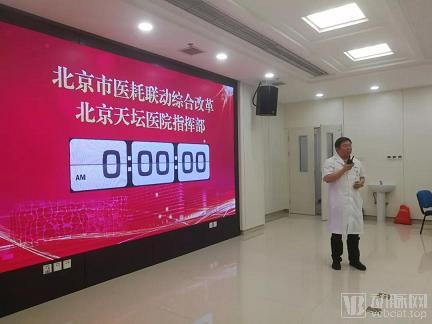
Image source: Beijing Tiantan Hospital
At 00:00 on June 15, Wang Yongjun announced, “The switch-over of the integrated reform information system for medical consumption linkage at Beijing Tiantan Hospital was successful!”
Meanwhile, a patient arrived at the Emergency Department of Beijing Tiantan Hospital, becoming the first patient received by the hospital after the switchover of the integrated reform information system for medical consumption linkage. Following the initial diagnosis, the attending physician ordered a complete blood count (CBC) plus C-reactive protein (CRP) test. As the physician clicked the mouse, the medical information system smoothly printed out the test requisition form adjusted in accordance with the reform requirements, and the patient successfully completed the payment and testing procedures.
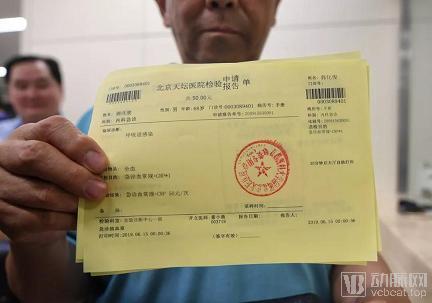
Image source: Beijing Tiantan Hospital
Abolish the Hospital Compensation Mechanism Completely
According to Lei Haichao, the current reform decision abolishes markups on medical consumables, meaning that medical institutions will no longer charge any markup fees for such items. By eliminating markups on drugs and consumables and reducing fees for certain laboratory tests, the use of prescription medications and medical consumables such as stents and catheters will no longer generate additional profits for medical institutions. Abolishing this compensation mechanism helps promote the rational use of laboratory tests and medical consumables, standardize the service practices of healthcare professionals, reduce waste, and incentivize continuous improvement in clinical skills. It also facilitates a shift in the development model of medical institutions from one driven by resource-intensive scale expansion to one focused on connotative quality and efficiency, thereby delivering health services that meet public expectations.
According to projections, the total medical expenditure in Beijing remains broadly balanced following the reform. Taking into account medical insurance reimbursement policies, out-of-pocket costs for outpatient patients remain largely unchanged, while those for inpatients have increased slightly. However, at the individual patient level, costs vary by condition: expenses for conditions requiring extensive use of high-value consumables may decrease, whereas those for conditions primarily treated through technical and labor-intensive services may increase. In response, relevant authorities have conducted detailed analyses. For conditions where price adjustments may lead to significant cost increases, measures combining cost containment, medical insurance policies, and financial assistance programs have been implemented to ensure that the financial burden on low-income households and vulnerable groups remains affordable.
This article was edited from: Beijing Evening News, Economic Daily, and Beijing Tiantan Hospital