

Strategic Blueprint for Private Rehabilitation Hospitals: Patient Acquisition, Revenue Growth, Specialty Development, and Medical Insurance Integration
Population aging, rising living standards, and growing awareness of health and rehabilitation have prompted the state to formulate policies encouraging the development of the rehabilitation and elderly care industries. Notably, in 2016, the national medical insurance system expanded the number of reimbursable rehabilitation services from 9 to 29, directly spurring significant private capital investment in the establishment of specialized rehabilitation hospitals.
Data show that as of 2015, there were 453 specialized rehabilitation hospitals across China. By 2016, this number had increased to 495, representing a 9.2% growth. Major players such as Sanxing Pharmaceutical, Fosun Pharma, Hejia Shares, Hunan Development, Vanke, Huapont Life Sciences, and Tasly have all made strategic moves into the specialized rehabilitation hospital sector.
However, the seemingly prosperous landscape did not last. Some industry giants delayed the construction of subsequent rehabilitation hospitals because the operational data of their existing facilities failed to exceed expectations, and some hospitals have yet to achieve profitability. Nevertheless, a significant number of specialized rehabilitation hospitals have demonstrated strong performance in patient volume, growth trends, and revenue.
The state has consistently encouraged the development of private hospitals. However, how should private rehabilitation hospitals approach top-level design, develop specialized departments, integrate with medical insurance systems, and acquire patient sources? Furthermore, why do industry experts believe that private rehabilitation hospitals are well-suited to establish specialized pain rehabilitation departments? To address these questions, VCBeat interviewed several experts in an effort to uncover strategic insights for the growth of private rehabilitation hospitals.


Xu Baoguo, Vice President of the Greater Bay Area Rehabilitation Medicine Association, told VCBeat that the development of healthcare is inseparable from policy support. The increase in the number of rehabilitation items covered by medical insurance from 9 to 29 directly spurred the establishment of a large number of private rehabilitation hospitals. Recently, the introduction of multiple policies has directly or indirectly facilitated the development of private rehabilitation hospitals.
I.Expanding the Space for Socially Operated Medical InstitutionsThe government imposes no planning restrictions on the aggregate number or spatial distribution of privately run medical institutions. Medical personnel who are currently employed or on unpaid leave are permitted to establish medical institutions. Approval efficiency shall be improved, and all localities must establish a cross-departmental joint approval mechanism for privately run medical institutions by the end of the year. Pilot programs for clinic filing-based management will be launched this year and next in ten cities, including Beijing, Shanghai, and Shenyang.
II.Strengthen Policy SupportPrivate healthcare institutions shall be treated equally with public hospitals in terms of designation as basic medical insurance providers and direct settlement for cross-provincial medical care, enabling more private institutions to join the basic medical insurance network and participate in cross-regional settlement systems, thereby driving an increase in patient volume. Private healthcare institutions may obtain land use rights through allocation, negotiated transfer, or leasing, and are eligible for tax incentives applicable to small and micro enterprises or high-tech enterprises in accordance with relevant regulations. They shall enjoy equal treatment with public hospitals in hospital accreditation and professional title evaluation for technical personnel.
III.Support social medical institutions and public medical institutions to cooperate in the development of "Internet + Medical Health", carry out remote medical collaboration, and share services such as medical testing and imaging.. Support private medical institutions in prioritizing the acceptance of referrals for rehabilitation, nursing, and other services from tertiary public hospitals. Facilitate the integration of commercial insurance systems with those of private medical institutions to provide one-stop direct billing and settlement services. The government supports the procurement of services from private primary healthcare institutions and provides tax and fee reductions, in accordance with relevant regulations, to private medical entities offering rehabilitation and nursing services within communities.
IV.Strengthening Medical Regulation, establish mechanisms for reporting complaints and handling them, crack down on illegal and irregular activities in accordance with the law, and impose a lifetime industry ban on entities with serious breaches of trust.
Rehabilitation encompasses numerous fields. In establishing private rehabilitation hospitals, it is essential to first identify specialized disciplines for focused development. Hejia Shares proposes conducting a thorough disciplinary assessment as the initial step.
Xu Baoguo, Vice President of the Greater Bay Area Rehabilitation Medical Association, told VCBeat that for private rehabilitation hospitals to build core competitiveness and attract patients, they must first clearly define their target patient populations. The field of rehabilitation is highly segmented, encompassing areas such as cardiac, speech, neurological, orthopedic, and pain rehabilitation. At the Ciai Pain Rehabilitation Forum, held during the China Non-Public Rehabilitation Annual Conference in Changsha on June 23, Xu will focus on elaborating on “the Core Competitiveness of Non-Public Healthcare and Its Significance.”
If private rehabilitation hospitals launch too many services at inception, the construction costs and operational complexity will be prohibitively high, making it difficult to achieve break-even within just a few years. Instead, they should develop targeted specialized rehabilitation services based on local conditions.
Xiao Ling, General Manager of the Rehabilitation Division at Hejia Shares, told VCBeat that newly established rehabilitation specialty hospitals need to rapidly develop distinctive and competitive departments while getting hospital operations up and running.
She stated that the specialBy integrating the development of dominant disciplines with an analysis of rehabilitation departments in local public hospitals, a strategy for differentiated competition is formulated. This approach not only addresses the local disease spectrum and public rehabilitation needs but also takes into account the hospital’s clinical departments, physician resource background, and local medical insurance reimbursement policies. Based on this information, the founding team produces a disciplinary diagnostic report and formulates a top-level design plan to guide the rehabilitation hospital’s development path over the next five to ten years.。
For example, in the development of Nantong Rehabilitation Specialist Hospital, initial research revealed that Nantong is located in a relatively developed region of China, with a significantly aging population and a high incidence rate of cerebrovascular and cardiovascular diseases such as stroke.
At that time, the rehabilitation departments of some major hospitals in Nantong had only about 30 beds. Although patients had the ability to pay, the hospitals were far from meeting patient demand. Moreover, the rehabilitation departments of other hospitals mainly focused on nursing care rather than addressing patients’ functional impairments from a clinical perspective.
In light of this, Hejia Shares has designated neurological rehabilitation and orthopedic trauma rehabilitation as key specialties for development at Nantong Hejia Rehabilitation Hospital. As the hospital’s brand becomes established, it will subsequently introduce a day care center and pediatric rehabilitation services tailored to the needs of the Nantong community.
After a rehabilitation hospital is established, securing a patient base is crucial for its sustainable development. Currently, the patient sources for most rehabilitation hospitals fall into two categories. The first consists of patients acquired through marketing efforts, while the second involves partnerships with general hospitals to meet rehabilitation needs that these institutions are unable to fulfill.
After a rehabilitation hospital is established, promotional efforts are necessary to raise awareness. However, given the unique nature of healthcare services, excessive promotion may not be beneficial. Xu Baoguo believes that, in its marketing strategy, a rehabilitation hospital should first shift its underlying philosophy from a traditional product-centric approach to one centered on patient needs.
Previously,Many hospitals approach marketing from a product-centric perspective, promoting in the media their acquisition of advanced equipment such as shockwave therapy devices and PET-CT scanners, or the recruitment of renowned experts for clinical consultations. These efforts focus on promoting their own offerings rather than addressing patient needs.。
Hospitals should adopt a patient-centric approach to marketing: identify patients’ needs and address their specific problems, then promote the hospital’s capabilities in solving those issues. Such targeted messaging enhances relevance and effectiveness.
The opportunity for building private rehabilitation hospitals lies in meeting the rehabilitation needs that public hospitals cannot fulfill; therefore, collaborating with public hospitals is another important way for private rehabilitation hospitals to secure patient referrals.
Xiao Ling told VCBeat that a significant source of patients for Nantong Hejia Rehabilitation Hospital is referrals from tertiary hospitals. Previously, the rehabilitation departments of public hospitals in Nantong faced the dilemma of “patients being unable to get admitted and those already admitted being reluctant to be discharged.” Many patients requiring acute-phase rehabilitation could not be admitted due to full bed capacity in the rehabilitation departments. Meanwhile, patients who were already admitted were unwilling to leave, as they understood that they could recover better and faster under the guidance provided by the rehabilitation department.
However, in accordance with relevant national regulations, there are specific requirements for hospital bed turnover rates. Patients cannot remain hospitalized indefinitely; consequently, many patients do not receive sufficient rehabilitation time, which adversely affects their recovery outcomes.
In accordance with the internationally prevalent three-tier rehabilitation system, after the acute rehabilitation phase, patients with stabilized conditions and ongoing rehabilitation needs should be transferred to specialized rehabilitation hospitals, thereby facilitating their better reintegration into family and society.
The establishment of Nantong Hejia Rehabilitation Hospital can meet the needs of this patient population, allowing them to continue enjoying medical insurance coverage, thereby addressing the concerns of both patients and hospitals.
Xiao Ling told VCBeat that, in this process, two key issues were primarily addressed:
First,The establishment of the hospital requires its inclusion in the local medical insurance reimbursement system.This matter involves more than just simple software information integration; it requires consideration of multiple issues. Nantong Hejia Rehabilitation Hospital is the first private specialized rehabilitation hospital in the local area. How to integrate with medical insurance, and how to implement standardization and supervision, are unprecedented challenges that require multi-party communication among enterprises, hospitals, the Health Commission, and the Medical Insurance Bureau.
Second,After aligning with the Affiliated Hospital of Nantong University and becoming a member of its medical group, integrating its expert resources and patient base is also a critical process.. As Nantong Hejia Rehabilitation Hospital was established from the ground up, as a start-up hospital, it requires support from public hospitals, particularly those with an academic background, in areas such as patient acquisition and the development of its medical talent pipeline.
In addition, Xiao Ling stated that the reputation of private hospitals is crucial. As long as patient recovery outcomes are sufficiently clear and demonstrable, word-of-mouth referrals from patients and their families constitute the most authentic and powerful marketing channel. Through dissemination within patient communities, individuals with both the capacity and need for care will be drawn to seek treatment.
Acquiring patients enables hospitals to meet healthcare demands while boosting revenue, which is crucial for private hospitals.
However, the fees for rehabilitation services are extremely low. Under the current pricing standards, a single physical therapy session costs no more than 100 yuan, which is insufficient to cover hospital costs. In contrast, adopting an integrated diagnosis-and-treatment model can significantly boost hospitals’ revenue.
For instance, the Pain Rehabilitation Department should also be equipped to perform plasma and radiofrequency ablation therapies, thereby addressing patients’ needs in a single intervention.
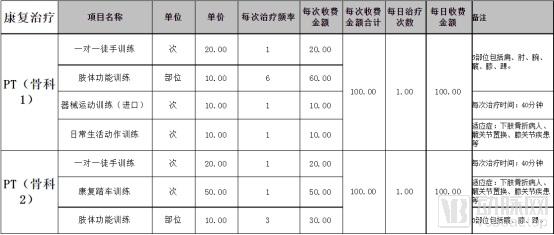
Charges for Certain Rehabilitation Services
China lacks a well-established rehabilitation referral system, and cases similar to that of Nantong Hejia Rehabilitation Hospital are not widespread. Private rehabilitation hospitals are currently unable to promptly intervene in the rehabilitative treatment of patients in general hospitals.
As a private rehabilitation hospital, it is necessary to address issues related to patient acquisition and revenue generation. Huasheng Rehabilitation Hospital, under Huabang Health, adopts a strategy centered on rehabilitation while establishing select auxiliary clinical departments.
VCBeat has previously reported that the configuration of clinical departments should center on rehabilitation, prioritizing specialties such as neurology and orthopedics based on public demand. This is because neurological rehabilitation patients currently account for 60%–70% of the rehabilitation population in China, while orthopedic rehabilitation patients make up 20%.
As a tertiary hospital, in accordance with policy regulations,Tertiary hospitals must balance the medical needs of the surrounding population; therefore, Watson Rehabilitation Hospital has also established outpatient clinics in gynecology, pediatrics, internal medicine, surgery, and dentistry to facilitate access to care for local residents.。
The reason for setting up the departments in this way,This is because Kuankuan Rehabilitation Hospital, affiliated with the Second Affiliated Hospital of Chongqing Medical University and in which Huabang Health holds a stake, initially offered only rehabilitation services during its early operational phase, resulting in suboptimal therapeutic and operational outcomes. The underlying reason is that physicians struggled to intervene promptly in patients’ rehabilitation processes; by the time many patients arrived at Kuankuan Rehabilitation Hospital, they had already missed the optimal window for intervention.
Due to the lack of outpatient clinical services, the range of patients and conditions that the hospital could treat was relatively narrow, leading to some waste of medical resources. Since 2016, Kuanren Hospital has implemented reforms by adding clinical departments, which not only serve the surrounding population but also improve operational efficiency, resulting in increasingly better operational performance.。
As mentioned above, the services currently offered by rehabilitation departments and specialized rehabilitation hospitals in China are predominantly focused on neurological and orthopedic rehabilitation.
There remains a gap between private rehabilitation hospitals and public tertiary Grade A hospitals in terms of overall clinical and rehabilitative care standards. To enhance competitiveness and build brand recognition while improving rehabilitation quality, many experts recommend developing specialized rehabilitation departments, such as pediatric rehabilitation and pain management rehabilitation.
Pain rehabilitation, in particular, presents an opportunity for private rehabilitation hospitals.
Bi Sheng, Chairman of the Pain Rehabilitation Professional Committee of the Chinese Association of Rehabilitation Medicine, told VCBeat that pain rehabilitation is a novel interdisciplinary field integrating pain medicine and rehabilitation medicine, and serves as a subspecialty within rehabilitation medicine.
The development of the rehabilitation sector in China has been relatively slow. The rehabilitation capabilities of most hospital departments remain inadequate, and many pain-related issues arising during the rehabilitation process are still unresolved.
Particularly, pain management during the rehabilitation process poses significant challenges. Examples include shoulder pain in hemiplegia, stump pain after amputation, central post-stroke pain following cerebral stroke, and neuropathic pain after spinal cord injury. Currently, most rehabilitation departments lack the capacity to effectively address these pain conditions. Since unresolved pain can hinder the implementation of rehabilitation programs, it is crucial to develop specialized disciplines in pain rehabilitation.
Xiao Ling stated that private hospitals have unique opportunities and advantages in developing pain rehabilitation.
First,Facilitates the implementation of patient-centered, multidisciplinary collaborative treatment.
As the "fifth vital sign" following blood pressure, respiration, pulse, and body temperature, pain is no longer merely a vital sign; with improvements in living standards and the public's increasing unwillingness to endure its suffering, it is gradually being recognized as a disease in its own right.
However, there are many causes of pain. When patients visit public hospitals, they often do not know which department to register with, as the underlying causes may involve orthopedic injuries, tumors, neurological disorders, or rheumatic and immune diseases.
Due to workflow constraints, it is difficult for multiple departments in public hospitals to coordinate care around a single patient. This hinders accurate diagnosis and leads to suboptimal treatment outcomes.
However, private hospitals can readily establish an integrated model of diagnosis and treatment. From the initial diagnostic stage, they adopt a patient-centered approach, conducting multidisciplinary consultations to clearly identify the etiology. During the treatment process, they can also mobilize human resources to deliver patient-centered care. In contrast, multidisciplinary consultations in public hospitals primarily serve patients with complex and refractory conditions.
Second,Pain rehabilitation techniques are relatively easy to master, which is also an advantage for private hospitals in developing pain specialty departments.. The primary rehabilitation approaches for pain management include minimally invasive procedures and physical therapy; hospitals can relatively easily cultivate relevant personnel, with a short training cycle.
Third,Pain rehabilitation easily builds a strong reputation for its effectiveness.. The evaluation of pain treatment efficacy is simply based on whether the patient experiences pain or not, and therapeutic effects are relatively easy to achieve. This makes it easy to generate positive word-of-mouth among patients, which benefits hospital brand building.
Therefore, it is easy for private rehabilitation hospitals to achieve visible results and economic benefits by developing specialized pain rehabilitation departments.
In addition to specialized pain rehabilitation, rehabilitation hospitals should leverage their own resources to establish distinctive specialty services. For instance, institutions with cardiac specialists and related resources can develop cardiac rehabilitation programs, while those with pediatric resources can focus on pediatric rehabilitation. Differentiated specialty services can help private hospitals build their brand and achieve greater financial returns.