

Tencent AIMIS Launches AI-Powered Glaucoma Screening to Empower Primary Care and Community Health

Tencent
Internet Comprehensive Service Provider
Glaucoma is the second leading cause of blindness worldwide, surpassed only by cataracts. Unlike cataracts, which can be surgically treated to restore vision, vision loss caused by glaucoma is irreversible. Epidemiological survey data from China indicate that the prevalence of primary glaucoma is approximately 3.8%, with the number of glaucoma patients aged 40 and above projected to reach 21 million in 2020.
However, public awareness of glaucoma screening and prevention in China remains low. At the time of initial diagnosis, 75% of patients with chronic angle-closure glaucoma and open-angle glaucoma are already in the moderate to advanced stages, resulting in irreversible vision loss or even blindness, which imposes a significant burden on patients’ families and society.
Glaucoma is not a terminal illness. In fact, with early diagnosis, appropriate treatment, and timely intervention to halt disease progression, vision loss and blindness can be avoided. Therefore, enhancing public awareness of glaucoma screening and prevention, along with improving the diagnostic accuracy of physicians, represents a critical step in curbing the advancement of glaucoma. In this context, artificial intelligence can deliver substantial value.
Compared with other diseases, ophthalmic diseases have a natural fit with artificial intelligence technology.
Professor Wang Ningli, President of the Ophthalmology Branch of the Chinese Medical Doctor Association and Head of the Glaucoma Group of the Ophthalmology Branch of the Chinese Medical Association, pointed out in an interview: “Ocular diseases differ from other conditions; most are controllable, and 80% can be diagnosed with just a single fundus photograph. Meanwhile, the cost of fundus photography is significantly lower than that of lung or brain imaging, providing artificial intelligence companies with more data to enhance the reliability of their algorithms.”
On November 16 last year, Tencent and Professor Wang Ningli’s expert team from Beijing Tongren Hospital jointly launched a collaborative research initiative on AI-assisted diagnosis of glaucoma. By leveraging deep learning on extensive disciplinary knowledge, clinical data, and expert clinical experience, the glaucoma screening function of “Tencent Miying” has established a specialized diagnostic model. This model achieves high-precision, pixel-level segmentation of the optic disc and optic cup regions in fundus images, and intelligently calculates clinically significant parameters such as the cup-to-disc ratio with precision. It assists physicians in performing rapid and stable calculations of clinical parameters, thereby enabling highly accurate intelligent identification of glaucoma, particularly early-stage glaucoma. This advancement helps improve the efficiency of glaucoma screening and addresses the shortage of glaucoma diagnostic specialists.
Within six months of signing the collaboration agreement, Tencent and Professor Wang Ningli’s expert team from Beijing Tongren Hospital continuously provided support to the Miying algorithm, leading to steady improvements in its performance. On June 16, during the 13th Annual Conference of the Ophthalmologist Branch of the Chinese Medical Doctor Association, Tencent and Professor Wang Ningli’s team unveiled their latest joint research achievements: an AI-assisted intelligent screening tool for early-stage glaucoma that enables identification before patients suffer vision loss, ensuring timely and effective treatment. With an accuracy rate exceeding 95%, this feature has been officially launched on “Tencent Miying.”
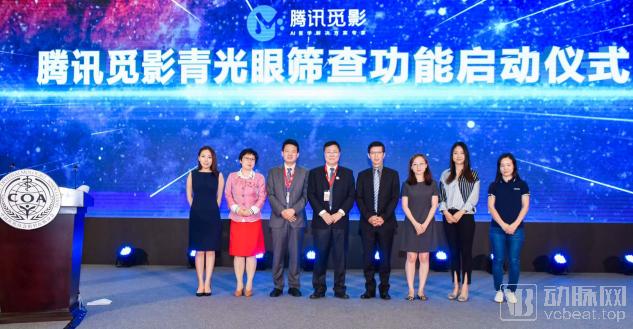
Professor Wang Ningli, President of the Ophthalmology Branch of the Chinese Medical Doctor Association and Head of the Glaucoma Group of the Ophthalmology Branch of the Chinese Medical Association, pointed out that early detection, early diagnosis, and early treatment are key to the prevention and control of glaucoma. However, due to the insidious nature of glaucoma, its complex pathogenesis, as well as the shortage of ophthalmologists and uneven distribution of medical resources in China, early diagnosis of glaucoma faces challenges. Artificial intelligence-assisted approaches have brought new perspectives to the prevention and control of glaucoma.
Wang Shaojun, Vice President of Tencent Healthcare, stated that with the aid of artificial intelligence and remote diagnostic technologies, primary healthcare institutions are expected to gain the capability to conduct glaucoma examinations. This will facilitate convenient local screening and follow-up for the public, help alleviate the shortage of professional ophthalmologists, expand the coverage of glaucoma screening, and enable earlier detection of the disease in patients.
Supported by Tencent Youtu Lab, the glaucoma screening feature of “Tencent Miying” employs leading unsupervised domain adaptation technology to enhance the generalization capability of deep learning models across multi-center images, effectively addressing the issue of model performance degradation in clinical testing. Meanwhile, Tencent Youtu Lab has also designed a spatial attention mechanism based on multi-model cascading, which amplifies the weights of key regions of interest to clinical glaucoma specialists, thereby improving the interpretability of model outputs and ultimately increasing the sensitivity and specificity of glaucoma detection.
With the assistance of artificial intelligence, a preliminary assessment of whether an examinee has fundus diseases can be made in just a few seconds. This will help alleviate the bottleneck caused by the shortage of professional ophthalmologists and usher in a new model for primary-level screening of fundus diseases. Currently, the “Tencent Miying” AI-powered fundus screening system has been jointly validated with more than 30 hospitals across China and has been piloted in primary healthcare institutions in multiple provinces and municipalities, including Guangdong, Shandong, Sichuan, and Guangxi. To date, it has screened over 65,000 individuals.
With the assistance of “Tencent Miying,” the workflow for fundus disease screening has been optimized: patients undergo fundus photography at primary healthcare institutions or off-site screening centers; the “Tencent Miying” intelligent fundus screening system then performs remote AI-based analysis and automatically generates assessment reports, thereby enhancing diagnostic efficiency. The final examination is completed upon review by an ophthalmologist. This means that, with the support of “Tencent Miying,” specialized ophthalmologists can provide broader screening coverage to primary care and community settings through remote diagnostic services.
In fact, in addition to diagnosing common fundus diseases such as glaucoma, fundus examination can also be used for the early screening of certain cardiovascular and cerebrovascular diseases, as well as various systemic conditions. This indicates substantial potential for integrating artificial intelligence with community- and primary care-level fundus disease screening, making AI-driven community screening for fundus diseases a promising, efficient, and convenient disease management model.