

b-ONE Orthopedics: First Chinese-developed Hip and Knee Implants Successfully Implanted in the U.S., Marking a Breakthrough for Domestic High-end Medical Devices
In June 2019, Professor Donald Kastenbaum of Mount Sinai Hospital in New York, USA, personally implanted the first artificial joint prostheses independently developed and manufactured by a domestic Chinese joint company in the United States—the MOBIOTM total knee system and total hip system from b-ONE Kuanyue Orthopedics (hereinafter referred to as “b-ONE”).
Since becoming the first Chinese joint company in October 2018 to have both its independently developed hip and knee joints cleared by the U.S. FDA via the 510(k) pathway, b-ONE has once again made history by becoming the first Chinese brand with independently developed joint implants to formally enter the U.S. market. The inaugural implantation was performed at Mount Sinai Hospital, which is ranked among the top hospitals in the United States (ranked 18th by U.S. News & World Report in 2017), marking the recognition of b-ONE’s joint products by the mainstream U.S. healthcare market.

Left: Surgical footage from the United States; Right: Mount Sinai Health System in New York
Image source: b-ONE Kuanyue Orthopedics
China's Joint Replacement Market Maintains Rapid Growth
Population aging is a significant and unavoidable challenge in modern society. As the aging population intensifies, the number of individuals suffering from joint-related diseases is rapidly increasing. Artificial joint replacement surgery, as a critical therapeutic intervention, has driven robust growth in the corresponding joint implant market in recent years. In 2017, the global joint replacement market was valued at $19.1 billion and is projected to reach $31.9 billion by 2024, representing a compound annual growth rate (CAGR) of 7.7%.
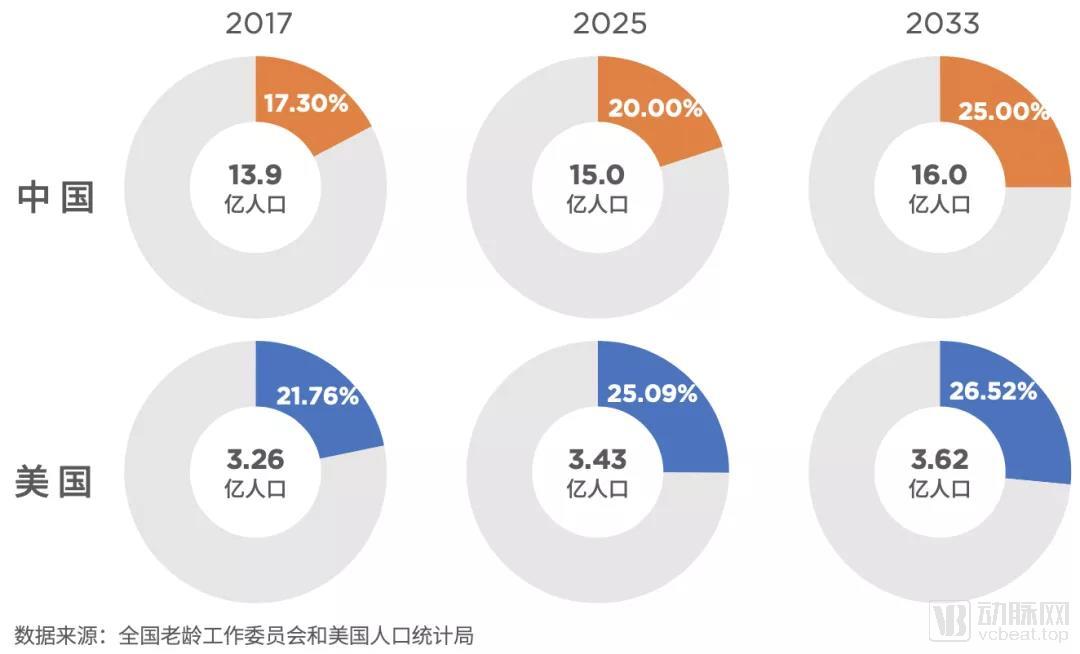
For the Chinese market, data show that in 2017, the population aged 60 and above exceeded 240 million, accounting for 17.3% of the total population; it is projected that by 2033, China’s elderly population will surpass 400 million, representing 25% of the total population. In 2018, the volume of China’s joint replacement market approached 700,000 procedures annually, continuing to maintain robust double-digit growth.
Leveraging advanced product technologies and robust marketing systems, imported joint brands secured an early strategic advantage in the development of China’s joint replacement market. Particularly in the field of knee arthroplasty, the top four international tier-one brands once accounted for more than 50% of surgical volume and over 70% of sales revenue in the domestic market. Imported joint brands are expensive, with unit prices often significantly higher than those of comparable domestically produced brands.
In recent years, propelled by favorable policies such as the promotion of domestic substitution and healthcare cost containment, Chinese joint implant brands have caught up rapidly, achieving sustained high-speed growth. However, due to significant gaps compared with imported brands in terms of product philosophy, manufacturing processes, quality management, and brand marketing, domestically produced products have remained confined to the mid- and low-end segments of the Chinese market, struggling to establish a stable presence in the core high-end and top-tier markets. More importantly, as advanced joint implants must function alongside human movement for decades, their research and development, testing, production, and quality control constitute a highly complex system that rigorously tests both technical and managerial capabilities.
China’s domestic joint replacement industry started late, with inherent weaknesses in its R&D system, a lack of accumulation of key technologies and original intellectual property rights, making it extremely difficult to enter developed-country markets that emphasize IP protection. For over two decades, numerous Chinese joint replacement companies have made successive efforts, yet none have managed to break into the U.S. market. To this day, many products from Chinese joint replacement firms are still labeled as “low-price, low-quality,” and even when exported, they remain confined to markets in less-developed countries. Acquiring established overseas joint replacement companies thus appears to be the only viable route to rapidly gain access to developed-country markets.
In the spring of 2015, the initial founders of b-ONE gathered in Shanghai. Their original dream was “to build a Chinese joint company that can truly go global.” Among them were many serial entrepreneurs in the orthopedic industry. After personally witnessing the rapid and unchecked growth of China’s domestic orthopedic sector, they aspired to “slow down,” be more “grounded,” and truly “devote themselves to crafting high-quality products.”
Overtaking on a Curve from Scratch
For b-ONE, starting from scratch and carving out a niche in China’s highly competitive joint implant industry is no easy feat; achieving overtaking on the bend and becoming the first to go global is even more challenging. From its inception, b-ONE chose a distinctly different path: “R&D in the U.S., Global Manufacturing.”

As the global leader in the joint replacement industry, the United States is home to three of the top four joint replacement companies worldwide. Its scientific research capabilities and talent accumulation in R&D within the joint field are ahead of other countries. In late 2015, b-ONE was honored to invite Dr. Mark Kester to join as Chief Scientist. With over thirty years of experience in joint R&D, Mark served as Senior Director of Global R&D at Stryker before joining b-ONE, making him a preeminent joint R&D expert in North America. Under Mark’s leadership, b-ONE has attracted a team of experienced engineering R&D professionals from across North America and officially established its Global R&D Center in New Jersey in 2016. Today, the b-ONE R&D team collaborates closely with leading joint specialist teams in North America, Europe, and China, adhering to the product philosophy of “Advanced Design · Premium Quality.” Currently, b-ONE is the first Chinese joint company to establish an R&D center in the United States.
“Global Manufacturing” strategy demonstrates b-ONE’s commitment and standards for quality. Since 2017, b-ONE has successively launched two manufacturing bases in Beijing and Suzhou, China, for the production of joint prostheses and surgical instruments. To create “joint products that bring peace of mind and pride to our families,” b-ONE rigorously selects overseas raw material suppliers identical to those used by top-tier international brands, and performs key processes critical to prosthesis performance in Europe.
All key manufacturing processes for b-ONE’s products and tools undergo four-stage validation and are tested by third-party international authoritative institutions. Taking knee joint prostheses as an example, b-ONE is one of the few joint companies worldwide that employs the industry’s most rigorous coordinate measuring machine (CMM) multi-section measurement method to perform 100% inspection of femoral surfaces. Only through stringent inspection processes can trustworthy, high-quality products be created. b-ONE’s product quality complies with Chinese National Standards (GB) and American ASTM standards, laying a solid foundation for b-ONE products to obtain U.S. FDA approval and ultimately enter the U.S. market.
Targeting Developed Country Markets, Expanding Globally
b-ONE has targeted developed-country markets since its inception, and the United States, as the largest market by size, was naturally b-ONE’s primary target for international expansion and proof of capability. However, it is no easy feat for a medical device product under an entirely Chinese brand to enter the U.S. market.
In October 2017, b-ONE submitted its first application to the U.S. Food and Drug Administration (FDA). On August 30, 2018, after extensive preparation and the completion of an application dossier spanning thousands of pages, b-ONE became the first Chinese joint replacement company to obtain FDA 510(k) clearance for a self-developed hip replacement product. Two months later, on October 12, b-ONE’s total knee system also received FDA clearance, making it the first Chinese joint brand to secure FDA clearance for both hip and knee products.
Obtaining FDA approval is merely the first step toward gaining market access in the United States, followed by a challenging path to commercialization. The U.S. joint replacement market is intensely competitive, and since Chinese joint brands have never previously been present in the market, hospitals’ understanding of Chinese joint products is largely equated with biased perceptions of “Made in China.”
To successfully gain entry into Mount Sinai Hospital in New York, b-ONE established a dedicated project team led directly by the CEO, comprising key members from R&D, production, quality management, regulatory affairs, operations, sales, and marketing. Over a nine-month period, the team prepared extensive documentation and data, demonstrating to the hospital’s procurement decision-making committee that b-ONE’s products embody advanced concepts and superior quality comparable to any top-tier international brand. The proposal was approved by vote, facilitating successful hospital admission and ultimately enabling the first implantation of a Chinese-made joint prosthesis in the United States. As Professor Donald Kastenbaum stated after the surgery, “Entering the U.S. market is a milestone in b-ONE’s development, requiring tremendous effort. b-ONE has proven its value and capabilities to the world through its products!”
Orthopedic Consumables Will Return to Intensive Cultivation and Product-Centric Excellence
For many domestic Chinese orthopedic brands, the past decade was the first half, characterized by wild growth and rapid market expansion; the next decade will be the second half, defined by intensive cultivation and product supremacy. Returning to product-based competition and focusing on product quality is the inevitable path for industry development. As in other consumer sectors, with the continuous emergence of Chinese innovation and the ongoing improvement of Chinese quality, the recognition of domestically produced medical products among Chinese doctors and patients is gradually increasing, making import substitution an irreversible industry trend.
Meanwhile, the demographic structures of major countries worldwide will undergo significant changes over the next two decades. For the first time in human history, there will be more than 1.5 billion people aged 60 and above globally, with China’s elderly population accounting for nearly one-quarter of this total. No longer content to trudge through a "gray" phase of life with faltering steps, these seniors are poised to embrace this new stage with greater vitality. The growing number of highly active patients greatly expands the potential and innovation horizons of the joint replacement industry.
Standing at the historical intersection of these two major trends, we may be witnessing and experiencing the golden age of Chinese joint brands.
Professor Richard Rothman, a global luminary in orthopedics and founder of the Rothman Orthopaedic Institute, once stated, “In the coming decade, successful companies must understand a value equation: most countries lack sufficient funds to meet everyone’s healthcare needs, so we must strive to create higher-quality products at reasonable costs.” Today, the global medical market is increasingly focused on achieving greater cost-effectiveness. The rise of high-value, Chinese-made joint replacement products—driven by innovation and grounded in quality—in premium European and American markets is sure to write a new chapter in the global orthopedic industry. For b-ONE, sustained R&D investment and stringent manufacturing standards will serve as its long-term strategy for competing on the world stage.
Shi Lei, Vice President of Investment at STO Capital, stated, “We are encouraged by Kuanyue Medical’s achievements in the U.S. market. STO Capital has long been committed to delivering the highest-quality medical products and services to patients worldwide, including those in China. Kuanyue’s breakthrough in the world’s most developed markets represents a landmark event for Chinese-owned, high-end medical devices with independent intellectual property rights going global.”
From “Made in China” to “Innovated in China,” and then to “Chinese Brands,” the global expansion path of China’s joint replacement industry mirrors that of other high-end manufacturing sectors. For b-ONE, successfully entering the U.S. market is merely a small step in a long journey. Its ultimate vision is to benefit the global orthopedic market through Chinese innovation and ultimately instill pride in Chinese brands. “The road ahead is long and far; I will tirelessly seek and explore.”