

Philips Future Health Index 2019: China Leads Global Adoption of Telehealth, AI, and Digital Health Records

Philips Healthcare
Integrated service provider in healthcare, quality living, and lighting fields
Recently, Royal Philips released the “2019 Future Health Index Report,” exploring the impact of digital health technologies on healthcare professionals and patients. This marks the fourth consecutive year that Philips has globally published the Future Health Index Report.
This report presents findings from a survey of 15,000 members of the general public and over 3,100 healthcare professionals across 15 countries worldwide. It examines the application of digital technologies in healthcare systems, their impact on healthcare providers and patients, and the current state of digital health technology development in the surveyed countries.
VCBeat has compiled and organized this report, which primarily covers the following aspects:
I. Enhanced Penetration of DHRs, Telemedicine, and AI
II. 80% of Chinese Respondents More Willing to Proactively Contact Healthcare Professionals
III. China Leads the World in Digital Health Technology Adoption
With the emergence and development of emerging technologies, some healthcare professionals are adapting to new ways of working and gradually recognizing the benefits brought by digital health technologies. However, most countries have yet to realize that enabling healthcare professionals to fully leverage digital medical technologies in their work can yield substantial benefits.
Through surveys, Philips aims to enhance healthcare professionals’ awareness of the importance of digital health, empowering them to become true advocates of digital medicine. This initiative seeks to influence peers and patients, remove barriers to the adoption of digital medical technologies, extend the careers of healthcare professionals, and improve patient treatment outcomes.
I. Enhanced Penetration of DHRs, Telemedicine, and AI
Currently, some healthcare professionals are adapting to new ways of working and beginning to recognize the benefits brought by digital health technologies.
This report indicates that digital health technologies have permeated the daily workflows of healthcare professionals. The proportions of healthcare providers who electronically share patient health data with their peers within and outside medical institutions are 80% and 32%, respectively. This suggests that if healthcare professionals encourage patients to share their data, it will have significant implications for building a data-rich healthcare system.
Data sharing is not the norm, but it holds significant potential to improve healthcare experiences. Surveys indicate that 40% of healthcare professionals frequently recommend patients use digital health technologies or mobile health applications to track three key health indicators: blood pressure, physical activity, and body weight. However, only about 10% of healthcare professionals report that patients are willing to share their health data with them. Among patients who use digital health technologies or mobile health applications, only 36% regularly and proactively share their data with physicians.
Meanwhile, the majority of healthcare professionals utilize new technologies such as Digital Health Records (DHRs), telemedicine, and AI in their work. Among these, DHRs and telemedicine have higher penetration rates, at 76% and 61%, respectively; in contrast, the penetration rate of AI technology is lower, at only 46%.
The use of Digital Health Records (DHRs) by healthcare professionals has yielded significant positive impacts. Most respondents indicated that the application of DHRs not only enhances the quality of care and improves patient outcomes, but also boosts job satisfaction among healthcare providers.
Despite a 61% penetration rate, 39% of surveyed healthcare professionals indicated that their clinics or hospitals do not utilize telemedicine. This suggests that telemedicine has yet to fully realize its potential in improving healthcare accessibility. Nevertheless, the majority of respondents demonstrated a strong willingness to adopt telemedicine. Additionally, 45% of respondents believed that non-emergency care could also be delivered through remote consultations.
Artificial intelligence (AI) also holds positive implications for healthcare workflows, yet currently, only 46% of healthcare professionals utilize AI technologies in their clinical practice. Most healthcare professionals are accustomed to using AI for routine administrative tasks, such as scheduling (64%). To deliver higher-quality care, healthcare professionals will more extensively apply AI technologies in clinical settings in the future, which will have a more profound impact on patient experience, including diagnosis and treatment.
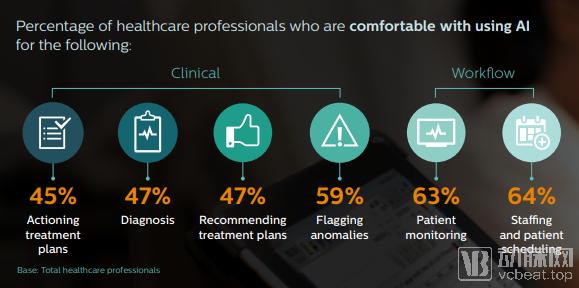
Most healthcare professionals are accustomed to using AI for daily administrative tasks, such as schedule management (64%).
(Screenshot from the original report)
II. 80% of Chinese Respondents More Willing to Proactively Contact Healthcare Professionals
Healthcare professionals have played a pivotal role in transforming healthcare delivery through digital technologies; however, it is equally important to understand how these technologies positively impact patients’ care experiences. Empowering patients to access their own health data and actively engage in their care can significantly enhance the quality of healthcare services and the overall patient experience.
This survey reveals that many patients desire access to their personal health data. Nearly half of the respondents indicated that tracking health metrics via digital technologies enables them to more conveniently monitor their condition and exert greater control over their health.
Among respondents who could access their digital health records, 82% rated their healthcare experience as good or even superior. In contrast, among those unable to access their digital health records, only 66% considered their healthcare experience to be good.
Accessing digital health records and understanding how they simplify health management can encourage patients to use these records more actively and effectively. The report shows that respondents who have access to digital health records and are encouraged to use them more frequently state that they typically leverage this data to manage their health, control their weight, communicate with physicians, safeguard data security, reduce medical expenses, and obtain medical information.
Meanwhile, when patients have access to their health data, they are more willing to collaborate with healthcare providers. Among respondents who can access their own health data, 84% expressed the desire for healthcare professionals to also have access to these data. Among those who cannot access their digital health records or are unsure whether they have such permission, 64% similarly indicated that they wish healthcare personnel to have access to patients’ digital health records.
Patients who are able to track and share their health data tend to have a more positive perception of the medical care they receive. Among patients who use digital health technologies and share their health data with healthcare providers, 74% of respondents rated the quality of care they received as high or very high, compared to 66% among those who use digital health technologies but do not share their health data with healthcare providers.
To facilitate data usage and sharing, patients often have high expectations for convenience and require some guidance. Data indicate that if healthcare providers more frequently recommend digital health technologies or mobile health applications, patients are more likely to adopt these technologies. There is also evidence suggesting that patients will be more inclined to use digital health technologies if the process of sharing data with healthcare providers becomes more convenient.
The report also indicates that the primary drivers encouraging patients to adopt digital health technologies include assured data security, affordable pricing, recommendations from healthcare professionals, and the convenience of sharing data with healthcare providers.
Older adults aged 55 and above are most likely to use digital health technologies (40%) under the recommendation of healthcare professionals. Additionally, 34% of individuals aged 35–54 and 33% of those aged 18–34 are willing to adopt digital health technologies. These data indicate that healthcare professionals can play a significant role in data-centric elderly healthcare systems.
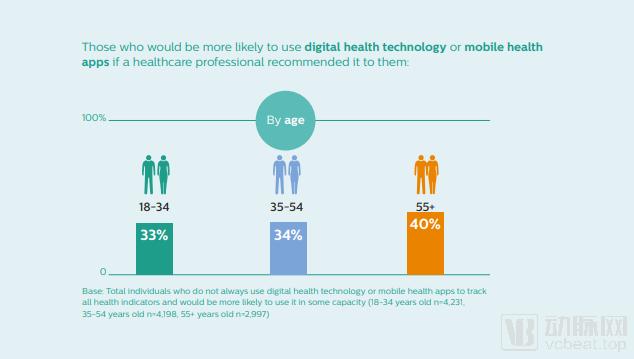
Adults Aged 55 and Older Are Most Likely to Use Digital Health Technologies
(Screenshot from the original report)
Healthcare providers recommending that patients use digital health technologies can foster deeper communication between both parties.
Chinese healthcare professionals are more proactive in recommending digital health technologies to patients. They typically encourage patients to use digital health tools or mobile health applications to track key health indicators such as blood pressure, physical activity, and body weight, and may even monitor more advanced health data through patient-reported metrics. In turn, patients actively communicate with their physicians based on the health data they have tracked.
Data shows that among Chinese respondents who use digital health technologies or mobile health applications, 80% are more willing to proactively engage with healthcare professionals. In contrast, the average proportion across the 15 surveyed countries is only 47%.
III. China Leads the World in Digital Health Technology Adoption
In recent years, several emerging countries have demonstrated the potential to surpass others in the adoption of digital health technologies. By 2019, nations such as China, Saudi Arabia, India, and Russia had already achieved leapfrog development, with digital health technologies increasingly becoming an integral part of the healthcare experience for both medical professionals and patients. Among these, China and Saudi Arabia are at the forefront in the utilization of new technologies.
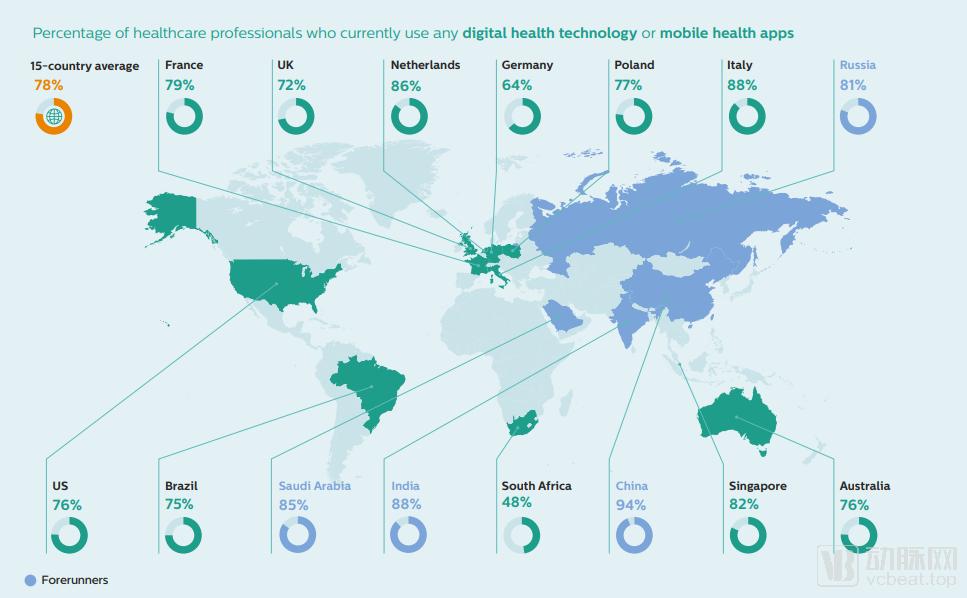
Among the 15 surveyed countries, 94% of respondents in China reported using digital health technologies or mobile applications.
(Screenshot from the original report)
Some countries are shifting from acquiring digital health technologies to actively using them. Respondents from China, Saudi Arabia, and India reported that they use digital health technologies and mobile health applications to track key health indicators, guide their daily activities based on health prompts, and maintain communication with healthcare professionals. In fact, China has performed better in this regard.
Currently, the proportion of patients in Russia adopting digital health technologies is lower than in other countries; however, its high growth rate and user penetration indicate significant potential for future adoption of digital health technologies in Russia. In other words, some countries are leveraging technology to improve healthcare accessibility.
Among the 15 countries surveyed, wearable device revenue was projected to grow by an average of 4.5% in 2019, with most emerging markets experiencing higher growth rates. For instance, Russia’s wearable device revenue was expected to increase by 5.6%, Saudi Arabia by 4.6%, and India by 5.8%. China recorded the highest wearable device revenue in 2019 at $45.99 billion, with a projected annual growth rate of 10%.
Meanwhile, emerging countries are leading the development of artificial intelligence (AI) in healthcare. From 2013 to the first quarter of 2018, China accounted for 60% of global investment and financing in the AI sector, ranking first worldwide, followed by the United States (29%) and India (5%). These countries also demonstrate strong public awareness of AI. Surveys indicate that the general public in China, Russia, and Saudi Arabia believes that the application of AI in healthcare will help produce more accurate diagnostic results.
In the realm of telemedicine, countries with lower physician density (number of physicians per 1,000 people) exhibit higher telemedicine adoption rates. In this survey, the average telemedicine adoption rate across the 15 participating countries was 61%. Specifically, the adoption rates in China, Saudi Arabia, India, and Russia were 89%, 75%, 67%, and 65%, respectively. Furthermore, 44% of Chinese respondents and 40% of Russian respondents expressed a preference for consulting doctors remotely via digital channels for non-urgent care.
Technological advancements continue to evolve, serving as a driving force for the ongoing transformation of global healthcare systems. Healthcare professionals who have integrated digital health technologies into their workflows have already observed positive impacts on both their operational efficiency and the way patients experience medical care. As new challenges and demands emerge, both healthcare providers and patients must continuously learn and adapt to these technologies, thereby expanding and deepening their utilization of digital health solutions.
(Compiled by Xu Shengnan)
Source: https://images.philips.com/is/content/PhilipsConsumer/Campaigns/CA20162504_Philips_Newscenter/Philips_Future_Health_Index_2019_report_transforming_healthcare_experiences.pdf