

Notice on Soliciting Public Comments for the 'Guidelines on Strengthening Planning and Land Use Support to Promote the Development of Elderly Care Services'
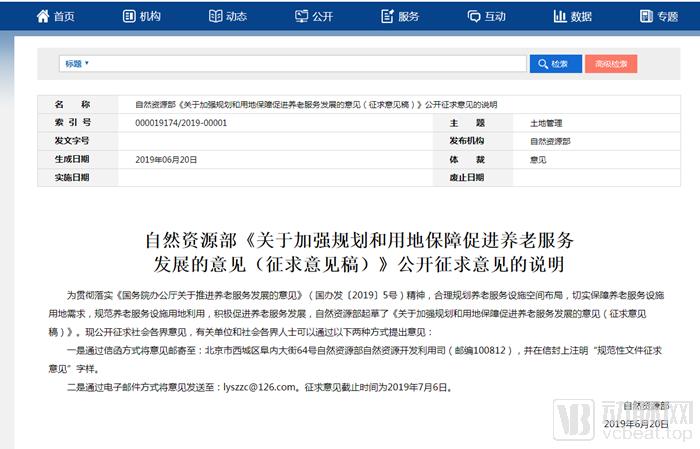
VCBeat (WeChat: vcbeat) has learned that on June 20, 2019, the Ministry of Natural Resources issued the “Opinions on Strengthening Planning and Land-Use Guarantees to Promote the Development of Elderly Care Services (Draft for Comments)” (hereinafter referred to as the “Opinions”).
“The Opinions” point out that we should rationally plan the spatial layout of elderly care service facilities, effectively guarantee the land use needs for these facilities, standardize the utilization of land for elderly care services, and actively promote the development of elderly care services. The following recommendations are proposed:
Reasonably Define the Land Use Scope for Elderly Care Service Facilities
(I) Clarify the scope of land use for elderly care service facilities.
Land for Elderly Care Service Facilities Refers toSpecializedProvide elderly people with services such as daily life care, rehabilitation nursing, custodial care, and medical healthcare.Land occupied by buildings and site facilities that cannot be sold separately, including nursing homes, care facilities, homes for the elderly, elder care centers, community-based elderly care service centers, and adult day care centers.
(2) Determining the land use purpose and term for elderly care service facilities.
In accordance with the territorial space planning and the national standard "Current Land Use Classification (GB/T 21010—2017)," land designated for social welfare purposes in the plan may be separately allocated for elderly care service facilities; where the planned land use is compatible with elderly care service facilities, such facilities may be accommodated provided that their primary use is not adversely affected; for land with other designated uses, elderly care service facilities may only be constructed as ancillary facilities, with the corresponding land area apportioned accordingly. Elderly Care Service Facility LandSupplied through land grant, the term of its land use rights grantMust not exceed 50 years;Supplied via lease, its lease termShall not exceed 20 years.
Comprehensive Planning for the Spatial Layout of Land Use for Elderly Care Service Facilities
(3) Ensure the scale of land allocated for planning elderly care service facilities.
The formulation of master plans and detailed plans for urban territorial space shall strictly adhere to the per capita land use standards for towns.Standard of no less than 0.1 square metersPlan and allocate elderly care service facilities by zone and level. In areas with a high proportion of elderly population or rapid aging trends, the per capita planned land use standard for elderly care service facilities may be appropriately increased. If the land area allocated for elderly care service facilities fails to meet the prescribed minimum standards, it shall not pass the review of the overall territorial space plan and detailed plans.
(4) Implement the spatial layout of elderly care service facilities.
Master territorial spatial plans shall establish the layout principles and standards for elderly care service facilities based on the local population structure and aging trends. Detailed plans, in accordance with the requirements of the master territorial spatial plan and aligned with the special plan for elderly care service facilities, shall specify land use purposes and development intensity for specific plots, thereby implementing the total quantity, layout, construction standards, and related requirements for existing, newly built, and renovated/expanded elderly care service facilities identified in the special plan onto specific plots.
(V) Implement the planning and design standards for elderly care service facilities.
Newly developed urban areas and newly built residential (small) communities shall construct supporting elderly care service facilities in accordance with planning and design standards and specifications such as the Standard for Planning and Design of Urban Residential Areas, the Code for Planning of Urban Public Facilities, and the Code for Planning of Elderly Care Facilities in Towns and Cities. These facilities must be planned and constructed concurrently with residential buildings. It is encouraged to consolidate the allocation indicators for multiple small-area residential communities to centrally establish home-based elderly care service facilities. The natural resources authorities at the municipal and county levels shall strictly review the planning and design proposals for elderly care service facility projects; construction project planning permits shall not be issued to those that fail to meet the requirements of planning and design standards and specifications.
Effectively Guaranteeing Land Supply for Elderly Care Service Facilities
(6) Prioritize the allocation of land for elderly care service facilities.
Municipal and county-level natural resources authorities shall prioritize meeting the land use needs for elderly care service facilities when formulating annual plans for the supply of state-owned construction land,Clearly specify the location, area, intended use, and method of supply for parcels of land designated for elderly care service facilities, and disclose this information to the public.. Where land for elderly care service facilities involves newly added construction land, within the annual land use plan quotasPriorityArrangements have been made.
(7) Clarify the planning, land use, and development conditions for elderly care service facilities.
Newly developed urban areas and residential (small) communities shall be equipped with independently sited elderly care service facilities in accordance with regulations. Where such facilities can be allocated to separate land parcels based on their planned use, they shall be supplied as distinct land parcels; where separation into individual parcels is not feasible, the area proportions and supply methods for the land used for elderly care services and for other community purposes shall be clearly specified. Land parcels supplied exclusively for elderly care service facilities shall, in principle, be limited to no more than 3 hectares; if medical, healthcare, rehabilitation, and other medical and health facilities are centrally co-located, the area shall not exceed 5 hectares. For land designated for elderly care services that also accommodates medical and health facilities, relevant requirements for the construction of supporting medical service facilities may be included as conditions for land supply, with a clear stipulation that the property cannot be subdivided or transferred separately. When supplying residential land through assignment, approaches such as “capping housing prices and land premiums while competing on the floor area of co-located elderly care service facilities” may be adopted; however, factors that could impair fair competition, such as an institution’s qualifications or credit ratings, shall not be used as conditions for land assignment.
(8) Safeguard, in accordance with the law, the use of allocated land or land contributed as capital at an assessed value by non-profit elderly care service institutions.
Non-profit elderly care service projects invested in and constructed by public institutions, private entities, or overseas capital may apply in accordance with the law to obtain state-owned construction land through allocation. When applying for allocated land, elderly care service institutions shall provide documents such as the Registration Certificate of Private Non-Enterprise Units or the Registration Certificate of Social Service Organizations as proof of their non-profit status. If relevant registration cannot be completed at the time of application, the preliminary review opinion issued by the civil affairs department regarding qualifications other than business premises may serve as a reference basis. The natural resources departments at the municipal and county levels shall accept applications in accordance with statutory procedures and requirements.The land user may simultaneously submit applications for the allocation of state-owned construction land and for the planning permit for construction land use. Upon completion of the approval process, the natural resources departments at the municipal and county levels shall concurrently issue the Land Allocation Decision and the Planning Permit for Construction Land Use.If two or more eligible investment entities simultaneously apply for the allocation of the same parcel of land, the natural resources departments at the municipal and county levels shall endeavor to coordinate and arrange other parcels of land available for elderly care facilities. If no other suitable parcels are available, or if coordination fails to resolve competing applications from two or more investment entities for the same parcel, the natural resources departments at the municipal and county levels may consult with the corresponding elderly care services authorities at the same level. They shall determine the recipient of the land use rights through allocation on a merit basis, using criteria such as service quality and fee standards.Government and social capital are encouraged to jointly invest in and construct non-profit elderly care service projects. Municipal and county people’s governments may provide land through capital contribution valued at appraised price or by taking equity stakes.
(9) Supply land for elderly care service facilities through various paid-use methods.
Within a reasonable period after the release of plans for the supply of state-owned construction land, if no entity meeting the conditions for land allocation submits an application for land use, the relevant land shall be subject to paid use in accordance with the law. The natural resources departments at the municipal and county levels shall disclose to the public the applications received for paid use and accept them in the order of long-term lease, lease-then-transfer, and grant, prioritizing shorter lease terms. These departments shall formulate annual rent standards for the leasing of state-owned construction land use rights by elderly care service institutions, which shall be implemented upon approval by the people's government at the corresponding level. The minimum transfer price (or paid use price) for land used for elderly care service facilities shall not be lower than 70% of the benchmark land price for public service land at the corresponding grade; in areas where benchmark land prices have not yet been established, the minimum transfer price shall not be lower than the sum of the objective costs for land acquisition and development plus relevant taxes and fees.
(10) Standardize the change of planning purposes and revenue management for existing land.
Where the proposed change complies with detailed planning requirements and land-use compatibility, natural resources authorities at the municipal and county levels shall, in accordance with laws and regulations, promptly process applications submitted by land use right holders to change the planned land use for the construction of elderly care service facilities. Where completed elderly care service facilities are operated by non-profit elderly care institutions, the originally allocated land may continue to be used under allocation, and no additional land premiums or similar fees shall be levied on land previously subject to paid use; if the conditions for land allocation are not met, the land use right holder may enter into an amendment agreement to the contract for paid use of state-owned construction land with the municipal or county natural resources authority, or execute a new contract, to adjust the paid use price.
(11) A transitional policy shall be implemented for the construction of elderly care service facilities by utilizing existing resources.
Encourage the establishment of elderly care institutions in central urban areas by utilizing existing commercial, office, industrial, and warehouse properties, as well as community facilities. For such existing properties, provided that the primary land user remains unchanged, a transitional policy may be implemented for five years, allowing continued use according to the original land purpose and rights type. Upon expiration of the transitional period, or when transfer procedures require changing the primary land user, if the new land user is non-profit, the land may continue to be used through allocation; if the new land user is for-profit, the matter may be handled through agreement, except in cases where laws, regulations, paid-use contracts, or allocation decisions explicitly stipulate that land use rights shall be reclaimed.
(12) Support the use of collective construction land for the development of elderly care service facilities.
Rural collective economic organizations may, in accordance with the law, use construction land to independently establish elderly care service facilities, or jointly establish such facilities with other entities and individuals through methods such as contributing land use rights as equity or forming joint ventures. In line with the national unified deployment, rural collective commercial construction land is permitted to enter the market for the construction of elderly care service facilities, provided that it complies with territorial space planning, adheres to strict usage controls, and has been obtained in accordance with the law. Efforts are encouraged to revitalize and utilize idle rural assets, such as school buildings and factory premises, to construct rural elderly care service facilities including nursing homes and senior activity centers.
Strengthening Land-Use Services and Regulation for Elderly Care Service Facilities
(13) Strictly restrict changes in the designated use of land for elderly care service facilities.
Land designated for elderly care service facilities as determined in detailed plans shall not have its planned land use arbitrarily changed without undergoing statutory amendment procedures. For land designated for elderly care service facilities supplied after the issuance of this document, it shall be stipulated in the paid-use contract or specified in the allocation decision letter that applications by land users to change the land use or to subdivide the parcel shall not be approved by the municipal or county natural resources authorities. If an elderly care institution ceases to use the land designated for elderly care service facilities due to its own reasons, the state-owned construction land use right shall be reclaimed by the government if the land was obtained through allocation; if the land was obtained through paid means, it may be transferred as a whole for continued use in elderly care services, with the obligations stipulated in the original paid land use contract assumed by the transferee, or the institution may apply for the government to reclaim the state-owned construction land use right. When municipal or county governments reclaim state-owned construction land use rights, they shall provide compensation to the original land use right holder based on the acquisition cost and the assessed value of the above-ground structures. For land designated for elderly care service facilities lawfully obtained by land users prior to the issuance of this document, management shall continue in accordance with the provisions of the allocation decision letter or the contractual agreement.
(14) Standardize the registration of elderly care service facilities.
Explore allowing for-profit elderly care service institutions to mortgage assets such as land and facilities acquired through paid means. Land designated exclusively for elderly care service facilities shall be registered as a single parcel and shall not be subdivided for registration. Upon completion of ancillary elderly care service facilities in newly built residential communities, initial registration shall be processed; after the handover procedures for such ancillary facilities are completed in accordance with relevant regulations or agreements, transfer registration shall be processed. Commercial banks shall issue asset (facility) mortgage loans to private elderly care institutions with clear property rights. Where for-profit elderly care institutions mortgage assets such as land and facilities acquired through paid means, real estate registration agencies shall actively process the real estate mortgage registration.
(15) Strengthen the planning and land-use regulation of elderly care service facilities.
Municipal and county-level natural resources authorities shall specify in the contracts for the grant of state-owned construction land use rights or in the allocation decisions the area, plot ratio, development investment conditions, and construction and development cycle of supporting elderly care service facilities, as well as the methods for handover, operation, management, and supervision after completion. Natural resources departments at all levels shall actively participate in cross-departmental comprehensive supervision of elderly care services and establish a coordination and supervision mechanism with relevant departments for the planning and land use of elderly care service facilities. The land use status of elderly care service institutions shall be incorporated into the land market credit system and the social credit system in the field of elderly care services, implementing joint incentives for trustworthiness and joint punishments for untrustworthiness. The natural resources inspection agencies stationed in localities shall supervise and inspect the implementation of policies regarding the planning and land use of elderly care service facilities by local people's governments, and propose corrective measures for any issues identified.
The “Opinions” stipulate that they shall take effect as of the date of issuance and remain valid for five years.
Source: Website of the Ministry of Natural Resources of the People's Republic of China:http://gi.mnr.gov.cn/201906/t20190620_2441404.html