

Another Dark Horse Emerges in the Blue Ocean of Grassroots Medical Testing
Mr. Chen, who lives on the outskirts of Zhumadian City in Henan Province, had been suffering from an inflamed and sore throat for four or five days. Finding it troublesome to travel over ten kilometers to a crowded large hospital, he finally sought care at a clinic downstairs when his symptoms became unbearable. He had expected the doctor to simply prescribe medication or administer an IV drip based on experience. However, he found this clinic to be different from what he was used to; it performed blood tests to accurately identify the cause of his illness and provided targeted treatment. As a result, he recovered in less than three days.
Such cases are becoming increasingly common in primary care clinics, which are also seeing a growing patient volume. This shift is driven by national macro-policies promoting tiered diagnosis and treatment and the decentralization of medical resources. In fact, some startups are leveraging internet and Internet of Things (IoT) technologies to empower primary care clinics, thereby transforming the current landscape of grassroots healthcare.
For instance, by using laboratory testing as an entry point, the model integrates blood collection at clinics, cold-chain logistics, and third-party testing to deliver reports within 24 hours. By empowering primary care clinics, it effectively establishes a robust laboratory department within these facilities, making diagnoses more scientific and evidence-based. Such a model is becoming a hot spot for entrepreneurship.
How Large Is the Primary Care Laboratory Testing Market? Statistical data from the National Health and Family Planning Commission shows that by the end of 2018, the total number of healthcare institutions across China reached 997,434. Among these, there were 33,009 hospitals, 943,639 primary healthcare institutions, and 24,866 specialized public health institutions. Compared with the previous year, the number of public hospitals decreased by 265, primary healthcare institutions increased by 10,615, and specialized public health institutions decreased by 7,061. It is evident that with the advancement of tiered diagnosis and treatment and the decentralization of high-quality medical resources, the demand for laboratory testing in the primary care market will exceed the current market size.
Recognizing this business opportunity, capital investors and entrepreneurs have flocked to the primary healthcare sector, aiming to leverage internet technology and logistics solutions to connect third-party medical laboratories with primary healthcare institutions. This approach seeks to address the diagnostic testing challenges at the grassroots level and truly empower primary healthcare providers.
According to incomplete statistics, more than 20 startups in China have entered the field of primary care testing. Leading companies include Shenzhen Kuaiyijian and Hangzhou Yunhu Technology. According to the official website of Shenzhen Kuaiyijian, the company was established in May 2015. It entered the primary healthcare service market by addressing the gap in clinical medical laboratory testing, leveraging its service capabilities that combine mobile internet with professional pharmaceutical cold-chain logistics. The company provides primary healthcare institutions with professional medical cold-chain transportation and platform software-related services. Kuaiyijian has secured nearly RMB 100 million in Series B financing.
According to the official website of Hangzhou Yunhu Technology, the company was established in January 2017. Guided by its vision of “making medical testing simpler and diagnosis more convenient,” it has built an internet-based platform for medical testing resources. The group comprises three subsidiary companies and integrates resources within the medical testing industry through platforms such as “Yunhu Yijian,” “Yunhu Medical Care,” “Life Science Cold Chain Alliance,” and “Mi Gene,” thereby promoting the “Internet + Healthcare” service model. Currently, Yunhu Technology has also announced that it has secured tens of millions of US dollars in financing.
In fact, competition is more intense than imagined. Reporters have noted that, in addition to the companies that have “surfaced” into the spotlight, there are low-profile “dark horses” hidden in this field—Sichuan Haoyisheng Cloud Medical Technology Co., Ltd. Headquartered in Chengdu and backed by the well-known Haoyisheng Pharmaceutical Group, this company has been laying out its presence in primary-care medical testing for nearly four years.
A financial statement obtained by reporters from informed sources indicates that the company’s business has expanded to nearly 30 provinces, autonomous regions, and municipalities across China, establishing partnerships with over 100,000 clinics. Conservatively estimated, its annual revenue has reached hundreds of millions of yuan. Based on previous public information from Kuaiyijian and Hangzhou Yunhu, Haoyisheng Cloud Healthcare holds approximately one-third of the market share in comparison. Nevertheless, despite its substantial scale in primary-care medical testing, there is hardly any media coverage of this enterprise online. According to prior reports by vertical media outlets such as VCBeat, among the more than 20 companies operating in China’s primary-care testing sector, this company remains remarkably low-profile, with its workforce size, financing status, and business layout all unknown.
Kuaiyijian is based in Shenzhen, Guangdong; Haoyisheng Cloud Healthcare in Chengdu, Sichuan; and Yunhu Technology in Hangzhou, Zhejiang, forming a tripartite standoff in terms of headquarters locations. However, investigative reporting reveals that their business development models and strategic focuses differ significantly.
Let us first examine the core business shared by these three entities: blood testing. Specifically, primary healthcare institutions can access third-party medical testing services with doorstep collection at zero upfront investment. After a physician draws blood, they use an internet-based platform to dispatch a logistics courier for specimen pickup. The blood samples are then transported via a multi-tier, end-to-end cold-chain logistics system to a medical laboratory for analysis. Test reports are promptly delivered back to the primary care physicians through online channels. This establishes a closed-loop workflow: Patient → Clinic Physician → Logistics Courier → Third-Party Laboratory → Clinic Physician → Patient.
Based on current information, within the entire closed-loop system, KuaiYiJian and YunHu emphasize the standardization of cold-chain logistics, while HaoYiSheng Cloud Healthcare focuses on medical practices.
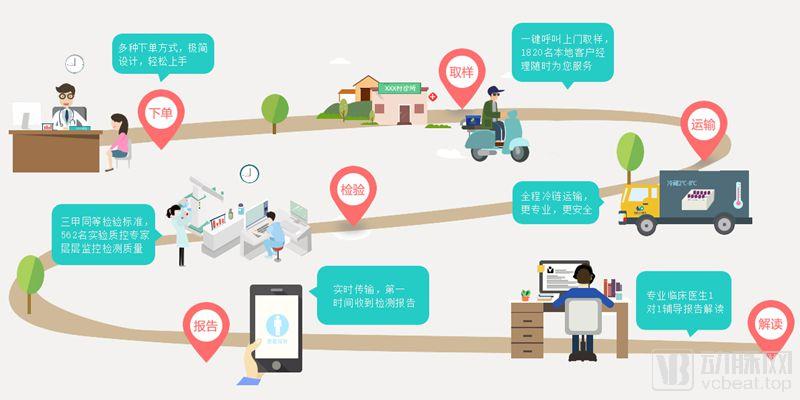
Good Doctor Flowchart
According to previous reports by VCBeat, Yunhu Cold Chain is dedicated to providing life sciences companies with one-stop, nationwide cold chain services and establishing a platform-based logistics network across China.
Kuaiyijian’s logistics DNA is even more pronounced, as can be gleaned from the founding team’s backgrounds: Before launching his venture in March 2015, founder Wang Zheng had spent a considerable period working at SF Express. According to VCBeat, when Wang Zheng embarked on his entrepreneurial journey from SF Express, he sought to enter the grassroots healthcare market from a logistics perspective, leveraging robust logistics and information technology capabilities to provide medical specimen delivery services for laboratory testing.
Perhaps due to genetic differences, their strategies and operational approaches also vary. Haoyisheng Cloud Healthcare, backed by a large pharmaceutical enterprise parent company, consistently emphasizes medical professionalism. Information from its official website and other scattered sources reveals that, in addition to standardizing cold-chain logistics and systematizing grassroots distribution networks, the company places greater emphasis on physician development. Its academic team alone comprises over 100 members, including renowned physicians from top-tier (Grade A tertiary) hospitals across China and internally recruited specialists. Furthermore, health education and science popularization at the grassroots level, along with fulfilling the social function of extending healthcare services to underserved areas, have become core business components of the company. Reporters’ firsthand experience found that in terms of user services, innovations such as strict quality control by in-house laboratory technicians and 24-hour online customer service guidance are reshaping the grassroots medical service system.
According to sources close to the company, Haoyisheng Cloud Healthcare conducts over 1,000 online and offline academic training sessions annually, reaching tens of thousands of clinic physicians and pharmaceutical sales representatives. “Their perspective is that physician skills must be cultivated and patient awareness raised, which requires a long-term process of development and nurturing, rather than merely offering auxiliary support services.”
Each of the three has its own model and focus; it is premature to conclude which holds greater promise. Perhaps the one that goes further deserves more attention, but undoubtedly, a true understanding of the decentralization of national medical resources may be the correct path.