

Jinxin Fertility Group Launches IPO on HKEX with Over HK$20 Billion Market Cap, RMB 920 Million Revenue and 20,000+ IVF Cycles in 2018

JINXIN FERTILITY
Assisted Reproductive Technology Service Provider
VCBeat (WeChat ID: vcbeat) has learned that Jinxin Fertility Medical Group was listed on the Hong Kong Stock Exchange today, June 25, with the stock code 01951 and an issue price of HK$8.54 per share. As of press time, the share price was quoted at HK$9.28, with a turnover of HK$2.24 billion and a market capitalization of HK$22.094 billion.
Jinxin Fertility Group is a provider of assisted reproductive services, with shareholders including prominent investors such as Warburg Pincus, Sequoia Capital China, WuXi AppTec, and CITIC Bank. As the first publicly listed private assisted reproduction company, what key milestones did Jinxin Fertility hit, and what are its competitive advantages?
What kind of company is JINXIN FERTILITY?
Leveraging decades of experience, JINXIN FERTILITY has grown into a leading provider of assisted reproductive services in China and the United States, continuously expanding its network to deliver increasingly high-value premium services. The group’s portfolio includes three major assisted reproduction centers: Chengdu Xinan, Shenzhen Zhongshan, and HRC Fertility in the United States.
Specifically, JINXIN FERTILITY owns and operates Chengdu Xinan Gynecology Hospital and Shenzhen Zhongshan Urology Hospital (acquired in January 2017), and jointly manages the Reproductive Center of Chengdu Jinjiang District Maternal and Child Health Hospital (Jinjiang Reproductive Center).
According to a Frost & Sullivan report, Shenzhen Zhongshan Hospital achieved the first IVF-ET baby birth in Shenzhen and the first ICSI baby birth in Shenzhen. Additionally, Jinjiang Reproductive Center was rated as a Grade-A Key Specialty Center for Reproductive Medicine in Sichuan Province in 2016. In the western United States, HRC Fertility is a recognized pioneer in IVF using ICSI technology and the application of PGS technology.
In the United States, on December 24, 2018, the Group acquired Willsun BVI, which owns HRC Management, the entity that manages HRC Medical under a management services agreement.
HRC Fertility is a leading full-service provider of assisted reproductive services in the United States, with over 30 years of experience. In addition to IVF services similar to those offered in China, it provides preimplantation genetic screening (PGS) services and facilitates preimplantation genetic diagnosis (PGD) services through third-party clinics or institutions. Ranked number one among all assisted reproductive service providers in the U.S. by the number of IVF treatment cycles delivered in 2017 to Chinese outbound patients seeking assisted reproductive care in the United States, HRC Fertility enables these patients to access higher-standard and more comprehensive advanced services in the U.S. compared to what is available in China.
JINXIN FERTILITY traces its origins to 2003, when a team of experienced and dedicated physicians and managers established the Jinjiang IVF Center in Chengdu, Sichuan Province, to focus on assisted reproductive services and related treatments. Shenzhen Zhongshan Hospital was founded in May 2004 by several individual founders, including Mr. Zeng Yong, a member of the senior management team. Shenzhen Zhongshan Hospital provides assisted reproductive and other ancillary medical services, and facilitated the birth of Shenzhen’s first baby conceived through IVF-ET technology, as well as the first baby conceived through IVF combined with ICSI technology.
According to the Frost & Sullivan report, JINXIN FERTILITY ranked third in China’s assisted reproductive services market in 2018, performing 20,958 in vitro fertilization (IVF) oocyte retrieval cycles and capturing a market share of approximately 3.1%. Based on the same metric, JINXIN ranked first among non-state-owned assisted reproductive service providers in China in 2018.
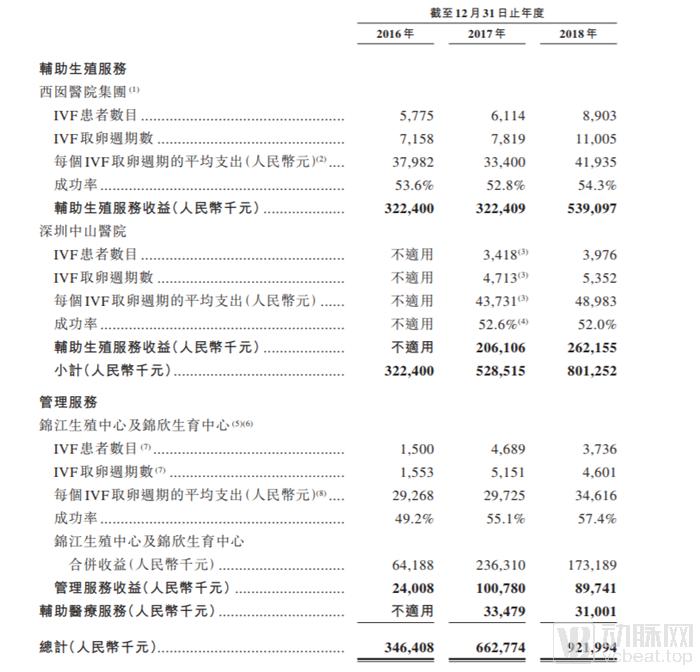
JINXIN FERTILITY: Cycle Volume, Revenue, and Success Rates at Its Hospitals
HRC Fertility (including HRC Medical, managed by HRC Management under a management services agreement) ranked first in the assisted reproductive technology services market in the Western United States in 2018, performing 4,500 IVF egg retrieval cycles, which accounted for approximately 7.5% of the total market share in the Western United States.
Regarding the most closely watched metric of IVF success rates, according to a Frost & Sullivan report, Jinxin Fertility, together with Jinjiang Reproductive Center, was one of only approximately 23 licensed assisted reproductive service providers in China that performed more than 5,000 IVF oocyte retrieval cycles in 2018. The assisted reproductive medical institutions within Jinxin Fertility’s China network achieved a high success rate of 54% in 2018, compared with the national average of 45%.
Similarly, according to the Frost & Sullivan report, HRC Fertility’s success rate reached 62% in 2016, exceeding both the U.S. national average (53%) and the California state average (57%). All these factors constitute significant barriers to entry for new competitors.
Milestone Events:
In January 2003, Jinjiang Reproductive Center was approved by the Sichuan Provincial Health Department to provide AIH treatment;
In July 2006, Jinxin Reproductive Center obtained the license to provide conventional IVF-ET and IVF via ICSI;
In March 2010, the predecessor of Chengdu Xinan Hospital was established;
In October 2015, Chengdu Xinan Hospital previously obtained ISO 9001:2008 certification, demonstrating that its management quality meets rigorous international standards;
In May 2016, VIP infertility treatment services were launched;
In September 2016, Chengdu Xinan Hospital commenced operations; and entered into discipline co-construction and cooperation agreements with the Jinjiang District Maternal and Child Health Hospital for the joint group management of these medical institutions;
In January 2017, acquired Shenzhen Zhongshan Hospital;
In July 2017, HRC Management began managing HRC Medical through an MSA;
In August 2017, Warburg Pincus, LLC invested in JINXIN FERTILITY through its special purpose vehicle;
In April 2018, Laisi Capital invested in Jinxin Group as a pre-IPO investor;
In August 2018, CITIC Capital Investments, Sequoia Capital China, Southern Creation, and WuXi AppTec invested in JINXIN FERTILITY as pre-IPO investors;
In December 2018, acquired HRC Management, which manages HRC Medical through a management services agreement;
In February 2019, the operations of Chengdu Xinan Hospital were relocated to the new hospital building;
In May 2019, acquired Chengdu Jinyi, which owns a new hospital building and parking facilities.
Revenue Model
As for revenue, during the track record period, JINXIN FERTILITY’s revenue was primarily derived from the provision of assisted reproductive services, management services, and ancillary medical services. 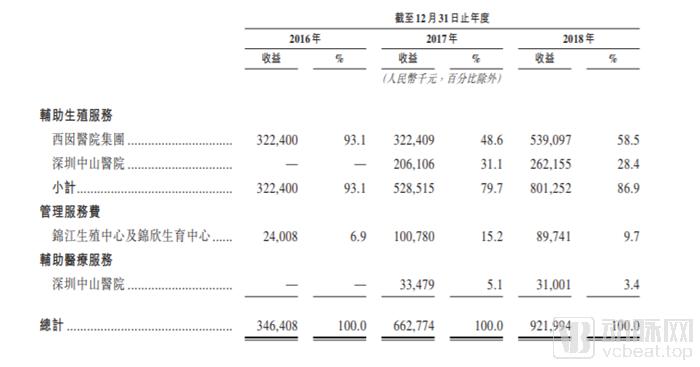
Three Major Revenue Sources
In 2016, 2017 and 2018, JINXIN FERTILITY’s revenue was RMB346.4 million, RMB662.8 million and RMB922.0 million, respectively. In 2016, 2017 and 2018, its profit for the period and total comprehensive income was RMB103.7 million, RMB198.6 million and RMB212.1 million, respectively.
In 2016, 2017, and 2018, the adjusted net profits were RMB 103.7 million, RMB 198.6 million, and RMB 250.3 million, respectively.
Assisted Reproductive Services:Two primary treatment options are offered to patients: (i) artificial insemination (AI), which can be performed using husband’s sperm (AIH) or donor sperm (AID); and (ii) in vitro fertilization (IVF) techniques, achieving fertilization through conventional IVF with embryo transfer (IVF-ET) or intracytoplasmic sperm injection (ICSI). Conventional IVF-ET services are primarily provided. Additionally, JINXIN FERTILITY offers related supportive services for assisted reproduction, including nutritional guidance, traditional Chinese medicine treatments, and psychological counseling.
For the years ended December 31, 2016, 2017 and 2018, revenue from assisted reproductive services amounted to RMB322.4 million, RMB528.5 million and RMB801.3 million, respectively, accounting for 93.1%, 79.7% and 86.9% of total revenue for the same periods.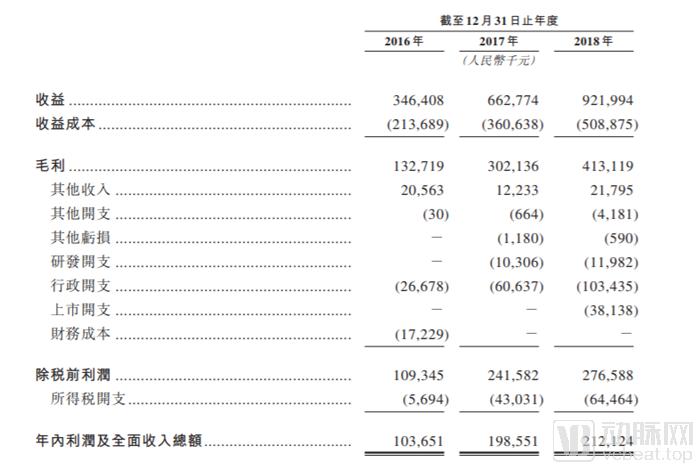
Revenue Performance Over the Past Three Years
Management Services:JINXIN FERTILITY charges management fees for providing cooperative management services to the Jinjiang Reproductive Center and the Jinxin Fertility Center (the Reproductive Health and Infertility Clinic of Sichuan Jinxin Women's and Children's Hospital), pursuant to the discipline co-construction and cooperation agreements entered into with Chengdu Jinjiang District Maternal and Child Health Hospital and Sichuan Jinxin Women's and Children's Hospital, respectively.
In March 2018, JINXIN FERTILITY terminated the management services provided to Jinxin Fertility Center to optimize its business structure and resources. Subsequently, the operations of Jinxin Fertility Center and the related co-construction and cooperation agreements for relevant disciplines were also terminated. In December 2018, JINXIN FERTILITY acquired HRC Management, which had been providing management services to HRC Medical in the United States under a management services agreement since July 2017.
For the years ended December 31, 2016, 2017 and 2018, JINXIN FERTILITY’s revenue from providing management services to Jinjiang Reproductive Center and Jinxin Fertility Center amounted to RMB24.0 million, RMB100.8 million and RMB89.7 million, respectively, representing 6.9%, 15.2% and 9.7% of its total revenue for the same periods.
Auxiliary Medical Services:At Shenzhen Zhongshan Hospital, JINXIN FERTILITY also provides medical services in the fields of gynecology, urology, and internal medicine, which are designated as ancillary medical services.
For the years ended December 31, 2017 and 2018, JINXIN FERTILITY’s assisted reproductive medical services generated revenues of RMB33.5 million and RMB31.0 million, respectively, accounting for 5.1% and 3.4% of our total revenues for the same periods.
The assisted reproductive technology (ART) service markets in both China and the United States are fragmented. However, China presents significant opportunities for ART service providers due to low ART penetration rates, rising infertility prevalence, and limited supply of ART services. Meanwhile, the United States remains an attractive ART market, offering comprehensive, mature, and high-end assisted reproductive services.
Market Prospects
Infertility is a reproductive system disorder characterized by the failure to achieve a clinical pregnancy after 12 months or more of regular, unprotected sexual intercourse. Causes of female infertility include, but are not limited to, ovulatory disorders, tubal or uterine damage, and cervical abnormalities. Causes of male infertility include, but are not limited to, low sperm count, abnormal sperm function, and obstructions in sperm transport.
Infertility is becoming increasingly prevalent worldwide, primarily driven by the rising average age at first childbirth, as well as unhealthy lifestyles and environmental factors. The prevalence of infertility is calculated by dividing the number of infertile couples by the number of couples of reproductive age (defined as women aged 15 to 49 years). Globally, the prevalence of infertility rose from 11.0% in 1997 to 15.4% in 2018, and is projected to reach 17.2% by 2023. Amid the rising global infertility rates, various medical services have emerged, including (i) pharmacological treatment, (ii) surgical intervention, and (iii) assisted reproductive services.
Driven by the rising infertility rate, coupled with increasing demand for a higher quality of life stemming from improved living standards and greater awareness of birth defects and their prevention, the global assisted reproductive services market grew from USD 20.4 billion in 2014 to USD 24.8 billion in 2018, representing a compound annual growth rate (CAGR) of 5.1%. The market is expected to further expand to USD 31.7 billion by 2023, reflecting a CAGR of 5.0% from 2018.
In China, the prevalence of infertility is projected to increase from 16.0% in 2018 to 18.2% in 2023, driven primarily by environmental pollution, poor work-life balance, and other unhealthy lifestyle factors, in addition to other global contributors to infertility. Fueled by rising fertility demand and recent government incentive policies, such as the two-child policy introduced in 2015, China’s assisted reproductive services market grew at a compound annual growth rate (CAGR) of 13.6% from 2014 to 2018 and is expected to grow at a CAGR of 14.5% from 2018 to 2023.
Despite the rapid growth of the assisted reproductive services market, China’s penetration rate in 2018—calculated as the number of couples receiving assisted reproductive technology (ART) services divided by the number of infertile couples requiring such services—was as low as 7.0%, and is projected to reach 9.2% by 2023. 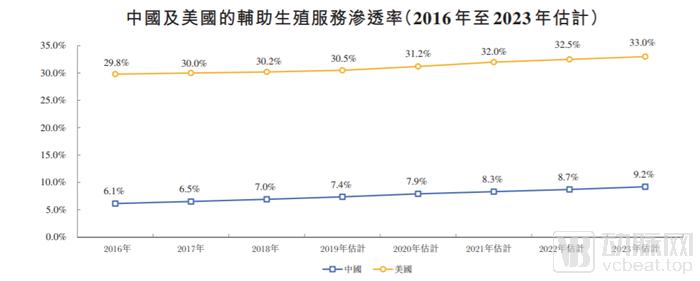
Service Penetration Rate
In the United States, the prevalence of infertility is projected to rise steadily from 16.0% in 2018 to 17.9% in 2023, primarily driven by increases in the average age at first childbirth, obesity rates, and unhealthy stress levels. The U.S. assisted reproductive services market registered a compound annual growth rate (CAGR) of 6.6% from 2014 to 2018, and the CAGR is expected to reach 5.9% from 2018 to 2023.
Driven by population aging, a substantial increase in the number of patients with chronic diseases, and rising income levels, demand for medical services in China has surged in recent years. The revenue of Chinese medical institutions increased from RMB 2,643.5 billion in 2014 to RMB 4,085.8 billion in 2018, representing a compound annual growth rate (CAGR) of 11.5%, and is expected to further rise to RMB 6,191.8 billion by 2023, corresponding to a CAGR of 8.7% from 2018.
China’s assisted reproductive services market has also grown rapidly, increasing from RMB 14.0 billion in 2014 to RMB 25.2 billion in 2018, representing a compound annual growth rate (CAGR) of 15.8%. Driven by the relatively low penetration rate of assisted reproductive services in China (7.0% in 2018), rising affordability and growing demand for such services, as well as increased investment in assisted reproductive technology services, the market is expected to reach RMB 49.6 billion by 2023, corresponding to a CAGR of 14.5% from 2018.
In 2018, there were approximately 47.8 million infertile couples in China, a figure expected to rise to about 50.3 million by 2023. In comparison, around 568,000 patients received assisted reproductive technology (ART) services in China in 2018, with this number projected to grow to approximately 855,000 by 2023, representing a compound annual growth rate (CAGR) of 8.5%. Consistent with this growth trend, the number of ART institutions in China increased from 88 in 2006 to 451 in 2016.
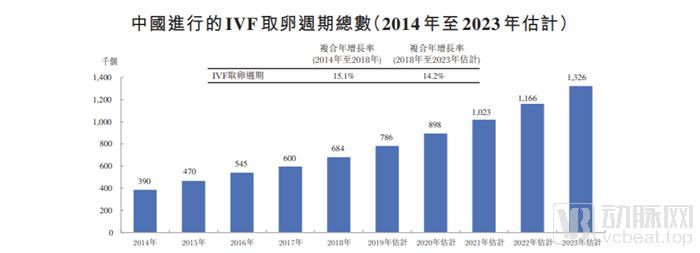
Expected Number of Oocyte Retrieval Cycles
Specifically, the number of IVF egg retrieval cycles performed in China has increased substantially. The total number of IVF egg retrieval cycles rose from approximately 390,000 in 2014 to approximately 684,000 in 2018, representing a compound annual growth rate (CAGR) of 15.1%. Driven by growing demand and improving affordability of assisted reproductive services, the total number of IVF egg retrieval cycles is estimated to reach approximately 1,326,000 in 2023, corresponding to a CAGR of 14.2% from 2018. In 2018, the success rate for IVF egg retrieval cycles in China was approximately 45%, whereas the success rate across JINXIN FERTILITY’s network in China was 54%.
Competitive Landscape
In China’s assisted reproductive services market, JINXIN FERTILITY primarily competes with comprehensive public hospitals, specialized reproductive hospitals, and a limited number of private medical institutions; whereas in the United States, it mainly competes with private assisted reproductive services clinics. Both the Chinese and U.S. markets are relatively fragmented, with the top five market participants in each accounting for less than 20% and 15% of market share, respectively, based on the number of IVF oocyte retrieval cycles performed in 2017.
The Chinese assisted reproductive technology (ART) services market is primarily composed of public medical institutions, including the Reproductive Hospital Affiliated to Shandong University, Peking University Third Hospital, and Shanghai Ninth People’s Hospital Affiliated to Shanghai Jiao Tong University School of Medicine. A small number of private medical institutions include CITIC-Xiangya Reproductive & Genetic Hospital and JINXIN FERTILITY. In 2016, approximately 90% of the existing licensed ART service providers were public institutions.
China’s various institutions providing assisted reproductive services include public and private medical facilities with differing priorities and specialties. With rapid urbanization in emerging regions and the high concentration of public medical institutions in major cities, China’s private assisted reproductive services market is expected to continue growing. 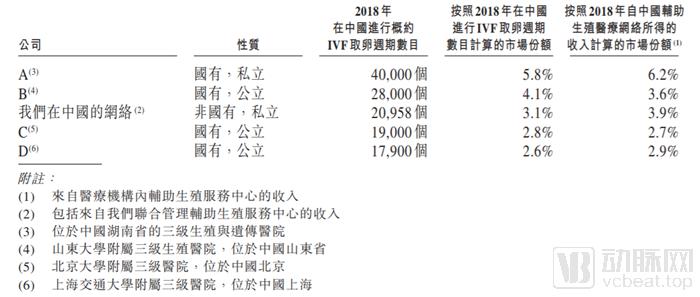
Hospital Competitive Landscape
In terms of IVF egg retrieval cycles, due to the relatively fragmented nature of China’s assisted reproductive services market, the top 10 and top 20 providers accounted for 26% and 36% of the market share, respectively, in 2018. Based on the number of IVF egg retrieval cycles performed and the revenue generated by assisted reproductive institutions, JINXIN FERTILITY ranked third and second in China, respectively (with market shares of 3.1% and 3.9%), securing the top position among all non-state-owned assisted reproductive service providers.
As an increasing number of Chinese patients seek a broader range of services, such as surrogacy and egg and sperm cryopreservation, a significant number are traveling abroad for assisted reproductive technology (ART) services. Southeast Asian countries like Thailand have gained popularity due to their relatively lower service costs. Similarly, the United States has become a preferred destination owing to its higher standards of care, wider array of service options, and more personalized, customized services. In 2018, approximately 18,000 Chinese nationals went overseas for ART services, with 30% of them choosing the United States.
It is worth emphasizing that the Chinese assisted reproductive services market still has significant entry barriers, which constitute JINXIN FERTILITY's competitive moat:
1. Medical Institution Practicing LicenseChina’s assisted reproductive technology (ART) services market is subject to strict regulation. ART service providers must separately obtain five categories of approval certificates: for AID, AIH, conventional IVF-ET, IVF via ICSI, and PGD/PGS. These certificates are typically issued sequentially; providers first receive certificates such as AIH and, after practicing for several years, may then be granted certificates for more complex procedures such as IVF via ICSI. If a service provider fails to pass the periodic verification procedures conducted by government regulatory authorities, its certificates may be revoked. As of December 31, 2016, there were a total of 451 licensed ART institutions, of which 327 held IVF licenses. Among these 327 medical institutions, only 35 were privately operated.
Second, high-quality talent resources.Chinese patients are more inclined to seek treatment at medical institutions that employ renowned physicians. Furthermore, due to concerns regarding team structure and operations, there is a scarcity of experienced physicians in this field in China, and they often hesitate to work for private assisted reproductive technology (ART) service providers. Cultivating professional and experienced experts and establishing influential medical teams in China require substantial time and resources to develop effective operational models to ensure success.
Third, brand reputation.In China, patients tend to choose assisted reproductive service providers with good reputations, which usually refers to those with experienced doctors, well-managed laboratories, high success rates, and most importantly, a proven track record of having performed a large number of IVF egg retrieval cycles. In 2018, only about 23 assisted reproductive service providers in China conducted more than 5,000 IVF egg retrieval cycles, two of which were non-state-owned medical groups.
Fourth, securing funding.New market entrants typically need to invest substantial initial capital to acquire and operate facilities, as well as to purchase the essential medical equipment and products required for IVF treatments, in order to meet the standards necessary for obtaining the required medical licenses. Furthermore, according to the Guiding Principles for the Allocation Planning of Human Assisted Reproductive Technologies issued by the former National Health and Family Planning Commission in 2015, new licenses for assisted reproductive services may only be granted to tertiary hospitals (general or obstetrics and gynecology) and tertiary hospitals (obstetrics and gynecology or maternal and child health care service centers), which necessitates significant capital investment.
In addition to the large and growing patient population and high entry barriers, China’s assisted reproductive technology (ART) services market is also characterized by flexible pricing (unconstrained by social insurance reimbursement), minimal capacity constraints in outpatient services, and operational leverage.
Related Reading:
Jinxin Fertility Group Plans Hong Kong Listing; Over 18,000 IVF Treatment Cycles in 2017