

YuanQi Technology Files Prospectus: Building the Interoperability Foundation for Hospital External Connectivity Platforms
The lack of unified standards for informatization construction, a fragmented competitive landscape, and low market concentration are the main issues currently facing China’s healthcare informatization sector. Against this backdrop, interoperability has become the central theme of current informatization development.
Wuhan Yuanqi Technology Co., Ltd. (hereinafter referred to as “Yuanqi Technology”), established in 2007, is a pioneer in this field.
While most companies in the industry flocked to the bustling application-layer development, Qian Haiyuan, Chairman and Chief Architect of Wuhan Yuanqi Technology Co., Ltd., had already turned his attention early on to building the underlying framework for healthcare informatization.

Qian Haiyuan, Founder of Yuanqi Technology (Photo provided by the interviewee)
Yuanqi Technology is an independent software developer specializing in healthcare informatization, providing hospitals with comprehensive information integration solutions for external liaison operations. The company was listed on the New Third Board in 2016 (stock code: 836949).
The hospital external liaison platform it has built can centrally interface with various internal hospital systems, encapsulate diverse business logic, and thereby provide unified interface standards and services externally. This enables hospitals to expand their services outward on demand without compromising business operations or data security.
In 2009, China’s healthcare informatization was still in a relatively closed and nascent stage. Wuhan Tongji Hospital became the first to integrate online appointment registration into its Hospital Information System (HIS), pioneering the connection between internal hospital information systems and the internet.
Subsequently, China’s healthcare informatics industry entered an unprecedented period of rapid and vibrant growth. New concepts such as Bank-Hospital Connect, Internet hospitals, resident health cards, cardless medical insurance payments, medical consortia, and prescription circulation emerged in succession, with an increasing number of social service providers extending their business operations into hospitals. A prerequisite for such business expansion is often integration with hospitals’ internal information systems.
As the number of interface engines increases geometrically, challenges in connectivity between internal and external hospital systems have emerged.
“Currently, the state of healthcare informatization in China is characterized by vigorous application-level development, yet the underlying technical architecture remains unstable,” Qian Haiyuan, Chairman of Wuhan Yuanqi Technology Co., Ltd., told reporters. In the early days, hospitals’ external business operations were less complex. When only a few vendors’ products were integrated into hospital information systems, point-to-point interface methods were typically adopted due to their low cost and ease of implementation.
As hospitals expand their external operations, the drawbacks of traditional single-application subsystem development and point-to-point integration become increasingly apparent when the number of interface engines to be integrated grows to over a dozen or even dozens.
1. In the absence of coordinated planning, the complex information systems built according to diverse operational needs often hinder data exchange within hospitals, making interoperability difficult to achieve.
II. The integration of multiple interfaces has increased the difficulty for hospitals in interface matching and system upgrades. Each time a new interface is integrated, HIS vendors must repeatedly modify the system, leading to persistently high costs for the construction and maintenance of hospital information systems. Moreover, over time, this practice may leave many hidden risks for future upgrades of hospital information systems. Many hospitals often face the risk of “cliff-like” tear-down and reconstruction during later-stage upgrades of their information systems.
III. High rates of redundant IT construction and severe waste of resources. Taking hospital payment systems as an example, the proliferation of payment channels such as bank cards, WeChat Pay, and Alipay has made it a major challenge for hospital information infrastructure to achieve unified management of refunds, reconciliation, and financial reporting.
In the new era, an external liaison platform capable of unifying standards is particularly important.
Qian Haiyuan stated that the core operating principle of Yuanqi Technology’s nationwide-first hospital external liaison platform is to establish a unified, standardized integration and conversion platform between the complex and dynamic external environment and the hospital’s internal business network.
Leveraging firewalls and network gap devices, the platform effectively implements data isolation and security control, thereby safeguarding hospital data security and minimizing external business interference with internal hospital processes. The platform not only provides unified interface standards and services externally but also enables lightweight integration of internal hospital business systems.
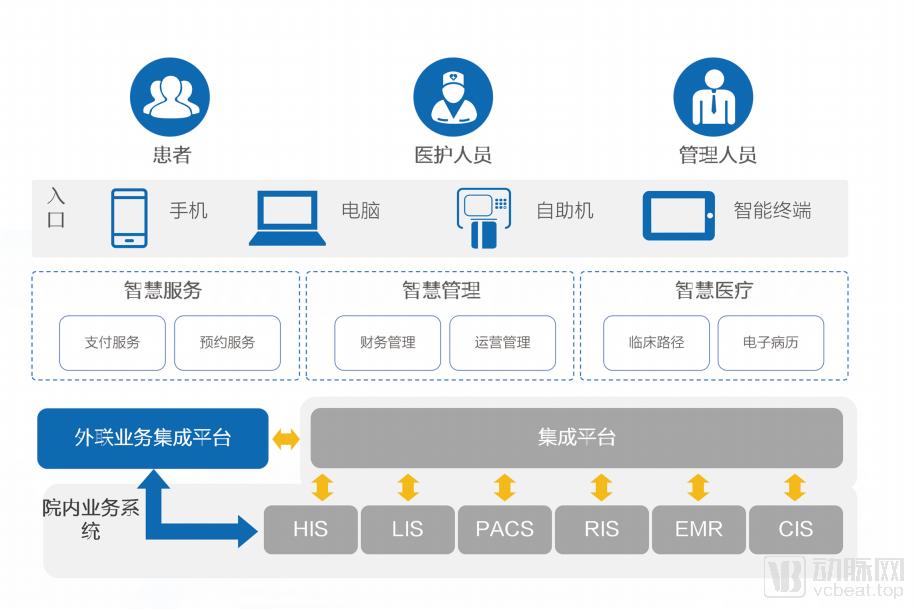
Schematic Diagram of the Yuanqi External Liaison Platform (Image provided by the interviewee)
The primary prerequisite for achieving this goal is to achieve "interconnectivity" of underlying technologies.
Qian Haiyuan described to reporters his early career at a well-known listed software company. Java programmers and .NET programmers each occupied an entire floor, with no communication or interaction between them. As a result, the same end product ended up having different versions.
“The same applies to hospital information technology infrastructure; differing technical standards adopted by various institutions and IT vendors make it difficult to establish standardized and regulated management when integrating with internal hospital information systems.”
Therefore, in the early days of Wuhan Yuanqi Technology Co., Ltd., Qian Haiyuan innovatively proposed a development theory based on parametric construction and, building on this foundation, developed a rapid application development tool—PowerNT.
One of the most distinctive features of PowerNT is its unique compatibility, which virtually breaks down the barriers of technical language.
“Regardless of whether the front-end development uses languages such as Java, .NET, or Python, PowerNT can represent them in Java form on the back end.” He further explained that it is akin to translation software that can translate various languages, including English, German, French, and Japanese, all into Chinese.
Within this framework, individuals speaking different languages can collaborate effectively. This means that regardless of the technical standards adopted by external vendors, PowerNT can convert them into a standardized format for transmission to the hospital’s internal systems, thereby minimizing disruptions to these systems from external operations.
Qian Haiyuan introduced that the hospital outreach platform pioneered by Yuanqi, built on its cross-language development tool PowerNT, primarily offers the following services:
1. Unified User Indexing and Authentication Service.
2. Unified online and offline payment services (bank cards, third-party payments, medical insurance, commercial insurance).
3. Foundational services for applications (messaging, scheduling, workflow, HL7, reporting, etc.).
4. Provide security control and audit mechanisms for non-access and data interaction.
5. Provide end-to-end convenient services and integrated management.
6. Provide statistical, analytical, and management support for business, finance, and operations.
Platform establishment is typically just the first step; subsequent resource alignment is equally important.
Since the launch of its hospital outreach platform, Wuhan Yuanqi Technology Co., Ltd. has established collaborations with over 300 hospitals. Among these, more than 100 are large Grade A tertiary hospitals, including Wuhan Union Hospital, Yinchuan First People’s Hospital, and Hebei General Hospital.
Meanwhile, Wuhan Yuanqi Technology Co., Ltd.’s external liaison platform has also achieved significant results in resource matchmaking:
1. It can connect with major banks such as ICBC, Agricultural Bank of China, Bank of China, China Construction Bank, Minsheng Bank, China Merchants Bank, Bank of Ningxia, Hankou Bank, Industrial Bank, and Bank of Hebei through direct integration or the MIS-POS model. This enables unified management of hospital refunds, reconciliation, and financial reporting, while ensuring a consistent service experience for patients across different terminals.
2. Successfully integrated with mainstream HIS vendors such as Chuangye, Tianjian, Neusoft, Kingstar, Donghua, Zhonglian, and Kingdee, as well as some regional small-scale HIS providers.
3. By encapsulating the entire workflow of diagnostic and treatment services, the platform provides unified interfaces for third-party internet platforms. Functions covered include appointment registration, ticket retrieval, treatment reminders, report collection, outpatient itemized bills, inpatient prepayment, and inpatient itemized bills. The system supports integration with hospitals’ independent mobile apps, WeChat Official Accounts, Alipay Service Windows, official websites, as well as third-party medical cloud platforms (such as Tengyi, Haoyi.com, Guahao.com, Quyi, and telecom operators).
4. Implemented secondary integration of medical insurance systems in Hubei, Tianjin, Chongqing, Sichuan, Hebei, Henan, Shanghai, Qinghai, Ningxia, Nanjing, and Qingdao, enabling self-service devices to handle independent registration and payment, thereby significantly increasing the utilization rate of self-service kiosks.
5. Provides services including electronic health card application solutions, in-hospital issuance of resident health cards, renovation of in-hospital acceptance environments for resident health cards, integration with population health information platforms, and health data upload. Successfully assisted Yichang City in establishing a “Citywide Integrated Regional Diagnosis and Treatment Service Big Data Center,” comprehensively deepening the integration and application of health and clinical big data.
In terms of team composition, Wuhan Yuanqi Technology Co., Ltd. currently has a workforce of 270 employees, with technical personnel accounting for more than 70%.
According to its disclosed financial data, Wuhan Yuanqi Technology Co., Ltd. reported total annual revenue of RMB 93.68 million and net profit excluding non-recurring items of RMB 13.85 million in 2018. From 2015 to 2018, the company’s average annual revenue growth rate reached 67.37%, while the growth rate of net profit excluding non-recurring items was 79.83%.
It was reported that Yuanqi had previously completed its Series A financing of RMB 11.88 million in 2017 and its Series B financing of RMB 15 million in 2018. The company has now initiated its Series C financing round.
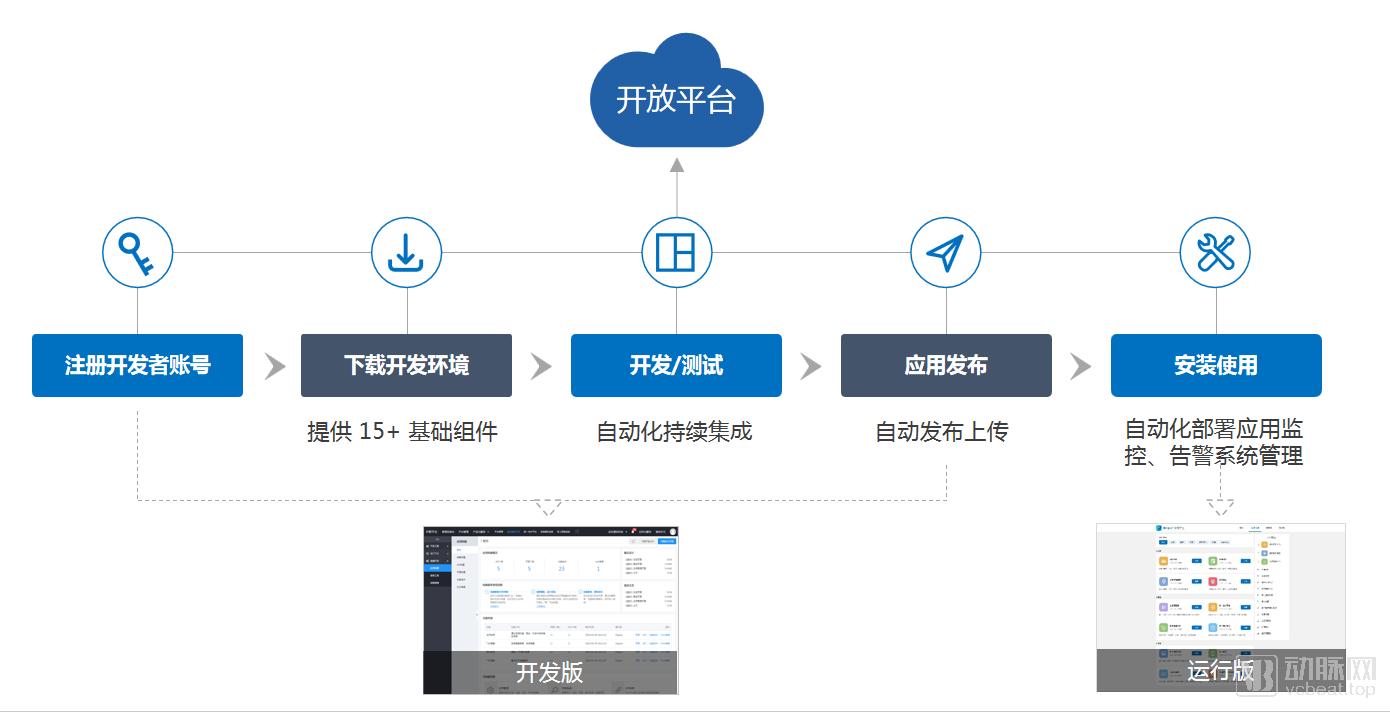
Schematic Diagram of the Yuanqi Ecological Open External Connectivity Platform
Qian Haiyuan revealed to reporters that, as a next step, Yuanqi will build an ecosystem-oriented open external liaison platform based on its existing hospital external liaison platform, empowering application innovation developers. Adopting an open microservices and bus architecture, the platform provides an integrated full-lifecycle application management system covering research and development, management, release, deployment, scaling, monitoring, and alerting.
“Yuanqi’s ecosystem-based open external connectivity platform connects application developers on one end and hospitals on the other. Developers need only download the Yuanqi External Connectivity Platform, register an account, and upload their applications; after review by Yuanqi, the applications can be distributed via the platform,” said Qian Haiyuan. He added that once applications are uploaded, hospitals can freely choose from a variety of apps through the platform without altering their internal operations or compromising data security.
It is reported that Yuanqi’s ecosystem-based open external connectivity platform will be unveiled at the CHIMA exhibition in Xiamen on July 4.