

Where Will China's 40 Million Disabled Elderly Receive Long-Term Care? Four Key Solutions Emerge
In June, the National Health Commission held a press conference, stating that China has 40 million elderly individuals with disabilities or partial disabilities, among whom 12 million are completely disabled. However, there is currently a severe shortage of elderly health service supply in China, particularly in home-based health services for disabled seniors and long-term care services for this population.
Director Wang Haidong of the Department of Elderly Health stated that improvements would be made in four key areas:
First, issue policy documents for the elderly health service system, which include strengthening medical service institutions for the elderly, providing care for disabled elderly individuals, and enhancing home-based services.
Second, strengthen health education and preventive healthcare, and effectively implement health management services for the elderly within basic public health services;
Third, regarding long-term care for disabled elderly individuals, pilot programs for their assessment and health services will be launched this year in selected provinces and municipalities;
Fourth, advance the pilot programs for palliative care.
In light of these four requirements, VCBeat (WeChat ID: vcbeat) analyzes the existing gaps and areas for improvement in China’s elderly care landscape.
Prior to this, the concept of “care policies for disabled older adults” was not emphasized as a distinct issue. However, with the intensifying aging of China’s population, policies such as the “long-term care insurance system for older adults” and the “nursing subsidy system for disabled older adults” have been introduced successively, indirectly highlighting the specificity and importance of care issues for disabled older adults.
VCBeat has compiled provisions concerning disabled elderly individuals from national elderly care policies since 2011, with the aim of identifying emerging trends.
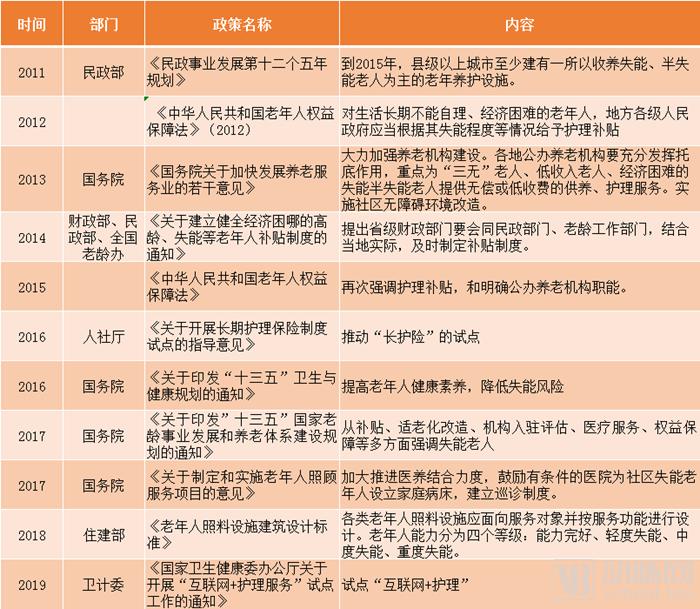
Key Policies for Disabled Elderly Individuals from 2011 to 2019 (Incomplete Statistics)
Source: VCBeat, compiled from public information
Throughout the evolution of policy development, coverage has expanded from initially targeting only those with severe disabilities requiring basic support to gradually encompassing all elderly individuals with disabilities. Policy measures not only address financial safeguards such as nursing subsidies, Long-Term Care Insurance (LTCI), and disability insurance, but also include supporting provisions for integrated medical and elderly care facilities, home modifications, institutional care, health services, and specialized care arrangements.
Indeed, the government must assume corresponding responsibilities in the care of disabled elderly individuals. In the "Letter from the Ministry of Civil Affairs on the Response to the Proposal on Government Departments Purchasing Social Services to Meet the Elderly Care Needs of Disabled Older Adults," emphasis is also placed on the government’s efforts in five major areas: exploring long-term care security for disabled elderly persons, improving care policies for this population, strengthening the development of nursing personnel, and implementing government procurement of services.
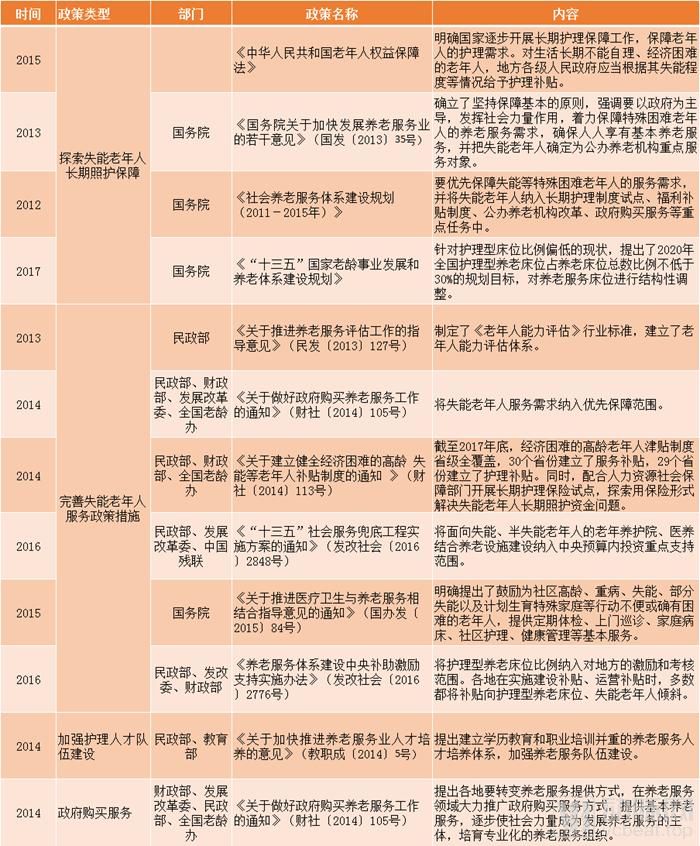
Government Explorations in Five Key Areas for the Care of Disabled Elderly in Recent Years
Source: “Letter from the Ministry of Civil Affairs in Response to the Proposal on Government Departments’ Purchase of Social Services to Meet the Elderly Care Needs of Disabled Older Adults”
For this relatively vulnerable group, the government has been continuously providing assistance, whether by raising public awareness or offering support in terms of personnel, funding, and material resources. However, given the large number of individuals with disabilities and their extensive needs, reliance on the government alone is insufficient.
Under the policy direction of fully liberalizing the elderly care market, an increasing number of industry professionals have recognized the potential in the field of care for disabled seniors. Industrial expansion targeting care for this population is gradually gaining momentum.
“Where to receive care” is a core issue in the care of disabled elderly people. According to China’s current “9073” (or “9064”) elderly care framework, the elderly care service system comprising home-based, community-based, and institutional care is equally applicable to the care of disabled elderly individuals. Director-General Wang Haidong also specifically emphasized institutional care and home-based services.
As the absolute size and relative proportion of China’s elderly population continue to grow, there is a need for societal responses to their medical and eldercare service needs. In terms of healthcare, older adults face an increased risk of chronic diseases, particularly multimorbidity (the coexistence of multiple chronic conditions), which poses challenges to the current specialty-based mainstream healthcare delivery system in China and worldwide. This necessitates age-appropriate adjustments in the mode of healthcare service provision.
Professor Chen He from Tsinghua University stated that China has made many beneficial attempts in building a long-term care system for the elderly, such as establishing an institutional-community-home-based elderly care service supply system and implementing long-term care insurance. However, there is still a long way to go, with significant room for improvement. In the future, areas urgently needing development and refinement include community and home-based elderly care, rehabilitation and palliative care, and the financing mechanisms of the long-term care service system. Furthermore, psychological and physical health often have complex interactive relationships. Enhancing the mental well-being of the elderly requires not only government efforts but also the active involvement of families and communities.
“Where to Receive Care” is the primary choice facing elderly individuals with disabilities. In the past, care for this population was predominantly provided by families, with services largely limited to assisting with basic activities of daily living such as eating, drinking, and toileting, while lacking professional care services.
However, with the accelerating pace of modern life, most adult children are unable to provide round-the-clock care at home. Hiring caregivers or placing elderly family members in long-term care facilities have become the choices faced by most households.
Due to the high risks associated with elderly individuals with disabilities and their substantial need for care, some elderly care institutions previously accepted only self-sufficient seniors. However, as the nation’s population aging intensifies, many self-sufficient seniors have gradually become partially or fully disabled, in addition to policy advocacy. Consequently, an increasing number of elderly care institutions have proactively or reactively added care services for disabled seniors.
According to VCBeat, some local governments have implemented a policy of “upgrading a batch, merging a batch, and shutting down a batch” of elderly care institutions, which has also accelerated the trend toward standardization and diversification in the sector. As one of the earliest organizations in China dedicated to caring for disabled seniors, Puqin Elderly Care has witnessed this transformation firsthand.
According to Tang Wenxiang, founder of Puqin Elderly Care, “nearly 30% of elderly care institutions currently have dedicated units for caring for disabled seniors.” At present, elderly care institutions in China that provide care for disabled seniors fall into two main categories: those specializing exclusively in disability care, and those offering comprehensive services to all types of elderly residents.
Zhang Qifeng, Operations Director at Puqin Elderly Care, stated that institutions proactively specializing in care for individuals with disabilities and dementia operate under a fundamentally different logic compared to standard elderly care facilities. This distinction spans product design, specialized facility renovations, and staffing of service teams. Most institutions focused on caring for disabled seniors are located near medical facilities or incorporate medical resources within their premises.
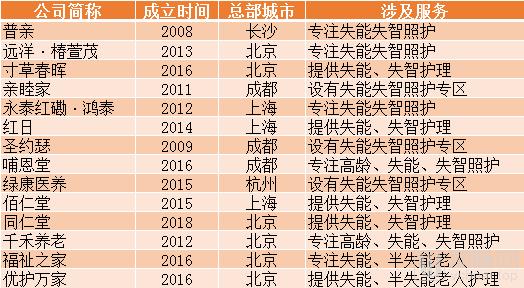
Chain-affiliated Care Institutions for Disabled Elderly
Source: Compiled by VCBeat based on public information
In terms of positioning for the care of disabled elderly individuals, most market-oriented nursing homes target seniors who are not covered by government safety-net programs. Fees vary based on geographic location, specific target demographics, and the degree of disability, ranging from 2,000 yuan to over 10,000 yuan per month.
In addition to “going out,” “bringing in” is also an important option for elderly care. At present, domestic helpers in the market generally provide daily living assistance services. However, disabled elderly individuals require not only daily living assistance but also professional medical nursing knowledge to support certain rehabilitation nursing services and emergency treatment services.
Currently, neither medical “nurses” nor domestic “nannies” can fully meet the care needs of disabled elderly individuals. Zhao Xia, founder of Xiaobai Home Care, stated that the supply side of the market is characterized by shortages and a lack of standardization, has not achieved scale, and consists of a relatively fragmented caregiving workforce with low levels of standardization and professionalism. Therefore, to provide more professional care services, it is necessary to invest one’s own funds in training caregivers.
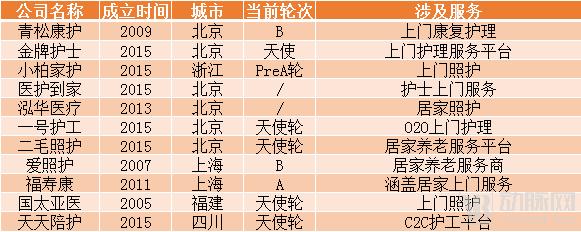
"Companies Providing In-Home Services for Disabled Elderly Individuals"
Source: VCBeat, compiled from public information
Chen Rui, co-founder of No. 1 Caregiver, stated that over 95% of the company’s home-based care services are currently provided to elderly individuals with disabilities or dementia. The positioning of individual home nursing agencies varies; some home-care service providers include daily living assistance, while others incorporate medical services.
Compared with the currently fragmented nursing care protocols in China, Japan’s long-term care insurance system is relatively well-established. It operates on a “needs-based” model, classifying levels of care dependency into multiple grades based on functional impairments such as inability to stand, walk, dress (e.g., putting on or taking off pants), manage bowel movements, eat meals, swallow food, or retain memory. Corresponding to these different levels, a variety of services are provided, including home visits, day care at long-term care facilities, short-term residential stays, admission to special nursing homes for the elderly, and placement in welfare facilities for older adults.
Japan’s well-developed elderly care system benefits from its refined long-term care framework.
The World Health Organization defines long-term care as the provision of care by non-professional caregivers (such as family members, friends, or neighbors) and professional caregivers, with the aim of ensuring the quality of life, maximizing independence, and preserving the dignity of individuals who are not fully capable of self-care.
Yang Jinyu, a former IBM healthcare consulting advisor, told VCBeat that for a long time, the concept of long-term care was misunderstood. Yang emphasized that caregiving is not equivalent to mere custodial care, and disability does not mean the loss of opportunity for rehabilitation. However, many elderly individuals with disabilities currently miss out on rehabilitative training, resulting in permanent inability to recover.
Wu Danxing, a member of the Expert Committee on the Elderly Care Service Industry under the Ministry of Civil Affairs, stated that care for elderly individuals with disabilities, partial disabilities, or dementia lies between domestic caregiving and medical nursing, constituting an extended service chain. Its most prominent characteristics are continuity, long-term duration, comprehensiveness, and professionalism. The nursing objectives of hospitals differ fundamentally from those of long-term care for the elderly: hospitals aim for the complete cure of diseases, whereas long-term elderly care strives to maintain independence in daily living.
The long-term care philosophy of striving for independent living is fundamentally different from the traditional concept of “care.” Japan’s long-term care system has become relatively mature, with “self-reliance support” serving as its core caregiving philosophy. This approach encourages older adults to tap into their latent functional capacities and utilize their existing abilities to perform activities of daily living within their range of mobility. Meanwhile, care professionals provide attentive and meticulous nursing by integrating multidisciplinary expertise, including knowledge of geriatric physiology and geropsychology.
During the implementation process, "self-reliance support" requires a multidimensional assessment of the care recipient to analyze key information and determine how to mobilize their autonomy, thereby formulating a systematic care plan. Planned training is provided for disabled or semi-disabled elderly individuals to address declining or at-risk functions, enabling them to continue performing activities of daily living.
For example, try to let the elderly eat the food they usually want to eat, rather than just providing food to maintain physical strength; encourage the elderly to adopt a balanced and appropriate diet, eat more vegetables, fruits, and whole grains, and go to defecate immediately when there is an urge to defecate; reduce bed rest time, etc.
China’s long-term care system started relatively late. From a policy perspective, since the State Council issued the Outline of the 13th Five-Year Plan for National Economic and Social Development (hereinafter referred to as the “13th Five-Year Plan”) in 2015, which clarified the framework of a multi-tiered elderly care service system, a series of policies have been subsequently introduced to continuously advance the development of the long-term care system for the elderly. In June 2016, the Ministry of Human Resources and Social Security issued the Guiding Opinions on Launching Pilot Programs for the Long-Term Care Insurance System, initiating pilots in two provinces and 15 cities. As a result, China’s long-term care policies have been progressively strengthened and refined in terms of both service delivery and payment systems.
In this process, policies and regulations serve as the basis for standardizing the service providers, content, target populations, and standards of the long-term care system, forming the foundation for ensuring its sound and coordinated operation.
"China's long-term care system is not yet fully developed, but such a service framework cannot be built overnight. Chen He told the reporter, 'Rather than comparing reality with textbook definitions, we should start from the current situation and identify areas for improvement. I believe there is no need to completely overturn the past and start anew; instead, we should continuously refine and enhance the system based on existing foundations.'"
Institutional care and home-based services can, to some extent, address the caregiving needs of elderly individuals who are already disabled or partially disabled. However, to prevent more seniors from progressing to disability or partial disability, it is essential to strengthen health education, promote preventive healthcare, and enhance health management for the elderly.
In recent years, health management has gradually transitioned from concept to practice. However, most health management services target the general population, primarily focusing on middle-aged and young adults with the financial capacity and willingness to pay. There are relatively few programs specifically designed for the elderly, and even fewer addressing age-related physiological decline and functional deterioration.
In addition to health management for age-related physical decline, there is relatively little focus on the prevention of psychological issues, geriatric-specific diseases, and common conditions among the elderly. However, Japan, with its severe aging population, offers valuable references for China in terms of health management and health education.
Japan places great emphasis on health management. Its health management philosophy was first introduced in 1959, followed by the concept of a nationwide plan in the 1980s. In the early 21st century, Japan launched the “21st Century National Health Promotion Campaign” and enacted measures such as the “Health Promotion Act” and “Guidelines for Exercise Activities in Health Promotion,” covering areas including health assessments, exercise guidance, nutritional counseling, mental health support, and preventive healthcare instruction.
Japan’s health management system primarily operates through a top-down network, integrating all aspects of health management into every stage to ensure systematic coherence and establish a robust societal framework for health management operations.
Furthermore, Japan has integrated health education into every aspect of health management. In addition to covering preventive knowledge for common diseases, infectious diseases, and frequently occurring conditions among residents, it also includes guidance on exercise-based rehabilitation.
In addition to health education, life and death education is equally important.
According to Secretary-General Zhuang Yingfu of the Aging Society Research Center at Tsinghua University and the Medical and Elderly Care Research Center at Peking University, the essential needs of disabled elderly individuals undoubtedly include professional care, rehabilitation training, and hospice care. However, people often focus only on professional care and rehabilitation training, while overlooking the importance of ensuring that disabled elderly individuals spend their final stages of life with dignity and comfort.
Disabled elderly individuals have a stronger need for palliative care than self-care elderly. Due to their loss of ability to care for themselves and long-term reliance on others for care, they have a greater desire to leave with dignity compared to ordinary elderly people.
Hospice and palliative care is an interdisciplinary field encompassing medicine, nursing, sociology, psychology, ethics, and other disciplines; ordinary families and elderly care institutions are unable to provide such professional services. As the number of disabled older adults increases, some elderly care institutions have gradually recognized this issue.
According to Lan Bo, founder of Qinmu Jia, the company’s medical-nursing centers and geriatric hospitals have established specialized care units for elderly individuals with disabilities and dementia. Given that such populations are also present within its elderly care facilities, and driven by national initiatives promoting palliative care, the Qinmu Jia Geriatric Hospital Society of Oncology Rehabilitation and Palliative Care was established on June 18 this year. This society aims to provide professional services to more terminally ill patients, particularly those with disabilities.
Not only elderly individuals with disabilities and dementia, but every individual is a potential recipient of palliative care services. China has adopted the approach of “pilot first, then scale up” to implement its policies. In October 2017, the first batch of palliative care pilots was launched in five cities (districts), and this June, pilot programs were expanded to cover 71 cities (districts), including the entire city of Shanghai. However, the development of palliative care still faces certain challenges: insufficient public awareness and acceptance, a significant gap between supply and demand, an underdeveloped specialized education system, and inadequate financial support.
Faced with various unresolved issues, a U.S. professor of gerontology and architecture once remarked that the level of a city’s civilization is not reflected in its skyscrapers, but rather in the care it extends to the elderly, children, and vulnerable groups. Therefore, we also call on more readers to pay attention to these populations and offer greater enthusiasm and assistance.